[GENERAL CHEMISTRY] Quantum Number and Theories
 Call Kai
 Learn
Learn Practice Test
 Spaced Repetition
 Match
Match Flashcards
 Knowt Play
1/41

Earn XP
Description and Tags
Proverbs 16:3
Name | Mastery | Learn | Test | Matching | Spaced | Call with Kai | Chat |
|---|
No analytics yet
Send a link to your students to track their progress
42 Terms
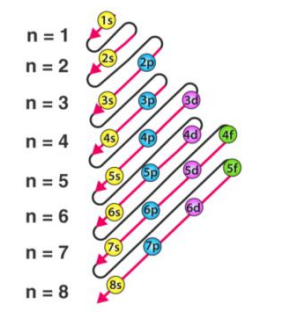
a. Aufbau Principle
[QUANTUM NUMBERS]
Atoms may be built by progressive filling of energy of main energy sub-level; level of lower energy levels are occupied first.
s=2, p=6, d=10, f=14
a. Aufbau Principle
b. Pauli's Exclusion Theory
c. Heisenberg's Uncertainty Theory
d. Hund's Rule
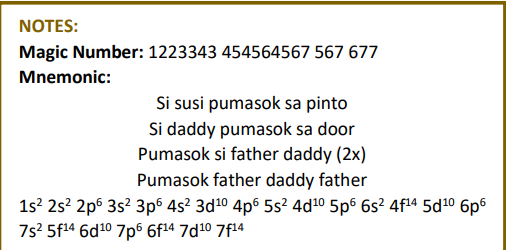
NOTES:
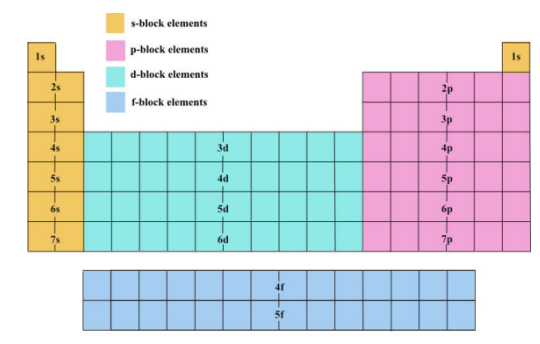
NOTES: Organization of the Periodic Table by Subshell Blocks
a. 2
[Noble Gases and Their Atomic Numbers]
Atomic number of the noble gas He.
a. 2
b. 10
c. 18
d. 36
e. 54
f. 86
b. 10
[Noble Gases and Their Atomic Numbers]
Atomic number of the noble gas Ne.
a. 2
b. 10
c. 18
d. 36
e. 54
f. 86
c. 18
[Noble Gases and Their Atomic Numbers]
Atomic number of the noble gas Ar.
a. 2
b. 10
c. 18
d. 36
e. 54
f. 86
d. 36
[Noble Gases and Their Atomic Numbers]
Atomic number of the noble gas Kr.
a. 2
b. 10
c. 18
d. 36
e. 54
f. 86
e. 54
[Noble Gases and Their Atomic Numbers]
Atomic number of the noble gas Xe.
a. 2
b. 10
c. 18
d. 36
e. 54
f. 86
f. 86
[Noble Gases and Their Atomic Numbers]
Atomic number of the noble gas Rn.
a. 2
b. 10
c. 18
d. 36
e. 54
f. 86
e. None
[QUANTUM NUMBERS]
Quantum numbers are fingerprints which include the following except:
a. Principal Quantum Number (n)
b. Azimuthal (ℓ)
c. Magnetic Quantum Number ((mℓ)
d. Magnetic Spin (ms)
e. None
a. I, II, III, IV
[QUANTUM NUMBERS]
Principal Quantum Number (n)
I. n = 1-7
II. Main energy level
III. Size of the orbital or electron cloud
IV. Distance of electron from nucleus
a. I, II, III, IV
b. I, II, III
c. II, III, IV
d. I, II, IV
a. Principal Quantum Number (n)
[QUANTUM NUMBERS]
Size of the orbital or electron cloud
Example: O2 = 1s2 2s2 2p4 (n=2)
a. Principal Quantum Number (n)
b. Azimuthal (ℓ)
c. Magnetic Quantum Number ((mℓ)
d. Magnetic Spin (ms)
e. None
d. I, II, IV
Azimuthal
I) l = 0 to 3
II) Also known as “Angular momentum”
III) Shape (only) of the orbital
IV) Subshell
Ex: O2 = ℓ = 1
[QUANTUM NUMBERS]
Azimuthal (ℓ)
I. l = 0 to 3
II. Also known as “Angular momentum”
III. Size and shape of the orbital
IV. Subshell
a. I, II, III, IV
b. I, II, III
c. II, III, IV
d. I, II, IV
a. l=0
[QUANTUM NUMBERS - Angular Momentum]
s
a. l=0
b. l=1
c. l=2
d. l=3
b. l=1
[QUANTUM NUMBERS - Angular Momentum]
p
a. l=0
b. l=1
c. l=2
d. l=3
c. l=2
[QUANTUM NUMBERS - Angular Momentum]
d
a. l=0
b. l=1
c. l=2
d. l=3
d. l=3
[QUANTUM NUMBERS - Angular Momentum]
a. l=0
b. l=1
c. l=2
d. l=3
b. Spherical
[QUANTUM NUMBERS - Angular Momentum]
Shape of s subshell.
a. Dumbbell
b. Spherical
c. Complex
d. Clover leaf
a. Dumbbell
[QUANTUM NUMBERS - Angular Momentum]
Shape of p subshell.
a. Dumbbell
b. Spherical
c. Complex
d. Clover leaf
d. Clover leaf
[QUANTUM NUMBERS - Angular Momentum]
Shape of diffuse subshell.
a. Dumbbell
b. Spherical
c. Complex
d. Clover leaf
c. Complex
[QUANTUM NUMBERS - Angular Momentum]
Shape of fundamental subshell.
a. Dumbbell
b. Spherical
c. Complex
d. Clover leaf
c. Magnetic Quantum Number (mℓ)
[QUANTUM NUMBERS - Angular Momentum]
Orientation of orbital in space.
Ex. O2 = mℓ = -1, 0, +1
a. Principal Quantum Number (n)
b. Azimuthal (ℓ)
c. Magnetic Quantum Number ((mℓ)
d. Magnetic Spin (ms)
e. None
c. Magnetic Quantum Number (mℓ)
[QUANTUM NUMBERS]
ml
a. Principal Quantum Number
b. Azimuthal
c. Magnetic Quantum Number
d. Magnetic Spin
a. 1
[QUANTUM NUMBERS]
Number of degenerate orbitals for n=1
a. 1
b. 3
c. 5
d. 7
b. 3
[QUANTUM NUMBERS]
Number of degenerate orbitals for n=2
a. 1
b. 3
c. 5
d. 7
c. 5
[QUANTUM NUMBERS]
Number of degenerate orbitals for n=3
a. 1
b. 3
c. 5
d. 7
d. 7
[QUANTUM NUMBERS]
Number of degenerate orbitals for n=4
a. 1
b. 3
c. 5
d. 7
a. 0
[QUANTUM NUMBERS]
ml of n=1
a. 0
b. -1, 0, +1
c. -2, -1, 0, +1, +2
d. -3, -2, -1, 0, +1, +2, +3
b. -1, 0, +1
[QUANTUM NUMBERS]
ml of n=2
a. 0
b. -1, 0, +1
c. -2, -1, 0, +1, +2
d. -3, -2, -1, 0, +1, +2, +3
. -2, -1, 0, +1, +2
[QUANTUM NUMBERS]
ml of n=3
a. 0
b. -1, 0, +1
c. -2, -1, 0, +1, +2
d. -3, -2, -1, 0, +1, +2, +3
d. -3, -2, -1, 0, +1, +2, +3
[QUANTUM NUMBERS]
ml of n=4
a. 0
b. -1, 0, +1
c. -2, -1, 0, +1, +2
d. -3, -2, -1, 0, +1, +2, +3
d. Magnetic Spin (ms)
[QUANTUM NUMBERS]
Magnetic moment or rotation.
a. Principal Quantum Number (n)
b. Azimuthal (ℓ)
c. Magnetic Quantum Number ((mℓ)
d. Magnetic Spin (ms)
d. Magnetic Spin
[QUANTUM NUMBERS]
Ms
a. Principal Quantum Number
b. Azimuthal
c. Magnetic Quantum Number
d. Magnetic Spin
e. a and b
[QUANTUM NUMBERS]
Incomplete spin.
a. Clockwise
b. +1/2
c. Counterclockwise
d. -1/2
e. a and b
f. c and d
f. c and d
Complete spin.
a. Clockwise
b. +1/2
c. Counterclockwise
d. -1/2
e. a and b
f. c and d
a. Diagmagnetism
[QUANTUM THEORIES]
Magnetism type wherein there is no unpaired e-.
a. Diagmagnetism
b. Paramagnetism
c. Amagnetism
d. Polymagnetism
b. Paramagnetism
[QUANTUM THEORIES]
Magnetism type wherein there is at least 1 unpaired e-.
a. Diagmagnetism
b. Paramagnetism
c. Amagnetism
d. Polymagnetism
b. Pauli's Exclusion Theory
[QUANTUM THEORIES]
No 2 e- will have same set of quantum number (exclusive).
a. Aufbau Principle
b. Pauli's Exclusion Theory
c. Heisenberg's Uncertainty Theory
d. Hund's Rule
b. Pauli's Exclusion Theory
[QUANTUM THEORIES]
No more than two electrons can occupy each orbital and if two electrons are present, they must have opposite spins.
a. Aufbau Principle
b. Pauli's Exclusion Theory
c. Heisenberg's Uncertainty Theory
d. Hund's Rule
c. Heisenberg's Uncertainty Theory
[QUANTUM THEORIES]
It is impossible to predict or accurately determine the particle's velocity (position & momentum).
a. Aufbau Principle
b. Pauli's Exclusion Theory
c. Heisenberg's Uncertainty Theory
d. Hund's Rule
d. Hund's Rule
[QUANTUM THEORIES]
Orbitals are filled up singly before pairing up.
a. Aufbau Principle
b. Pauli's Exclusion Theory
c. Heisenberg's Uncertainty Theory
d. Hund's Rule
d. Hund's Rule
[QUANTUM THEORIES]
Most stable arrangement of e- in subshells is the one with greatest no. of parallel spins.
a. Aufbau Principle
b. Pauli's Exclusion Theory
c. Heisenberg's Uncertainty Theory
d. Hund's Rule