2. & 3. General Parturition, Obstetrics, & Fetotomy
 Call Kai
 Learn
Learn Practice Test
 Spaced Repetition
 Match
Match Flashcards
 Knowt Play
1/86

There's no tags or description
Looks like no tags are added yet.
Name | Mastery | Learn | Test | Matching | Spaced | Call with Kai | Chat |
|---|
No analytics yet
Send a link to your students to track their progress
87 Terms
True or false: As parturition nears, pre-partum changes occur. These vary across species.
true
In domestic species, what initiates parturition?
the fetus
What hormone must decrease in order for parturition to occur?
progesterone
In domestic species, how many stages is parturition divided into?
3
What are the 3 stages of parturition?
I
E
E
initiation of myometrial contractions (removal of progesterone block)
expulsion of the fetus
expulsion of the fetal membranes (placenta)
What is significant about the duration of the stages of parturition?
it varies by species
What are the main mechanisms of parturition?
M
I
A
maturation of the fetal hypothalamic-hypophyseal-adrenal axis
increased fetal corticoids from the adrenal cortex
activation/conversion of placental enzyme systems
What is involved in the mechanism of parturition that is the activation/conversion of placental enzyme systems?
D
I
decreasing progestagens
increasing estrogen precursors and estrogens
What are the other mechanisms of parturition?
I
R
P
U
R
increased sensitivity of the fetal adrenal glands to ACTH
relaxin (relaxation of pelvic ligaments)
prolactin (part of the initiation of lactation)
up regulation of oxytocin receptors in endometrium
release of prostaglandin F2 alpha
________ must drop for parturition to occur.
progesterone
________ rises as parturition nears.
estrogen
What is stage 1 of parturition?
initiation of myometrial contractions (removal of progesterone block)
What occurs during stage 1 of parturition?
M
R
A
A
I
N
S
A
E
C
F
D
myometrial contractions
restlessness
anorexia
abdominal discomfort
increased pulse and respiration
nesting and or isolation from others
shifting weight
arched back
elevated tail
colic like signs
fetus rotates itself in preparation for exit (in mare, ewe, and cow) and this initiates Ferguson’s reflex
dilation of cervix
neuroendrocine reflex comprising the self-sustaining cycle of uterine contractions initiated by pressure on the cervix or vaginal walls that is an example of positive feedback
ferguson’s reflex
In Ferguson’s reflex, when the fetus puts pressure on the cervix/cervical canal, it stimulates the release of ________, which stimulates ________ ________. This pushes the fetus into the cervix/cervical canal, causing more pressure, thus more ________ release and so on.
oxytocin; uterine contractions; oxytocin
What is the stage 2 of parturition?
expulsion of the fetus
What occurs during stage 2 of parturition?
F
R
A
D
fetus enters cervical canal
rupture of chorionic membranes (chorioallantois)
active controlled abdominal pressing
delivery of the fetus
What is the stage 3 of parturition?
expulsion of the fetal membranes
What is the duration of stage 3 of parturition?
varies by species
What does PPP stand for?
presentation, position, posture
relationship of the spinal axis of the fetus to that of the dam and the portion of the fetus that is entering the birth canal
presentation
What is the normal presentation of a fetus?
longitudinal - cranial
What are the types of presentation?
L
T
longitudinal - cranial or caudal
transverse - ventral or dorsal
anatomic relationships of the dorsum of the fetus relative to the maternal pelvis
position
What is the normal position?
dorsosacral
What are the other position possibilities?
P
L
R
dorso:
pubic
left ilial
right ilial
anatomic relationship of the fetal extremities to its own body
posture
What are the types of posture that are possible?
F
E
R
flexed
extended
retained
What is important to remember when it comes to posture?
be specific about which joints are affected
What is the normal posture?
head and forelimbs extended
Overall, what is the normal PPP for parturition?
cranio-logitudinal, dorso-sacral, head and forelimbs extended
In dogs, what is considered normal PPP?
cranio or caudo-longitudinal, dorso-sacral, head and limbs extended
In equine, what is the normal PPP?
cranio-longitudinal, dorso-sacral or ilial, head and forelimbs extended
difficulty giving birth
dystocia
What are examples of different causes of dystocia?
F
A
M
F
fetus too large or dam too small (feto-maternal mismatch) → very common
abnormal presentation, position, or posture
multiple feti
fetal malformations
Dystocia is more common in ________ than ________.
primipara; multipara
Among the common domestic species, ________ pose the highest incidence of dystocia and ________ have the lowest incidence.
cattle; cats
While specifics vary across species, what are some general truths when it comes to dystocia management?
P
C
V
D
B
B
U
E
physical exam of the dam
clean the perineal area
vaginal exam (assess fetal viability, number, PP, size)
develop a delivery plan
be clean
be gentle
use lots of lube for entry and delivery
epidural
When it comes to dystocia management, what is the theriogenologist’s mantra?
be clean, be gentle, and use lots of lube
What are the types of lube available?
P
M
K
J
petroleum
methylcellulose
KY jelly
J-lube (polytheylene polymer)
What is the lube of choice?
methylcellulose
Which lube is fatal if introduced into the abdomen and causes toxicity with marked accumulation of eosinophilic granular material in the bladder, kidneys, and spleen?
J-lube (polyethylene polymer)
How is methycellulose lubricant available?
powder or liquid form
How should an epidural be given?
inject slowly and avoid repeat epidurals
True or false: Twenty gauge needles inserted through unclipped hair resulted in the least amount of hair contamination. Spinal needles inserted through unclipped hair transferred many long hairs into the joint space.
true
Removal of hair is not indicated for arthrocentesis with ________ ________ needles, but is recommended when using ________ needles with ________.
sharp injection; spinal; stylets
Where do you want to give your epidural and how?
find the most cranial moveable space with the bevel forward and a slight tilt to the needle
Why can the hanging drop technique be useful?
will suck drip down, allowing you to know you are in the space
What are aspects that are involved when it comes to post-epidural?
C
T
D
I
careful coming out of stocks
turn into paddock with good footing
do not ship until the epidural wears off
if need to repeat epidural, use less volume, as epidural space may be decreased, thus volume may move forward
What are the methods of correction and delivery?
A
C
F
C
assisted vaginal delivery (AVD) → standing or laying
controlled vaginal delivery (CVD) → anesthetized ± elevated that is common in equine
fetotomy (dead fetus only)
cesarean section
process by which the fetus is restored to a deliverable fashion
mutation
pushing the fetus out of the maternal pelvis into the uterine cavity (maternal abdomen) to enable correction of the abnormality and allows for more space to mutate
repulsion
turning the fetus on its longitudinal axis
rotation
turning the fetus on its transverse axis into a cranial or caudal presentation which is a rare presentation in cattle but is most commonly seen in draft breed horses
version

What is this PPP?
cranio-longitudinal, dorso-sacral, right forelimb flexed at the carpus (retained limb)
What is rule #1 when it comes to correction of a retained limb?
bring limb up midline and protect the uterus

What is seen here? How do you straighten the legs?
contracted tendons; impossible to straighten them

What PPP is seen here?
cranio-longitudinal, dorso-sacral, head extended, both forelimbs flexed at the shoulder (retention of both front limbs)

What PPP is seen here?
cranio-longitudinal, dorso-sacral, head and forelimbs extended, hindlimb flexed at the hip (presentation of one hind limb)

What PPP is seen here?
cranio-longitudinal, dorso-sacral, head and forelimbs extended, hindlimbs flexed at the hips (dog sitting)

What PPP is seen here?
cranio-longitudinal, dorso-sacral, head flexed right, both forelimbs extended (flexed neck/head retained)
What are ways to hold onto the head?
N
F
E
N
N
nose hold
fingers in mouth (intermandibular space)
eye socket holds (blunt eye hooks)
noose around lower jaw
noose around head that passes through opening of mouth
Wry neck is the same as a flexed neck, however, it is ________ to correct since the spine is ________ in this position.
impossible; fixed
How do you deliver a wry neck fetus? Why?
fetotomy or C-section may be necessary; not agreeable with life

What PPP is seen here?
caudo-longitudinal, dorso-sacral, hind limbs flexed at the hip (breech)

What PPP is seen here?
caudo-longitudinal, dorso-sacral, hind limbs flexed at the hock and stifle (hock presentation)
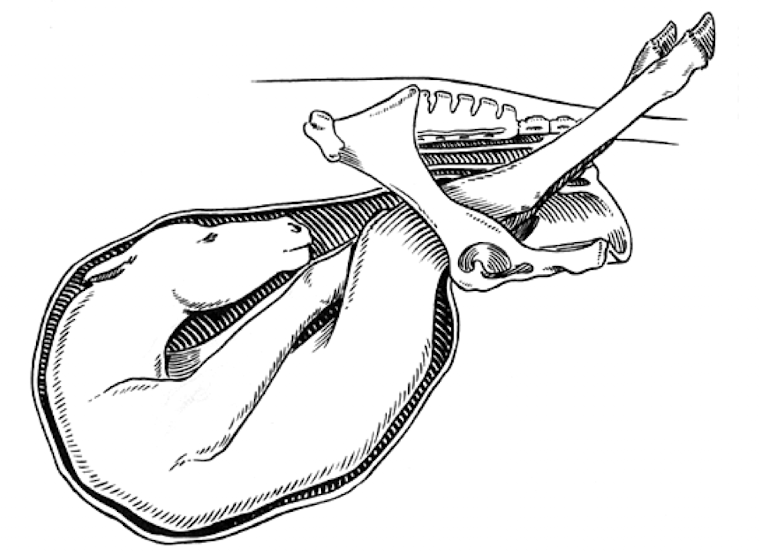
What is the PPP seen here? Why is this being pointed out?
caudo-longitudinal, dorso-pubic, hind limbs extended (rear feet pointed down); when down, likely cranio-longitudinal but can be backwards and upside down
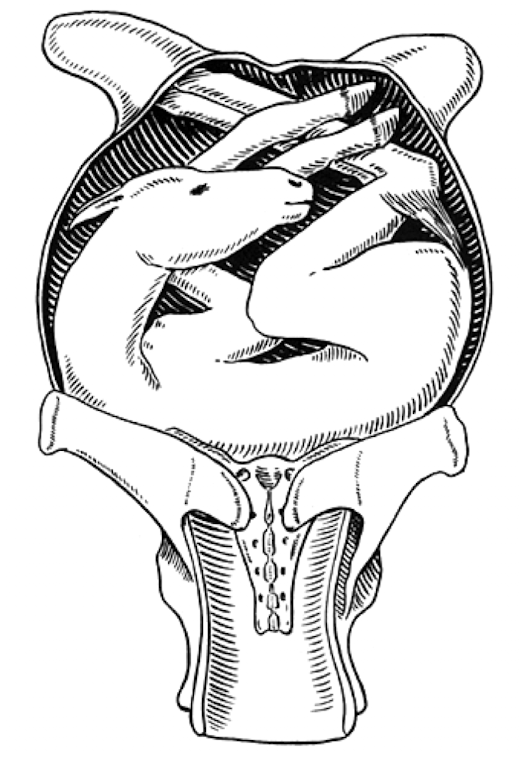
What is this PPP?
dorso-transverse
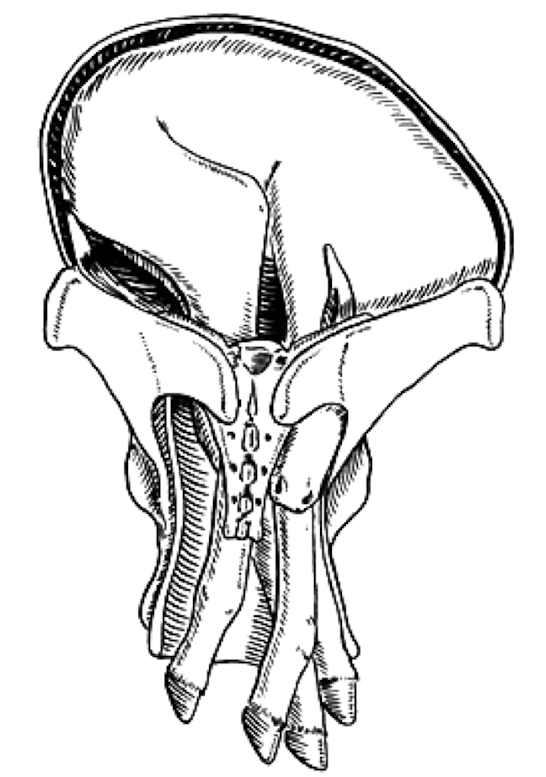
What is this PPP? What is important to make sure of with this?
ventro-transverse; that you’re not feeling twin legs
What else is accompanied with a ventro-transverse PPP?
V
F
ventral displacement of uterus
folding of the uterus/cervix
What are the presentations when it comes to twins?
B
B
O
both anterior
both posterior
one anterior, one posterior and vice versa (differentiate from dog sitting)
When pulling the fetus, what will traction on both forelimbs simultaneously often result in? Therefore, how should they be pulled?
shoulder lock; traction on one forelimb/hindlimb and then the opposite forelimb/hindlimb should be applied
How can you prevent hiplock?
rotate calf as fetal head emerges from the vulva
What part of the fetus are the widest part?
hips (wider than dam’s pelvis)
Why is rotation helpful when it comes to hiplock?
allows the hips (greater trochanters) more space
What are the types of fetotomy?
partial and full
Which type of fetotomy is most common?
partial
True or false: A partial fetotomy can be as little as one cut and can include the amputation of the head, neck, or limbs.
true
What are indications for a partial fetotomy?
F
F
fetal malposture
fetal oversize
What is involved in a full fetotomy?
5-6 specific cuts
What presentation is typically seen when a full fetotomy is indicated?
cranial
What are the typical steps in a full fetotomy?
D
A
D
D
decapitation or cervical/vertebral amputation (one cut)
amputation of forelimbs (two cuts) → subcutaneous or percutaneous
detruncation (one or two cuts)
division of the pelvis (must be divided diagonally and can be done in one cut)
What is involved in detruncation?
T
E
D
L
transection
evisceration
destruction of the rib cage
lumbar transection
True or false: Can be time consuming and takes a certain amount of stamina.
true
Where does detruncation transection occur?
right behind front limbs
Where does lumbar transection occur?
right in front of hind limbs
Should you cut above or below the hock? Why?
below; easier to grab and pull the fetus out