4 - Percentage Error & Calculation of Doses
 Call Kai
 Learn
Learn Practice Test
 Spaced Repetition
 Match
Match Flashcards
 Knowt Play
1/53

Earn XP
Description and Tags
Important Terms only
Name | Mastery | Learn | Test | Matching | Spaced | Call with Kai | Chat |
|---|
No analytics yet
Send a link to your students to track their progress
54 Terms
a. Percentage error
_________ is important to recognize the limitation of the instruments used and the magnitude of error incurred
a. Percentage error
b. Absolute error
c. Relative error
d. Systematic error
a. % Error = (error / quantity desired) × 100
[Percentage Error]
The formula for percentage error
a. % Error = (error / quantity desired) × 100
b. % Error = (error / quantity actual) × 100
c. % Error = (quantity desired / error) × 100
d. % Error = (error / theoretical) × 100
a. % Error = [(actual - theoretical) / quantity desired (theo)] × 100
[Percentage Error]
The percentage error formula expressed as
a. % Error = [(actual - theoretical) / quantity desired (theo)] × 100
b. % Error = [(theoretical - actual) / quantity desired (theo)] × 100
c. % Error = [(actual - theoretical) / quantity desired (actual)] × 100
d. % Error = [(theoretical - actual) / quantity desired (actual)] × 100
a. ± 5% or less
[Percentage Error]
The acceptable error in weighing according to USP
a. ± 5% or less
b. ± 10% or less
c. ± 1% or less
d. ± 2% or less
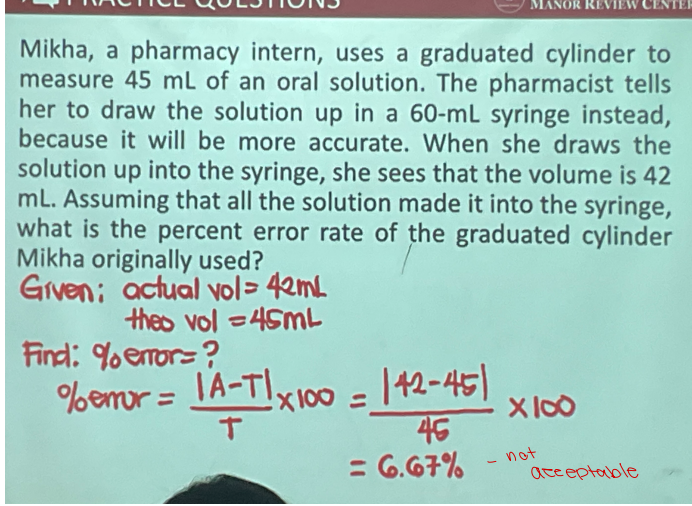
b. 6.67% (not acceptable)
📌Acceptable error = ± 5% or less
[Percentage Error]
PRACTICE PROBLEM:
Mikha, a pharmacy intern, uses a graduated cylinder to measure 45 mL of an oral solution. The pharmacist tells her to draw the solution up in a 60-mL syringe instead, because it will be more accurate. When she draws the solution up into the syringe, she sees that the volume is 42 mL. Assuming that all the solution made it into the syringe, what is the percent error rate of the graduated cylinder Mikha originally used?
a. 7.14%
b. 6.67%
c. 5.00%
d. 8.33%
a. Minimum Weighable Quantity (MWQ)
Weighing accuracy is also known as
a. Minimum Weighable Quantity (MWQ)
b. Sensitivity Requirement (SR)
c. Acceptable error
d. Prescription balance
a. Weighing accuracy (Minimum Weighable Quantity)
The smallest quantity that should be weighed on a prescription balance
a. Weighing accuracy (Minimum Weighable Quantity)
b. Sensitivity Requirement (SR)
c. Acceptable error
d. Percentage error
a. Sensitivity Requirement (SR)
[Weighing Accuracy]
________ is the minimum weight to move the pointer by one division scale
a. Sensitivity Requirement (SR)
b. Minimum Weighable Quantity (MWQ)
c. Acceptable error
d. Percentage error
a. True
[Weighing Accuracy]
The Sensitivity Requirement (SR) of a balance must be known or determined
a. True
b. False
d. 6 mg
[Weighing Accuracy]
Usual Sensitivity Requirement (SR) of a Class A prescription balance such as the:
Torbal torsion balance
Ohaus electronic
a. 2 mg
b. 4 mg
c. 8 mg
d. 6 mg
d. 0.1 ug
[Weighing Accuracy]
Sensitivity Requirement (SR) of a Sartorius BasicLite analytical balance
a. 6 mg
b. 1 mg
c. 6 g
d. 0.1 ug
a. 6 mg
[Weighing Accuracy]
The usual Sensitivity Requirement (SR) of a balance
a. 6 mg
b. 5 mg
c. 10 mg
d. 12 mg
Torbal torsion balance
Ohaus electronic balance
[Weighing Accuracy]
Class A prescription balance include _______
a. Torbal torsion balance and Ohaus electronic balance
b. Sartorius BasicLite analytical balance
c. Both a and b
d. Neither a nor b
a. Dose
[General Dose Calculation]
The amount of drug administered or taken by a patient for intended medicinal effect
a. Dose
b. Single dose
c. Total dose
d. Dosage regimen
b. Single dose
[General Dose Calculation]
The amount of drug taken at one time
a. Dose
b. Single dose
c. Total dose
d. Dosage regimen
c. Total or Daily dose
[General Dose Calculation]
The amount of drug taken during the course of therapy
a. Dose
b. Single dose
c. Total or Daily dose
d. Dosage regimen
a. Divided doses
[General Dose Calculation]
The total or daily dose may be in
a. Divided doses
b. Single doses
c. Multiple doses
d. One-time doses
BID - Twice a day
TID - Three times a day
QID - Four times a day
[General Dose Calculation]
Examples of divided doses [3]
a. Dosage regimen
[General Dose Calculation]
The schedule of dosing (e.g 4x a day for 3 days) is also known as
a. Dosage regimen
b. Single dose
c. Total dose
d. Divided dose
d. Dosage regimen
[General Dose Calculation]
The amount of drug taken at one time is called
a. Dose
b. Single dose
c. Total dose
d. Dosage regimen
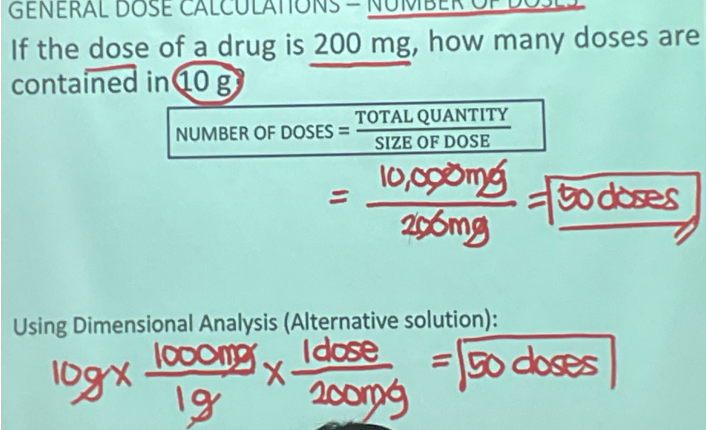
c. 50 doses
[General Dose Calculation]
PRACTICE PROBLEM:
If the dose of a drug is 200 mg, how many doses are contained in 10 g?
a. 20 doses
b. 30 doses
c. 50 doses
d. 100 doses
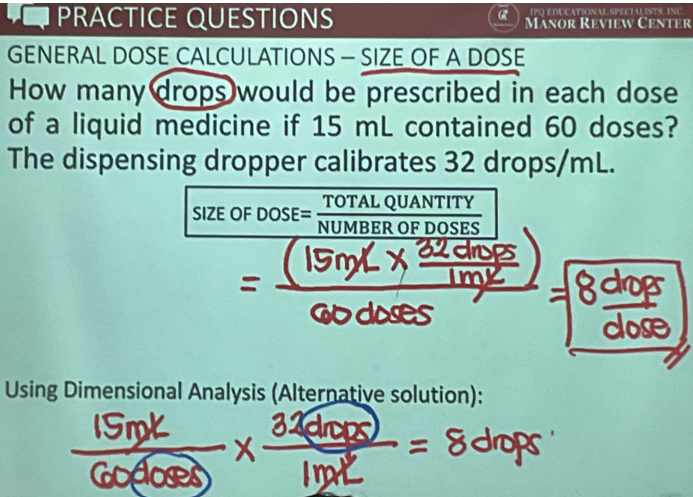
d. 8 drops/dose
[General Dose Calculation]
PRACTICE PROBLEM:
How many drops would be prescribed in each dose of a liquid medicine if 15 mL contained 60 doses? The dispensing dropper calibrates 32 drops/mL.
a. 4 drops/dose
b. 6 drops/dose
c. 10 drops/dose
d. 8 drops/dose
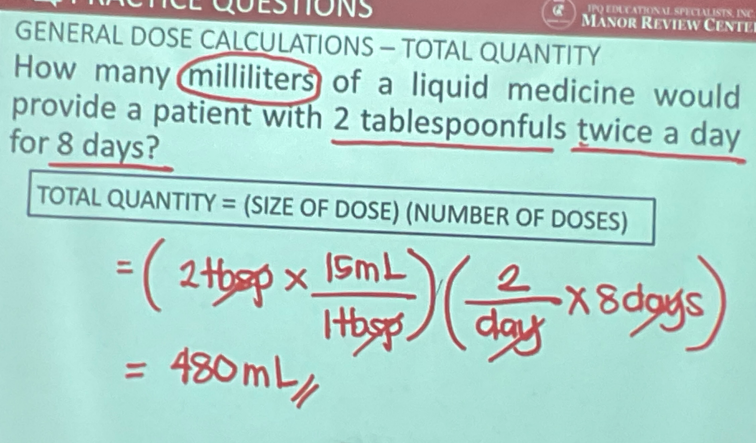
c. 480 mL
[General Dose Calculation]
PRACTICE PROBLEM:
How many milliliters of a liquid medicine would provide a patient with 2 tablespoonfuls twice a day for 8 days?
a. 240 mL
b. 360 mL
c. 480 mL
d. 600 mL
b. Pediatrics
[Special Dosing Consideration]
_________ deals with disease in children from birth through adolescence
a. Geriatrics
b. Pediatrics
c. Gerontology
d. Neonatology
a. From birth to one month
[Special Dosing Consideration]
The age range for a neonate (newborn)
a. From birth to one month
b. From birth to one year
c. From one month to one year
d. From 1 year to 5 years
a. Born < 37 weeks AOG
[Special Dosing Consideration]
The gestational age for a premature infant
a. Born < 37 weeks AOG
b. Born 37-41 weeks AOG
c. Born ≥ 42 weeks AOG
d. Born < 40 weeks AOG
b. Born 37-41 weeks AOG
[Special Dosing Consideration]
The gestational age for a term infant
a. Born < 37 weeks AOG
b. Born 37-41 weeks AOG
c. Born ≥ 42 weeks AOG
d. Born 38-42 weeks AOG
c. Born ≥ 42 weeks AOG
[Special Dosing Consideration]
The gestational age for a post-term infant
a. Born < 37 weeks AOG
b. Born 37-41 weeks AOG
c. Born ≥ 42 weeks AOG
d. Born 40-42 weeks AOG
c. 1 month to one year
[Special Dosing Consideration]
The age range for an infant
a. Birth to one month
b. Birth to one year
c. 1 month to one year
d. 1 year to 5 years
c. Growth & development
[Special Dosing Consideration]
The age 1 month to one year (Infant) is for:
a. Growth only
b. Development only
c. Growth & development
d. Maturation
c. 1 year through 5 years
[Special Dosing Consideration]
The age range for early childhood
a. Birth to one year
b. 1 month to one year
c. 1 year through 5 years
d. 6-12 years
c. 2 - 3 years
[Special Dosing Consideration]
Toddler
a. Birth to one year
b. 1 month to one year
c. 2 - 3 years
d. 6-12 years
b. 6-12 years
[Special Dosing Consideration]
The age range for late childhood
a. 1 year through 5 years
b. 6-12 years
c. 13-17 years
d. 12-18 years
b. 6-12 years
[Special Dosing Consideration]
Puberty
a. 1 year through 5 years
b. 6-12 years
c. 13-17 years
d. 12-18 years
c. 13-17 years
[Special Dosing Consideration]
The age range for adolescence
a. 1 year through 5 years
b. 6-12 years
c. 13-17 years
d. 12-18 years
a. "Wear or tear"
[Special Dosing Consideration]
Geriatrics is also known as
a. "Wear or tear"
b. "Growth and development"
c. "Aging process"
d. "Degeneration"
a. Geriatrics
[Special Dosing Consideration]
_______ deals with the management of illness or disability in the elderly
a. Geriatrics
b. Pediatrics
c. Gerontology
d. Neonatology
Management of illness or disability in the elderly
Reduced kidney function
Multiple coexisting pathologies
Multidrug therapies
[Special Dosing Consideration]
Geriatrics deals with the ______ [4]
a. 65 years and above
[Special Dosing Consideration]
The WHO definition of elderly
a. 65 years and above
b. 60 years and above
c. 65-74 years
d. 75-84 years
b. 60 years and above
[Special Dosing Consideration]
The Philippine definition of senior citizen according to RA9994
a. 65 years and above
b. 60 years and above
c. 60-74 years
d. 65-74 years
a. 60 to 74 years old
[Special Dosing Consideration]
The classification of older adults as young-old
a. 60 to 74 years old
b. 75 to 84 years old
c. >85 years old
d. 65 to 74 years old
b. 75 to 84 years old
[Special Dosing Consideration]
The classification of older adults as middle-old
a. 60 to 74 years old
b. 75 to 84 years old
c. >85 years old
d. 65 to 74 years old
c. >85 years old
[Special Dosing Consideration]
The classification of older adults as old-old
a. 60 to 74 years old
b. 75 to 84 years old
c. >85 years old
d. >90 years old
d. 133 mg
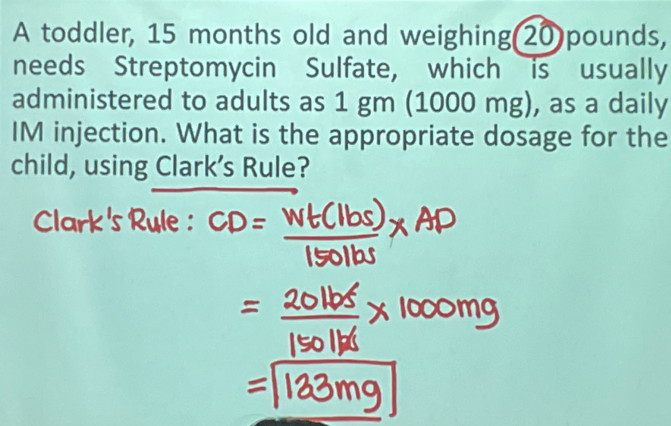
[Dosing Based on Age]
PRACTICE PROBLEM:
A toddler, 15 months old and weighing 20 pounds, needs Streptomycin Sulfate, which is usually administered to adults as 1 gm (1000 mg), as a daily IM injection. What is the appropriate dosage for the child, using Clark's Rule?
a. 100 mg
b. 120 mg
c. 150 mg
d. 133 mg
c. 1200 - 1500 mg
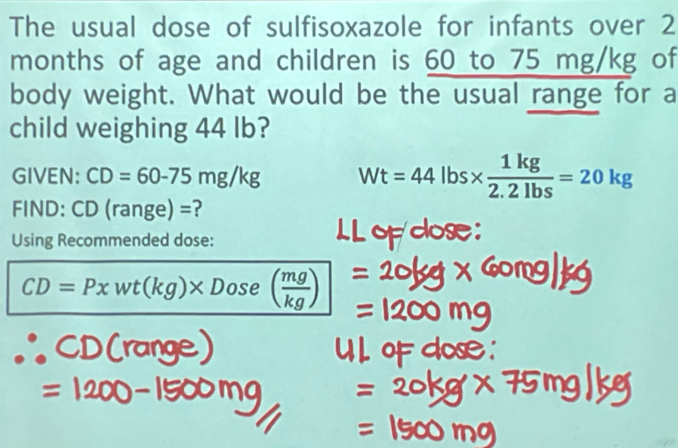
[Dosing Based on Body Weight]
The usual dose of sulfisoxazole for infants over 2 months of age and children is 60 to 75 mg/kg of body weight. What would be the usual range for a child weighing 44 lb?
a. 1000 - 1300 mg
b. 1100 - 1400 mg
c. 1200 - 1500 mg
d. 1300 - 1600 mg
a. Body Surface Area (BSA)
________ is useful for patients on chemotherapy and some drugs for pediatric patients (except neonates)
a. Body Surface Area (BSA)
b. Body Weight
c. Body Mass Index (BMI)
d. Lean Body Mass
a. Neonates
BSA is useful for patients on chemotherapy and some drugs for pediatric patients except
a. Neonates
b. Infants
c. Children
d. Adolescents
b. Patients on chemotherapy and some drugs for pediatric patients (except neonates)
[Dosing Based on Body Surface Area]
Dose calculation based on BSA (m²) is useful for these patients
a. Geriatric patients and neonates
b. Patients on chemotherapy and some drugs for pediatric patients (except neonates)
c. All pediatric patients including neonates
d. Adult patients on maintenance therapy
a. Body Surface Area (BSA)
______ represents the relationship between Height and weight
a. Body Surface Area (BSA)
b. Body Weight
c. Body Mass Index (BMI)
d. Lean Body Mass
a. Body Surface Area (BSA)
________ is a precise guide for the maturity of body organs and metabolic rate (correlated to liver volume as well)
a. Body Surface Area (BSA)
b. Body Weight
c. Body Mass Index (BMI)
d. Lean Body Mass
a. Liver volume
[Dosing Based on Body Surface Area]
Body Surface Area (BSA) is correlated to
a. Liver volume
b. Kidney volume
c. Heart volume
d. Lung volume
a. 1.73 m²
[Dosing Based on Body Surface Area]
The BSA of an average adult is
a. 1.73 m²
b. 1.5 m²
c. 2.0 m²
d. 1.0 m²
b. 47.98 mg
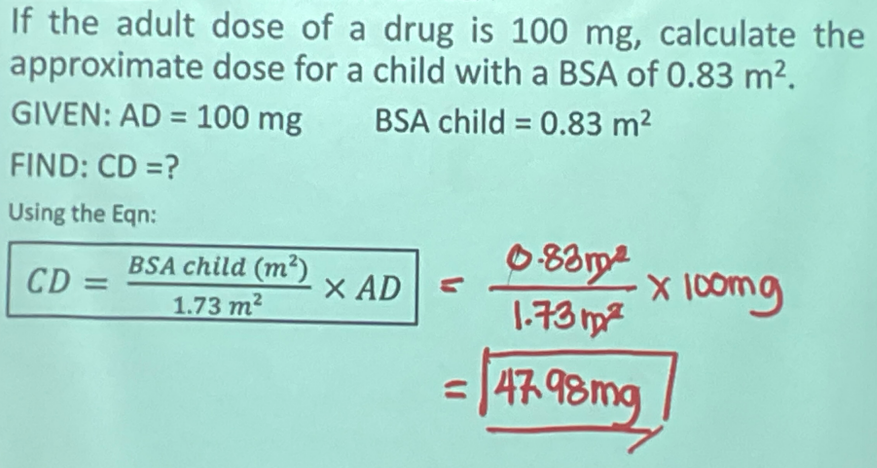
[Dosing Based on Body Surface Area]
PRACTICE PROBLEM:
If the adult dose of a drug is 100 mg, calculate the approximate dose for a child with a BSA of 0.83 m²
a. 38.00 mg
b. 47.98 mg
c. 58.00 mg
d. 68.00 mg
a. 1.73 m²
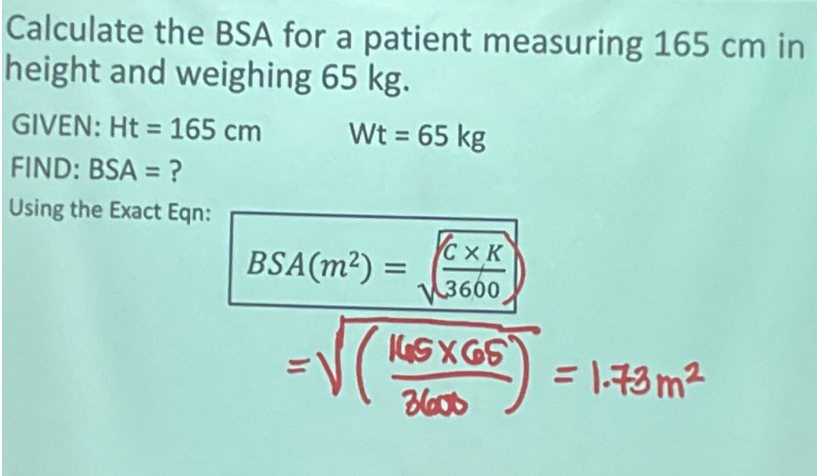
[Dosing Based on Body Surface Area]
PRACTICE PROBLEM:
Calculate the BSA for a patient measuring 165 cm in height and weighing 65 kg.
a. 1.73 m²
b. 1.85 m²
c. 1.60 m²
d. 1.95 m²