Cell Bio Chapter 10 The Nature of Gene
 Call Kai
 Learn
Learn Practice Test
 Spaced Repetition
 Match
Match Flashcards
 Knowt Play
1/48

There's no tags or description
Looks like no tags are added yet.
Name | Mastery | Learn | Test | Matching | Spaced | Call with Kai | Chat |
|---|
No analytics yet
Send a link to your students to track their progress
49 Terms
Gene
Discrete factors which are maintained throughout the life of an organism and then passed on to each of its progeny.
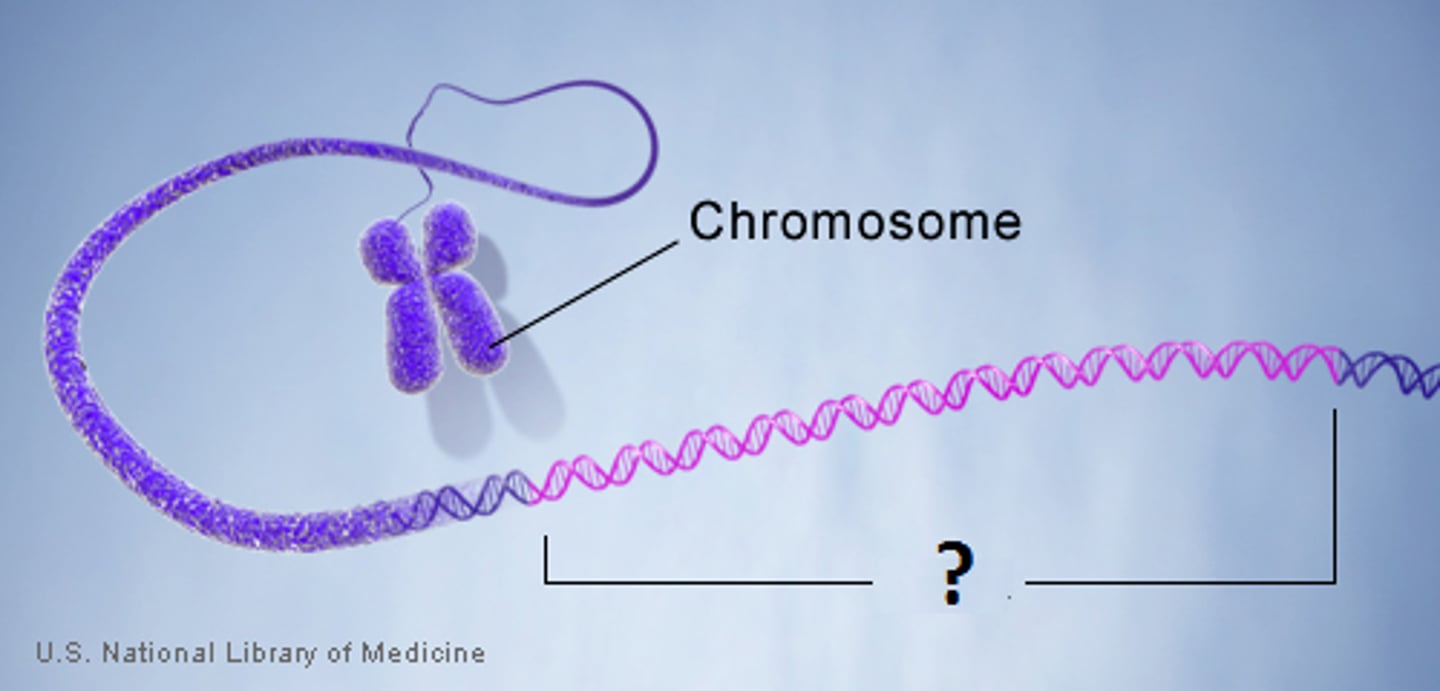
Chromosome
The physical carrier of genes.
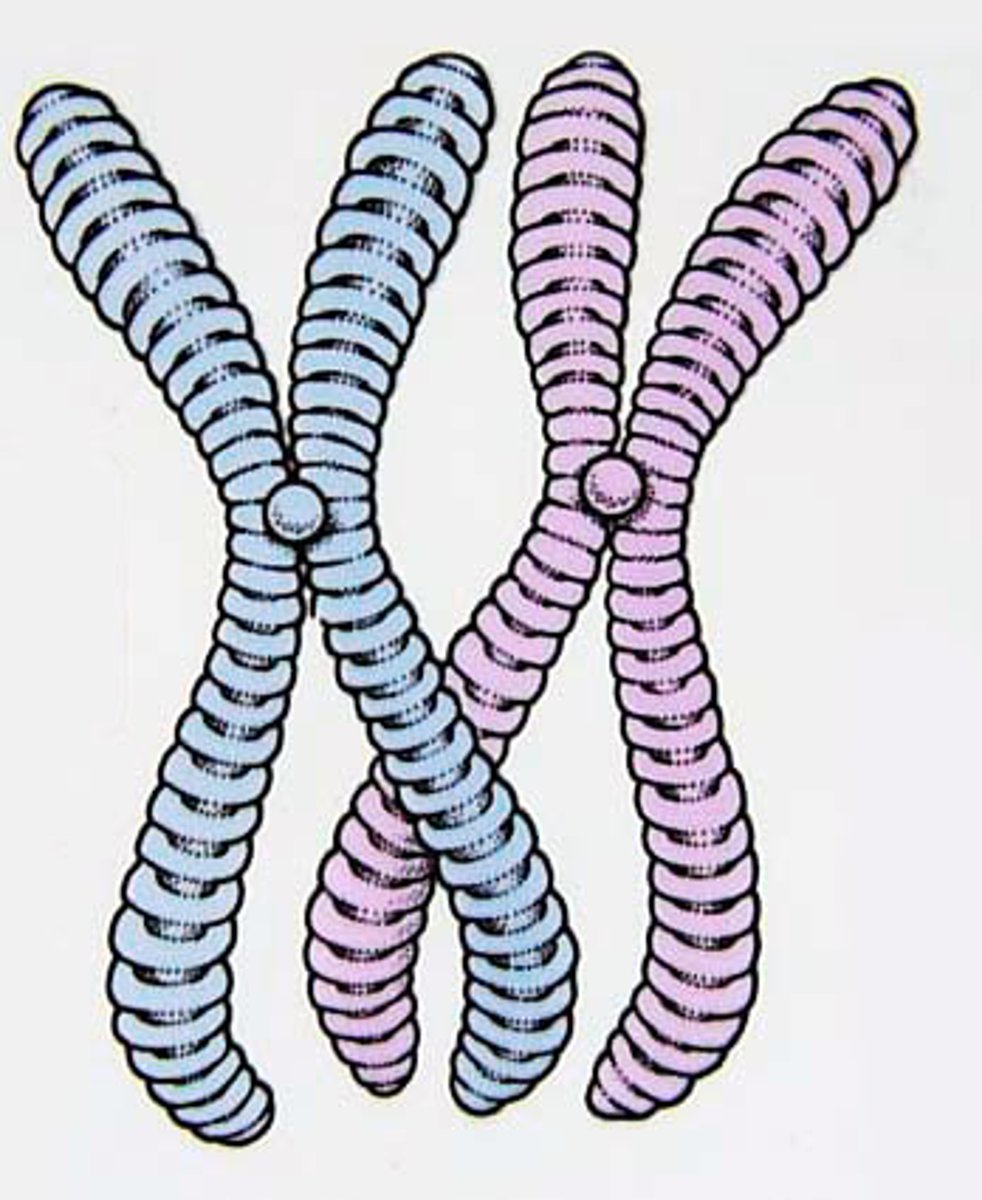
DNA
The genetic material in all organisms.
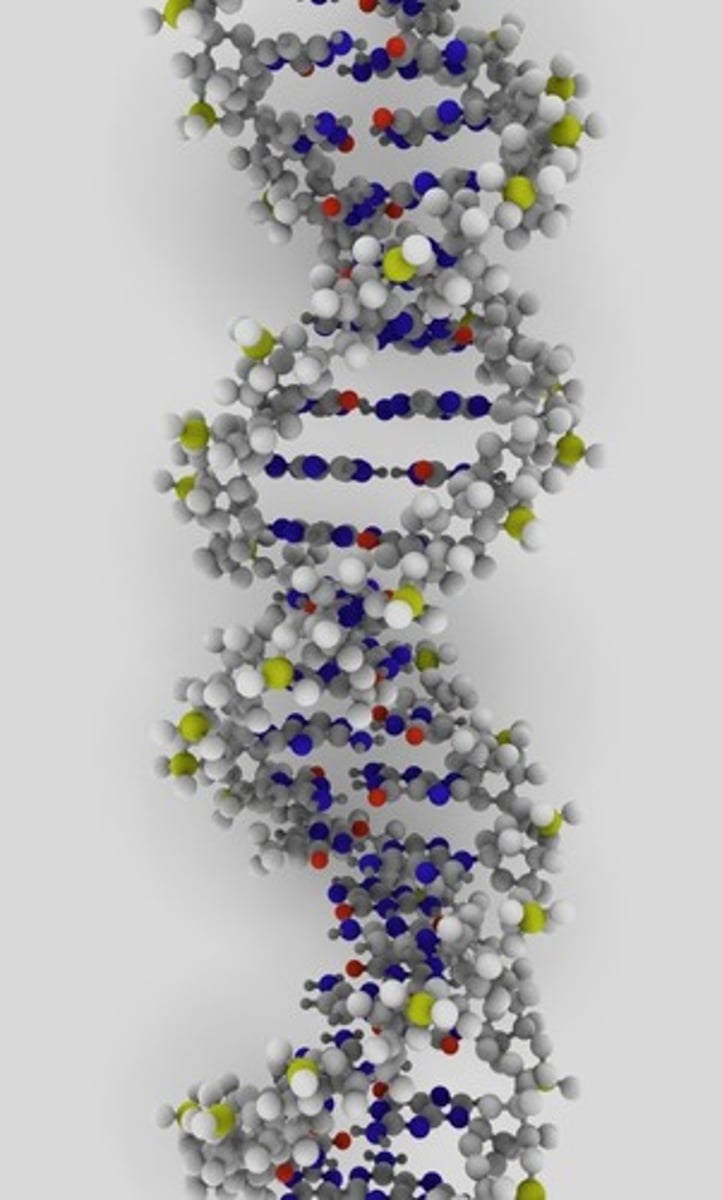
Nucleotide
The building block of DNA consists of a phosphate, a deoxyribose, and a nitrogenous base.
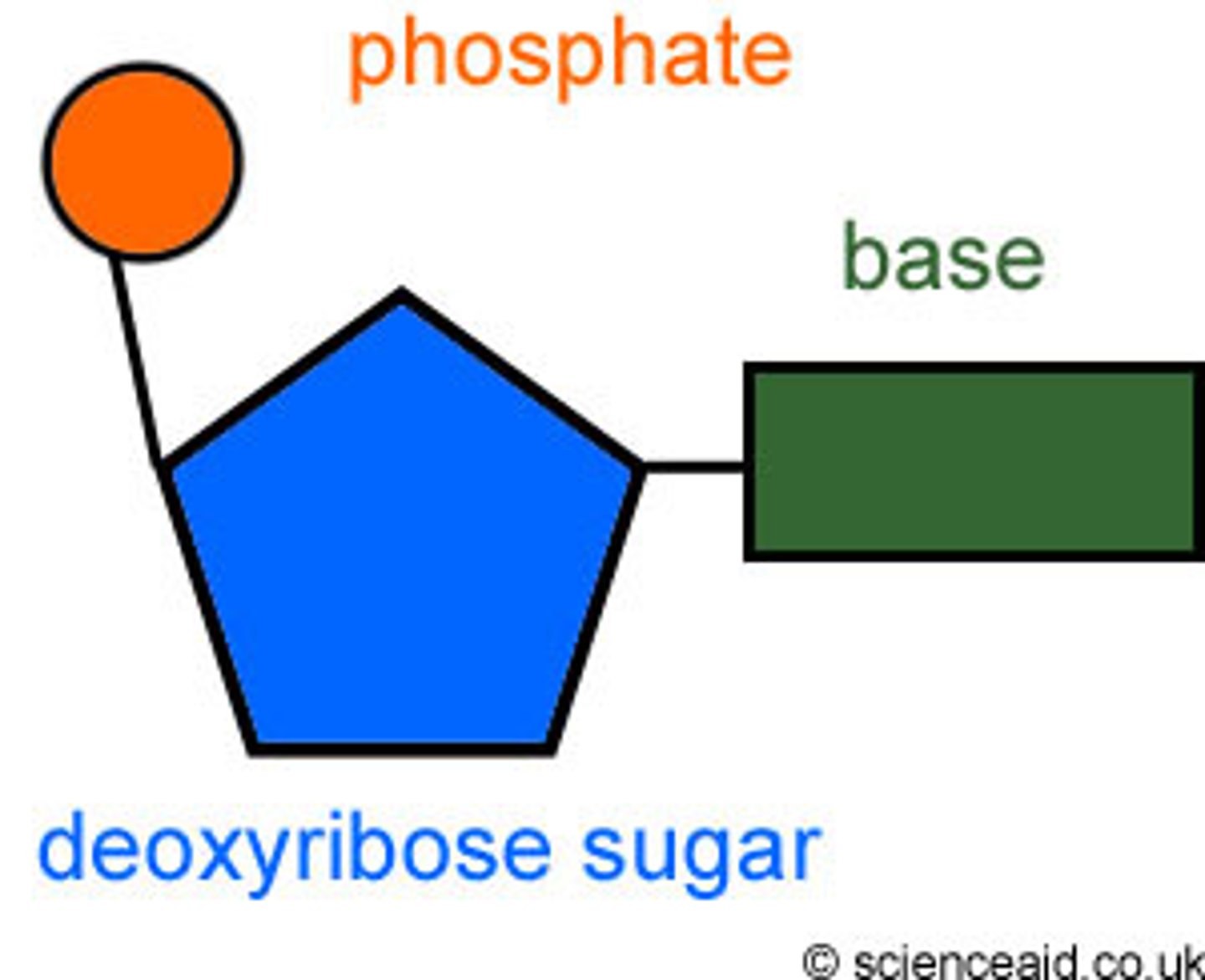
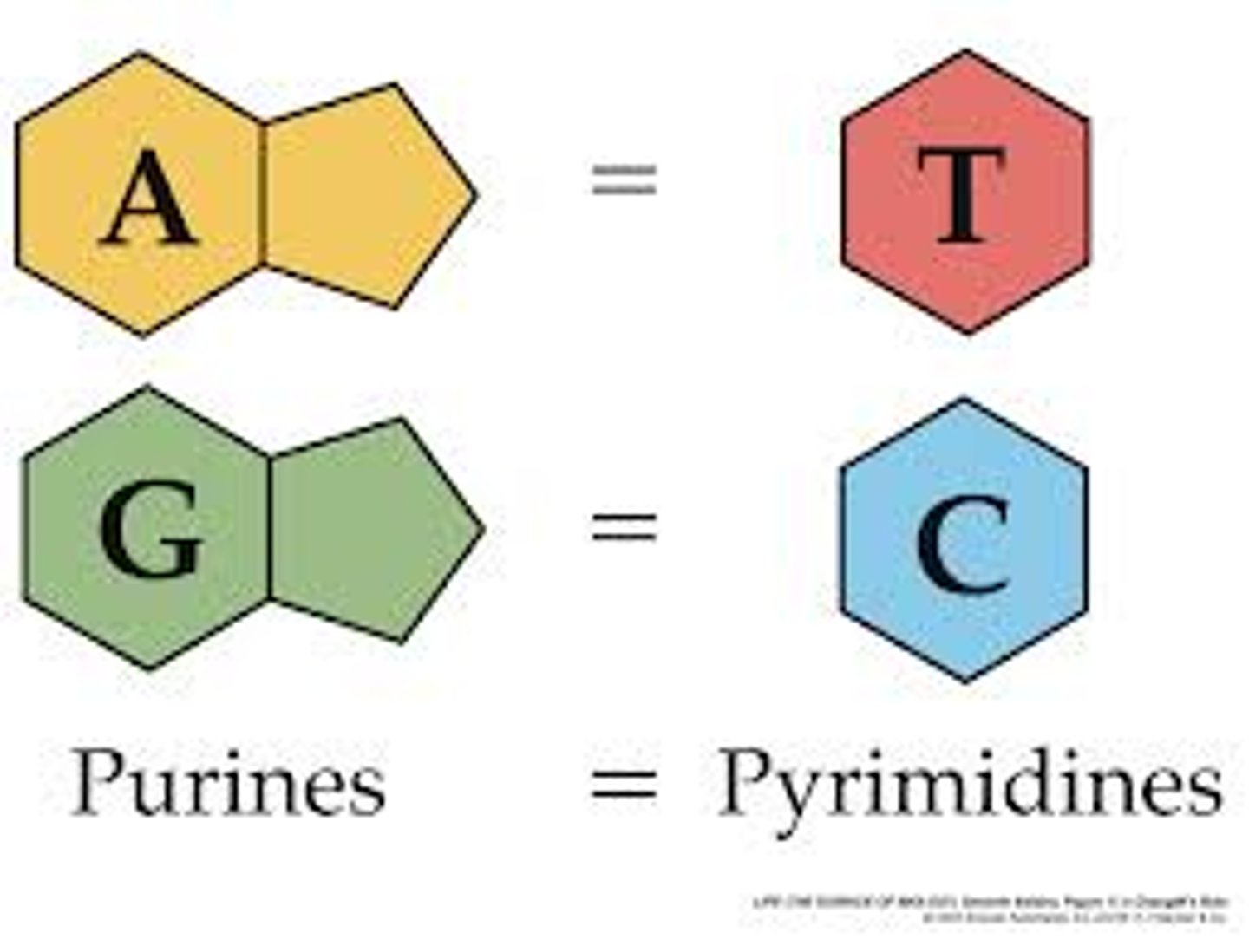
Pyrimidine
A type of nitrogenous base; includes thymine (T) and cytosine (C).
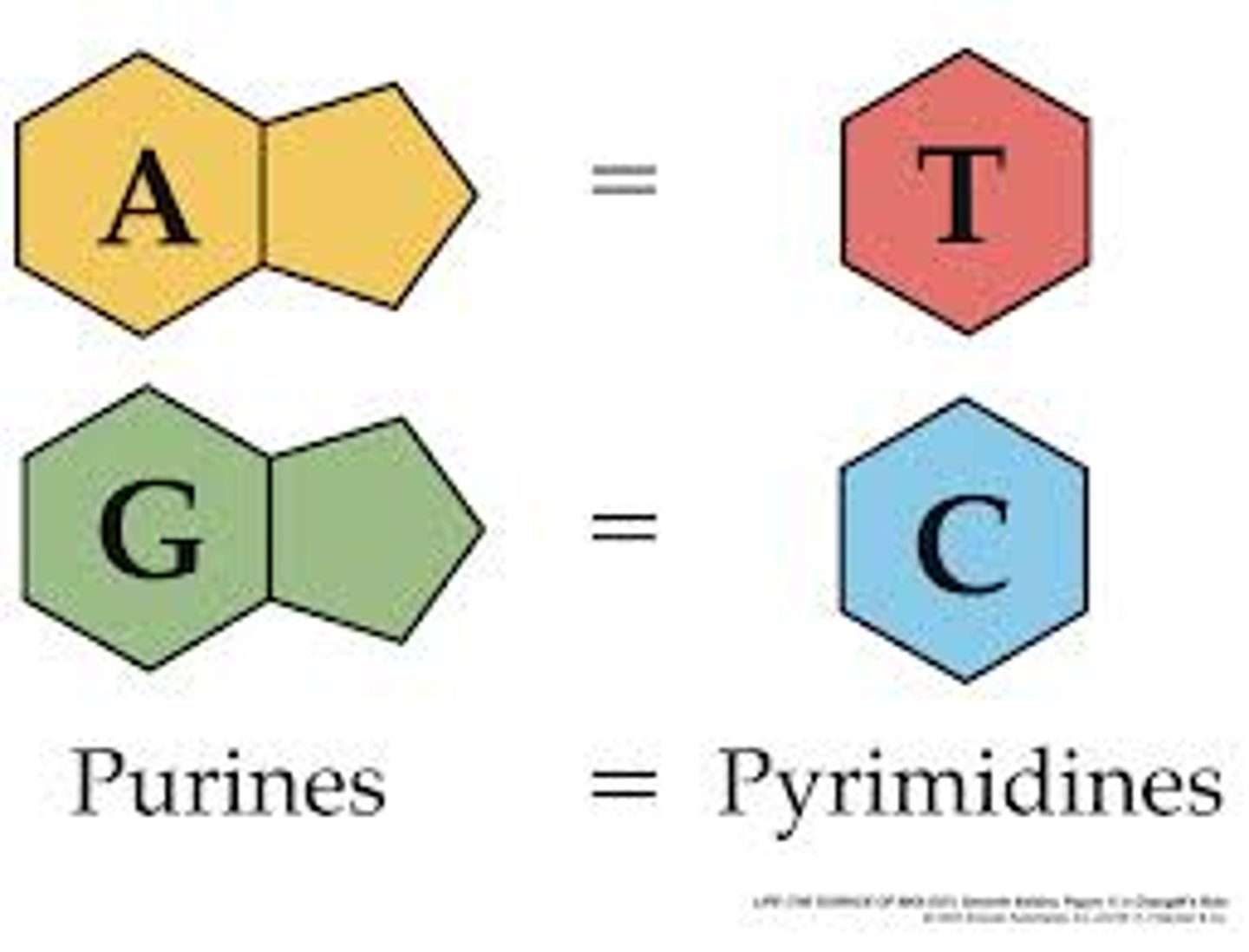
Purine
A type of nitrogenous base; includes adenine (A) and guanine (G).
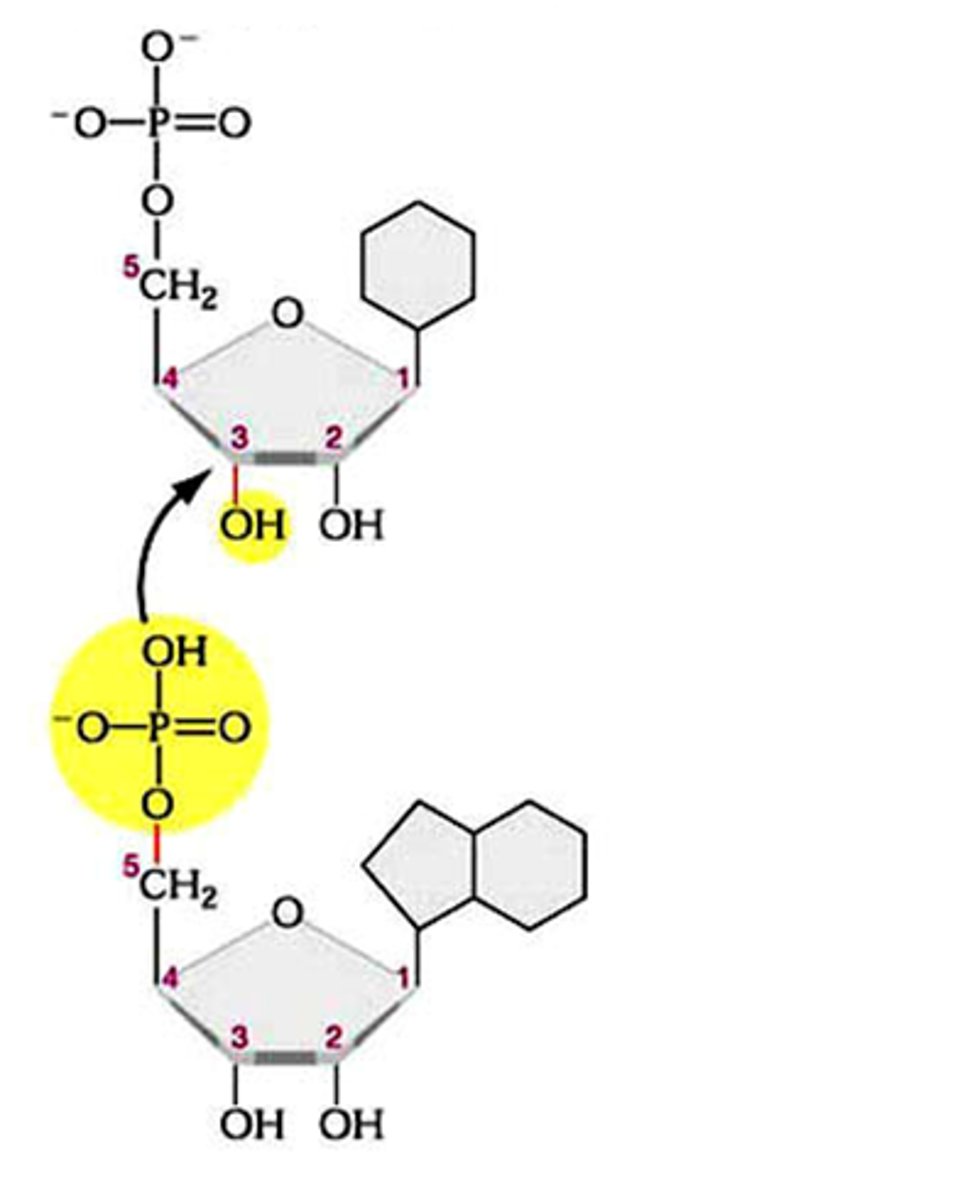
5' end of nucleotide
The end of a nucleotide where the phosphate group is attached to the carbon 5.
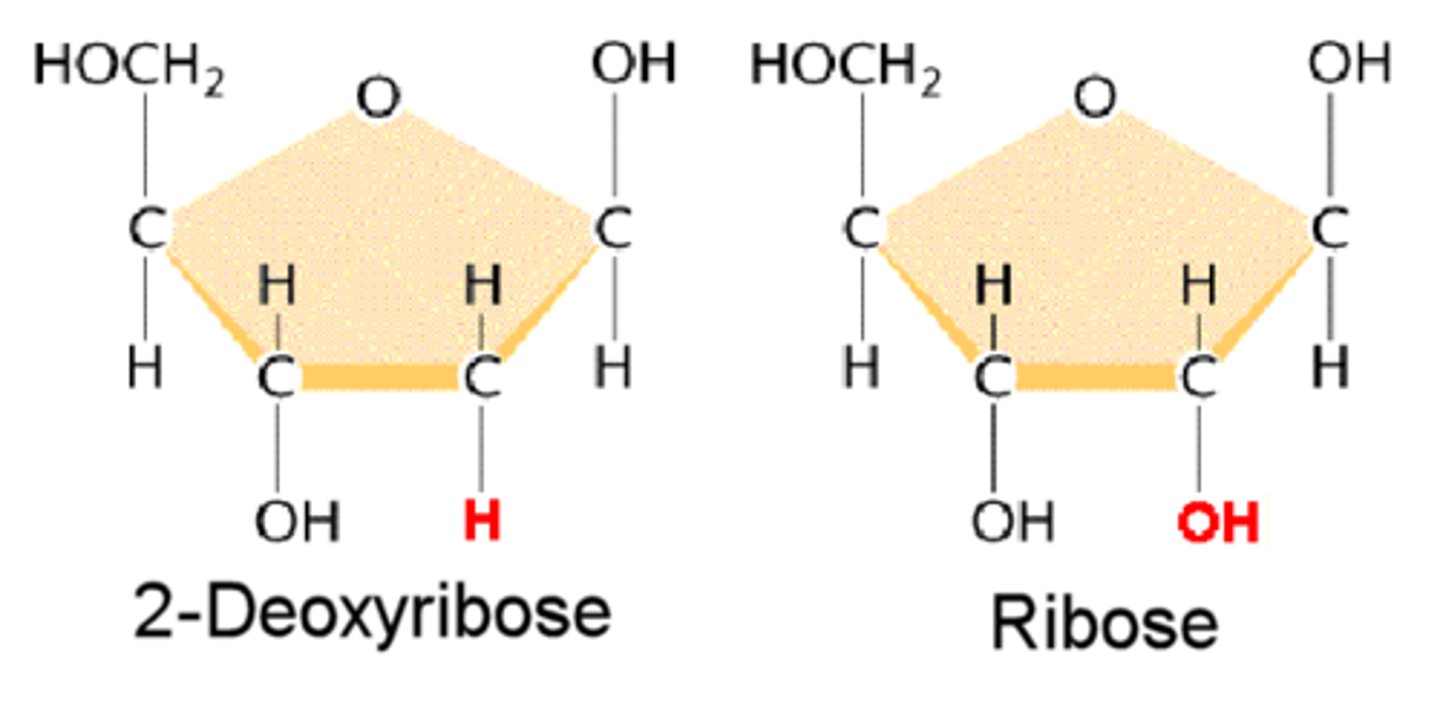
3' end of nucleotide
The end of a nucleotide where the hydroxyl group is attached to the carbon 3.
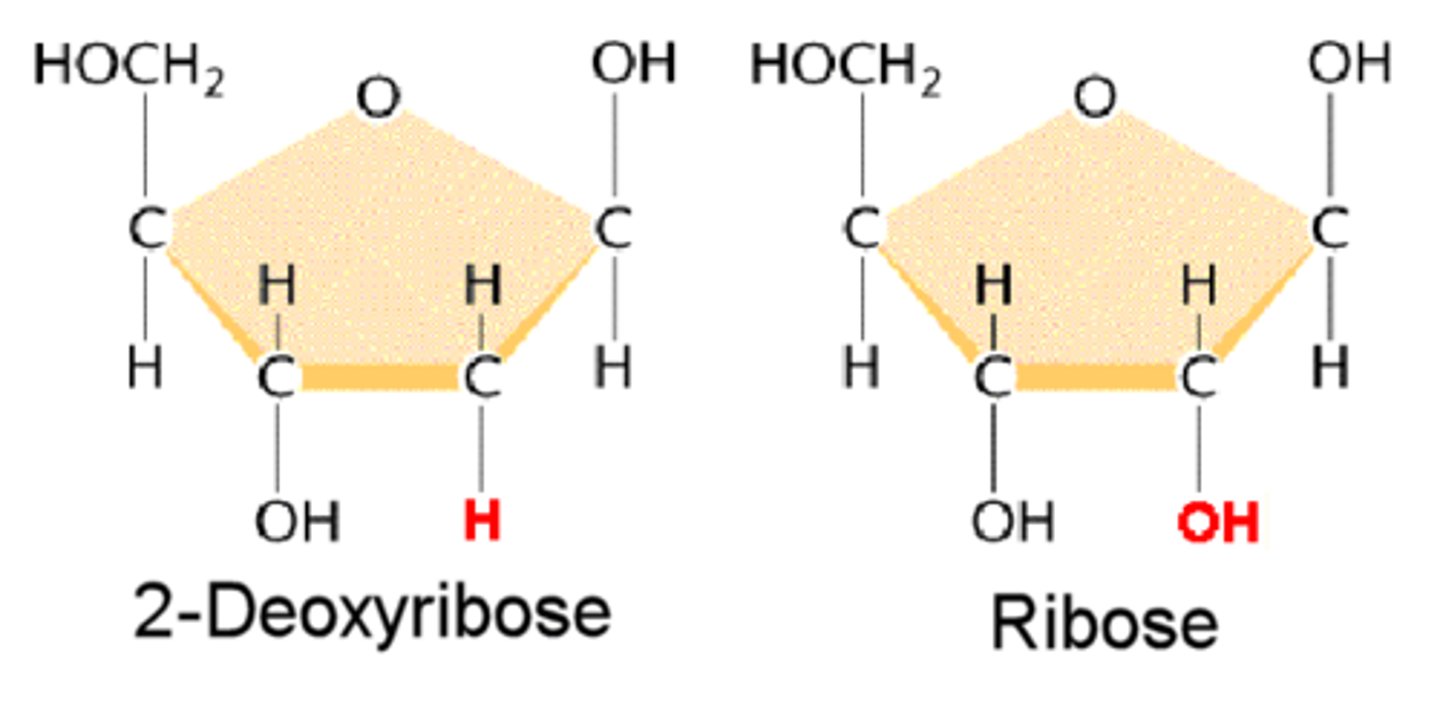
Phosphodiester bond
The type of bond linking the deoxyribose and phosphates in the DNA backbone.
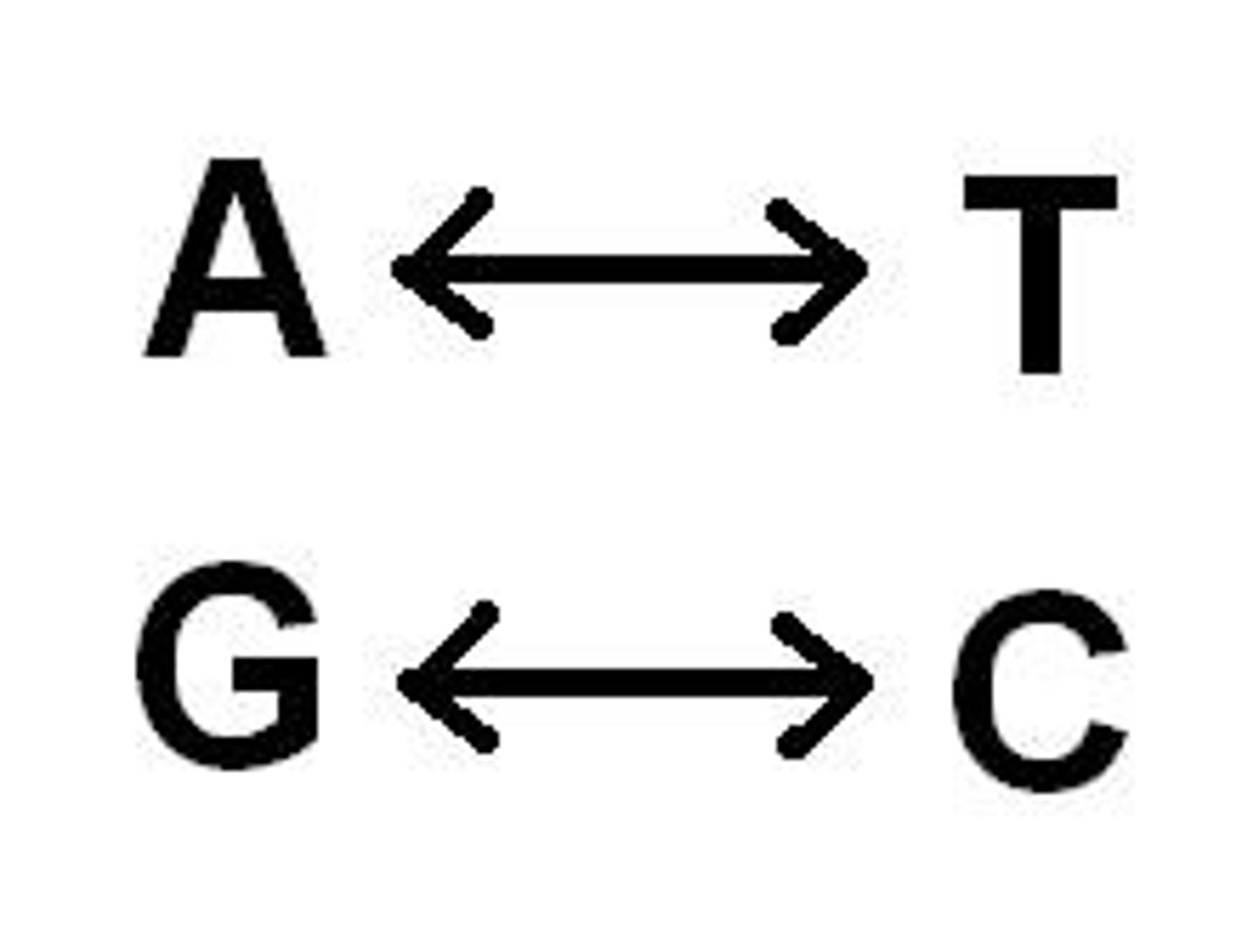
Chargaff's rules
The number of adenine equals the number of thymine, and the number of cytosine equals the number of guanine.
What determines the type of nucleotide?
nitrogenous base
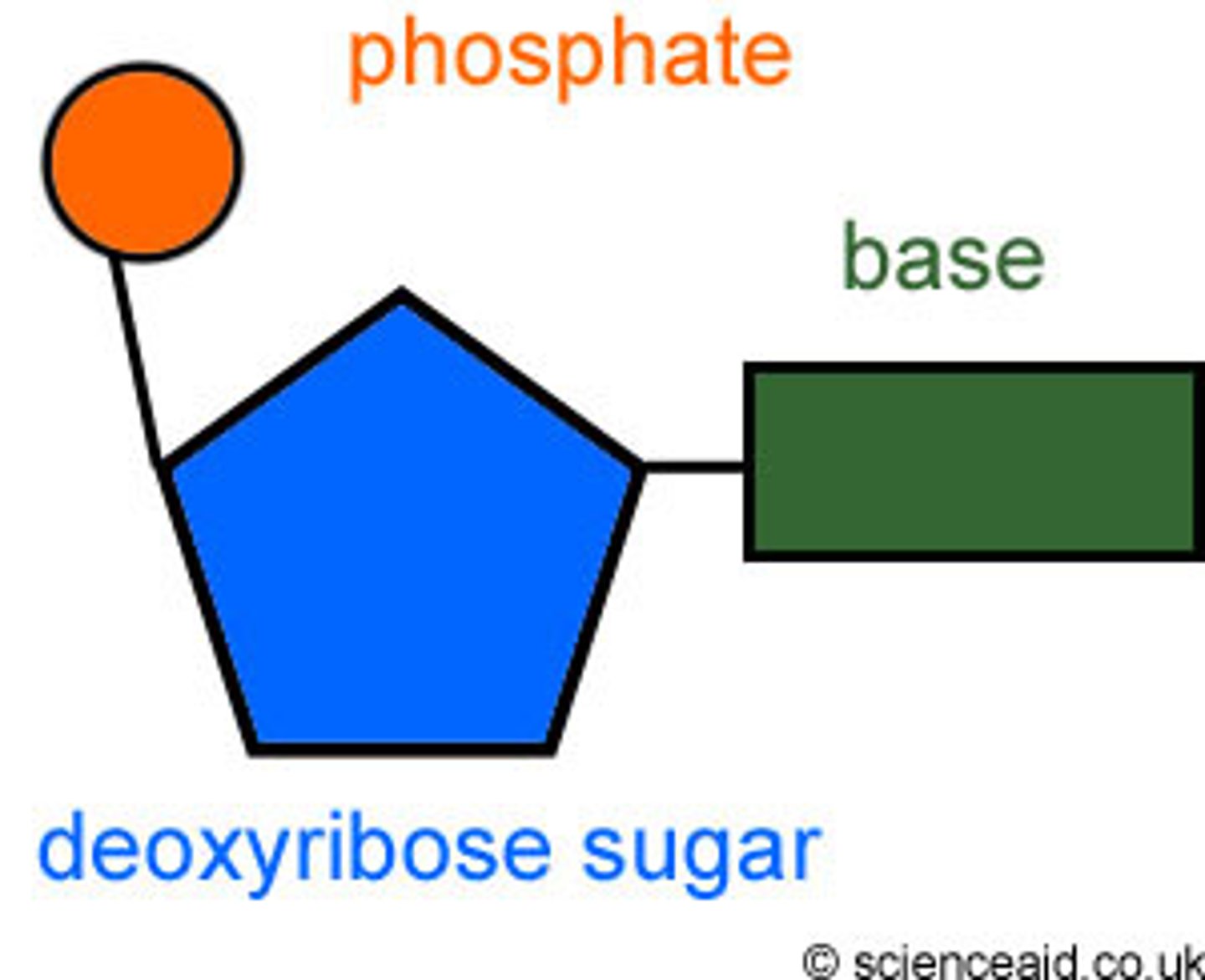
What part of the nucleotide links them together?
phosphate group
Watson-Crick Proposal
The model proposes that DNA is composed of two chains of nucleotides that spiral around each other, forming a double helix.
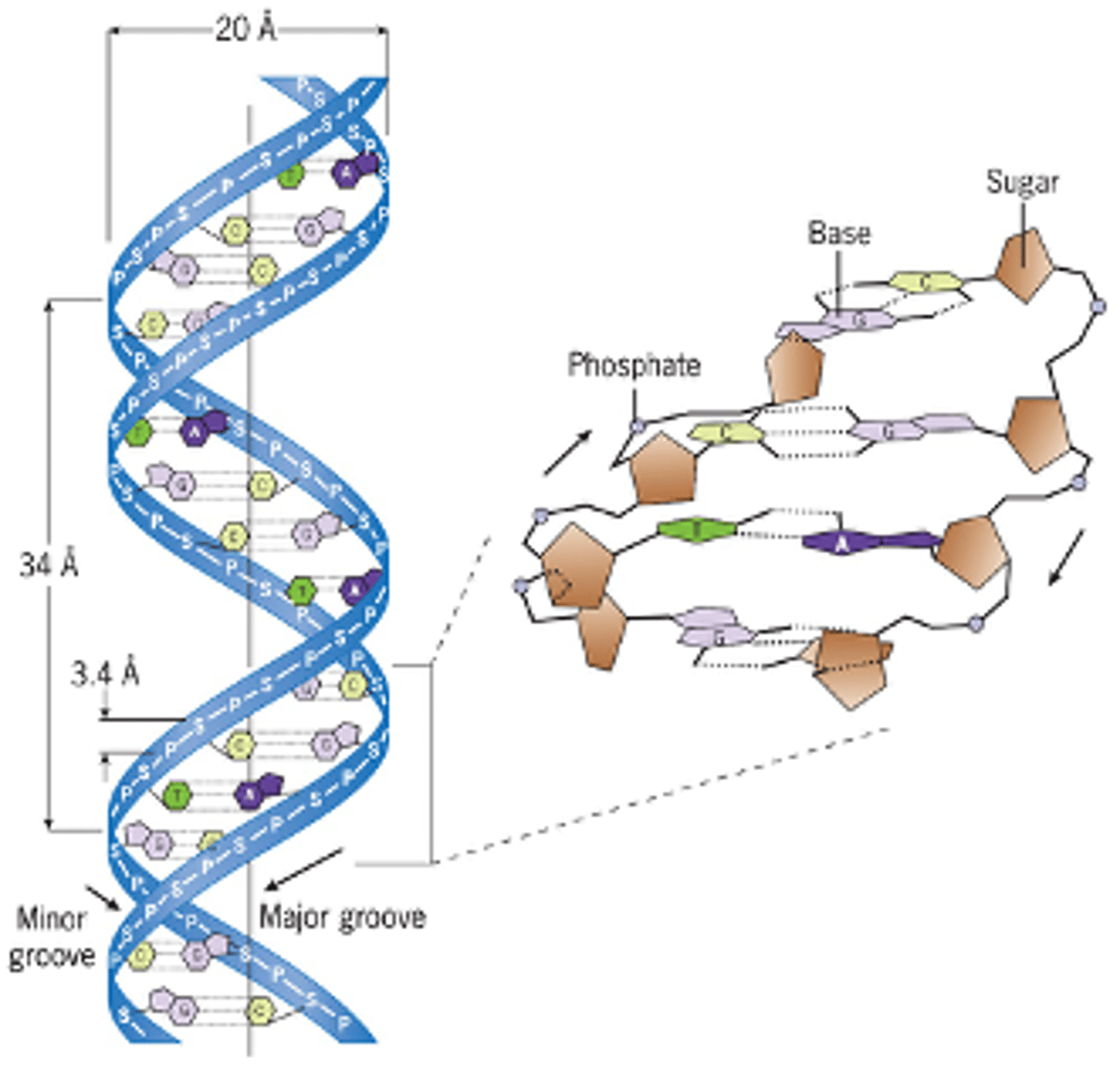
DNA is composed of ____ chains of nucleotides.
Two
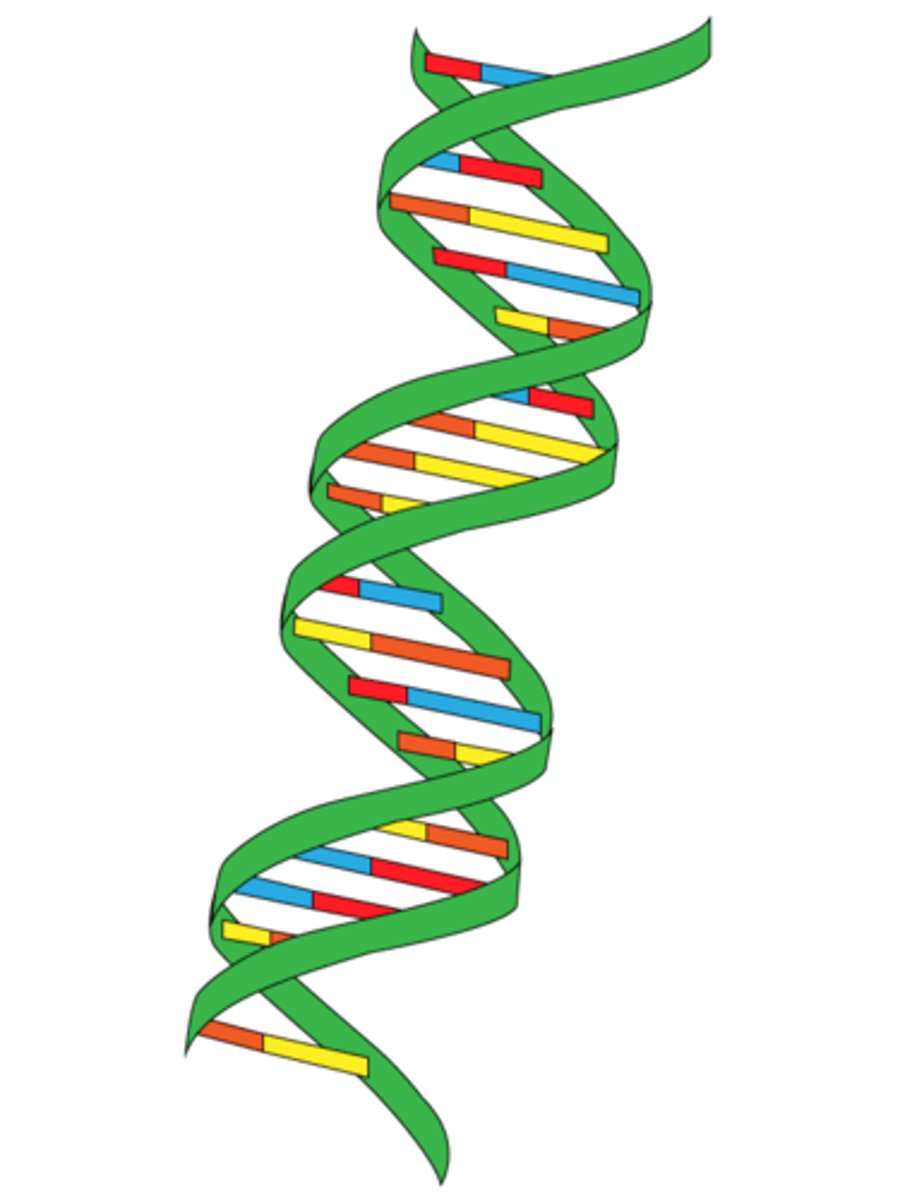
The two chains spiral around each other forming a pair of___________ helices.
Right-handed
Antiparallel
Describes the orientation of the two chains of DNA running in opposite directions.
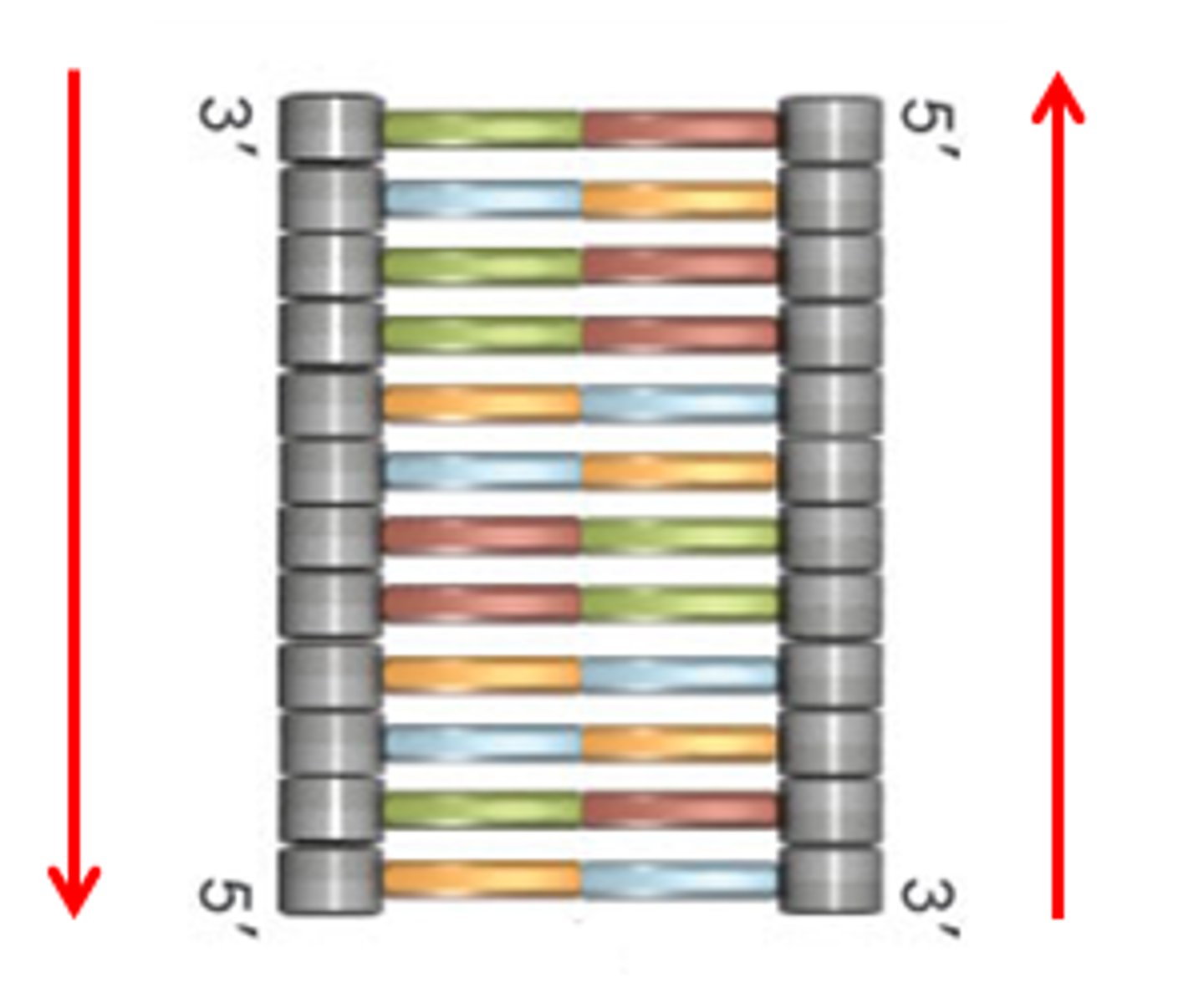
The sugar-phosphate backbone is located on the ________ of the molecule and the bases are _________ the helix.
Outside, Inside
Hydrogen bonds
The bonds that hold the two DNA chains together between each base.
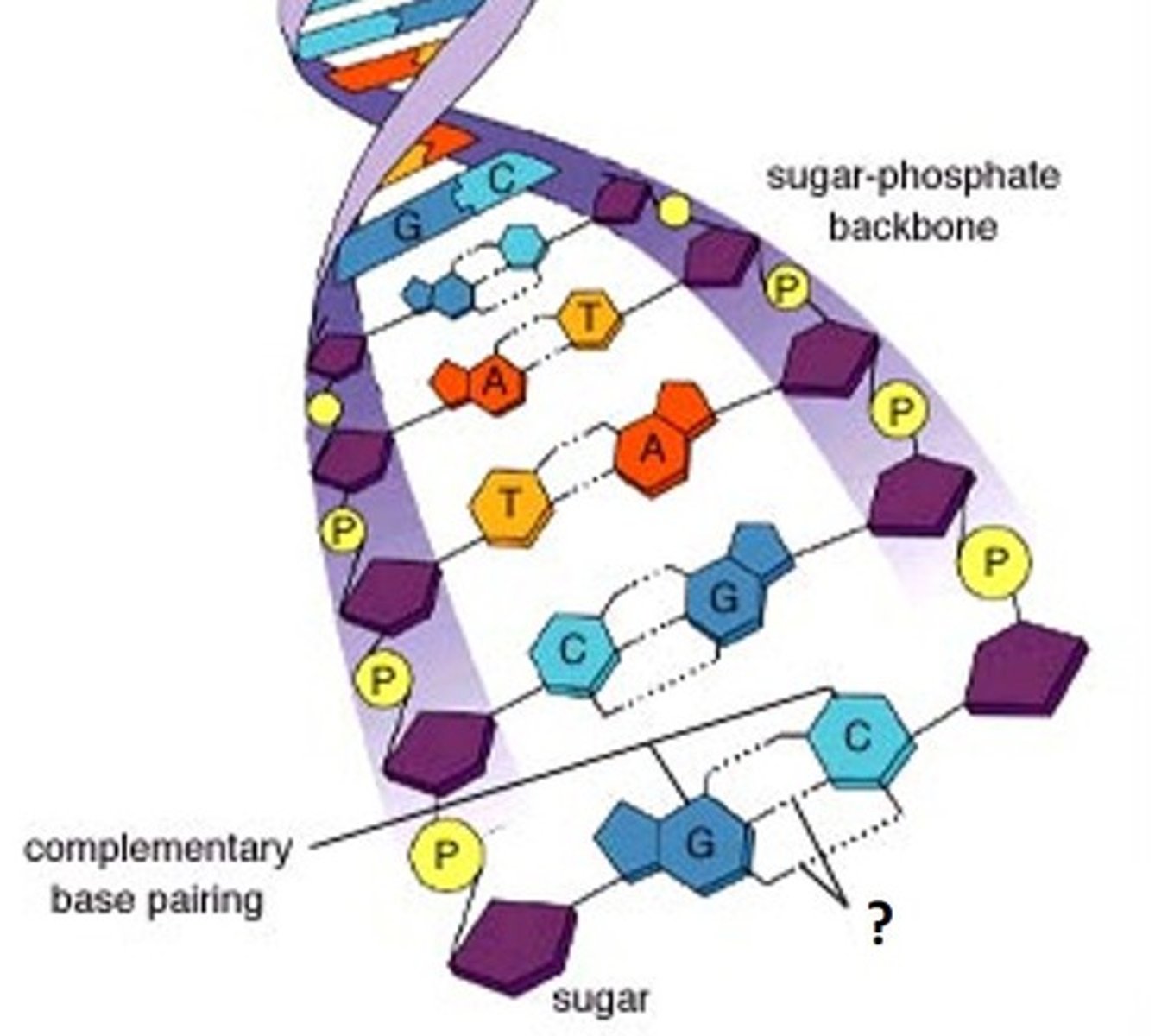
The double helix is _____ wide.
2nm
Pyrimidines are always paired with _________.
purines
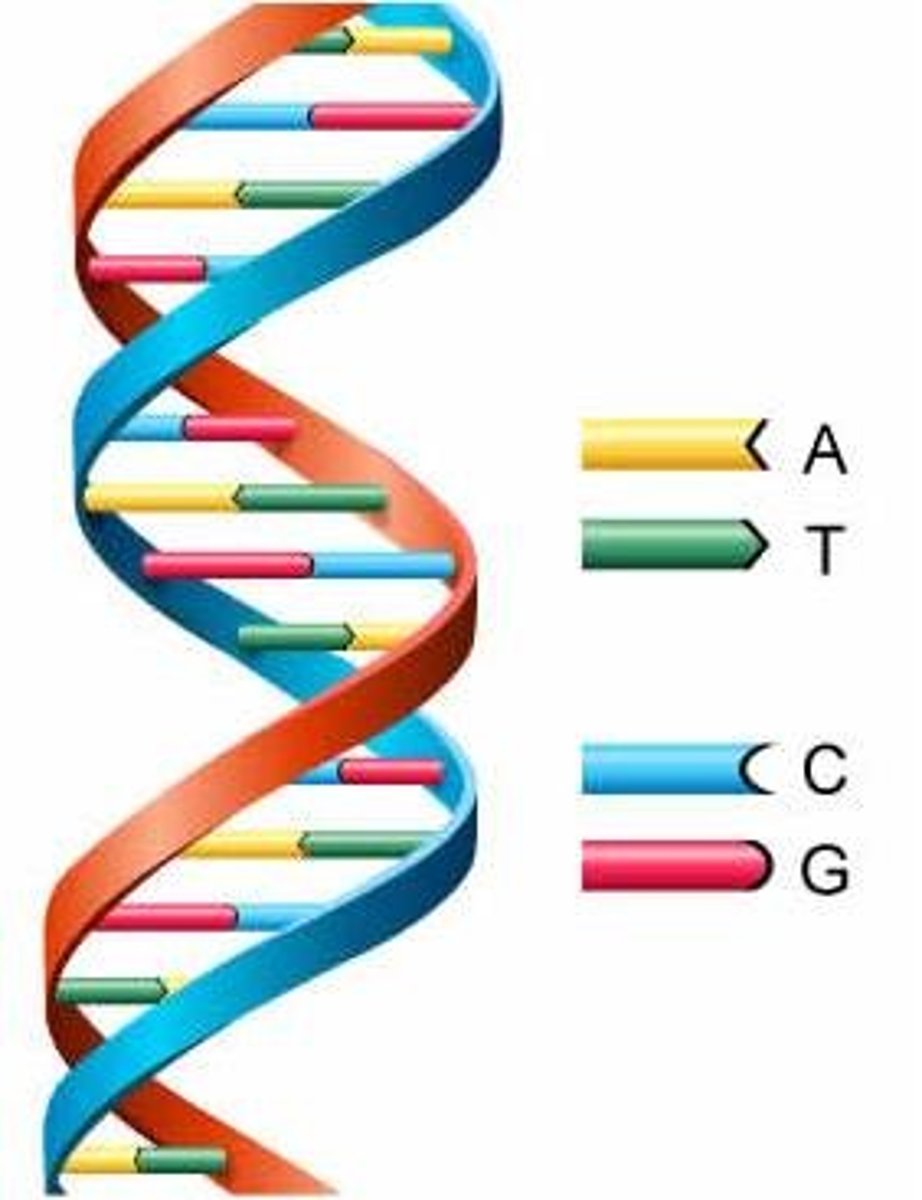
Purines are always paired with _________.
pyrimidines
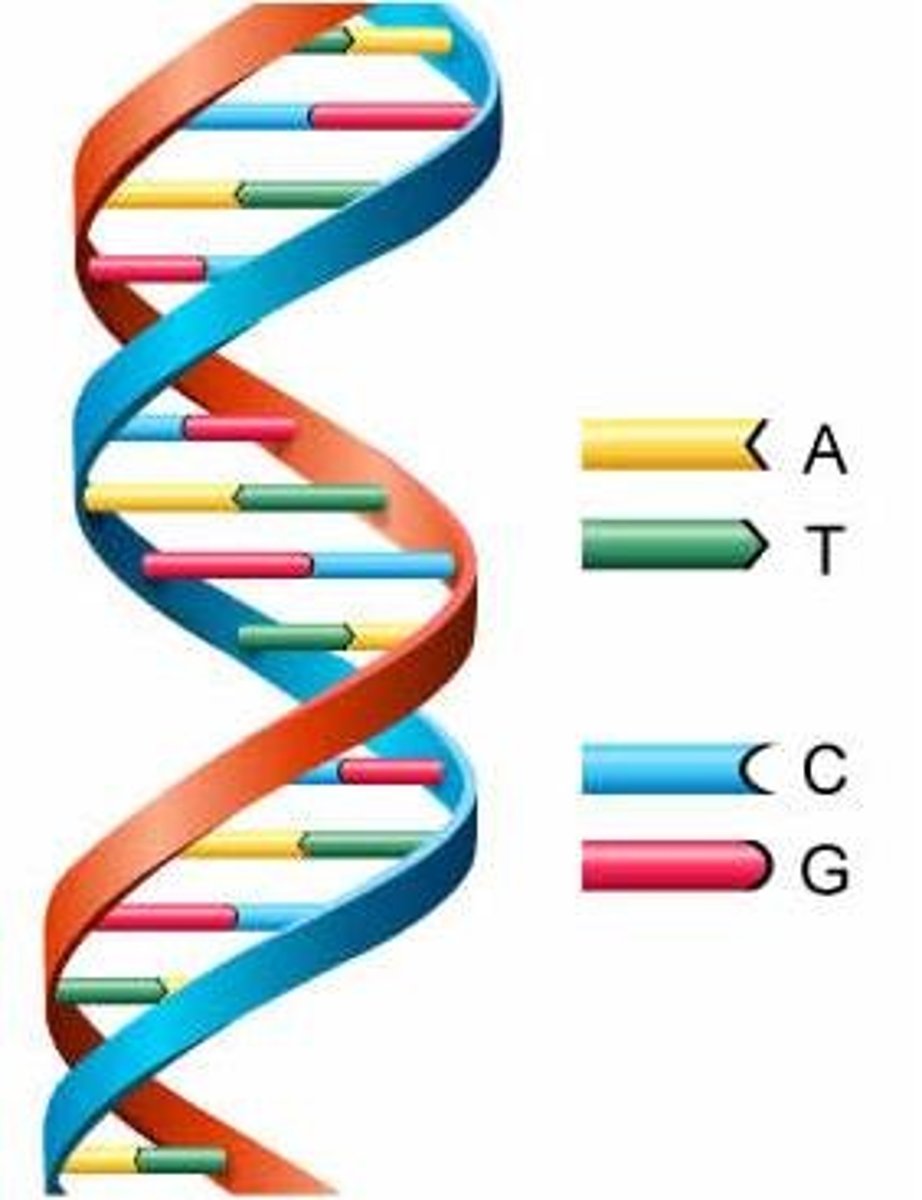
Only _______ and _______ pairs fit within double helix.
A-T and C-G
Major groove
The wider groove in the DNA double helix.
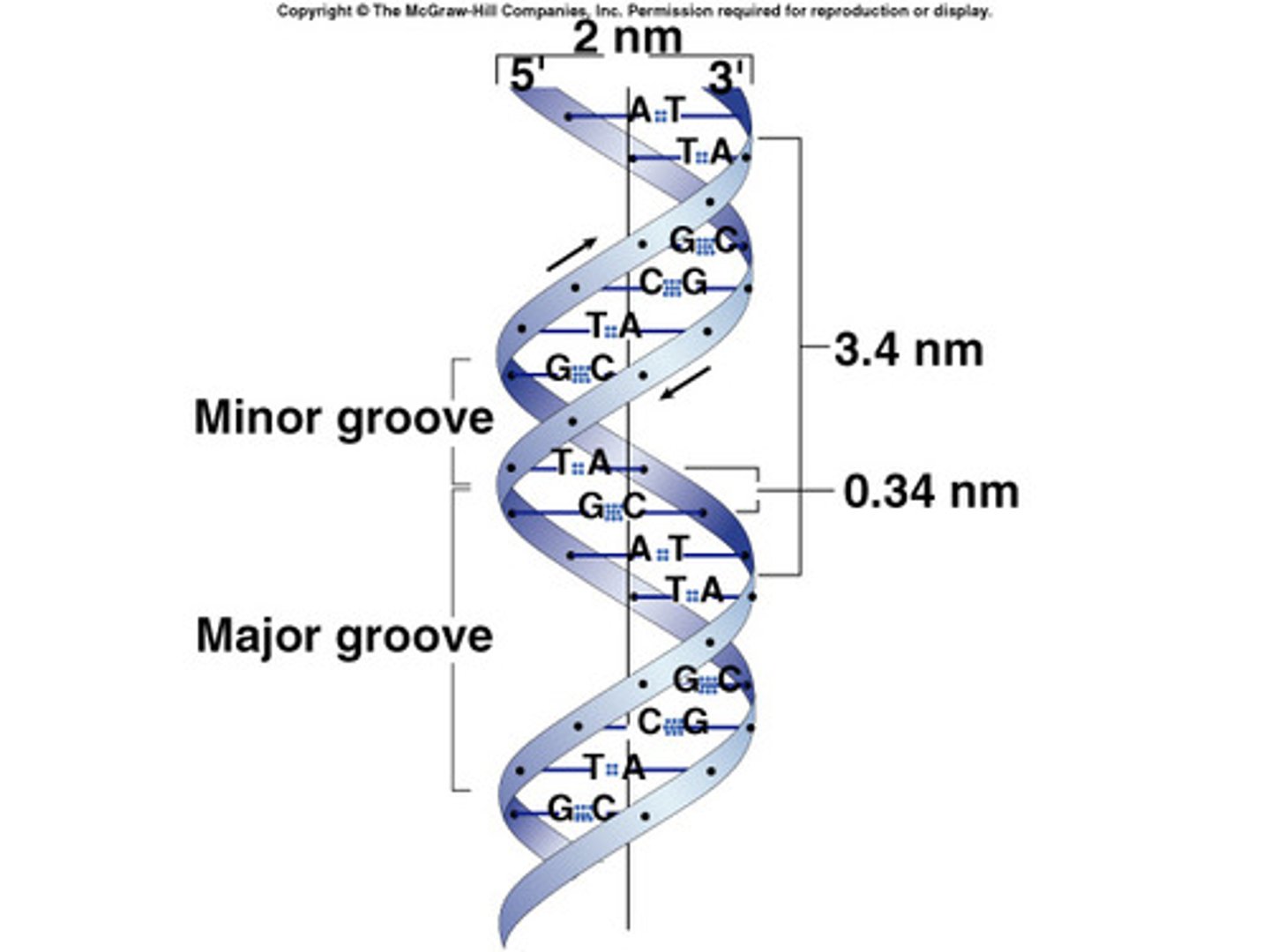
Minor groove
The more narrow groove in the DNA double helix.
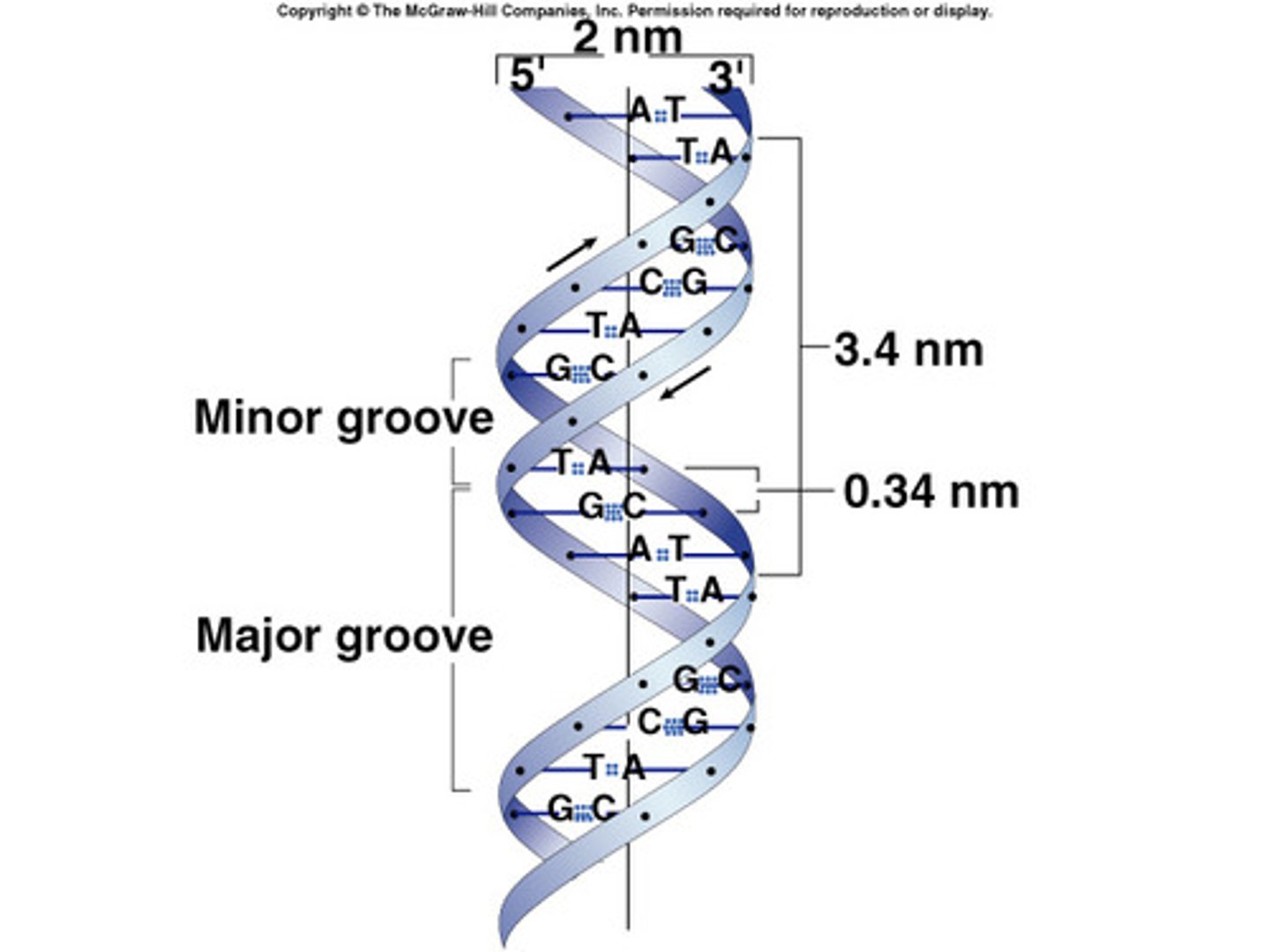
Complete turn of double helix
Occurs every 10 residues (3.4 nm).
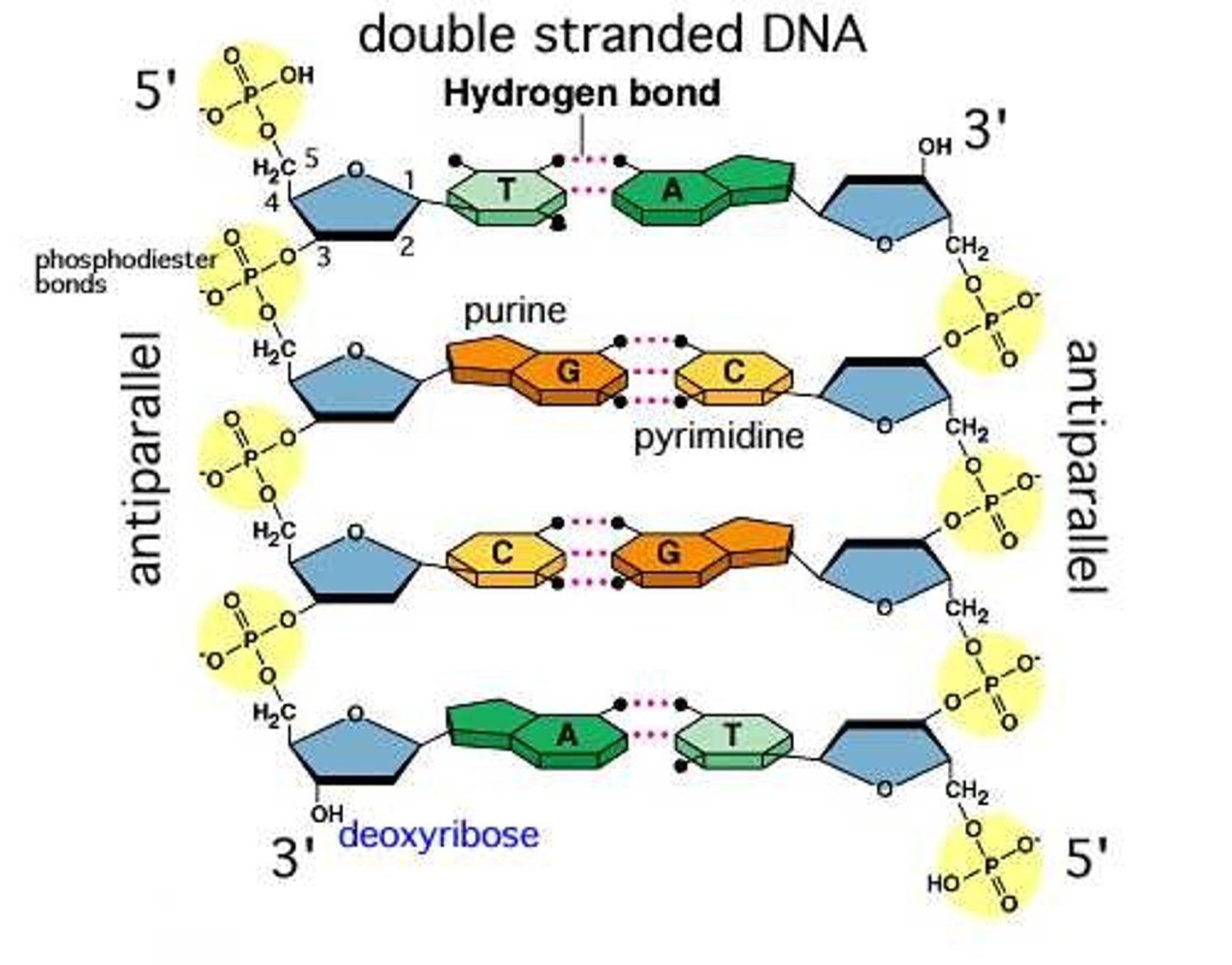
The two chains are _____________ to each other
complementary
Genome
The unique collective body of the genetic material of an organism.
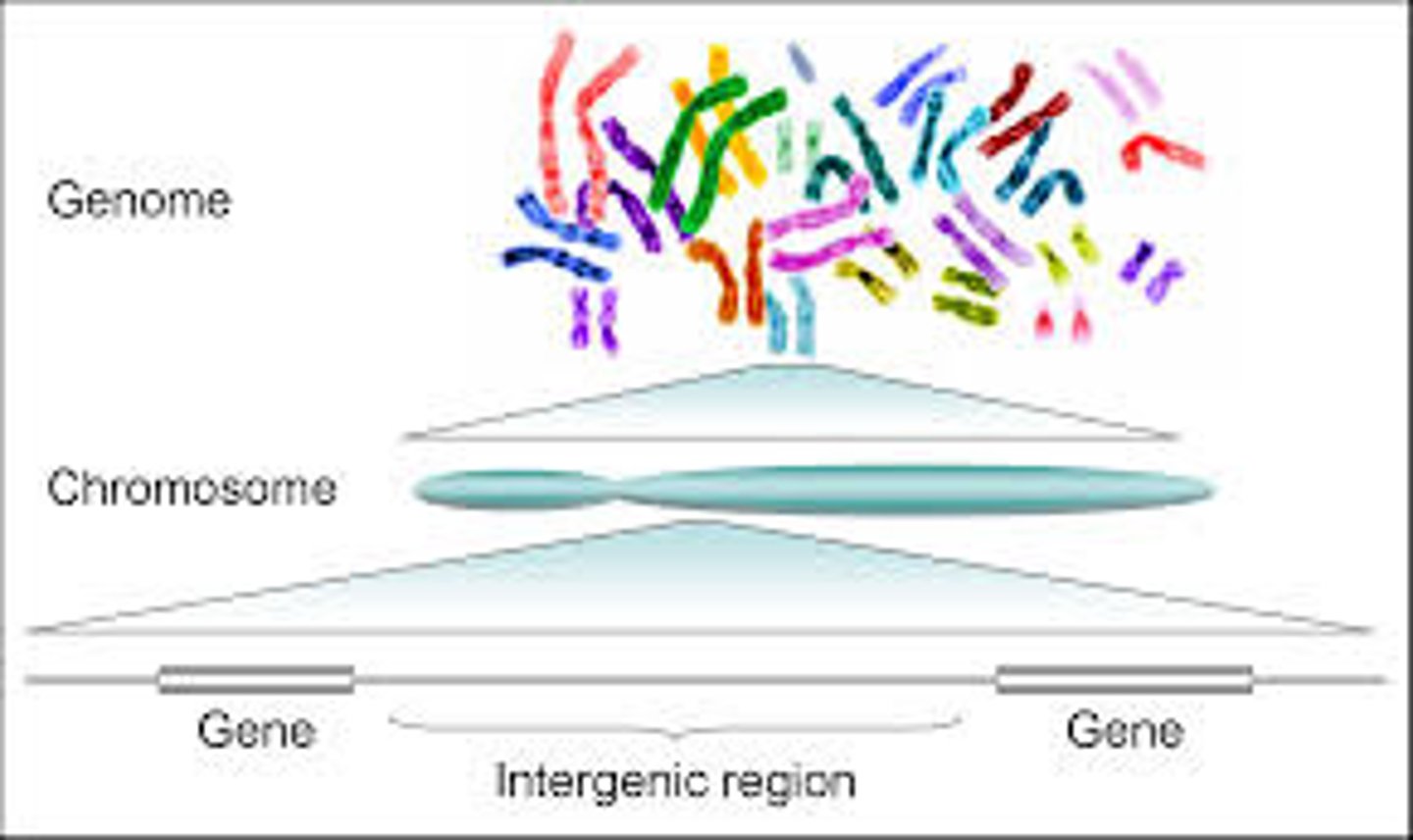
Human genome
All of the genetic information stored in a single (haploid) set of human chromosomes: 22 autosomes plus X and Y sex chromosomes.
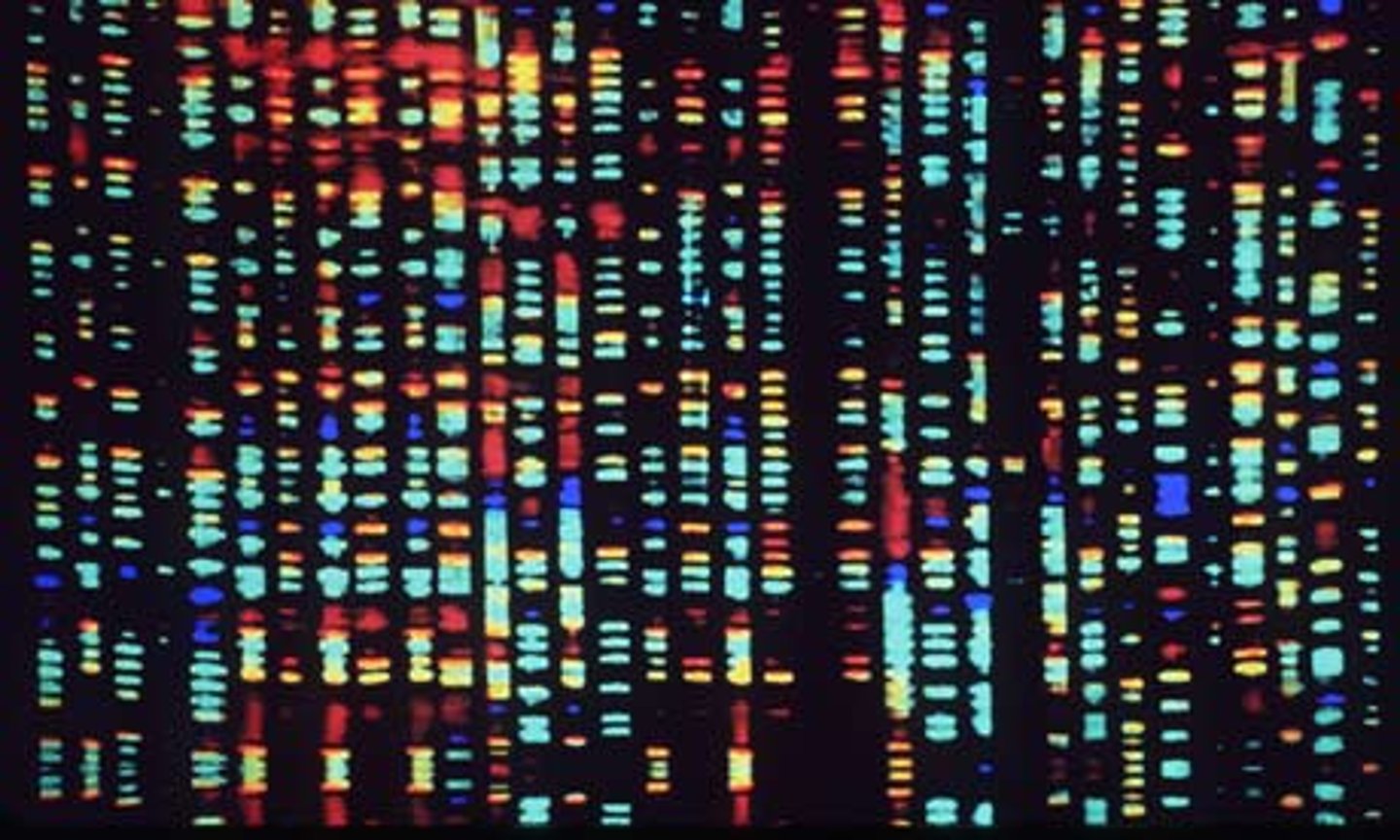
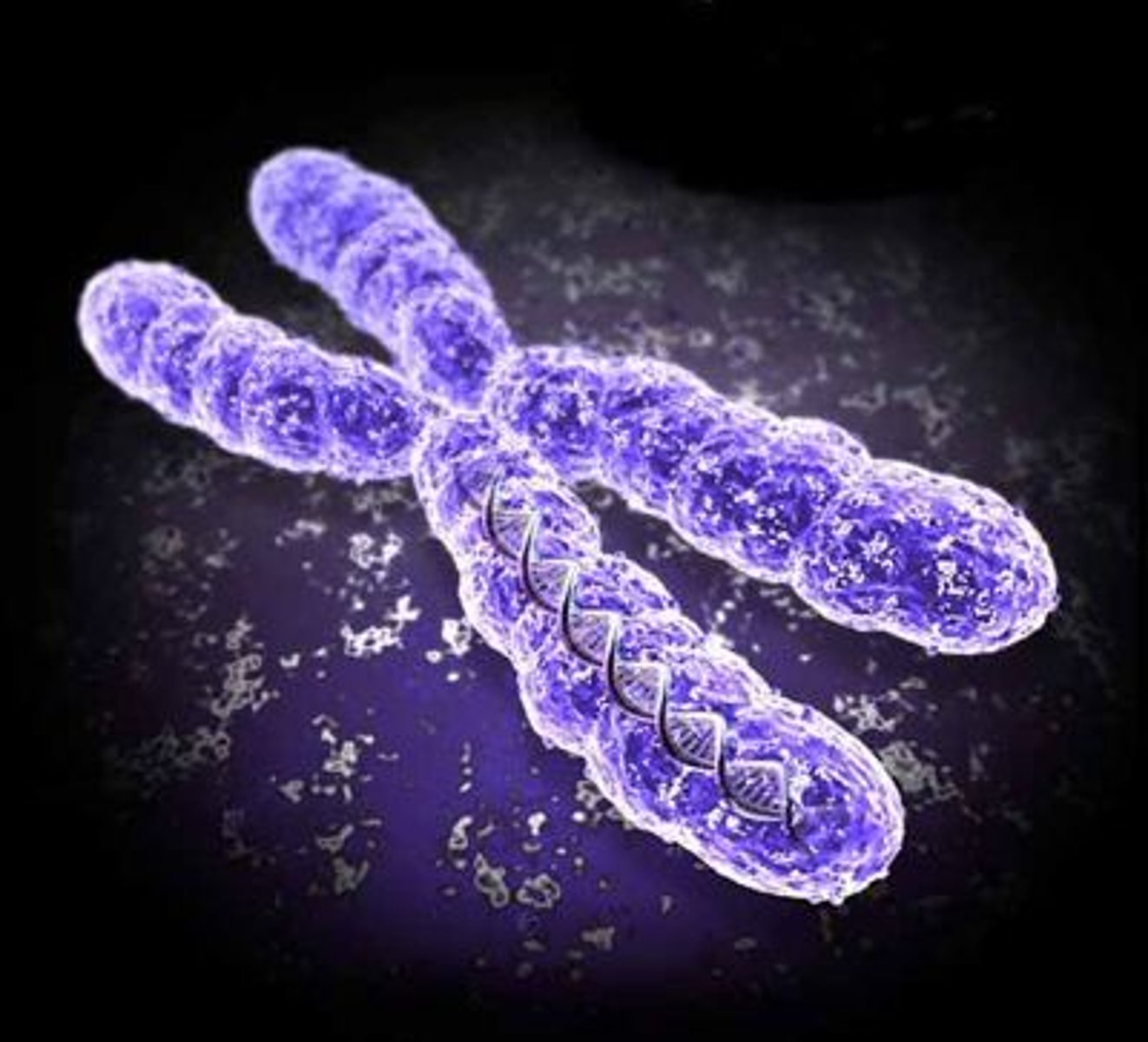
How many chromosomes do humans have?
46 (23 pairs)
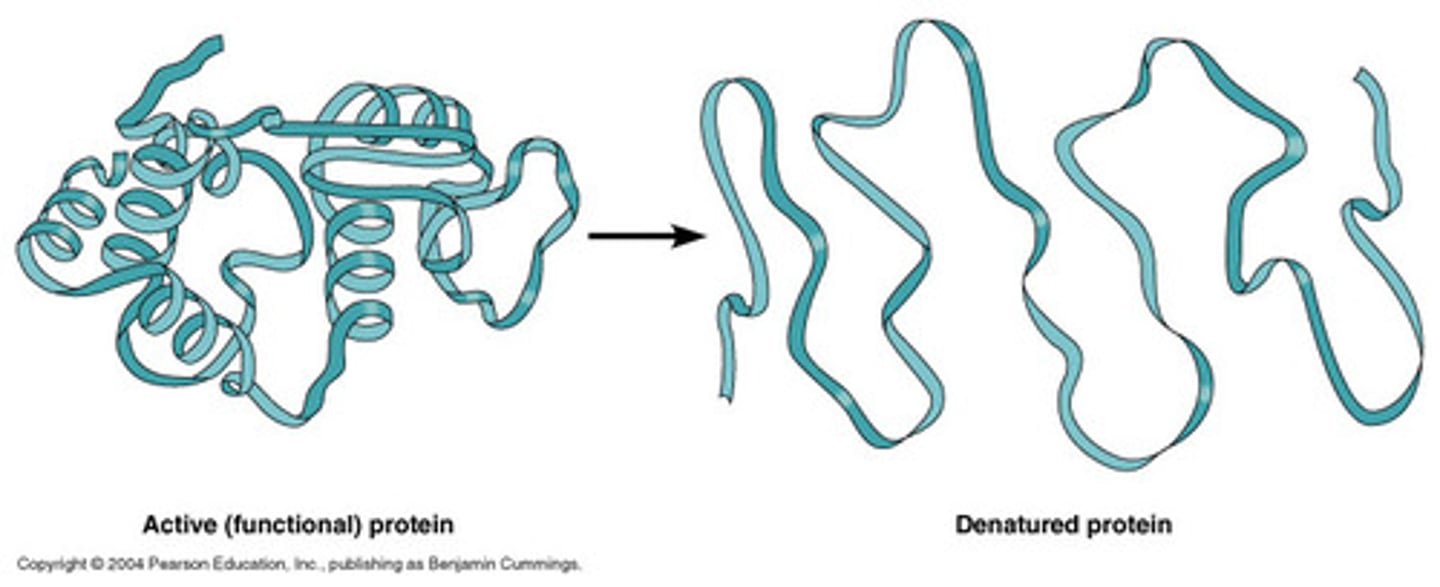
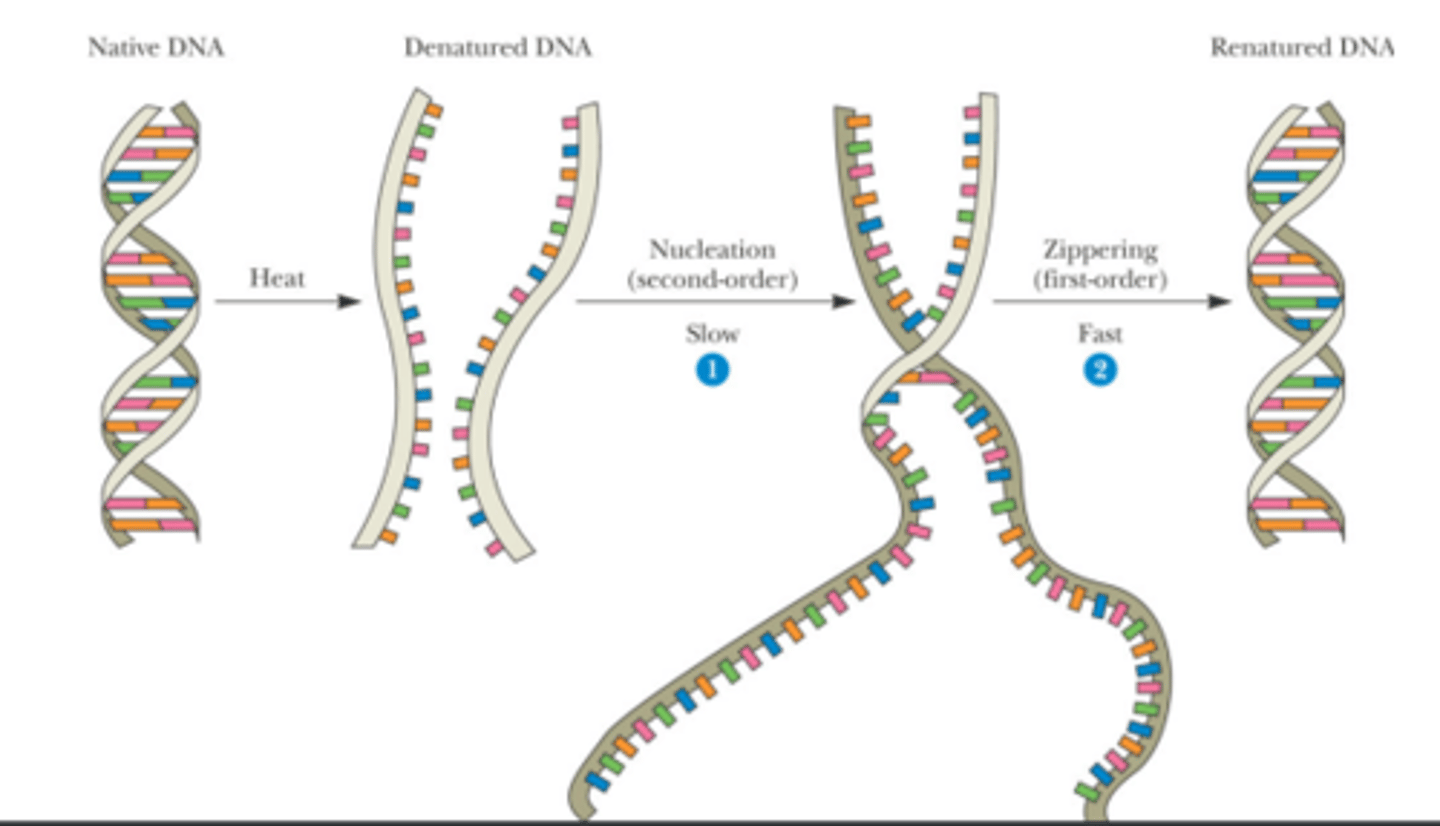
Denaturation (DNA melting)
The DNA double helices can be separated into two strands when the DNA solution is heated to a certain temperature.
Renaturation or reannealing
Single-stranded DNA molecules are capable of reassociating with correct base pairing.
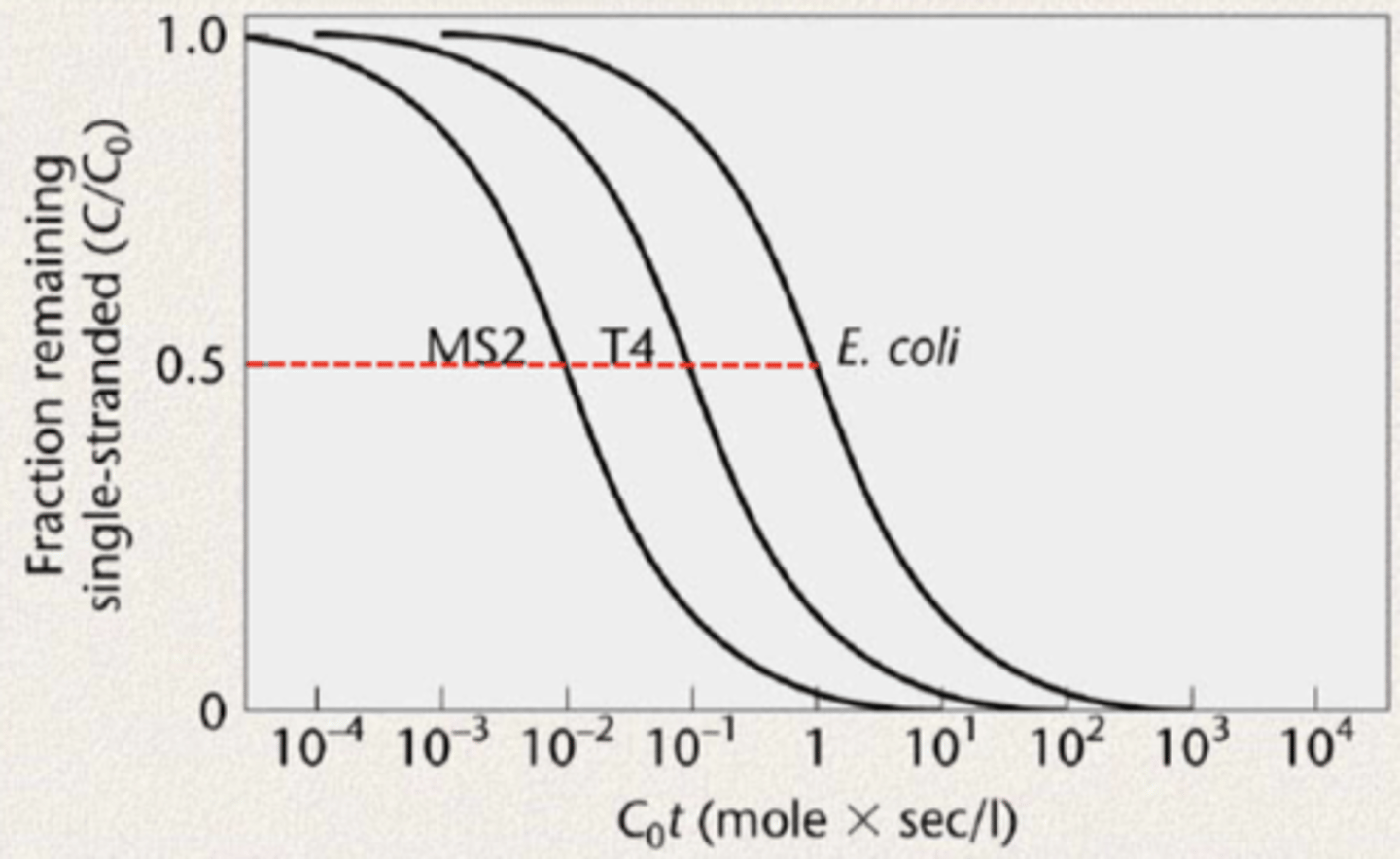
Rate of renaturation (bacteria and viruses)
The smaller the genome size, the faster the renaturation.
Eukaryotic genomes
Reannealing shows three classes of DNA: Highly repeated, Moderately repeated, and Nonrepeated.
Highly Repeated DNA Sequences
Represent about 1-10% of total DNA, short and present in clusters where the given sequence repeats without interruption.
Satellite DNAs
Five to a few hundred base pairs long for each, forming large clusters up to several million bp(evolve very rapidly, genomic elements vary even between closely related species).
Minisatellite DNAs
10 to 100 base pairs long for each, forming up to 3000 repeats(tend to be unstable, used for DNA fingerprinting).
Microsatellite DNAs
1 to 9 base pairs long for each, forming a 10 to 40 bp long cluster(scattered throughout the genome, used to analyze the relationships between different human populations).
Moderately Repeated DNA Sequences
Accounts for about 20 to 80% of the genome depending on the organism.
Repeated DNA Sequences with Coding Functions
Including the genes that code for ribosomal RNAs(rRNAs) and histones
Repeated DNA Sequences that Lack Coding Functions
Scattered throughout the genome as individual elements
Histones
Protein that helps in DNA packaging
Non-repeated DNA Sequences
Single-copy DNA sequence that codes for the majority of proteins. (Less than 2% of human genome encode for protein)
Whole-Genome Duplication (Polyploidization)
In polyploidization, offspring have four chromosome homologues rather than two.
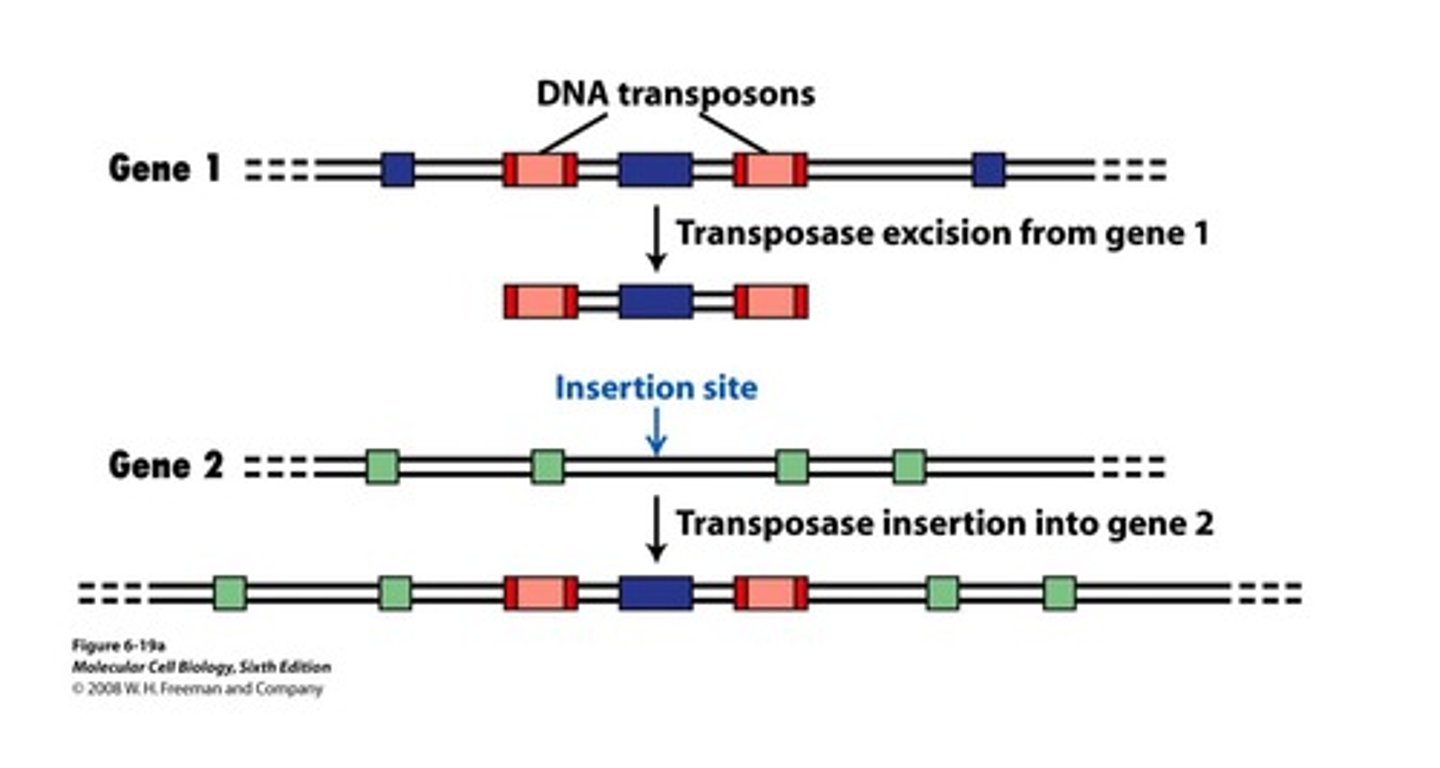
Transposition
Genetic rearrangement where genetic elements are capable of moving around the genome.
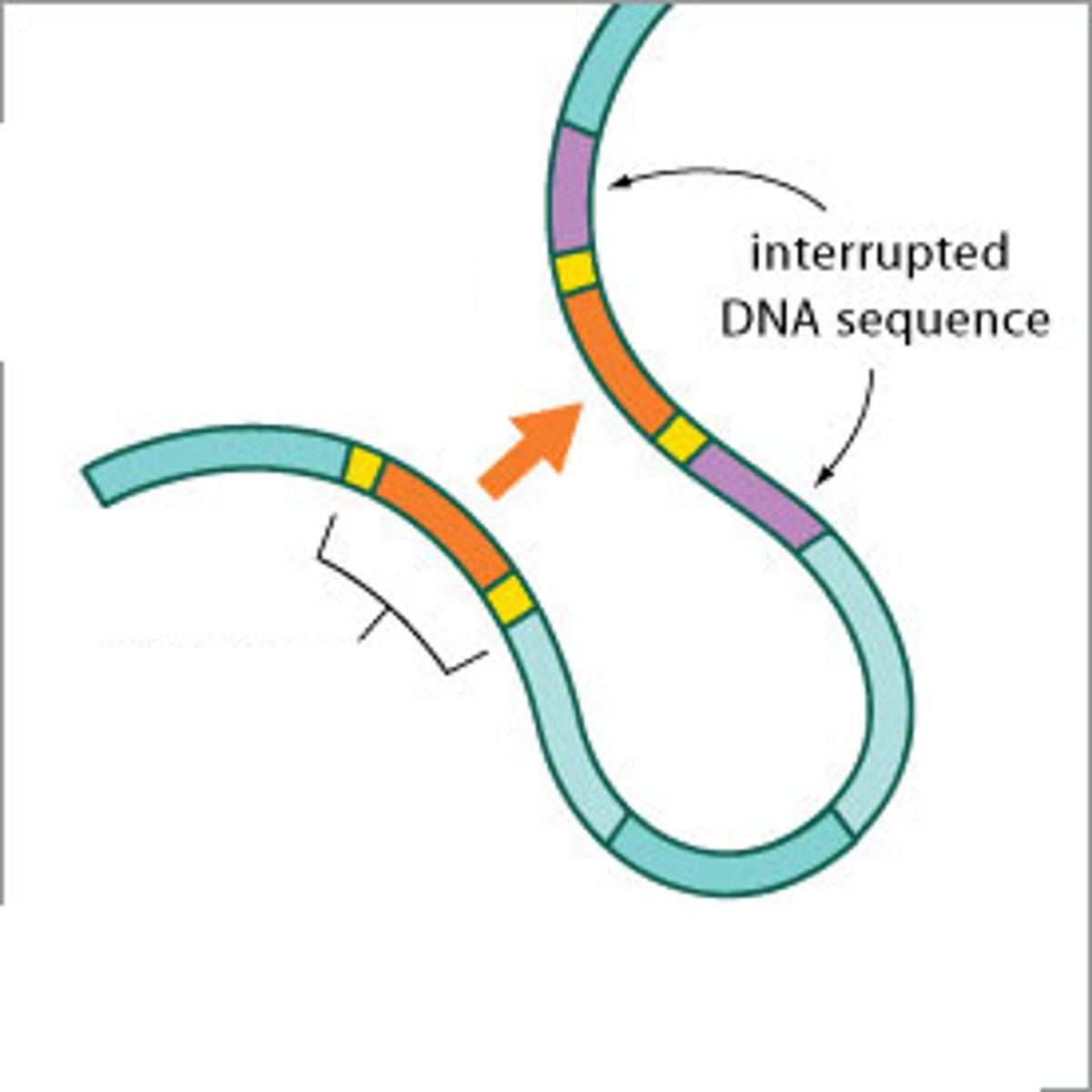
Transposable elements
Mobile pieces of DNA that can copy themselves into entirely new areas of the chromosomes
Transposons
Transposable elements in the bacteria that encode a protein called transposase.
Transposase
Catalyze excision of transposon from donor DNA and insertion of the transposon to the recipient DNA. (Cut-and paste pattern)
Transposons in eukaryotes
cut-and-paste (keep same number of DNA)
Retrotransposons
Transposable elements in eukaryotes that use a copy-and-paste mechanism. (increase in DNA)