Developmental Language Disorders - DLD
 Call Kai
 Learn
Learn Practice Test
 Spaced Repetition
 Match
Match Flashcards
 Knowt Play
1/8

There's no tags or description
Looks like no tags are added yet.
Name | Mastery | Learn | Test | Matching | Spaced | Call with Kai | Chat |
|---|
No analytics yet
Send a link to your students to track their progress
9 Terms
DLD Definition
Persistent difficulty (across the lifespan) in the acquisition and use of listening and speaking skills across any of the 5 domains: phonology, morphology, syntax, semantics, and pragmatics.
A language disorder is ore of an umbrella term that indicates persistent difficulties with one or more aspects of language.
Language is the only area of difficulty
DLD Characteristics:
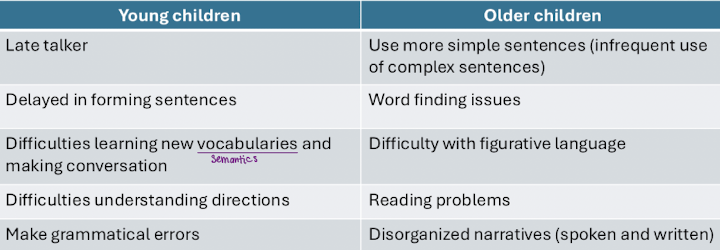
Atypical Signs:
parent concerns
history of delayed speech and language development
academic difficulties
processing difficulties
persistent social problems
speech production difficulties
DLD affects all 5 domains:
Common Characteristics:
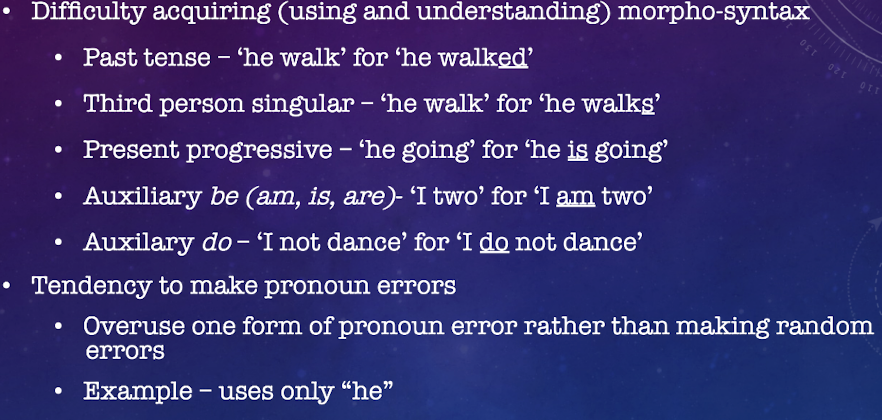
difficulty learning language rules → morpho-syntax
additional difficulites
semantics
pragmatics
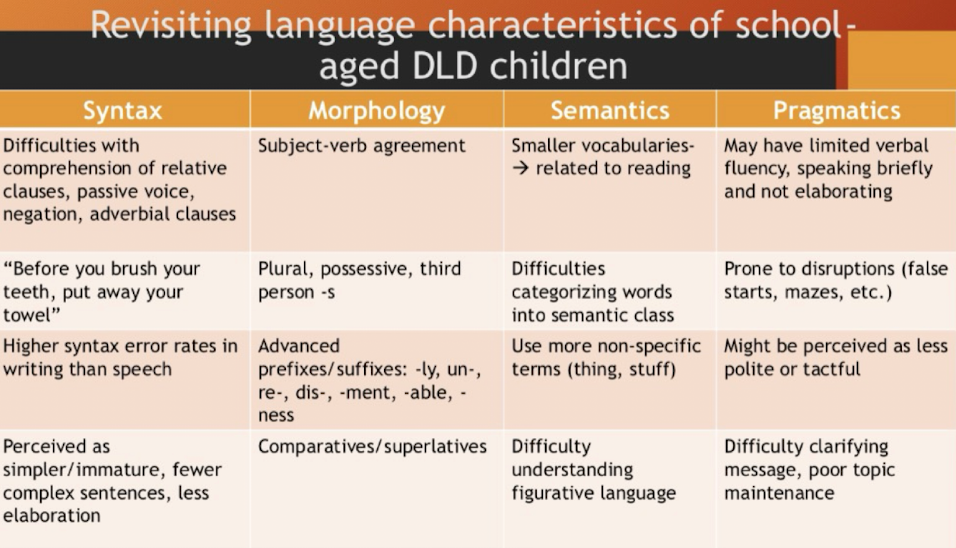
Content: Semantics
has smaller/more limited vocabularies
difficulty with fast mapping → typical development… learn meaning and label of a word after only one exposure
children w/ SLI need at least 2x the exposure to an object to be able to name it
Form: Syntax/ Morphology
Use: Pragmatics
may act like younger children
less flexibility in tailoring message to listener or repairing communication breakdown
Assessment:
parent interview and in-depth case history
norm-referenced assessment (e.g., CELF)
in-depth language sample analysis
criterion-referenced assessment to provide information w/ respect to deficits in content, form, and use
Intervention Models:
Indirect Intervention:
consultation an collaboration w/ others
parents/caregivers
educators
Direct Intervention:
Most frequently used
taget specific lang weakness
provide many opportunities to practice
provide a means to promote generalization
opportunities to practice in multiple settings and w/ multiple communication partners