Moles
 Call Kai
 Learn
Learn Practice Test
 Spaced Repetition
 Match
Match Flashcards
 Knowt Play
1/30

There's no tags or description
Looks like no tags are added yet.
Name | Mastery | Learn | Test | Matching | Spaced | Call with Kai | Chat |
|---|
No analytics yet
Send a link to your students to track their progress
31 Terms
What is a mole?
Amount of a substance
What is Avogadro's number
6.022 x 10^23
What is relative atomic mass (Ar)
The mass of an atom of an element when compared to 1/12 of the mass of a carbon-12 atom. No units
What is relative formula mass (Mr)
The mass of a molecule or compount when compared to 1/12 the mass of a carbon-12 atom. No units
What is Molar Mass (M)
The mass of one mole of a substance. Units g/mol
How to calculate the Molar Mass of H2O
H20= 1*2+16=18g/mol
Formula for Moles

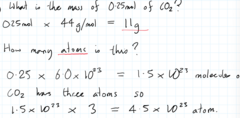
How to calculate how many atoms of 1mol of CO2
Describe the experiment to determine the empirical formula of copper(II) oxide via reduction
Weigh: Record mass of empty test tube with hole + bung.
Add & Weigh: Add copper(II) oxide, re-weigh to find initial mass of CuO
Purge & Ignite: Pass methane gas to flush out air; light the excess methane emerging from the hole.
Heat: Heat strongly until black powder turns fully pink/brown (copper metal).
Cool: Turn off heat, keep methane flowing until cool.
Final Weight: Re-weigh tube, bung, and remaining copper.
What physical observation indicates that copper(II) oxide has been reduced?
Black solid (CuO) turns to Orange (Cu)
Why is it necessary to continue the flow of methane until the apparatus is cool?
To cool the tube and to stop O2 getting back into the test tube, preventing the formation of CuO
Why might this experiment result in a formula with:
a) Too much oxygen?
b) Too much copper ?
Too much O: Incomplete reduction (black CuO) wasn't heated long enough to fully react).
b) Too much Cu: Copper solid blown out of the tube.
What is empirical formula
the simplest whole number ration between the number of atoms of each element in its chemical formula
What are the two ways you can calculate empirical formula
With masses of each element of percentages of each element
If the empirical formula is not a whole number ratio what must you do
Find a multiple that makes both numbers whole numbers
Describe the experiment to find the empirical formula of magnesium oxide via combustion.
Weigh: Record the mass of a crucible with its lid.
Prep & Weigh: Clean 10g magnesium ribbon, coil it into the crucible, and re-weigh with the lid.
Heat & Lift: Heat strongly with a roaring flame. Periodically lift the lid briefly to allow oxygen in while preventing white smoke from escaping.
Constant Mass: Heat to constant mass, then allow to cool.
Final Weight: Re-weigh mass of crucible
What is observed when magnesium burns, and what key safety precaution must be taken during finding the EP for MgO?
White gas
Red Glow
Why is it necessary to lift the lid of the crucible when heating MgO for the EP experiment
So Oxygen can get in
Why do we wish to prevent the white smoke leaving the crucible?
To try not to let any MgO out, as losing it leads to a lower mass skewing the EP
Explain why the MgO combustion experiment rarely produces the right EP, why may it produce a formula with too much Mg
As the lid wasn't lifted for long enough
Stopped heating too early
Experiment to calculate the formula of hydrated Copper Sulfate
Weigh: Record mass of empty crucible or evaporating dish.
Add & Weigh: Add blue hydrated copper sulfate crystals, re-weigh to find mass of hydrate.
Heat Gently: Heat gently with a Bunsen burner until the blue crystals turn completely into white anhydrous powder.
Constant Mass: Cool and re-weigh; repeat heating and weighing until mass remains constant.
Final Mass: Record the final mass of the crucible + white anhydrous Copper Sulfate
What is the molecular formula
The Real Chemical formula of a substance
How to convert EF to MF
Then times the empirical formula compound by the multiple

What two pieces of info are needed to calculate water of hydration
The mass of the anhydrous salt
The mass of the water
What is the formula for % by mass

steps to find mass of a substance from the mass of another substance
Balanced equation
Convert mass to moles of known mass
Convert between moles using the molar ratio in the balanced equation
Convert moles to mass
Formula for moles of a gas
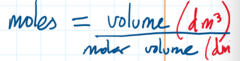
How many cm3 if one dm3
1000
Formula for percentage yield

Formula for Molar Concentration

What is the molar volume of a gas
24 dm3 or 24000cm3