Psychology - Memory
 Studied by 0 people
 Call Kai
 Learn
Learn Practice Test
 Spaced Repetition
 Match
Match Flashcards
 Knowt Play
1/74

There's no tags or description
Looks like no tags are added yet.
Name | Mastery | Learn | Test | Matching | Spaced |
|---|
No study sessions yet.
75 Terms
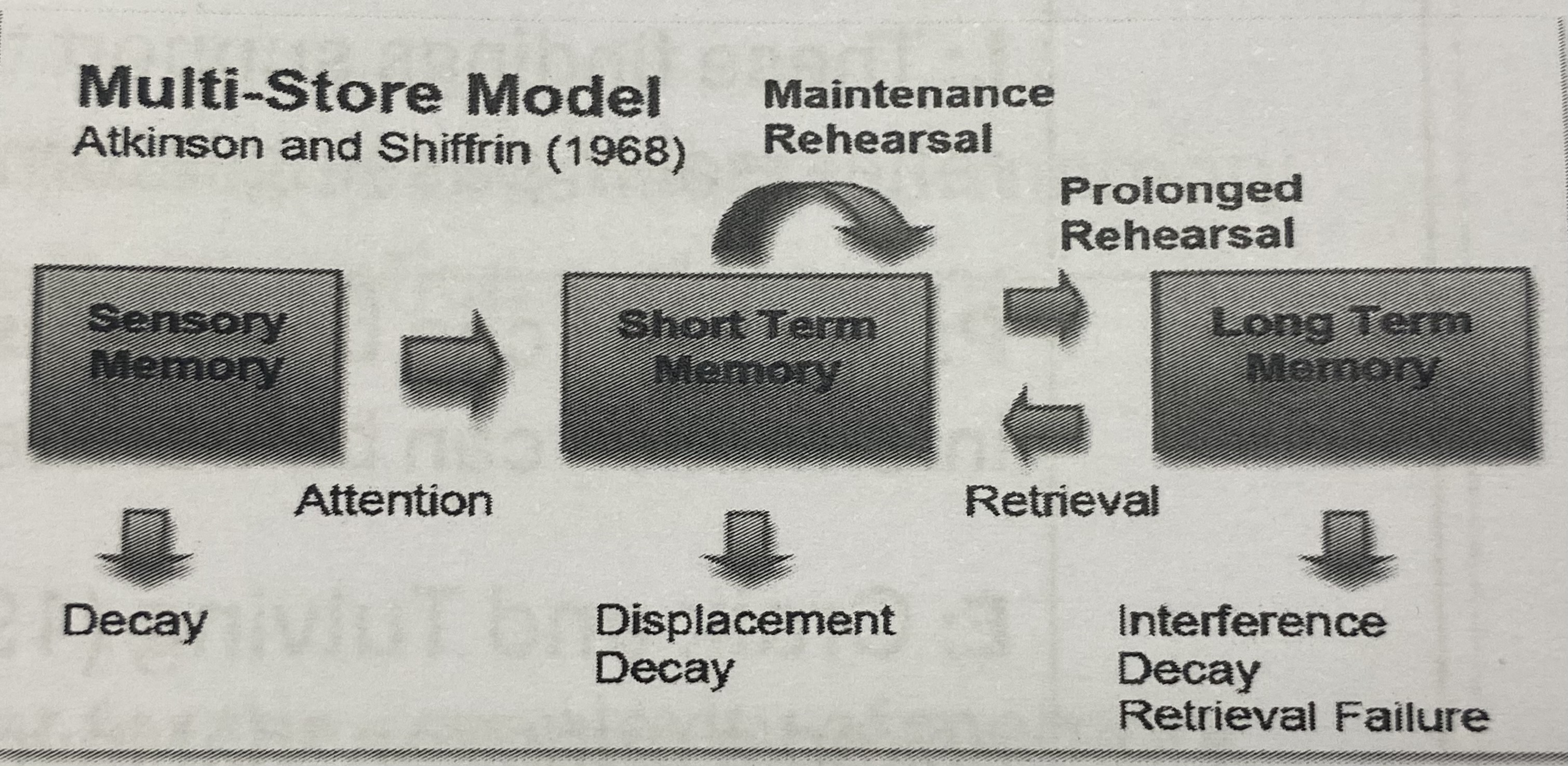
The Multi-Store Model of Memory (Who made it and what does it look like?)
Murdock (1962)
Aim: Investigate the primary-recency effect
Method: Ask P’s to remember a list of one syllable words and immediately recall them.
Findings: They could only remember the words at the beginning and end of the lists, but not the middle.
This supports the MSM because the words at the beginning are rehearsed, displacing the words in the middle (since they didn’t have enough time to rehearse them) and moves into the LTM. The words at the end remain in the STM. This also supports the role of rehearsal.
Craik and Tulving (1975)
Method: P’s had a list of nouns and were asked a question that involved shallow or deep processing. For example, asking whether the words was printed in capital letters (shallow) or whether the word fitted in a sentence (deep).
Findings: P’s remembered more words in the task involving deep processing rather than shallow processing.
This suggests the depth of processing can play a significant role, besides amount of rehearsal, in transferring info to LTM.
This challenges the MSM because of the reason above.
Clive Wearing Case Study by Blakemore (1988)
A virus caused damage to the hippocampus which meant Wearing had very little LTM for events that had happened in his life. However, he could still remember skills such as playing piano, reading music and writing in a diary which suggests the LTM is not unitary (not a single system).
This demonstrates that the LTM may store and process episodic (memory for events) and procedural (skills) differently.
KF Case Study by Shallice and Warrington (1974)
KF damaged his STM for info spoken to him, but could retain info presented visually, suggesting the STM is not unitary (a single system).
This suggests the STM has separate ‘visual’ and ‘acoustic’ components.
What are the strengths of the MSM?
Supporting research - Murdock
Simple and provides clarity (it’s easy to understand)
Foundation for further research - laid groundwork for more complex models such as WMM
Rehearsal mechanism - highlights importance of rehearsal in memory retention → practical applications in education
What are the weaknesses of the MSM?
Fails to explain why info in everyday life can be transferred to the LTM without prolonged rehearsal → supporting evidence (Craik & Tulving)
The STM store and LTM store shouldn’t be considered unitary stores → supporting evidence (Clive Wearing and KF)
Oversimplified - doesn’t account for complexity of memory processes (e.g role of emotions, context, different types of coding)
Ignores STM - doesn’t explain how we manipulate info in STM
Lack of ecological validity - supporting research lacks real-world applicability, limiting the model’s relevance
No explanation for flashbulb memories - doesn’t explain how emotionally charged memories can be stored in LTM without rehearsal
Serial Processing Assumption - assumes a linear flow of info, may not reflect how memory works in practice.
Sensory Register
This holds the sensory information received from the environment.
3 types of sensory memory: Iconic (visual), echoic (sound), and haptic (touch).
Capacity: Large
Duration: Brief (~0.5 sec)
Info must be attended to in order for the info to travel to the STM.
Short-term Memory
A temporary store for holding small amounts of information for brief periods of time. Maintenance rehearsal must take place for the info to stay
Coding: Acoustic
Duration: 18s-30s
Capacity: 7±2 items
Prolonged rehearsal allows the info to travel to the LTM.
Long-term Memory
Holds information from past events.
Coding: Semantic
Duration: Lifetime
Capacity: Unlimited
Info can be retrieved from here so that it can be used in the STM.
What are the 3 types of LTM?
Semantic (meaning)
Episodic (memory of events)
Procedural (skills and habits)
Maintenance Rehearsal
Repeating information to keep it in the STM
Prolonged Rehearsal
Giving something more meaning by linking it with prior knowledge to keep it in the LTM.
Ex: You meet someone new and they have the same name as your favourite character from a show, you make a link between those two facts to remember your new friend’s name.
Sperling (1960) Sensory Register Research
Aim: Investigate capacity + duration of SR, specifically the iconic memory
Method: P’s shown a grid of 12 letters (3 rows of 4) for 50ms
Whole report condition - P’s asked to recall as many letters as they could from entire grid (could only recall 4-5 letters but some claimed to see more)
Partial report condition - P’s heard a high, medium, or low pitched tone immediately after grid disappeared, each tone corresponding to a specific row, and asked to recall that row.
Findings:
WR condition - 4-5 letters recalled on average
PR condition - recalled ¾ letters from each row, suggesting they had access to all 12 briefly.
Conclusion: Sensory register has large capacity but short duration (< 1 sec), info decays rapidly unless attention is paid to it.
Baddeley (1966)
Aim: Investigate how info is coded in STM & LTM
Method: P’s divided into 4 groups (independent group design) and given different lists of words to remember
Acoustically similar/dissimilar
Semantically similar/dissimilar
Then they were asked to either instantly recall the words or recall after 20 minutes.
Findings:
(STM group) - Had more difficulty remembering and recalling acoustically similar words than dissimilar but no significant difference when recalling semantically similar + dissimilar words
(LTM group) - Had more difficulty remembering and recalling semantically similar words than dissimilar but no significant difference when recalling acoustically similar + dissimilar words
Conclusion: STM is primarily coded acoustically and LTM is primarily coded semantically (as similar words can cause confusion)
Jacobs (1887)
Aim: Investigate capacity of STM (specifically the number of digits or letters)
Method: P’s presented w/ sequence of digits or letters, increasing it by one item at a time
Asked to recall items in correct order immediately
Pace controlled at ½ second intervals using metronome
Digit span determined by longest list the P could recall correctly at least 50% of the time.
Findings:
Digits recalled more than letters
Average digit span = 9.3 items
Average letter span = 7.3 items
Digits recalled better than letters, possibly because there’s fewer digits
Conclusion: STM has a limited capacity, typically around 7 ± 2 items. Capacity can vary depending on type of material (digits vs letters).
Capacity is influenced by age
8 y/o girls recall an average of 6.6 digits
19 y/o girls recall an average of 8.6 digits
Miller (1957)
Wrote influential article ‘Magic Number 7’
→ Outlines how frequently humans use 7 (e.g 7 days a week, 7 deadly sins)
→ Concluded 7 ± 2 is he number of items human memory can hold
We also use ‘chunking’ to help remember large amounts of items.
Peterson + Peterson (1959)
Aim: Investigate duration of STM when rehearsal is prevented
Method: P’s given trigrams (e.g XQF) 3 letter consonants.
Immediately asked to count backwards in 3s from a random number (interference task), this was done for a set amount of time (3,6,9,12,15,18 secs) to prevent maintenance rehearsal.
After delay, asked to recall diagram
Findings:
Longer time delay = worse recall of the trigrams
After 3 secs - 90% of trigrams were recalled correctly
After 18 secs - recall dropped to > 10%
Conclusion: STM has a very limited duration around 18-30 secs when rehearsal is prevented. Without rehearsal, info in STM decays.
Talia Konkle (2010)
Aim: Investigate capacity of visual LTM
Method: P’s were shown approximately 2900 images of various objects (e.g chairs, mugs, shoes, etc)
Images shown for 3 secs each, P’s given short break in between.
Test phase - After viewing images, P’s completed forced-choice recognition test.
In each trial they were shown 2 similar images, and had to pick whether they had seen one of the two previously or not.
Findings:
P’s showed high accuracy in recognition - 96% accuracy with identifying the new images + the old one
Conclusion: Doesn’t seem to be a limit to the volume of info our LTM can retain, capacity = unlimited
Bahrick (1975)
Aim: Investigate the duration of LTM (specifically how well people can remember info from years ago)
Method: 293 Americans (17 y/o - 74 y/o) who had graduated high school were tested on their memory of old classmates using 4 methods:
Free recall test
Photo recognition test
Name recognition test
Name + photo matching test
Results:
Photo recognition test (cues) -
P’s who had graduated within 15 years: approximately 90% accuracy in recognising faces
P’s who had graduated up to 48 years ago: approximately 70-80% accuracy
Free recall test (no cues) -
P’s who had graduated within 15 years: accuracy dropped to 60%
P’s who had graduated up to 48 years ago: accuracy dropped to 30%
Conclusion: Recognition memory is strong w/ cues even after nearly 50 years, free recall declines more sharply over time. This suggests that info can remain in LTM for a lifetime, but retrieval is easier w/ cues.
March et al (1997)
Found that if people were not expecting to have to recall info, STM had a maximum duration of 4 secs.
What are the strengths of each store?
They were lab experiments → used experimental method → extraneous variables controlled
Standardised procedures → easily replicated → can check for reliability
Good internal validity (all variables are controlled)
Positive real-world benefits → teachers can plan lessons in chunks to reduce amount of new info that is needed to be held in the STM
(Sensory register) Biological support - brain scans show different areas of the brain are activated for different sensory supporting modality-specific stores
(STM) Controlled lab evidence - Miller, Peterson & Peterson, etc support the MSM claims
(LTM) Case studies (e.g Clive Wearing) show that LTM can be damaged while STM remains intact, supporting idea of separate stores
(LTM) Neuroimaging - brain scans show different types of LTM activate different brain areas, supporting idea of LTM being more complex
What are the weaknesses of each store?
Highly artificial tasks → don’t reflect memory in everyday life (March et al findings support this)
(Sensory register) - difficult to study due to its fleeting nature (lasts for a very short time), what we know is inferred and therefore our understanding is limited
(STM) Baddeley + Hitch (1974) research led to the WMM, suggesting the STM is not a single store but has multiple components
(LTM) Rehearsal is not always effective
The Working Memory Model (who made it and what does it look like?)
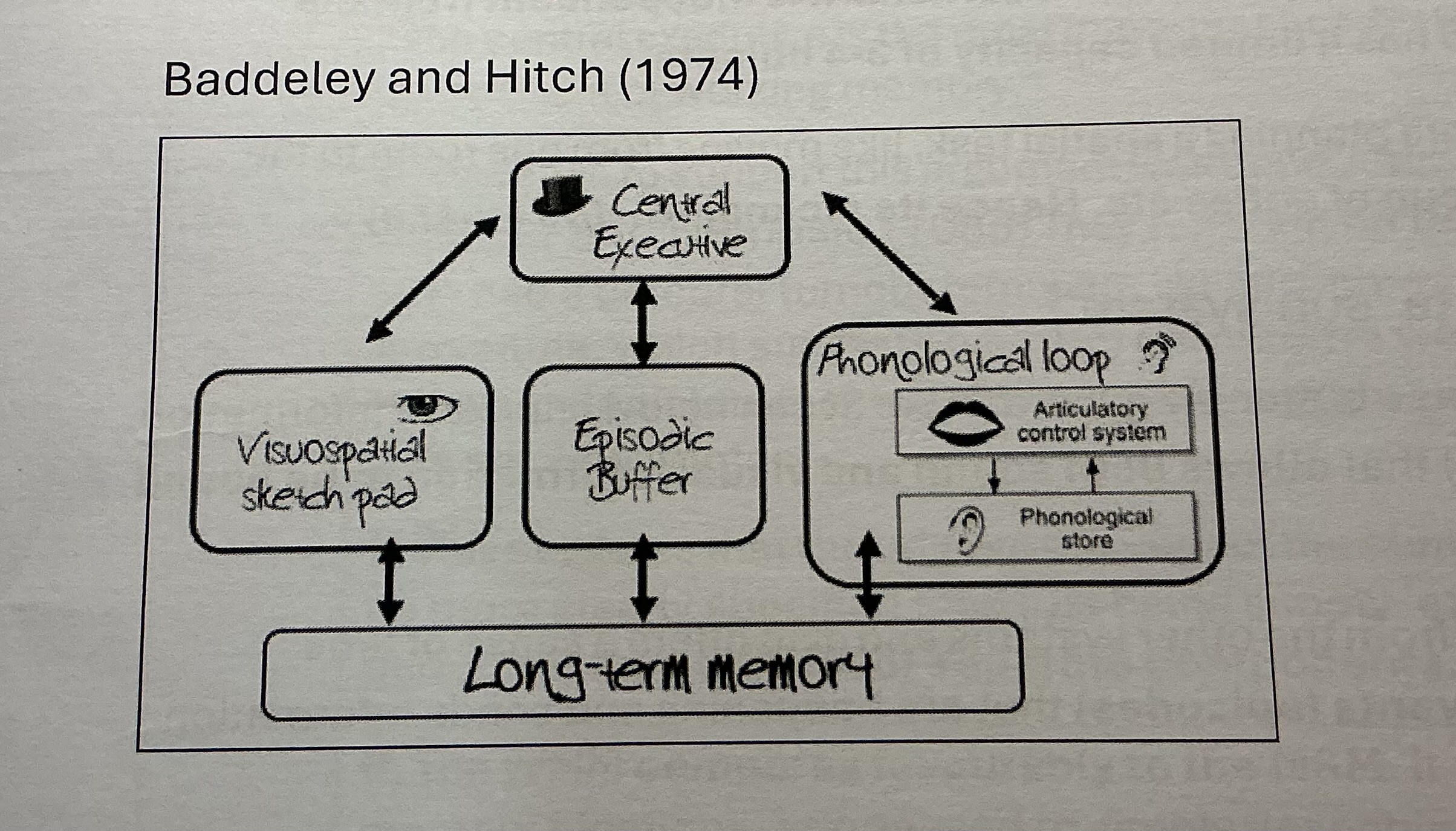
Central Executive
Direct attention to particular tasks
Determines how the brain’s resources are allocated to tasks
Attends and monitors incoming info from senses or LTM → Info is then sent to other sub-systems for processing and temporary storage
Very little capacity → Cannot attend to too many thing at once
No capacity for storing data (uses episodic buffer as storage system)
Phonological Loop
Limited capacity → Stores 2 seconds worth of speech based sounds
Has 2 components:
Phonological store → Allows 2 secs worth of acoustically coded items to be stored
Articulatory control process → Allows sub vocal repetitions of items in PS
Visuospatial Sketchpad
Processes and stores mental images and spatial info
Independent from the phonological loop
Capacity = 3-4 objects
Used when planning spatial task (e.g reaching for a cup of coffee)
Episodic Buffer
General store
Allows both sound and visual info to be bound together
Integrates info from other systems and offer sense of time sequencing
Records events (episodes) and sends info to LTM
Limited capacity → Can hold 4 chunks of info for CE
Gathercole and Baddeley (1993)
Found P’s had more difficulty doing 2 visual tasks (tracking a light and describing the letter F) than doing both a visual and verbal task at the same time. The 2 visual tasks are competing for the same sub system (VSS), whereas the separate tasks use different sub systems
Baddeley, Thomas and Buchanan (1975)
Found the ‘word length effect’ → Fewer long words can be recalled and more short words
This suggests the capacity of the phonological store is 2 secs worth of acoustic info
EVR Case Study by Eslinger and Demasio (1985)
EVR had a cerebral brain tumour removed, he performed well on tests of reasoning which suggest his CE was intact, but he had poor decision-making skills (suggesting his CE was not wholly intact)
What are the strengths of the WMM?
Supporting evidence for the limited capacity and separate nature of of the sb systems (Gathercole & Baddeley and Baddeley, Thomas & Buchanan)
Compares favourably to the MSM → Attempts to explain how memory functions instead of the structure of memory
Practical applications → Develop methods to help children w/ DHD to focus on tasks (e.g pacing of the lesson, simple instructions, removing distracting visuals around the board like wordy/colourful posters)
Supporting case studies
Good internal validity
MRI scans → When P’s perform dual tasks, distinct brain regions activate; supporting the idea of separate subsystems.
What are the weaknesses of the WMM?
Focuses only on STM → Makes model incomplete
Lack of clarity over the CE or the exact roles it plays
Case studies are idiographic (based upon a specific individual) → Not generalisable
Supporting research uses artificial tasks
Interference Theory
Suggests that forgetting is due to info in LTM becoming confused with/disrupted by other info during coding, leading to inaccurate recall. There are 2 types:
Proactive: Old info interferes with new info → Jacob’s et al argued this occurs because of competition between strength of the old learning and the weakness of the new learning
Retroactive: New info interferes with old info
Underwood (1957)
P’s (who were repeatedly asked to learn series of word lists) made far more errors as the number of lists increased, compared with when they first began to study
As P’s made more errors in the word lists shown a the end of the study → Demonstrates how old info interferes with newly learned info
Supports proactive interference
McGeoch and McDonald (1931)
Gave P’s an original set of words to recall. Then a second list, which varied in similarity to the OG list
The more similar the later list, the harder the OG list was to recall.
Supports retroactive interference and role of similarity
Baddeley and Hitch (1977)
Field study
Asked rugby players to recall the names of the teammates of teams they had played over the season
Their recall wasn’t affected by how much time had passed but by how many other teams they had played in the intervening time.
Shows retrospective interference in a real life setting
Schmidt et al (2000)
Collected a sample of 21 former students of a Dutch elementary school and sent them a map of the surrounding area of the school. The map had the street names removed and replaced w/ numbers from 1-48
P’s were asked to name as many as they could
Co-variable: How many times they had moved house
They correlated the number of times someone moved house (as a measure of inference) against the number of street names they forgot
They found a positive association between he number of times P’s had moved house outside the Molenberg neighbourhood and the number of street names
This is an example of retroactive interference
What are the strengths of the interference theory?
Supporting research (Underwood, McGeouch & McDonald, Baddeley & Hitch)
Biological support (brain scan studies) → Show that similar memories activate overlapping brain areas, which may cause confusion and interference
Wide applicability (motor skills, visual memory, etc)
What are the weaknesses of the interference theory?
Evidence primarily collected by lab studies
Doesn’t explain all types of forgetting
Individual differences
Retrieval Failure Theory
We forget due to absence of ‘cues’
When info is placed in the memory, associated cues are stored at the same time → If cues aren’t available at time of recall, info could be forgotten
Theory suggests info i still available for recall but can’t be accessed until the correct cues are in place.
Tulving (1983)
Made the ESP (Encoding Specificity Principle)
The principle is that: cutest present at time of coding must also be present at retrieval
If cues at coding and retrieval are different, then some forgetting will occur
Evaluate the ESP
Problem:
There is no way to disprove the theory
We can ONLY test that a cue was encoded at learning by testing whether it prompts recall
Being impossible to disprove weakens the validity
Godden and Baddeley (1975)
Aim: Study the effects of context dependent memory
Method: Deep water divers had to learn lists of 36 words (2 or 3 syllables) ether on land or underwater then recall on either land or underwater.
There were 4 conditions (+ results)
Learn on land, recall on land (same context) → 37% accuracy
Learn underwater, recall underwater (same context) → 32% accuracy
Learn on land, recall underwater (different context) → 24% accuracy
Learn underwater, recall on land (different context) → 23% accuracy
In different contexts, there was a 40% drop in accuracy
Conclusion: Recall is better in the same context
Supports the role of context
Carter and Cassaday (1998)
Aim: Study the effects of internal state dependent memory
Method: Gave antihistamine (anti-allergy) drugs or a placebo (vitamin pills) →Antihistamine has a mild side effect of causing drowsiness and therefore altering the state of awareness
Participants = Nottingham University students
P’s asked to learn and recall info in 4 conditions:
Learn on drug, recall on drug (same internal state)
Learn without drug, recall without drug (same internal state)
Learn on drug, recall without drug (different internal state)
Learn without drug, recall with drug (different internal state)
Results:
Accuracy decreased when internal states were mismatched
Accuracy increased when internal states were matched)
Conclusion: When internal cues aren’t available different during coding and retrieval, ability to recall decreases
What are the strengths of retrieval failure theory?
Supporting evidence (Godden & Baddeley and Carter & Cassaday)
Useful applications → Military training
High internal validity supports the theory
Revision strategies
Mnemonics → Working by creating strong retrieval cues (e.g acronyms, imagery examples) supporting the theory’s principle
Explains ‘tip-of-the-tongue’ phenomenon
What are the weaknesses of the retrieval failure theory?
Individual differences
EWT: Leading Questions Theory
We can only accurately retain fragments of our memories, and fill in the gaps
Reconstructions of events lead to inaccurate recalls, which can be compounded from leading q’s
Leading q’s are either phrased a certain way or use words that suggest a particular answer
Info after the event distorts our original memory
Loftus and Palmer (1974, part A)
Aim: Investigate whether wording of a question (specifically verb used) could influence a person’s memory of an event
Method: 45 P’s watched short video clips of car accidents (specifically the estimated speed of a car in a crash)
They were divided into 5 conditions (independent group design) and asked:
“About how fast were the cars going when they ___ into each other?”
The blank was filled in with different verbs for the 5 conditions (+ results of avg. speed estimates):
Smashed → 40.5 mph
Collided → 39.3 mph
Bumped → 38.1 mph
Hit → 34.0 mph
Contracted → 31.8 mph
Verbs used affected the speed estimates.
Conclusion: Supports idea that EWT is reconstructive and memories can be influenced by leading questions
Loftus and Palmer (part B)
Aim: Investigate whether leading q’s also lead to creation of false memories
Method: 150 different students were split into 3 conditions -
Asked the question w/ smashed
Asked he question w/ hit
Not asked a question
Asked a week later, “ Did you see any broken glass?”
Findings:
“Smashed” → 32% said they did
“Hit” → 13% said they did
No question → 12% said they did
Conclusion: Leading q’s can alter a person’s memory, for events and this supports the idea that EWT memory is reconstructive and can be distorted
Elisabeth Loftus (1979)
Showed P’s slides that showed the theft of a large purse from a handbag → 98% of P’s remembered the correct colour of the purse. Then, they read an account of the incident by a ‘professor of psychology’ where they stated the purse was brown (false, the real colour was red).
Only 2 P’s changed their answer
This goes against the idea of leading q’s leading to inaccurate recalls
What are the strengths of the leading question theory?
Some practical applications → Police DON’T use leading q’s
Reliable → 2 studies with standardised procedures
Reconstructive nature of memory → Lots of research has contributed to theories of memory that highlight how we ‘reconstruct’ memory, suggesting its not always accurate
What are the weaknesses of the leading questions theory?
Poor ecological validity (L&F) → watching a video of a crash wouldn’t trigger an emotional response in comparison to witnessing one in person
Evidence to go against it (Elisabeth Loftus)
Individual differences (age, memory ability, intelligence, etc)
Ethics → Witnesses an incident can cause distress on the viewer
All uni students (L&F) → Not generalisable
Post Event Discussion Theory
Co-witnesses are likely to discuss the event w/ EWs → Source of further distortion
EWs accounts can become inaccurate when a witness is exposed to misleading info after the event
Fiona Gabbert (2003)
Aim: Investigate whether PED between witnesses can lead to influencing another person’s recall of an event
Method: 60 University of Aberdeen students and 60 older adults from local community watched a video of a girl stealing money from a wallet.
There were 2 conditions -
Co-witness group: Informed they had witness the same video but they were shown different perspectives, only one person actually saw it. P’s in this group discussed and completed a questionnaire.
Control group: They completed the questionnaire without discussions
Findings:
71% of P’s in the co-witness group had mistakenly recalled false info
60% of P’s in the co-witness said she was guilty, despite the fact they didn’t see
0% of P’s in the control group mistakenly recalled false info
Conclusion: This highlighted issues w/ post-discussion and effect on accuracy of EWT. There are important implications for police interviews and the reliability of EWT in legal setting
Gabbert (2007)
Found that P’s receiving misinformation after an event were less accurate at recalling an event than controls, especially if it came from a social source (person) rather than a non-social source (written account).
Bodner (2009)
Found that when warning P’s not to report info that was second hand, recall was far more accurate
What are the strengths of post event discussion?
Consistent results from Gabbert’s study → Highly reliable
Practical applications → Police officers should advice witnesses to not report any second hand info
Controlled research design → Lab study
Good internal validity
What are the weaknesses of the post event discussion theory?
Unclear if these findings would occur in really life EWT
Lab study
Lack of validity
Demand characteristic
Individual differences
Anxiety Theory
EWS are usually very anxious and stressed when witnessing a crime, especially if they are victims themselves, due tot he danger they perceive to be in
Anxiety can be a source of distortion in EWT
Anxiety tends to be accompanied by physiological arousal (e.g pounding heart) which has been found to influence performance
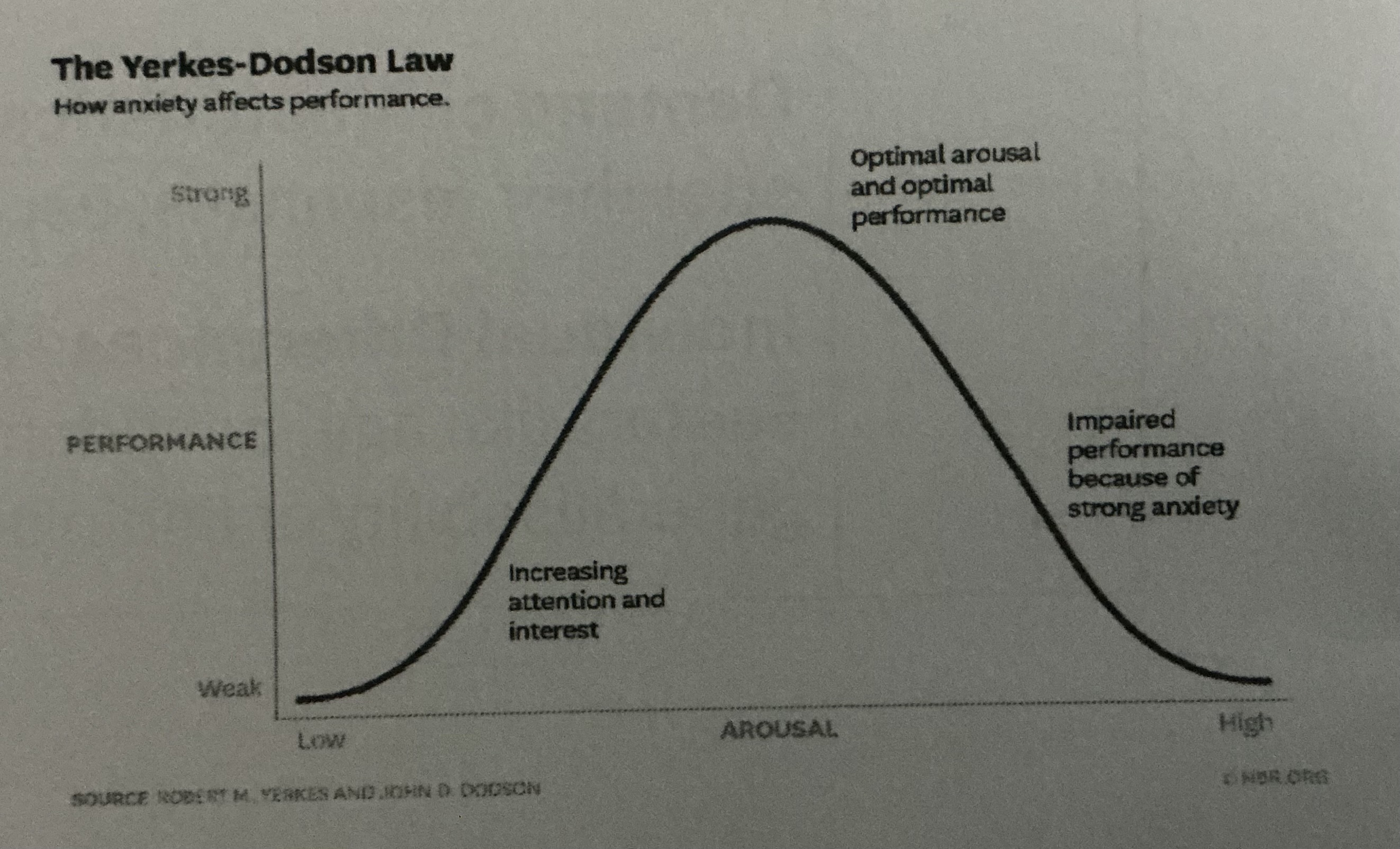
The Yerkes-Dodson Inverted U
Memory is les accurate when anxiety is either very LOW or or very HIGH
Moderate levels are beneficial for recall: this is described as an inverted U-shape curve
The YD effect can be used to explain errors made by EWs, particularly when recalling a violent crime
Very high state of arousal = Lower performance in recalling details
The Weapon Focus Effect
Elisabeth Loftus argued anxiety = most problematic for later recall when crime involves weapon
Research suggests anxiety of seeing weapon focuses all of your attention on the central details (weapon itself) → less able to recall th peripheral details
Johnson and Scott (1976)
Aim: Investigate accuracy of EW recall, particularly through the WF effect
Method: Design → Lab experiment w/ 2 conditions (independent group design)
Participants = Volunteers who believed they were taking part in a study on human memory
P’s seated in a waiting room and overhead a staged argument in next room
Low anxiety condition - Man waked out holding a pen with/ grease on his hand
High anxiety condition- Man emerged holding a bloody knife
In both conditions, the confederate stood in front of the P’s for 4 secs and uttered a single line of speech
P’s later asked to identify the man from a set of 50 photos
Findings:
Low anxiety condition → 49% correctly identified the man
High anxiety condition → 33% correctly identified the man
Suggest presence of weapon reduces accuracy of EW identification
Conclusion: Study supports the WF effect. Important implications for the reliability of EWT in high stress situations
Elisabeth Loftus et al (1987)
Asked P’s to watch one of two sequences:
Person pointing gun at cashier collecting cash
Person passing cheque to cashier receiving cash
Found that P’s correctly identified details about incident in ‘cheque’ condition more than they did in the ‘gun’ condition → Demonstrates WF effect
Fiona Pickel (1998)
Suggest Loftus is testing surprise, not anxiety
Showed a video of an incident in a hair dressing salon where the handheld item was either scissors, wallet gun or raw chicken
The wallet was a low anxiety item, low unusualness as it was a hair salon
EWs accuracy was significantly poorer in the high unusualness conditions
Suggests the WF effect is due to unusualness/surprise rather than anxiety/threat
Yuile and Cutshall (1986)
Conducted research into real-life crime
13 people, who had witnessed a shop keeper shooting a thief dead in Canada, were interviewed 5 months after the event
They were compared with the OG police interviews immediately after the event
P’s were asked to self-report how much anxiety they felt during the incident
High anxiety = 88% accuracy
Low anxiety = 75% accuracy
What are the strengths of the anxiety theory?
Research has real world applications → Investigations now loo for other alternative evidence (e.g CCTV) rather than just EWT
Theoretical contribution → Supports Yerkes-Dodson Law which suggests a curvilinear relationship between arousal and performance, adding depth to our understanding of how anxiety affects cognitive processes like memory
What are the weaknesses of the anxiety theory?
Effect may not be caused by anxiety (Fiona Pickel’s study supports this)
Differences in the results between research conducted on real-life EWs and in a lab environment (refer to Yuille and Cutshall)
Ethics → Inducing anxiety raises ethical concerns
Individual differences
Use of the Cognitive Interview - Geiselman et al (1985)
Before advent of cognitive interviews, police interviews would often be conducted in such a way that elicited fake info, w/ witnesses asked leading questions and unable to give accurate accounts of what happened
Geiselman argued police interviews must consider characteristics of human memory:
Memories are reconstructed → Misleading info can rewrite the memory
Retrieval cues are important → Absence can lead to inaccuracy
Other similar memories can interfere w/ accurate recall
4 techniques used in cognitive interviews:
Context reinstatement → Ask witness to try and picture the circumstances surrounding the crime or visualise the scene
Report everything → Tell witness that some people withhold information because they feel it’s irrelevant, but they should tell the whole story
Reverse order → Tell witness that although it may not feel normal, to try and tell the story in reverse order, this should help stop witnesses recreating the event in relation to expectations/stereotypes about what normally happens in crimes
Change perspective → Instruct witness to recall from a different physical perspective, use to disrupt the personal expectations of what usually happens in a crime (as seen in films etc)
Fisher et al (1987)
The enhanced cognitive interview social dynamics were taken into account, such as when to (or not to) establish eye contact, ways to reduce anxiety, minimising distractions, asking the witness to speak slowly and ask open ended questions
Kohnken et al (1999)
Carried out a meta-analysis of 53 studies investigating the ECI
Found 34% (on avg.) increase in amount of correct info generated compared w/ standard police interviews
Geiselman et al (1985) - part B
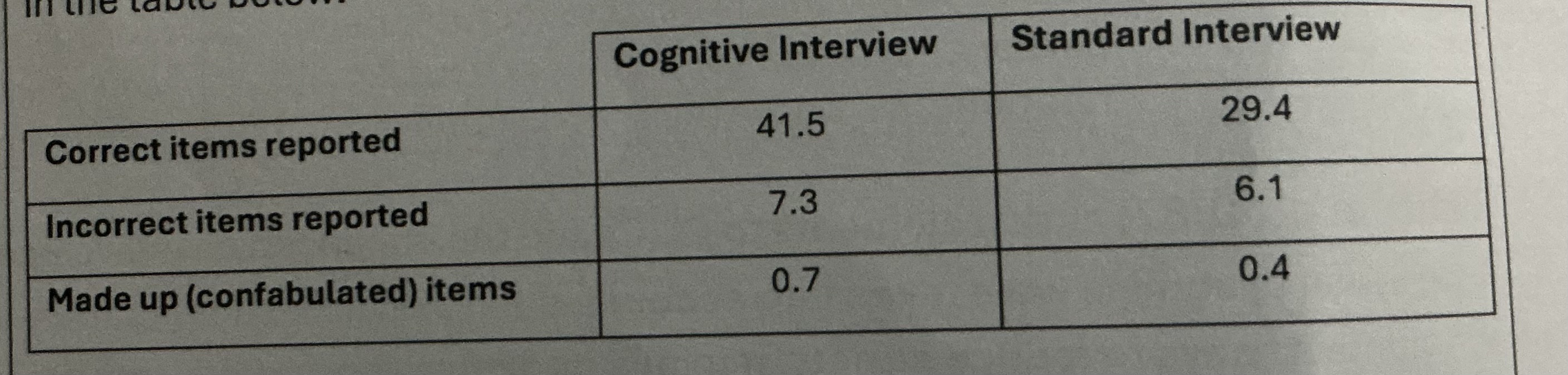
Aim: Assess whether C.I is more effective than standard police interviews
Method: Showed police training video to 89 students, 48 hours later, students were interviewed individually by American Law enforcement officers
Interviewers had either been train in standard police interviewing techniques or in the new C.I techniques
Results: (look at image)
Demonstrates consistent results and clearly show that accuracy of EWT is improved using C.I
Milne and Bull (2002)
Found that a combination of ‘report everything’ and ‘context reinstatement’ produces the most effective reports, which confirmed some of the police officers’ views that some aspects of C.I is better than others
What are the strengths of using cognitive interviews?
Supporting evidence (Geiselman and Kohnken)
Research is reliable
Reduces leading questions
Flexible and adaptable
What are the weaknesses of using cognitive interviews?
Takes longer and requires more training than standard interviews
Cognitive overload → The C.I can be mentally demanding, especially for vulnerable witnesses → May lead to fatigue or confusion, reducing quality of recall
Must be selective with what aspects you choose to invest time and resources in to reduce economic impact