Man Eco Quiz ⚞^. .^⚟
 Call Kai
 Learn
Learn Practice Test
 Spaced Repetition
 Match
Match Flashcards
 Knowt Play
1/50

There's no tags or description
Looks like no tags are added yet.
Name | Mastery | Learn | Test | Matching | Spaced | Call with Kai | Chat |
|---|
No analytics yet
Send a link to your students to track their progress
51 Terms
Managerial economics
application of economic principles and methods to business decision-making
It is a specialized stream of management studies that emphasize primarily on solving business problems and decision-making by applying theories and principles of microeconomics and macroeconomics
bridges the gap between the theory of economics and managerial practice
Microeconomics
social science that studies the implication of incentives and decisions, specifically how those affect the utilization and distribution of resources.
provides a more complete and detailed understanding the macroeconomics
Macroeconomics
branch or a study of economics that focuses on the behavior and performance of an economy as a whole
It differs from microeconomics, which analyzes the impact at an individual or smaller level
Marketing for Finance
using data-driven marketing tactics to reach and influence consumers of financial services
marketing ideas for finance companies include:
Building trust with the target audience
Embracing mobile platforms and devices
Using social media to engage and educate
Producing great content that provides value and solutions
Leveraging Influencers and experts to boost credibility
Microeconomicsfor Solving Operational Problems
Managers apply microeconomic principles and theories to handle internal issues production, sales, distribution, capital, pricing, profit, workforce, etc.
various microeconomic theories:
Production Theory
Investment Theory
Demand Theory
Market Structure Pricing Theory
Profit Management
Production Theory
In order to ensure high productivity with limited resources, microeconomics studies the impact of production-related decisions
Investment Theory
Companies diligently plan their gpjtal jnyestment to ensure resource utilization-generating higher returns.
Demand Theory
To ensure consumer satisfaction, managers analyze consumer needs and requirements
Market Structure Pricing Theory
It involves price determination and management-the business prices its products and services very competitively.
Profit Management
Profit maximization is the ultimate aim-this approach focuses on cost and revenue.
Macroeconomicsfor Handling External Environment Issues
Businesses operate in external environments-face unforeseen challenges. Macroeconomics deals with external challenges with the help of tools like PESTEL analysis.
components of PESTEL in detail:
Political (P)
Economic (E)
Social (S)
Technological (T)
Environmental (E)
Legal (L)
Political (P)
The government plays a critical role in a firm's progress. Thus, managerial economics studies how governance style, political unrest, and foreign collaboration affect private sector companies.
Economic (E)
Business profitability greatly depends on government policies, tax reforms. GDP, and the nation's economic stability.
Social (S)
The social environment molds businesses. This includes factors like societal values. beliefs, attitudes, consumer awareness, employment conditions, literacy rate, and trade unions.
Technological (T)
Technology enhances the production and distribution of goods or services.
Environmental (E)
When awareness of environmental concerns increases-firms face pressure to adopt sustainable and eco-friendly practices. This includes the curtailing of pollution. waste management, preservation of water, and preservation of natural resources.
Legal (L)
Businesses must operate within legal boundaries-national laws pertaining to consumer rights, labor laws, health and safety laws, product labeling regulations, and advertising guidelines.
Business Cycle
the rise and fall of business activities within an industry that include periods of profitabilityand periods of loss. Business cycles do not occur at regular intervals. These cycles occur irregularly butrepetitively.
Business Cycle Phases with Graph
A Country keeps track of the trade cycle to ensure that the economy is on the path of growth, unemployment steeps down, and the inflation rate remains under control.
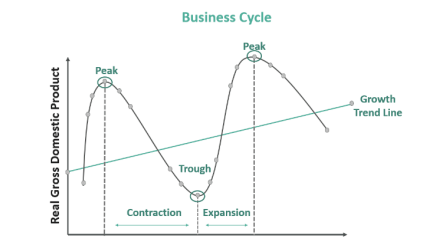
Business Cycle
An economy is expected to have constant growth, represented by the growth trend
line. In reality, though, the economy is unstable. National output goes up and down
periodically. It expands to touch the peak and contracts down to the trough.
long·term fluctuations in the economic output of a nation. In otherwords, it is the upswing ordownfall of a country's GDP.
Trade cycle consists of the following four phases
Expansion
Peak
Contraction
Trough
Expansion
When a nation's GDP shows an upward move or recovers with time, this period of growth is remarked as economic expansion
During this phase, the various economic indicators like consumer spending, income, demand, supply, employment. output, and business returns shoot up.
Peak
During the expansion phase, the GDP spikes to its highest level; this is considered the economy's peak
At this point economic factors like income, consumer spending, and employment level remain constant.
Contraction
phase of economic slowdown; it occurs when the stagnant peak GDP starts tumbling down towards the trough.
With this, the nation's production, employment level, demand, supply, income level, and other economic parameters plummet.
Trough
This is the stage at which the GDP and other economic indicators are at their lowest.
During this phase, the economy gets stuck at a negative growth rate. Additionally, the demand for goodsand services reduces.
Cause of Business Cycle
The changing Gross Domestic Product (GOP) of any nation triggers the fluctuations.
Business Cycle lasts for
A typical business cycle persists for 5.5 years on average; however, it may be shorter or longer than this.
Theories of Business Cycle
Pure Monetary Theory
Monetary Over-Investment Theory
Schumpeter’s Theory of Innovation
- First Approximation
- Second ApproximationKeynes Theory
Pure Monetary Theory
Hawtrey, the main supporter of this theory
The traditional business cycle theorists take into consideration the monetary andcredit system of an economy to analyze business cycles.
states that the business cycleisa result of changes in monetary and credit market conditions.
Monetary Over-Investment Theory
Monetary over-investment theory focuses mainly on the imbalance between actual and desired investments.
According to this theory, the actual investment is much higher than the desired investment.
Schumpeter’s Theory of Innovation
Joseph Alois Schumpeter (1883-1950) was an Austrian-trained economist, economic historian, and author.
theory of innovation advocates that business innovations are responsible for rapid changes in investment andbusiness fluctuations.
2 types: First Approximation and Second Approximation
First Approximation
Deals with the effect of innovatory ideas on an economy in the beginning
startup stage of innovation in which the economy is in equilibrium (demand/supplyare equal, no incentive for the price to change)
Second Approximation
Deals with the subsequent effects of first approximation
It is related tothespeculation of future economic conditions
Keynes Theory
developed in 1930s, which was the period when whole world was going through greatdepression
According to classical economists, ifthere is high unemployment condition in an economy, then economic forces, such as demand and supply, wouldactin a manner to bring back full employment condition.
Inflation
a rise in prices for goods and services rise which can be translated as the decline of purchasing power over time. Inflation is the rate at which prices.
Deflation
occurs when prices decline and purchasing power increases
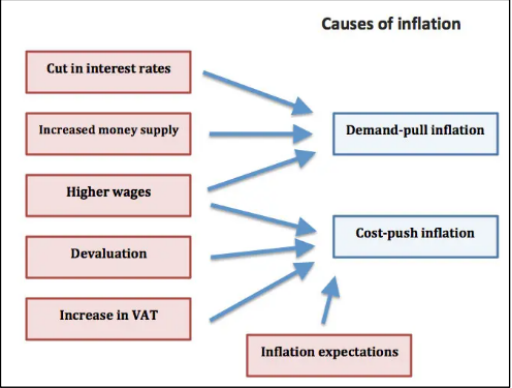
Causes of Inflation
Demand-pull inflation
Cost-push inflation
Devaluation
Rising wages
Expectations of inflation
Demand-pull inflation
aggregate demand growing faster than aggregate supply (growth too rapid)
Cost-push inflation
For example, higher oil prices feeding through into higher costs.
Devaluation
increasing cost of imported goods, and also the boost to domestic demand.
Rising wages
higher wages increase firms costs and increase consumers’ disposable income to spend more
Expectations of inflation
High inflation expectations causes workers to demand wage increases andfirms to push up prices
Effects of Inflation
Wage Pressure - demand high salary
Less Competitive - higher than international competition
Real debt level fall - Firms with debt maybe better off
Less confidence to involve - No benefit in investing
Economic growth - sign of rising demand or lower supply(war)
Cost-Push Inflation - rising cost to produce something force companies to raise the prices
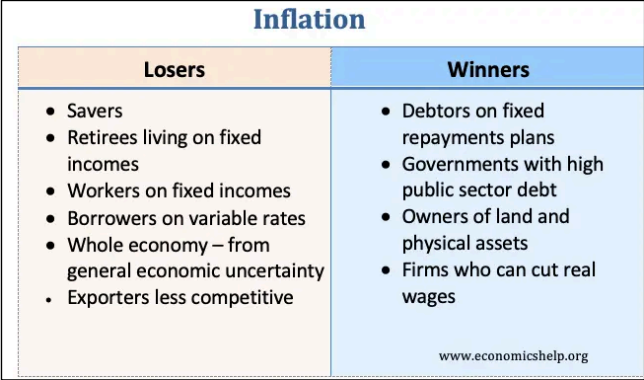
Losers and winners in inflation
Inflation will hurt those who keep cash savings and workers with fixed wages.
Inflation will benefit those with large debts who, with rising prices, find it easier to pay back their debts
Losers
Saver - Traditionally savers lose from inflation. If prices rise, the value of money falls
Workers on fixed-wage contracts - Another potential losers from inflation are workers who are stuck on fixed-wage contracts
Borrowers on variable mortgage rates - A rise in inflation can cause the government/central bank to increase interest rates
General economic confidence - If inflation is high and variable, it creates uncertainty for both consumers, banks and companies.
Exporters - If inflation is higher than our competitors, then goods will become less competitive and exporters will see a decline in demand and struggle to sell their goods.
Winners
Debtors - High rates of inflation can make it easier to pay back outstanding debt
Government - this is especially true if inflation is higher than expected.
Landowners/Owners of physical assets - In a period of hyperinflation, thosewith savings can see a rapid fall in the real value of their savings.
Physical wealth - such as land, factories and machines will retain its value. Firms who can cut wage real
Galleon Trade
trading system during the Spanish colonial period where large ships called galleons traveled between Manila (Philippines) and Acapulco (Mexico) from 1565 to 1815.
Trading System
It allowed goods such as silk, spices, porcelain, and other Asian products to be shipped from the Philippines to Mexico, while silver from the Americas was brought back to the Philippines. The Galleon Trade made the Philippines an important center of international trade and connected Asia, the Americas, and Europe for over 250 years.