AD2 AMACE REVIEWER
 Call Kai
 Learn
Learn Practice Test
 Spaced Repetition
 Match
Match Flashcards
 Knowt Play
1/107

Earn XP
Description and Tags
A comprehensive set of vocabulary flashcards covering basic church design, site planning principles, architectural elements, proxemics, and universal design based on the lecture transcript.
Name | Mastery | Learn | Test | Matching | Spaced | Call with Kai | Chat |
|---|
No analytics yet
Send a link to your students to track their progress
108 Terms
Chapel
A sacred space intended for worship where a priest visits to conduct services but does not reside.
Church
A diocesan building that serves as a place of worship and a residence for the priest.
Cathedral
A sacred building that serves as the official seat and residence of a bishop.
Proper orientation of the Altar
- Altar is always facing the east – morning sun
- West – entrance, etc
Inculturation
The adaptation of church architectural design to reflect and integrate with the local culture and context.
Church architectural style
- Renaissance 1600s
tier
Church architectural style
-Church architectural style
S-scroll
Church architectural style
- Neo gothic 1850s to turn of century of 1900
The only steel temple ni asia – san Sebastian
Juan nakpil
renovation of basilica of black Nazarene, quiapo church 1933
Fernando Ocampo
post war manila cathedral 1954
Jose-maria Zaragoza
santo domingo qc 1954
Ceasar concio
redemptorist church 1958
San Sebastian Church
The only steel temple in Asia, designed in the Neo-gothic style.
Francisco manosa
edsa shrine 1989
Leandro Locsin
The architect responsible for the Benedictine monastery of transfiguration in 1983.
Vertical structure
- Soaring heights
outside and inside – to evoke the
heavenly and eternal
dapat pagpasok ng simbahan,
mapapaluhod ka
Vertical structure
- catholic church
architecture should create an
atmosphere of catholic prayer and
worship
Iconographic Architecture
A design approach where the building itself serves as a symbol of heavenly things and a visible sign of the divine presence.
Permanence
Structure should be permanent, durable, should withstand the violence of man and brutality of nature.
Nave
The central part of a church building where the congregation is seated.
Narthex
The entrance or lobby area of a church, located at the end opposite the main altar.
Sanctuary
The elevated area of the church containing the altar; it must be visible to all and usually consists of a minimum of 5 to 7 steps.
Altar table
Solid stone top with 5 engraved
crosses – must be anchored to the
ground with stone or concrete
materials. Decorative cladding of
wood, metal, or other material is
allowed attached to concrete surface
along sides of table
Jesus is the symbol
Ambo
A fixed lectern used for readings that should match the design and materials of the altar table.
2 smaller lecterns, movable
Priest – used at the beginning of the
mass
Commentator – locate outside of the
main sanctuary at a lower level,
should be much smaller than the
ambo and more simple in design
Crucifix
crucified Christ is a requirement
Resurrected Christ or cross alone
without corpus is not proper
Sacristy
- Closets for priests (movable)
Vestments - Should be at least 0.70m depth w/ ventilation blades or holes w/ screen, cabinets for lectionaries and other books, sacred vessels, holy oil
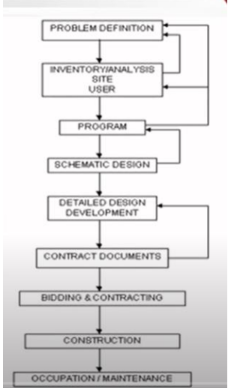
Lynch's Site Planning Process (1984)
A standard design process followed by architects that reflects the diff. phases of the design process which includes problem definition, inventory, and analysis of the site and users.
PROBLEM DEFINITION
Shows that even before you proceed with the
schematic design phase of the design
process, one must
INVENTORY/ANALYSIS SITE USER
Define the problem with the analysis
of the site and its users
Once you’re done with this, you can
now go to the PROGRAM
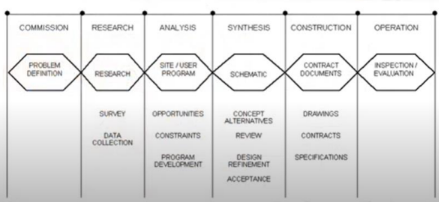
Planning – Design Process (Starke & Simonds, 2006)
Follow the ff phases of the design process
Research - Analysis - Synthesis
Emphasizes the linearity of the design process wherein one CANNOT proceed with the design development phase without first doing research and analyzing the site and its users.
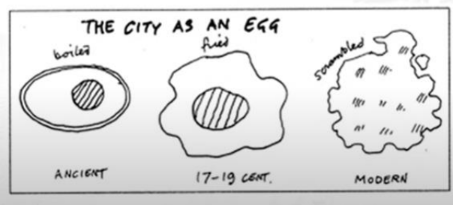
Ovo urban analogy
Shows how cities have evolved from walled defined centers to sprawling development in the recent years
As men multiply and comes to dominate the earth, the organization of land becomes more important to the quality of their lives
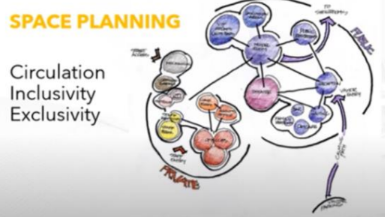
Space Planning
The efficient and productive use of interior spaces, defining circulation paths, and identifying levels of privacy and inclusivity.
Inclusivity of spaces
Identifying which ones are private and semi-public
Efficient and productive use of spaces
Considering where the spaces are
accessed outside the property
How these spaces are affected by
natural elements; Wind and Solar path
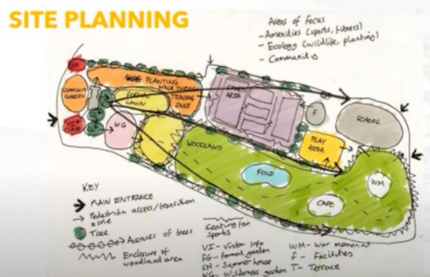
Site Planning
The artistic and functional arrangement of structures on the land and the shaping of the spaces between them to enhance everyday life.
Aim: moral and aesthetics: to make places which enhances everyday life
Space planning
Shows the relationship of spaces inside 1 structure
Inside a building
Site planning
Shows the relationship of bldgs. Inside a prop following a certain hierarchy and circulation pattern
Everything outside the bldg.
Developed thru multidimensional viewpoints from various stakeholders from diff sectors
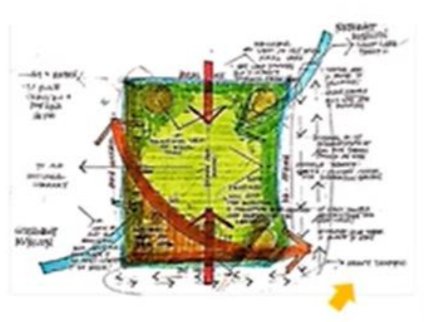
Site analysis
Must show all existing site conditions prior to your design
Shows a number of symbols that holistically defines the site
Different colored curved arrows
1. Research (general activities of the planning-design process)
- Program development
- Site and context inventory
2. Analysis (general activities of the planning-design process)
- Site analysis
3. Synthesis (general activities of the planning-design process)
- Conceptual design
- Preliminary design
- Site plan/master plan
Process
analyzing the data gathered about a particular site
Essentially about getting the right things in the right place
Being able to draw up detailed briefs to guide the designers and site managers
Interpretation of info is the most diff part of the site planning process
Necessary for a good site analysis (russ, 2009)
1. Data gathering
2. Evaluating the site
3. Recognizing concerns
4. Understanding of the administrative
requirements
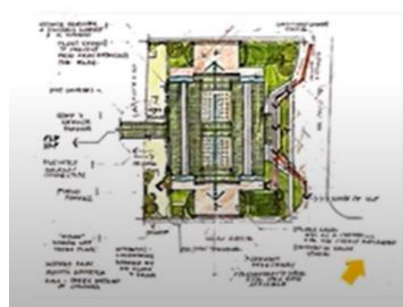
Site development plan
Reflects the bldgs. That you are proposing
Corresponding improvements on the spaces between them.
Bubble Diagram
A graphical tool used to show the circulation of users, vehicular traffic flow, and the arrangement of spaces based on natural elements.
Site analysis – basic diagram composition
1. Boundaries
2. Solar path
3. Wind direction
4. True north orientation
5. Traffic and pedestrian flow
6. Adjacent structures
7. Views/viewsheds
8. Vegetation
9. Others
Boundaries
roads, paths, access
Solar path
morning and afternoon sun
Amihan
The North East (NE) wind direction considered during site analysis.
Habagat
The South West (SW) wind direction considered during site analysis.
Adjacent structures
may have direct / indirect effect to your site
Vegetation
existing landscape
Attributes of site planning
1. Physical
ones reflected in the site analysis diagram
includes Soil, Topography, Hydrology, Geology and Climate
You should be wary of the different hazards, nuances, constraints of the different attributes of the site
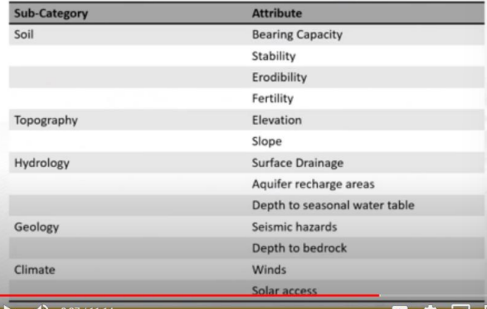
Attributes of site planning
2. Biological
Includes Vegetation, Wildlife, Flora and Fauna
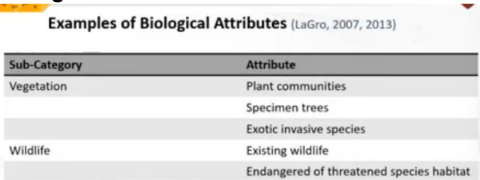
Attributes of site planning
3. Cultural
Data and information about the PEOPLE and who they are as stakeholders
Built environment is a manifestation of the people who built and are using it
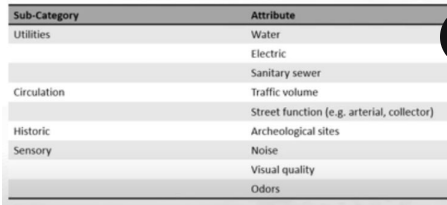
Attributes of site planning
4. Land use suitability
– can also translate to political attributes
- Codes and legal reqs we follow when designing
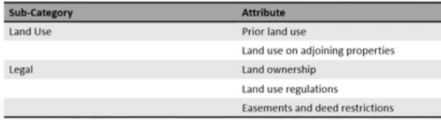
Survey
- Checklist of info or data pertaining to the site and its immediate context
- Would be drawn up after an initial analysis of the problem
- To guide the 1st survey, info would be gathered continuously as the problem develops
Primary data
- Data from primary sources and other data gather firsthand for the purpose of your project or research
- Initial personal reconnaissance – when you familiarize yourself with the site and its immediate env
- Data gathered by allied professionals and consultants for your project
Initial personal reconnaissance
– when you familiarize yourself with the site and its immediate env
o Notes
o Sketches
o Photographs
o Parang sa surveying
Data gathered by allied professionals and consultants for your project
o Geodetic engineer
o Environmental planner
o Geologist
o Hydrologist
o Biologist
o And others
Secondary data
Data gathered that have been collected and published for studies other than for your project or research
o Websites
o Government links
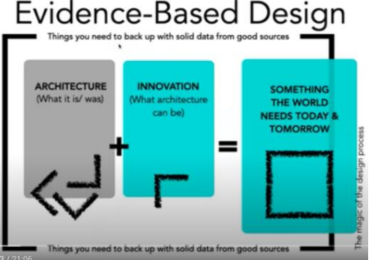
Evidence-Based Design
A design approach that uses solid data and research results, such as history or innovation, to provide architectural solutions.
ARCHITECTURE
That’s why u study HOA to have a lot of evidences of what kind of architecture works and does not.
INNOVATION
As a designer, u should come up with research that could be injected into the project so it becomes an architectural solution proposal for SOMETHING THAT THE WORLD NEEDS TODAY & TOMORROW.
Difference bet. Programming and design
Analysis of its parts so that it could become whole (synthesis)
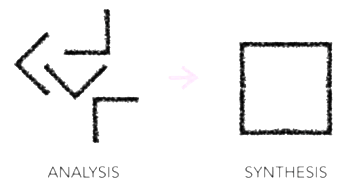
Analysis
Fundamental parts of the design problem are separated and identified
Synthesis
Parts are put together to form a coherent solution
Space program
- Tool that lists the spaces – what’s within it and its specific uses and function of each one in tabular form
- Info indicated are as such, but not limited to function, number of occupants, furniture / fixture / equipment and other critical factors
Segmental planning
- Isolates a small part of a project in order to focus on how everything works on a smaller scale
Adjacency/Space Matrix
A graphical tool used to represent and determine the relationship of spaces between each other during the design process.
Cohousing / Shared Housing
A semi-communal housing arrangement consisting of private homes clustered around shared community spaces like kitchens or laundry facilities. First cohousing development – 1972, Denmark.
Generation
- Group of indivs and living contemporaneously (existing, occurring, or originating during the same time)
- Every 10 years is a generation
- People born from 1980-1989: 80s generation
Childhood
o Infant
o Toddler adolescent
Adulthood
o Young adult
o Middle age
o Empty nester
Elderhood
o People over 60
o “retired”
Montessori Method
An educational approach reflected in design by providing children with autonomy, such as their own appropriately scaled sinks to encourage independence.
Babies/kids
- A lot of Filipino fams – decision to try cohousing or shared housing is influenced by
children
- Le courbusier (towards a new architecture) – “... man looks at the creation of architecture with his eyes, which are 5 feet 6 inches from the ground.”
Safety
- Being able to see the child ANYWHERE in the space
- Allowing the child to explore and learn without feeling “closed in”
- Allow adults to easily monitor
Stability and durability
Furniture and fixture that wont topple over
Fixed > loose
Attached to the wall
Play and creativity
Architectural solns that safely allow them autonomy in exploring and playing
Should allow them to see what is outside safely
No big cuts of windows
Adaptability
- “Kids grow really fast”
- Still their room as they grow older
Adulthood (working class)
- A lot of diff types of work setups u would have to consider such as family members who
Work outside the home
work at home but need a privat space
Elderhood
more time to spend on leisure activities
will need indoor and outdoor spaces to fill their days with diff activities
Proxemics
The study of how people unconsciously structure microspace, maintain territories, and manage distances between one another in daily life.
Loudness of voice
Indicator of the distance bet. 2 people
Whisper: close
Shout: distant
(literally and figuratively)
Social distancing
Came from the study of PROXEMICS
Intimate Distance
A proxemic zone measuring 0−1.5 ft (0−0.45 m), used for activities like protecting, comforting, or love-making. Speaking is minimal. There is a sense of discomfort when a
stranger enters one’s intimate space.
Personal Distance
A proxemic zone measuring 1.5−4 ft (0.45−1.2 m), often perceived as the limit of domination. Activities: holding hands, meeting with friends, and intimidation
Social Distance
A proxemic zone measuring 4−12 ft (1.2−3.6 m), used for business, casual social discourse, and classroom settings. Indiv can work independently without the need to interact (café, classroom). Voice is noticeably louder
Public Distance
A proxemic zone measuring 12−25 ft (3.6−7.6 m), recognized as the point of fight or flight where vocal details are lost.
Proxemics and cultural differences
- People from different nations, social classes, and upbringing have different perception of spaces
- Some require more space, while some require less
- Caused by various changes on environmental and social differences
- People from diff cultures not only speak diff languages but, what is possibly more important, inhabit different sensory worlds
- Social class
Lower class
seated close to one another
Upper class
each individual has ample space
Proxemics and home furniture
- Understanding the concept of proxemics aids to more efficiently designed living spaces considering
1. Inclusivity
2. Exclusivity
3. Unique cultural context
Seating areas
Dining table / meeting room
People choose their seats based on their intended involvement through control of eye contact
Seating areas
Living room
3 seater sofa
Seat more people
most people choose to occupy the END of the sofa first – to use the arm rest
2nd person – sits on the other end to set a comfortable distance from his/her companion
only user groups that are well acquainted are comfortable with the 3rd person sitting in the middle.
Universal design
- Promotes safe and easy to use designs
- FOR ALL
- design of products, environments, programs and services to be usable by all people, to the greatest extent possible, without the need for adaptation or specialized design
- Evolved from accessible design (for disabled people)
Equitable, flexible use & low physical effort
- Design that can be used comfortable by all with diverse abilities, which uses reasonable force to operate without the need for repetitive actions.
Simple and intuitive use
- Learnable, you know how to use it easily
- Design elements that visually signals its purpose with ease
- Also considers the size of the space to show the approach of its utilization