Midterm 1
 Call Kai
 Learn
Learn Practice Test
 Spaced Repetition
 Match
Match Flashcards
 Knowt Play
1/14

There's no tags or description
Looks like no tags are added yet.
Name | Mastery | Learn | Test | Matching | Spaced | Call with Kai | Chat |
|---|
No analytics yet
Send a link to your students to track their progress
15 Terms
Problem: Below is a table for experimentally measured concentrations and reaction rates for a reaction.
A (M) | B (M) | C (M) | Initial Rate (M/s) |
0.10 | 0.10 | 0.10 | 0.8 |
0.10 | 0.10 | 0.20 | 1.6 |
0.10 | 0.20 | 0.20 | 3.2 |
0.20 | 0.10 | 0.10 | 3.2 |
Find x, y, and z for the rate law: kA^xB^yC^z
*you need to find all of them TOGETHER (all three)
Answer: x=2, y=1, z=1
A system is in dynamic equilibrium. What is the difference between its bulk properties and microscopic properties?
Bulk properties - constant
Microscopic properties - changing
Think of a bathtub with water flowing in and out at the same rate:
Water molecules are constantly moving (microscopic changes)
But the water level stays the same (bulk property constant)
How to solve Le Chatter’s principle problems?
Find Kp or Kc
Make ICE chart
solve for x
Problem: Consider the reaction,
2NH3(g) → N2(g) + 3H2(g)
If the rate of formation of H2(g) is 0.12 mol·L–1·s–1, then the rate of disappearance of NH3(g) is:
Give your answer in mol/(L*s) to 1 sig fig. Do not include units in your answer. Canvas can't do this.
Method:
When it says “rate of formation” or “rate of reaction”, it just means the [A]/t ALONE, NOT the coefficient.
When you write relative rate laws, the molecule with the SMALLEST number of moles stays unchanged. However, that number goes to the NUMERATOR of all other coefficients. then, the coefficient in front of each molecule is written as the denominator.
N2 → 1 mol (smallest # of mols)
-1/2(NH3/t) = -N2/t = +1/3(H2/t)
you’re given 0.12 for the rate of formation of H2 (H2/t). SO, you must solve by multiplying by 1/3 = 0.12/3
now solve for -N2/t, which can equal x because you don’t know it
0.12/3= -x/2, where x = -0.08
Problem Select all true statements (there may be more than one)
Solids and liquid are not included in the Kc and Kp equations because they have an activity equal to 1.
Kc and Kp are the same thing as the k (rate constant) that you learned about before.
Kc is equal to Kp when the number of moles of gas (n) doesn't change.
Kc has units of molarity and Kp has units of pressure
Solids and liquid are not included in the Kc and Kp equations because they have an activity equal to 1.
Kc is equal to Kp when the number of moles of gas (n) doesn't change.
Units of Kp vs Kc?
trick question - they are UNITLESS
Practice: A reaction in which A, B, and C react to form products is first order in A, second order in B, and zero order in C.
Write a rate law for the reaction.
What is the overall order of the reaction?
By what factor does the reaction rate change if [A] is doubled (and the other reactant concentrations are held constant)?
By what factor does the reaction rate change if [B] is doubled (and the other reactant concentrations are held constant)?
By what factor does the reaction rate change if [C] is doubled (and the other reactant concentrations are held constant)?
By what factor does the reaction rate change if the concentrations of all three reactants are doubled?
Method: “doubled” → 2
for example, B:
start: (B)²
doubled: (2 times B)² = 4(B)² → so It changes by a factor of 4
rate law = kA^1B²C^0
1 + 2 + 0 = 3
(2 times A)^1 = (2A) = 2A → changes by a factor of 2
(2 times B)² = (2B)² = (2B)(2B) = 4B² → so It changes by a factor of 4
(2 times C)^0 = (2C)^0 = 1 → so it changes by a factor of 1
1 times 4 times 2 = 8
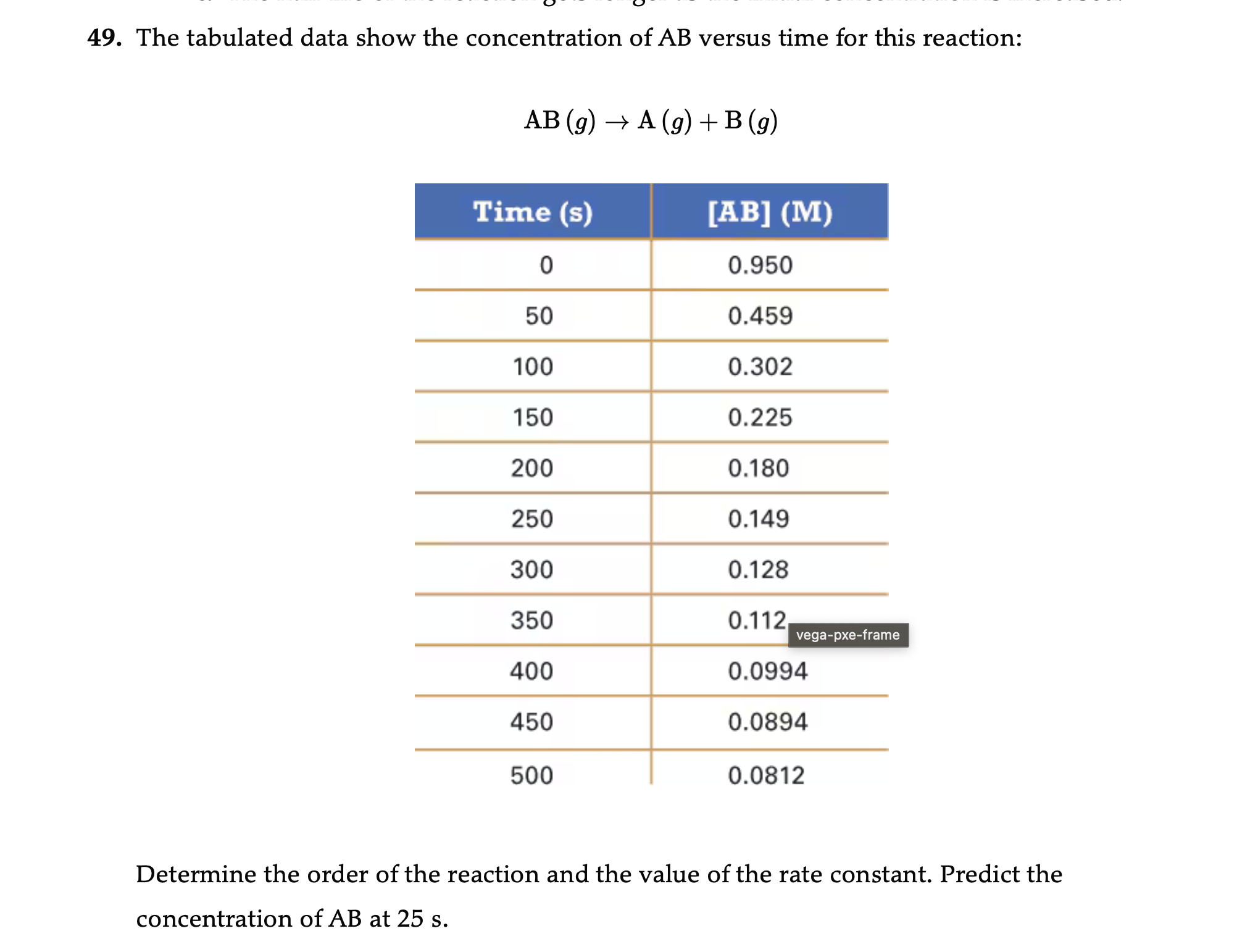
Problem: (image)
Method: if you are given concentrations together, you must find the orders using your intergrated rate laws. treated AB as the same as A for the integrated rate laws.
Test from different time intervals for each order’s integrated rate law: if two different time intervals yield similar/exact same results, THAT is the reaction order (bc it is consistent throughout the experiment) → that value is also your rate constant
use that specific order’s integrated rate law to solve for concentration at a certain time
Answer: 0.618 M, 2nd order reaction
When is a rate constant positive or negative?
trick question: rate constants (k) are ALWAYS positive
Which factors change rate constant (k)?
ONLY TEMPERATURE
Problem: If the [OH-] is 0.002M, what is the pH?
METHOD: pOH and pH are separate things, so you solve for pOH first then use pH+pOH = 14 to solve for pH
pH=11.301 (around)
When something refers to “concentration", what does it mean?
10^-pH or 10^-pOH
Problem: What is the pOH if a solution composed of 60mL of 0.0012M HCl and 200 mL of 0.0005M NaOH?
Method: M1V1=M2V2
M1 - original concentration of substance A
V1 - initial volume of substance A
M2 - final concentration of substance A
V2 - final volume (of BOTH substances being mixed)
**MAKE SURE to find the limiting reactant, bc what you put into your log equation will be the excess reactant
M of excess you found from the equation-M of limiting you found from the equation = M you will put into the log equation
Overall method:
M1V1 = M2V2 for each reactant
The smaller M will be the limiting reactant (keep in mind)
M excess - M limiting = M excess left over after reaction (for either H+ or OH^-
Input the log and solve for pH and pOH
answer: around 3.97
Problem: What is the concentration of hydronium ions after a 100mL solution of 0.02M Magnesium Hydroxide and 100mL of 0.05M nitric acid?
*NOTE: you’re given TWO OH, which means you multiply the initial concentration by TWO before doing any other stuff
Method: M1V1=M2V2
M1 - original concentration of substance A
V1 - initial volume of substance A
M2 - final concentration of substance A
V2 - final volume (of BOTH substances being mixed)
**MAKE SURE to find the limiting reactant, bc what you put into your log equation will be the excess reactant
M of excess you found from the equation-M of limiting you found from the equation = M you will put into the log equation
Overall method:
M1V1 = M2V2 for each reactant
The smaller M will be the limiting reactant (keep in mind)
M excess - M limiting = M excess left over after reaction (for either H+ or OH^-
Input the log and solve for pH and pOH
Answer = around 0.005
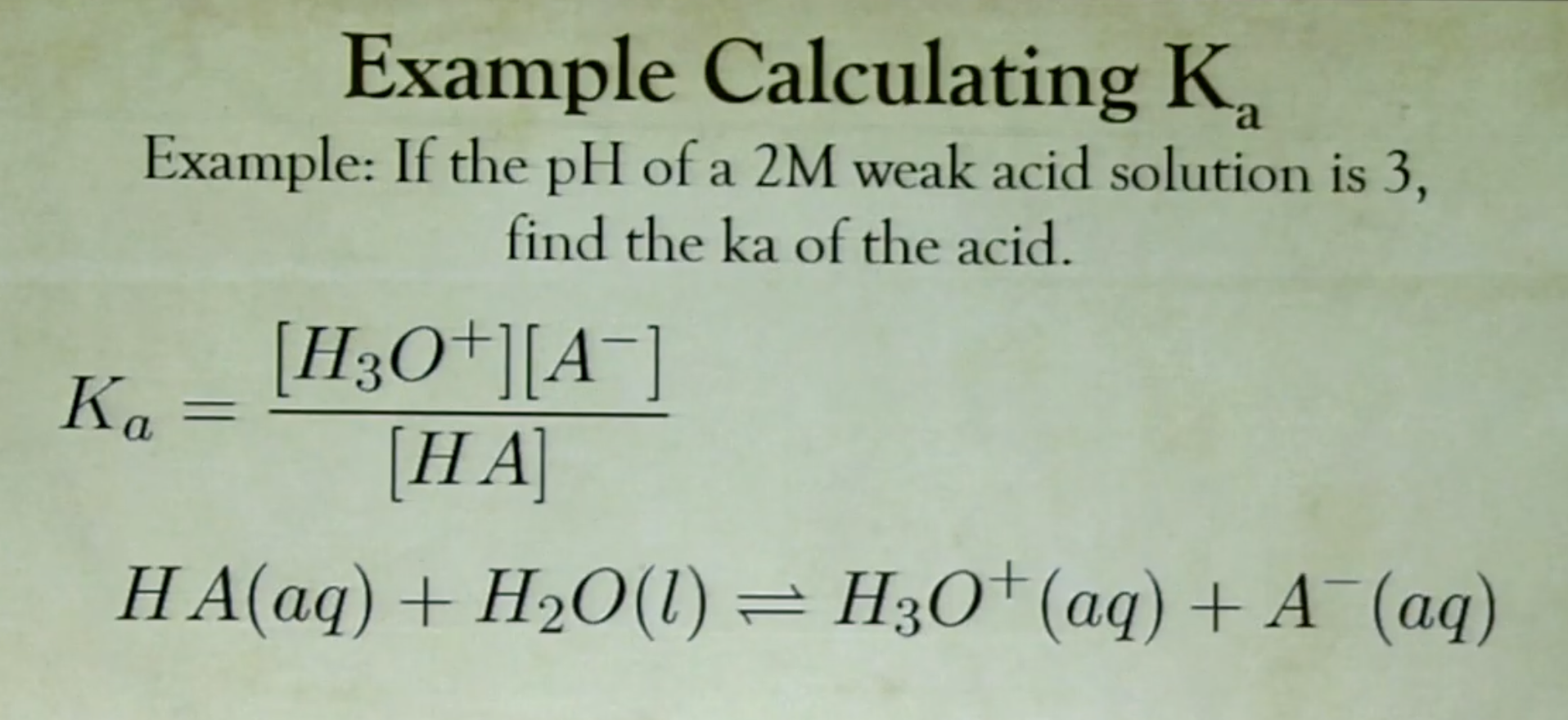
Practice
Method: ICE
Answer in image