PE Unit 1 AOS 1 SAC
 Call Kai
 Learn
Learn Practice Test
 Spaced Repetition
 Match
Match Flashcards
 Knowt Play
1/120

There's no tags or description
Looks like no tags are added yet.
Name | Mastery | Learn | Test | Matching | Spaced | Call with Kai | Chat |
|---|
No analytics yet
Send a link to your students to track their progress
121 Terms
Anterior
The front of the body
Posterior
The back of the body
Superior
A body part that is higher than the other (closer to the head)
Inferior
A body part lower than the other (further away from the head)
Medial
Closer to the midline of the body
Lateral
Further away from the midline of the body
Proximal
A body part closer to the trunk of the body
Distal
A body part away from the trunk of the body
Superficial
Closer to the surface of the body
Palmer
The anterior of the hand
Dorsi flexion
top of the foot
Planter
Bottom of Foot
Ligaments
Coonective tissues that connect bone to bone
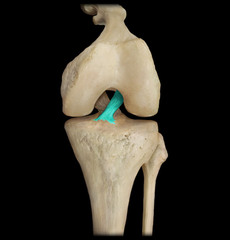
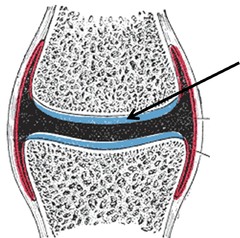
Cartilage
Flexible connective tissue that supports and protects bones by covering its surface so that they can move against each other.
Joints
Where two or more bones meet
Function of the skeleton
The primary function of the skeleton is to allow movement through a series of anatomical levers which allow muscles to pull on bones to change their position.
Long Bones
Long and thin, eg. humerus, radius, ulna, and femur
Short Bones
Small, cubed shaped eg. carpals and tarsals
Flat Bones
Flattened, broad surface, eg. ribs, scapula, sternum and skull
Irregular Bones
Vary in shape, complex shape, eg. vertebrae, facial bones
Axial Skeleton
Portion of the skeletal system that consists of the skull, rib cage, and vertebral column
Appendicular Skeleton
Bones of the limbs and limb girdles that are attached to the axial skeleton
Cervical Vertbrae
The 7 cervical vertebrae are small, designed to support the next and head.
Thoracic Vertebrae
The 12 Thoracic Vertebrae are larger and provide the anchor point for the ribs to attach and form the rib cage whuch protects the heart and lungs
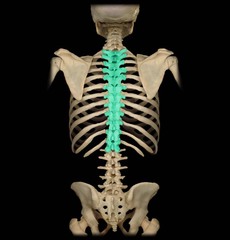
Lumbar Vertebrae
The 5 lumbar vertbrae are larger and allow the greatest range of movement
Sacral Vertebrae
5 vertebrae which are fused to form the sacrum in the pelvis
Coccyx Vertebrae
4 vertebrae that make up the tail bone
Fibrous (Fixed Joints)
Immovable joint, eg skull, pelvis
Cartilaginous joints
Allow only slight movement, eg. ribs attaching to sternum, lumbar vertebrae
Synovial Joints
Freely movable joints, eg. hip and knee joints, cervical and thoracic vertebrae
Types of synovial joints
pivot, hinge, saddle, plane, condyloid, ball-and-socket
What is a pivot joint?
A pivot joint only rotates one bone around another, eg. atlas and axis (top vertbrae)
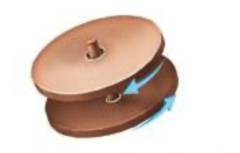
Movement type (Pivot)
Rotation
What is a gliding joint?
A gliding joint allows one bone to slide on top of another, eg. carpals/tarsals
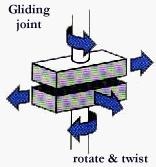
Movement type (Gliding)
Glide
What is a ball and socket joint?
Allows a wide range of movements in all directions, eg. shoudler, hip
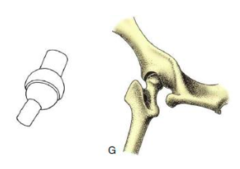
Movement type (Ball and Socket)
Flextion, extension, adduction, abduction, rotation, circumduction
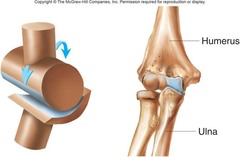
What is a hinge joint?
Movement in one plane only, eg. knee, elbow
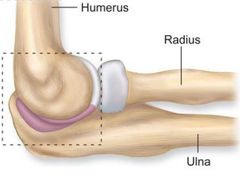
Movement type (hinge)
Flexion, Extension
What is saddle joint?
Movement occurs in two planes, eg. carpo metacarpal joint of thumb
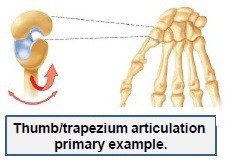
Movement type (saddle joint)
Flexion, Extension, Adduction, Abduction, Circumduction
What is a condyloid joint?
Movement limited to a hinge motion in 2 planes, eg. wrist
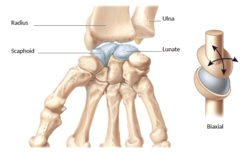
Movement type (condyloid)
Flexion, extension, adduction, abduction, circumduction
Abduction
Movement away from the midline of the body
Adduction
Movement toward the midline of the body
Circumduction
Movement is circular and results in the limb forming a cone shape from a joint. For example, pitching the ball in softball.
Extension
A movement that increases the angle between two body parts.
Flexion
Involves movement that results in a decrease in the angle of the joint
Rotation
When a body part makes a turning movement while the rest of the body remains still like turning your head or twisting your spine while your hips remain stationary
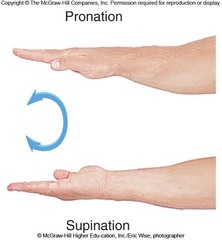
Pronation
Movement of the forearm that turns the palm towards the body, so the palm is posterior facing and the ulna and radius are crossed
Supination
Movement results in the forarm rotating so the point in anterior facing and the radius and ulna are uncrossed and parallel to each other
Inversion
Movement where the sole of the foot is angles towards the midline of the body
Eversion
Movement where the sole of the foot is turned away from the midline of the body
Dorsiflexion
Occurs at the ankle joint where the front of the foot is lifted towrds the shin
Plantar Flexion
Occurs at the ankle joint where the heel is lifted from the ground and/or when the toes are painted downwards.
3 types of muscles
skeletal, smooth, cardiac
Skeletal Muscle
Voluntary muscle tissue that is attached to the skeleton by tendons. These muscles contract to pull on bones, allowing for conscious movement.
Functions of the Muscular System
movement, posture, joint stability, heat production
Origin
The origin is at the end where the muscle attaches to the fixed or stationary bone
Insertion
The insertion is the end where the muscle attaches to the bone that is moving the most
Muscle Fibre Arrangement
The arangement of the bundles of musclr fibres is closely related to the force that can be generated in the muscle and the muscle range of motion
Fusiform Muscle Arrangement
The muscle fibres run the length of the muscle in the same direction as the tendon, which can contract rapidly but produce low forces eg. biceps brachii
- because force depends on the number of muscle fibres that can pull on the one tendon at the same time
Pennate Muscle Arrangement
Muscle run at the angles of the tendons. A larger amount of muscle fibres in this arrangement allows pennate muscles to generate greater force.
3 types of pennate arrangment
Unipennate, Bipennate, Multipennate
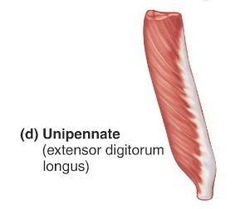
Unipennate Muscle Arrangement
Muscles fibres that align obliquely on only one side of a central tendon, resembling half of a feather eg. extensor digitorum longus
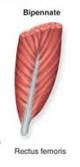
Bipennate
Muscle fibres attach on both sides of the central tendon, resembling a symmetrical feather eg. rectus femoris (quad)
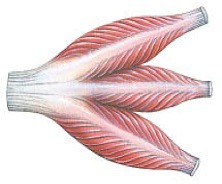
Multipennate Muscle Arrangement
Multiple rows of muscle fibres arranged obliquely, inserting diagnolly onto several branching tendons that converge into a single main tendon, eg. deltoid
What is a long fibre equal to?
Higher speed and movement eg. fusiform muscles as they run the length of the muscle allowing a greater range of motion
What do short/many fibres equal to?
Higher force, eg., pennate muscles, which contain shorter fibres allowing strong powerful contractions
Slow Twitch Muscle Fibres
Muscle fibres that have a high oxidative capacity and contract slowly.
Charcteristics of slow twitch fibres
red
small diameter
slow reaction time
lower intensity contractions
low fstiguability rate
work at a low intensity
Fast Twitch Muscle Fibres
Muscle fibres that are specialised for high-intensity, explosive anaerobic movements
Characteristics of fast twitch fibres
white
high intensity strength activities
large diamtete
fast reaction time
high fatiguabilitiy
low capilary density
higher intensity contractions
Sports Examples of Type I (slow-twitch / slow oxidative)
Marathon running, long-distance cycling, distance swimming, triathlon
Sports Examples of Type IIx (fast glycolytic / fast-twitch)
100 m sprint, powerlifting, gymnastics, explosive throwing events (shot put, javelin), vertical jumping
What is the role of the epimysium?
A connective tissue layer surrounding the entire muscle, providing protection and support.
What is the role of the perimysium?
Connective tissue surrounding a bundle of muscle fibres (fascicle) and allows blood vessels and nerves to pass through.
What is the role of the endomysium?
A connective tissue layer surrounding individual muscle fibres, supporting and protecting them.
What are myofibrils?
Long protein structures inside muscle fibres that contain the contractile proteins actin and myosin.
What is the sarcolema?
The sarcolemma is the specialised plasma membrane that surrounds a muscle fibre
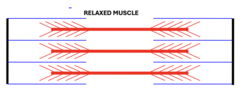
Step 1 of Sliding Filament Theory
Electrical impulse arrives at the relaxed muscle via the CNS
Step 2 of Sliding Filament Theory
Calcium is released which bonds the cross bridges to the actin
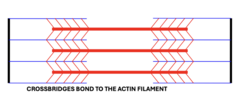
Step 3 of sliding filament theory
Cross bridges begin to pull the actin filaments towards the middle
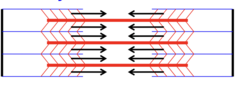
Step 4 of Sliding Filament Theory
Muscle Contracts and Shortens
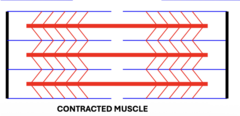
What happens to the sarcomere during contraction?
The sarcomere shortens as the Z-lines move closer together.
What happens to the H-zone?
It gets shorter
What happens to the A-band?
It stays the same length because it represents the length of the myosin filaments.
What happens to actin and myosin during the sliding filament theory?
Actin and myosin do not shorten. Their interaction causes the sarcomere to shorten.
The All or Nothing Principle
The All or Nothing Principle states that if the message/impulse from the brain to the motor unit meets a certain threshold, all muscle fibres in that motor unit will contract maximally at the same time. The number of motor units that are stimulated will determine the force generated.
What happens if the message/impulse does not meet the threshold?
If the message/impulse does not meet the threshold or is too weak, none of the muscle fibres in that motor unit will contract.
What is a smaller force equal to?
Fewer, smaller units are activated
What is a larger force equal to?
More, larger motor units are activated
The Size Principle
Motor units are recruited from smallest to largest as force requirements increase, allowing progressively greater force to be produced. For example, smaller motor units are required for a short handball then a 50 m kick to goal.
Reciprocal Inhibition
Occurs when muscles work in pairs or groups to produce movement.
How does reciprocal inhibition work?
While one muscle contracts (the agonist), the other (the antagonist) relaxes to allow movement.
Agonist
Contracts and shortens
Antagonist
Relaxes and lengthens
Isometric Contractions
Muscle contracts without a change in muscle length eg. planks, side planks, wall sit
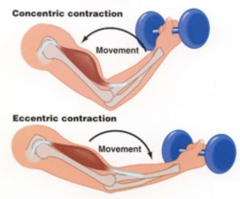
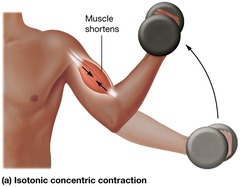
Concentric Contractions
Muscle shortens as it pulls bones together, building a force
Push-up: Pushing your body up from the floor.
Squat: Standing back up from the bottom position.
Eccentric contractions
An eccentric contraction occurs when the muscle contracts while lengthening.