5th Grade Electricity and Magnetism
 Call Kai
 Learn
Learn Practice Test
 Spaced Repetition
 Match
Match Flashcards
 Knowt Play
1/40

There's no tags or description
Looks like no tags are added yet.
Name | Mastery | Learn | Test | Matching | Spaced | Call with Kai | Chat |
|---|
No analytics yet
Send a link to your students to track their progress
41 Terms
Electricity
energy made available by the flow of electric charge through a conductor

Proton
positively charged particle
Electron
negatively charged particle
Static Electricity
The buildup of electric charges (+ or -) on an object
Build up of electric charges may be due to friction

magnet
a device that attracts iron and produces a magnetic field
Friction
the force that two surfaces exert on each other when they rub against each other
the transfer of electrons from one uncharged object to another by rubbing
Current
a flow of electricity through a conductor
Conductor
a material that easily allows the flow of electricity
Insulator
a material through which electricity DOES NOT pass easily
electromagnet
temporary magnet made by passing an electric current through a wire coiled around an iron bar

Poles
two ends of a magnet
the strongest parts of the magnet
Repel
to push away from something
2 objects pushing away from each other
Attract
to pull towards something
2 objects pulling toward each other
When the north pole of one magnet pulls toward the south pole of another magnet
What happens to a magnet when the electric Current is turned OFF
The magnetic field disappears - magnet is not magnetic
What happens to a magnet when the electric Current is turned ON
The magnetic field appears - Magnet is magnetic
Static discharge
The loss of static electricity as electric charges transfer from one object to another.

Where is the magnetic effect strongest for a magnet?
At the poles
What are three forms of Static Dischrarg
heat, light, and sound
Magnetic poles that are UNLIKE
attract each other
Magnetic poles that are ALIKE
repell each other
What happens when a proton and an electron come together?
they attract one another - because they have different types of electric charges
magnetic field
The area of magnetic force around a magnet

compass
An instrument containing a magnetized pointer that shows the direction of magnetic north.

open circuit
an incomplete electrical circuit in which no current flows
closed circuit
complete path along which electric current flows
Give examples of a conductor
metal such as iron, copper, silver, water, or aluminum, through which electricity will flow
Give examples of an insulator
glass, plastic, rubber, wood, and air
Things electricity cannot flow through
In order for charges to flow through a circuit it can not have any ______________
Breaks
magnetic field
the space around a magnet where the force of the magnet can attract or repel objects
Objects with the same charge move away from each other (T/F)
TRUE they repel each other
What is an example of static electricity?
Lightning, a sock stuck to a sweater, ballons rubbed on your hair
How many magnetic poles does a magnet have?
2, north and south
Give some examples of how magnets are used
compasses, headphones, speakers, doorbells, recording information in computers and on a videotape
magnet
- any material that attracts iron and materials that contain iron
- attract or repel other magnets
- one part of a magnet will always point north when allowed to swing freely

magnetic pole
- the ends of a magnetic object where the magnetic force is strongest
- poles that are unlike attract each other
- poles that are alike repel each other
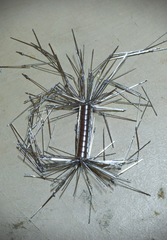
magnetic force
- a force produced when magnetic poles interact

magnetic field
- the region around a magnet where the magnetic force is exerted

magnetic field lines
- invisible lines that map out the magnetic field around a magnet
- these lines spread out from one pole, curve around the magnet, and return to the other pole

temporary magnet
- a magnet made from a material that easily loses its magnetism

permanent magnet
- a magnet made of a material that keeps its magnetism

compass
- a device with a magnetized needle that can spin freely
