Adaptations for Hot and Cold Environments: Biology of Desert and Arctic Organisms
 Call Kai
 Learn
Learn Practice Test
 Spaced Repetition
 Match
Match Flashcards
 Knowt Play
1/60

There's no tags or description
Looks like no tags are added yet.
Name | Mastery | Learn | Test | Matching | Spaced | Call with Kai | Chat |
|---|
No analytics yet
Send a link to your students to track their progress
61 Terms
What are abiotic factors?
Non-living properties of the environment, such as temperature, water, nutrient availability, and acidity.
What are biotic factors?
Living properties of the environment, including predator-prey interactions, plant-herbivore interactions, competition for resources, and symbiotic relationships.
What is the tolerance range of an organism?
The range of conditions within which an organism can thrive, survive, or not stay alive.
What are the two main categories of adaptations in hot environments?
Structural adaptations and physiological adaptations.
What is a structural adaptation?
Evolved modifications to an organism's physical structure.
What is a physiological adaptation?
Evolved modifications to an organism's internal functioning or metabolic processes.
What is a behavioral adaptation?
Evolved modifications to an organism's actions.
How do desert animals maximize heat loss?
By evolving insulation techniques and optimizing their surface area to volume ratio.
What is the significance of surface area to volume ratio (SA:V) in desert animals?
A high SA:V ratio allows for rapid heat release, while a low SA:V ratio helps resist temperature changes.
How do camels regulate their body temperature?
They have evolved optimal thickness of fur and fat to manage heat release.
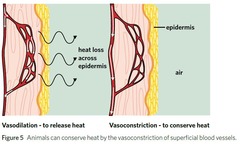
What role does the circulatory system play in temperature balance for desert animals?
It helps release heat through dilation of blood vessels and increased blood flow to the skin.
What is evaporative cooling?
A method of heat loss through the evaporation of water, such as sweating and panting.
Why is evaporative cooling a challenge in arid environments?
It requires water, which can lead to dehydration.
How do desert mammals conserve water through urine?
They excrete concentrated urine that contains very little water.
How do reptiles and birds conserve water?
By excreting uric acid with other wastes in a semi-solid state.
What adaptation do desert animals have regarding their feces?
They have highly complex digestive systems that produce feces with low water content.
What are nocturnal behaviors?
Behaviors characterized by being active during the night and sleeping during the day.
What is the main challenge for endotherms in hot environments?
They must evolve effective strategies to release excess metabolic heat.
What advantage do ectotherms have in hot environments?
They can use energy not spent on metabolic heat for other processes, such as foraging.
What is the difference between endurers and evaders in desert animals?
Endurers are larger animals that do not avoid extreme temperatures, while evaders are smaller animals that modify their behaviors to avoid extreme temperatures.
How do desert animals avoid extreme temperatures?
Many desert animals seek shade or retreat to burrow systems to avoid heat absorption from solar radiation.
What behavioral adaptation do endurers exhibit during the hottest periods of the day?
Endurers tend towards inactivity to reduce metabolic heat production.
How do larger mammals like pigs and elephants cool down?
They wallow in mud or water baths, using evaporative cooling to remove heat from their bodies.
What is the significance of burrow systems for desert animals?
Burrow systems maintain cooler temperatures than the outside environment and rarely change during the hottest hours of the day.
What is nocturnal behavior in desert animals?
Nocturnal behavior is characterized by being active during the night and sleeping during the day, taking advantage of cooler nighttime temperatures.
What are the three main strategies plants use to survive in hot and dry environments?
1) Decrease heat intake, 2) Maximize water uptake, 3) Minimize water loss.
How do plants reduce their heat intake?
Plants may have light-colored or reflective leaves, leaves of low surface area, or vertically hanging leaves to minimize sun exposure.
What adaptation allows desert plants to access groundwater?
Many long-living desert plants have extensive deep root systems that can reach groundwater reserves.
How do some desert plants store water?
Some plants collect and store large amounts of water during the rainy season for use in the dry season, like baobabs and cacti.
What is the role of sunken stomata in desert plants?
Sunken stomata reduce water loss by creating pockets of humid air around the stomata, minimizing transpiration.
How do guard cells regulate stomata in desert plants?
Guard cells lose water during hot parts of the day, causing them to become flaccid and close the stomata to prevent gas exchange.
What is the purpose of having rolled or folded leaves in desert plants?
Rolled or folded leaves help maintain a humid environment around the leaf, reducing water loss.
What is the effect of increasing surface area on heat dissipation?
Increasing surface area allows for greater heat dissipation, as seen in practical activities comparing temperature drop in different containers.
How does the volume of water affect heat dissipation in practical experiments?
A full cup of water has a lower surface area to volume ratio compared to a quarter-filled cup, affecting the rate of temperature drop.
What is the significance of the surface area to volume ratio in heat regulation?
A greater surface area to volume ratio allows for more efficient heat dissipation, which is crucial for temperature regulation in both animals and plants.
What adaptations do desert plants have for minimizing water loss?
Desert plants may have reduced stomatal density, sunken stomata, or mechanisms to close stomata during the hottest parts of the day.
What is the purpose of regeneration after fire in desert plants?
Regeneration after fire allows certain desert plants to recover and thrive in environments that experience periodic fires.
What is the most influential abiotic factor in cold environments?
Extremely low temperatures.
What adaptations have animals evolved to survive in cold environments?
Structural, physiological, and behavioral adaptations.
What adaptations have plants evolved to survive in cold environments?
Structural and physiological adaptations.
How do low temperatures affect biological reactions?
They slow down or stop reactions required for life.
What impact do piercing winds have on organisms in cold environments?
They increase heat loss and exert strong pressures on plants.
Why is low availability of nutrients a challenge for organisms in cold environments?
It restricts macromolecule synthesis and overall growth rate.
How does precipitation as snow affect organisms?
It makes it difficult to obtain the liquid water required for survival.
What is one structural adaptation animals use for temperature balance?
Thick insulating layers of fur, plumage, or subdermal fat.
How does decreasing surface area to volume ratio help animals in cold environments?
It slows down heat release, helping maintain body temperature.
What is the difference between endotherms and ectotherms in cold environments?
Endotherms maintain stable body temperatures via internal metabolic processes, while ectotherms cannot.
What is torpor?
A physiological state where metabolism is reduced to conserve energy.
What is vasoconstriction?
The constriction of small blood vessels to minimize heat loss.
What is countercurrent circulation?
A technique that uses heat from outgoing blood to warm incoming blood, maintaining core body temperature.
How do animals reduce exposed surface area in cold environments?
By hiding or protecting their peripherals, such as curling up.
What is the purpose of huddling in animals like emperor penguins?
To decrease individual surface area to volume ratio and retain heat.
Why do animals seek shelter in cold environments?
To find a stable microclimate with less wind and more forgiving temperatures.
What is seed dormancy in cold-adapted plants?
A state where seeds remain inactive until favorable conditions return.
How do cold-adapted plants modify their cell membranes?
To increase fluidity and prevent disruption at low temperatures.
What are the advantages of deciduous trees in cold environments?
They avoid frozen leaf tissue, require less energy and water, and experience less branch breakage.
What do cold-adapted plants produce in response to cold temperatures?
Antifreeze proteins that disrupt ice crystal formation.
What is the role of solutes like glucose in cold-adapted plant cells?
They increase resistance to freezing by lowering the freezing point.
What is the significance of migrating to warmer climates for some animals?
It allows them to avoid harsh cold conditions and find more resources.
What is the impact of snow precipitation on water availability for organisms?
It limits access to liquid water necessary for survival.
How do animals maintain a stable core body temperature in cold environments?
Through adaptations like countercurrent circulation and behavioral strategies.