DIV 1 Lecture 11/3 - Ferns and Gymnosperms
 Studied by 0 people
 Call with Kai
 Learn
Learn Practice Test
 Spaced Repetition
 Match
Match Flashcards
 Knowt Play
1/22

There's no tags or description
Looks like no tags are added yet.
Name | Mastery | Learn | Test | Matching | Spaced | Call with Kai |
|---|
No study sessions yet.
23 Terms
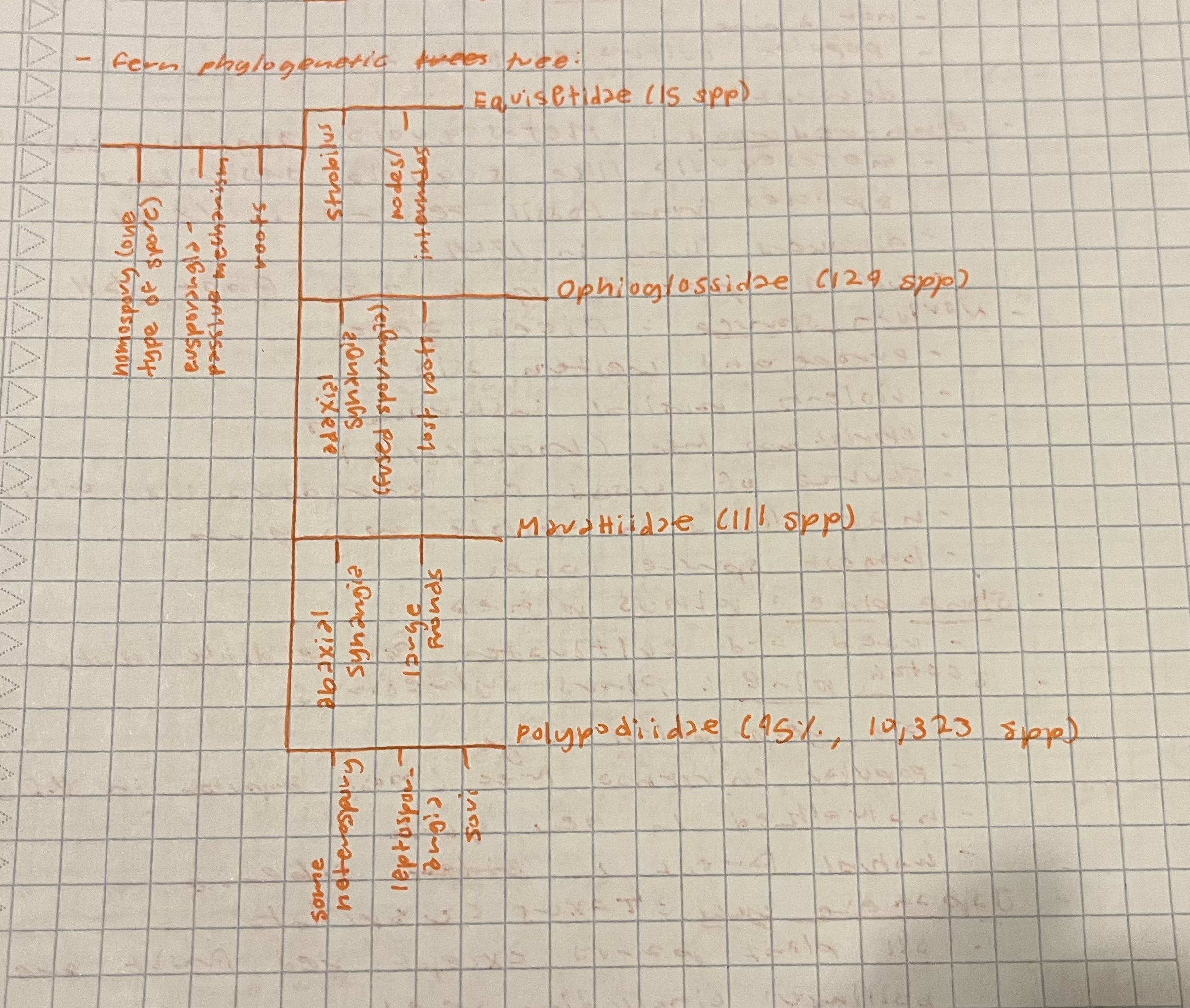
Fern groups
extant lineages and 4 subclasses
Polypodiidae (95%), 10,323 species
Marattidae, 111 species
Ophioglossidae, 129 species
Equisetidae, 15 species
Fern Traits
homospory: one type of spore for both sexes
Polypodiidae: some heterospory, leptosporangia, sori
Eusporangia: passive mechanism (wind dispersal)
Leptosparangia: development → active mechanism
Ophioglossidae: adaxial synangia (fused sporangia)
Equisetidae: strobilus, nodes/ internodes
Marattiidae: abaxinal synangia, large fronds
all subclasses have roots EXCEPT OPHIOGLOSSIDAE
What is the rarest fern in the United States?
American Harts tongue fern
listed as threatened species in the US
habitat destruction and over collection, etc
How is the American harts tongue fern being conserved?
habitat protection (USF and WS), climatic and habitat analysis, genetic diversity analysis, in vitro propagation for restoration (argmentation and reintroduction), under consideration for delisting
Origin of seed plants: Carboniferous
359 to 299 mya
dominated by lycophytes (spore → swimming sperms)
warm and humid swamps
cold and dry at the end of the Carboniferous
Origin of seed plants: Permian
299- 259 mya
greatest consolidation of the continents (pangea)
immense dry inland environment → lost a lot of ferns because it was dry
seedless vascular plants become regulated to coastal, wet areas
seed plants evolved under dry conditions and started to dominate
Environmental forces for evolution of the seed
free living gametophytes of seedless plants are vulnerable
retention of gametophytes on maternal parent is an advantage
Triassic (252 - 201 mya)
began with an impoverished earth, with hot and dry climate
favored planes pre-adapted to arid conditions
seed plants became the dominate group
further evolution of the seed and other innovations
gymnosperms (naked seed plants → ovules not in an ovary)
Examples of further evolution of the seed and other innovations:
1) seed: seed coat, food source and young plant versus spore
2) pollen: contains male gametes
reproduction becomes airborn
allowed sexual reproduction to occur even in dry environments
Cycadophyta
Cycads
dominate group during Jurassic (201-145 mya)- still present today
pinnately compound leaves
frond clustered on top
typically unbranched
Xerophytic (thick and leathery fronds, hypodermis, sunken stomata
When was the ”age of the Cycads”?
the Jurassic period
Diversity of Cycads:
11 extant (alive) genra, 800 species, tropics to subtropics
Ginkgophyta
peaked at jurassic
7 genra, 50 species → EXTICT
Ginkgo biloba is the LONE SURVIVER
unchanged for more then 150 mya (morphology conserved)
Ginkophyta traits
simple, fan-like and bilobed leaves
xerophic leaves
dichotomous veins
carkin-like reproductive structure
paired ovules
Gnetophyla
3 families (Aphedra, Welwischia, Gnetum)
1 genus in each
enigmatic group (morphological different)
monophyletic group (molecular and anatomical data used to group them)
Aphedra
jointed stems, small and scale-like leaves, shrubs
Welwischia
2 strap-like leaves, short/ stout stem, herb
Gnetum
simple and laminar leaves, tree form
Coniferophyta
Conifers
most ecologically and economically important gymnosperms
initial and subsequent diversification
Coniferophyta: initial diversification
Triassic (252 - 201 mya)
have rise to many families and genera that still exist today (ex. southern hemisphere: Ararcariaceae, Podocarpaceae, few pines)
Coniferophyta: subsequent diversification
Jurassic (201 - 145 mya)
Ex. Northern hemisphere: Pinaceae, Cupressaceae (Juniper, Cupressus, Thuja)
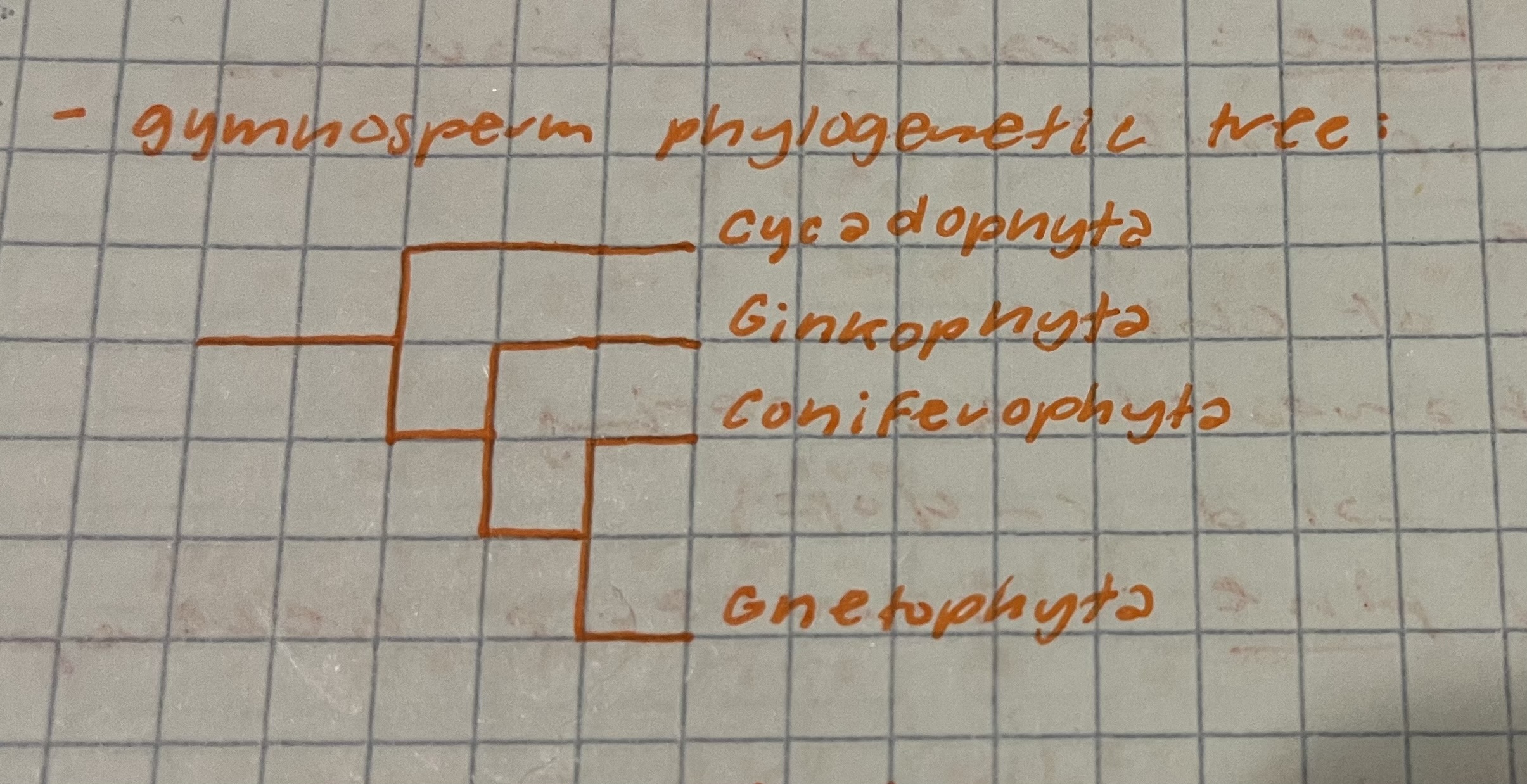
Gymnosperm phylogenetic tree
see image
Fern phylogenetic tree
see image