CHEM Chapter 2
 Call Kai
 Learn
Learn Practice Test
 Spaced Repetition
 Match
Match Flashcards
 Knowt Play
1/70

There's no tags or description
Looks like no tags are added yet.
Name | Mastery | Learn | Test | Matching | Spaced | Call with Kai | Chat |
|---|
No analytics yet
Send a link to your students to track their progress
71 Terms
Element
Contains only one type of atom
Molecule
Contains two or more atoms that are covalently bonded
Compound
Two or more different elements that are chemically combined in a specific ratio by mass, cannot be physically separated
Pure Substance
Contains only one substance
Mixture
Contains two or more pure substances, can be physically separated
Heterogenous Mixture
Contains two or more distinct phases
Homogenous Mixture
Contains a single phase
Phase
A region containing one substance that has physical boundaries
Law of Mass Conservation
Mass before reaction is the same as mass after reaction
X Symbol
Chemical symbol for the substance
Z Symbol
Atomic number, represents number of PROTONS in the nucleus, determines the element

A Symbol
Mass number, represents number of protons AND neutrons, defines the mass of one atom of the element

Ion
An atom with a charge
Cation
Positive ion
Anion
Negative ion
Isotope
Atoms/ions of an element that have a different number of neutrons
Unstable
Undergoing nuclear decay
Periods
Rows of the periodic table
Groups
The columns of the periodic table

Group A
Main Group Elements

Group B
Transition Elements/Metals

Elements 58-71 and 90-103
Rare-Earth Metals (Inner Transition Elements/Metals)
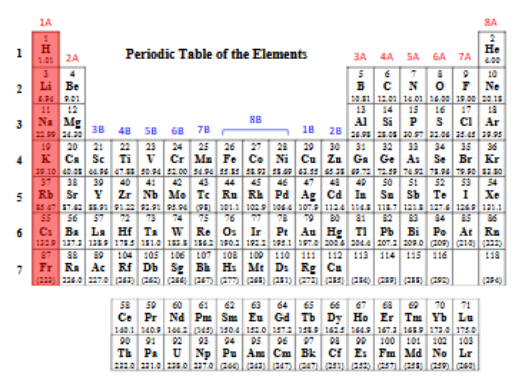
Group 1A
Alkali Metals

Group 2A
Alkaline Earth Metals

Group 7A
Halogens

Group 8A
Noble Gases

Elements to the Left of the “Staircase” Line
Metals
Elements to the Right of the “Staircase” Line
Nonmetals

Elements in the “Staircase” Line
Metalloids
Diatomic Elements
Br, I, N, Cl, H, O, F
Polyatomic Ions
Ammonium, Hydroxide, Chlorate, Nitrate, Carbonate, Sulfate, Phosphate
NH41+
Ammonium’s chemical formula
OH1-
Hydroxide’s chemical formula
ClO31-
Chlorate’s chemical formula
NO31-
Nitrate’s chemical formula
CO32-
Carbonate’s chemical formula
SO42-
Sulfate’s chemical formula
PO43-
Phosphate’s chemical formula
Law of Definite (or Constant) Composition
No matter what the source of a compound, it’s elements occur in the same proportion by mass
Law of Multiple Proportions
If elements A and B react to form two compounds, the different masses of B that combine with a fixed mass of A can be expressed as a ratio of small whole numbers
How is Atomic Mass calculated/found?
By taking each naturally occurring isotope and calculating the weighted average
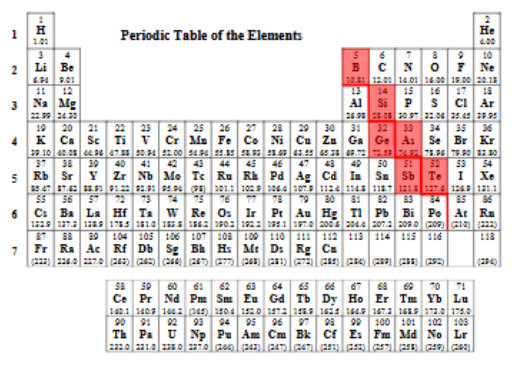
Metalloids
B, Si, Ge, As, Sb, Te
Ionic Bonding
Cations and anions bind together via electrostatic attraction (usually metals and nonmetals)
Covalent Bonding
Atoms share electrons and form molecules (Usually between nonmetals)
Metals tend to form:
Cations
Nonmetals tend to form:
Anions
Group 1A’s charge
1+
Group 2A’s charge
2+
Group 7A’s charge
1-
Group 6A’s charge
2-
Group 5A’s charge
3-
Group 4A’s charge
4-
F2
Flourine gas
H2, N2, O2, F2, Cl2, He, Ne, Ar, Kr, Xe, Rn
Gases at room temperature (25 C)
Mono-
Means “1”
Di-
Means “2”
Tri-
Means “3”
Tetra-
Means “4”
Penta-
Means “5”
Hexa-
Means “6”
Hepta-
Means “7”
Octa-
Means “8”
Nona-
Means “9”
Deca-
Means “10”
Binary Compound
Has 2 Elements
Binary Covalent Compound/Acid
H + Non-metal
Ternary Covalent Compound/Acid
H + Polyatomic ions
Hydrates
Ionic compounds whose crystal lattices contain trapped H2O
Mixed Salts
H+ that can be replaced with any Group 1A cation, Na+, K+
3 Polyatomic Ions that can make Mixed Salts
Carbonate/CO32-, Sulfate/SO43-, Phosphate/PO43-
Acids
Covalent compounds that can become ionic under the right conditions