Phospholipid membranes
 Call Kai
 Learn
Learn Practice Test
 Spaced Repetition
 Match
Match Flashcards
 Knowt Play
1/12

There's no tags or description
Looks like no tags are added yet.
Name | Mastery | Learn | Test | Matching | Spaced | Call with Kai | Chat |
|---|
No analytics yet
Send a link to your students to track their progress
13 Terms
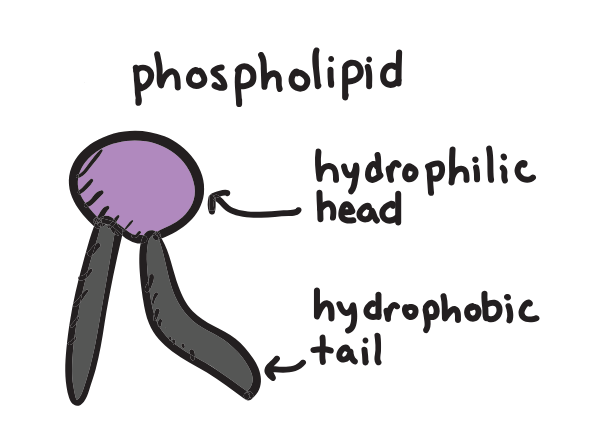
Structure of a phospholipid
Made up of a phosphate group, glycerol unit and two fatty acid tails
Why do phospholipids form a membrane (bilayer)?
Negatively charged (polar) phosphate head is hydrophilic
The fatty acid tails are non-polar, they are hydrophobic
If phospholipids are completely surrounded by water they form a phospholipid bilayer
What is meant by the term fluid mosaic model?
proteins can move freely through the lipid bilayer
ease of movement is dependent on the number of unsaturated fatty acids in the bilayer
contain various proteins
How do fat soluble molecules and polar molecules move through a bilayer?
Fat soluble organic molecules:
diffuse through the bilayer
Polar molecules:
require proteins
Two types of proteins in bilayer
intrinsic proteins
extrinsic proteins
What are intrinsic proteins?
completely span phospholipid bilayer
main transport system
can form channels, carrier proteins or active pumps
What are extrinsic proteins + their purpose?
on surface of bilayer or partially embedded in it
provide mechanical support
act as cell receptors
What are the two types of intrinsic proteins?
Channel proteins
Carrier proteins
What are channel proteins?
Pores in the membrane that let ions diffuse through
What are carrier proteins?
Proteins which change shape to let specific molecules through
What are glycoproteins + their function?
Protein with a carbohydrate molecule attached
can allows cells to attach to each other (cell adhesion)
acts as receptors for hormones and neurotransmitters
What are glycolipids + their function?
Carbohydrates attached to phospholipid molecules
act as cell markers or antigens
Purpose of cholesterol in cell membranes
Stabilises the membrane and regulates its fluidity