CBNS108 lectures 8-9
 Call Kai
 Learn
Learn Practice Test
 Spaced Repetition
 Match
Match Flashcards
 Knowt Play
1/94

There's no tags or description
Looks like no tags are added yet.
Name | Mastery | Learn | Test | Matching | Spaced | Call with Kai | Chat |
|---|
No analytics yet
Send a link to your students to track their progress
95 Terms
What are dorsalized mutants?
ventral structures converted to dorsal structures, making the whole embryo dorsal structures
What are ventralized mutants?
dorsal structures converted to ventral structures, meaning whole embryo has ventral structures
What are the maternal determinant(s) required for ventral fates?
Spatzle and toll
What are the maternal determinant(s) required for dorsal fates?
Cactus
What happens to an embryo with mutations in spatzle/toll genes?
Have no ventral structures; dorsal structures replace ventral
What happens to an embryo with mutations in the cactus gene?
Has no dorsal structures, ventral structures are in place of dorsal
How are spatzle/toll and cactus proteins initially present in the larva?
They are distributed uniformly
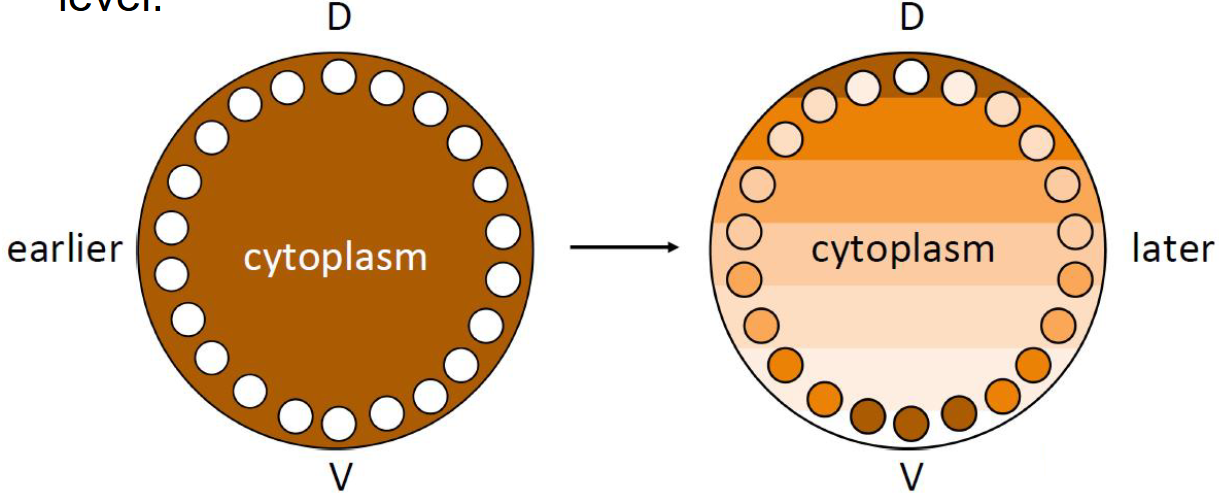
Explain the experiment behind these drawings
Immunohistochemistry with an antibody against dorsal protein. Depicts a cross section of the syncytial embryo with the color corresponding to dorsal protein level.
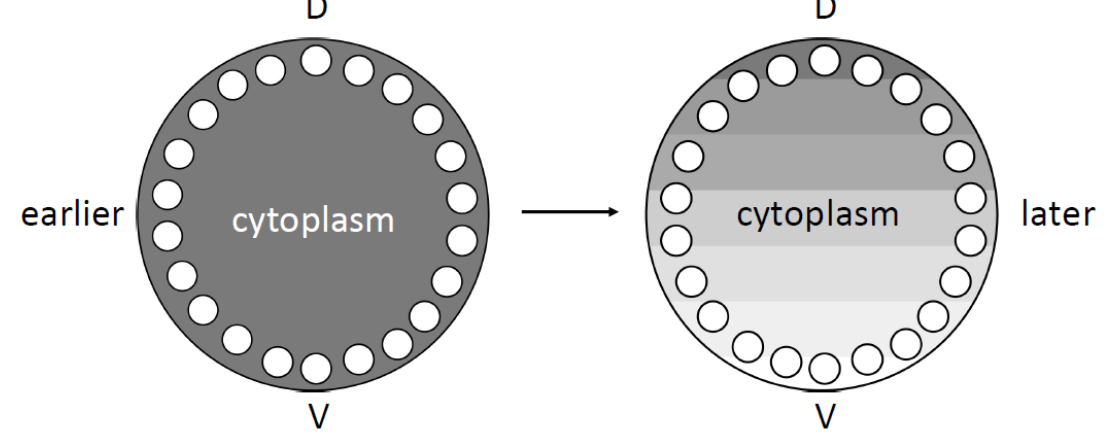
This figure shows immunohistochemistry experiments with an antibody against _______ protein.
Cactus
What happens to dorsal protein distribution during the syncytial blastoderm stage?
Dorsal protein is translocated to the nucleus in a V→D gradient(highest concentration in ventral nucleus).
What signaling pathway is essential for nuclear translocation of Dorsal protein?
Toll
What type of receptor is Toll?
receptor tyrosine kinase(RTK)
Fill in the blanks about the Toll signaling pathway: Toll is activated by the binding of ________. Toll activation initiates a kinase cascade that results in ___________ of ________, which is bound to _______.
Spätzle; phosphorylation; cactus; dorsal
What happens to phosphorylated cactus?
It gets degraded, which frees the dorsal it is bound to
What happens to free dorsal?
It translocates to nucleus and activates transcription of ventral genes
What is the origin of all the components of the Toll signaling pathway?
Maternal products in the egg
When is the Spatzle ligand activated?
After Fertilization
Where is the Spatzle ligand activated? How so?
On the ventral side, specifically in the peri-vitelline space.
By a localized protease cascade
On which side(D or V) is the Toll receptor activation gradient concentrated?
Ventral
How do maternal effect mutants with D-V patterning differ from those with A-P patterning?
The maternal effect mutants with D-V patterning defects show hyper-dorsalization or hyper ventralization, whereas those with A-P patterning defects only lose anterior, posterior or terminal fates
Explain the molecular basis behind the dorsal mutant phenotype.
An absence of dorsal means it cannot translocate to the nucleus and activate transcription of ventral genes. Phenotype contains only dorsal structures.
Explain the molecular basis behind the cactus mutant phenotype.
Absence of cactus means nothing is preventing dorsal from translocating into the nucleus and transcribing a ventral fate. Phenotype contains only ventral structures.
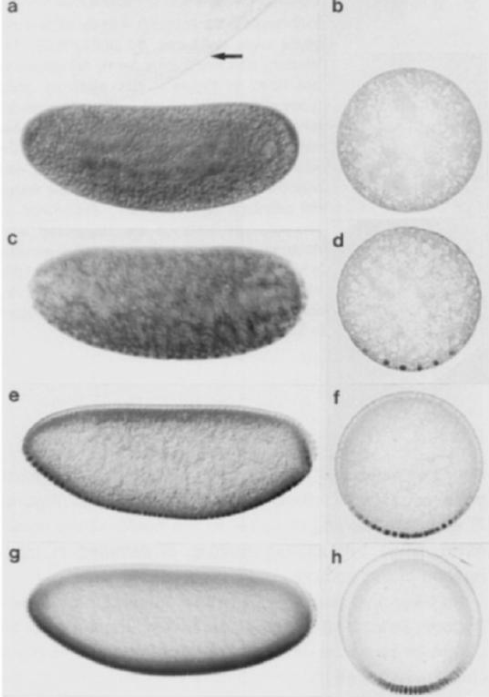
What can we observe about the nuclear gradient of dorsal protein from this image?
The asymmetry along the D-V axis is in the nuclear concentration of Dorsal Protein
True or false: dorsal protein is a morphogen
True
Zygotic target genes of Dorsal have different _________ _________ for activation or repression
threshold concentrations
How are Dorsal target genes regulated?
Whether a target gene is activated or repressed depends on the concentration of dorsal.
What are enhancers again?
Sequences in DNA regulatory regions of target genes that bind to transcription factors
What are high affinity binding sites?
Transcription factors bind to the enhancer even when its concentration is low
What are low affinity binding sites?
Transcription factors bind to the enhancer only when its concentration is high
______(high/low) response genes have high affinity binding sites. ______(high/low) response genes have low affinity binding sites
low; high
What determines whether an enhancer is a high affinity or low affinity binding site
The specific DNA sequence of the enhancer
Suppose a gene has a combination of low and high affinity binding sites for Dorsal. Where would the gene be expressed?
in the ventrolateral zone where Dorsal concentration is medium
What does the dorsal ectoderm become?
Epidermis
What does the lateral ectoderm become?
Epidermis and nervous system
Name two target genes of dorsal protein.
bpp, sog
What is bpp gene classified as?
BMP
What is sog gene classified as?
Chordin
Where is dpp expressed? Describe its gradient.
regions where there is no Dorsal protein in the nucleus; creates a D—>V gradient of dpp
Where is sog expressed? Describe its gradient.
In the lateral ectoderm, forming a V→D gradient.
Fill in the blanks about the BMP signaling gradient: The dorsal side contains ____(high/low) dpp and ____(high/low) sog. The ventral side contains ____(high/low) dpp and ____(high/low) sog.
High; low; low; high
What are some benefits of C elegans as a model organism?
-short life cycle
-can produce many offspring
-fixed number of cells in adults
-invariant cell lineage
-can be observed since it’s transparent
Describe the steps of C elegans development
Cleavage of fertilized egg—>embryogenesis—>hatchling—>growth and development into adult.
What type of experimental strategy is mutant analysis?
Break it
What type of experimental strategy is cell removal and differentiation in isolation?
Move it
Identify the 6 founder cells of the C elegans embryo.
AB, MS, E, C, D, P4
What tissue(s) does AB turn into?
Hypodermis and neurons(mostly), muscle(minor)
What tissue(s) does MS turn into?
Muscle(mostly), neurons(minor)
What tissue(s) does E turn into?
Gut
What tissue(s) does C turn into?
Muscle and neurons
What tissue(s) does D turn into?
Muscle
What tissue(s) does P4 turn into?
Germ line
What cell stage is the AP axis set up in?
1
What cell stage is the DV axis set up in?
2-4
What cell stage is the left-right axis set up in?
4-6
What occurs in the 1st cleavage division of C elegans?
P0 divides into AB and P1
What makes AB different from P1?
Only the P1 cell inherits P granules and PIE-1 maternal determinants
Which statement is true:
P granules and PIE-1 are asymmetrically distributed along the A-P axis
P granules and PIE-1 are uniformly distributed but are asymmetrically partitioned into the P1 cell
P granules and PIE-1 are uniformly distributed but are asymmetrically partitioned into the P1 cell
After egg contraction, what direction are aPARs carried? How about pPARs?
aPARs= anterior. pPARs=posterior
What are PAR proteins?
A network of scaffolding proteins, adaptors, and enzymes that form and stabilize asymmetries and regulate cell polarity.
Which side of the C elegans larva does sperm enter?
Posterior
Which side does the C elegans egg cortex contract toward?
Anterior
After sperm entry, where will cytoplasmic P granules and PIE-1 get segregated to?
Posterior
The cell that inherits cytoplasm with P granules and PIE-1 becomes:
P1
How can PIE-1 be visualized?
By tagging it with GFP. Since the embryo is transparent, we can see the fluorescence.
What two divisions occur in the second cleavage division(C elegans).
AB → ABa and ABp
P1 → P2 and EMS
Cell that inherits P granules becomes:
P2
Cell that DOESN’T inherit P granules becomes:
EMS
What induces ABa to ABp fate?
Being in contact with P2
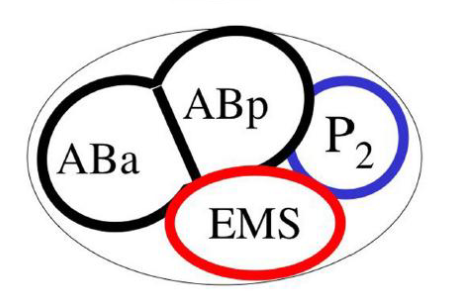
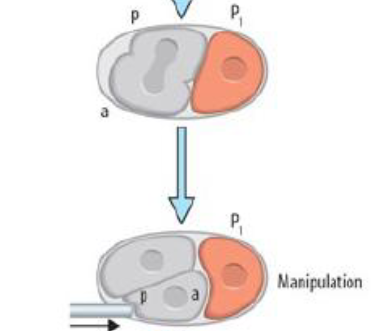
What happens if you push and rotate the future ABa cell?
ABa becomes the posterior cell, ABp becomes the anterior cell.
Embryo develops normally but “belly up”
When is the left right axis established?
After the D-V axis
What receptor do AB cells have?
GLP-1(notch receptor not ozempic)
What ligand do P2 cells express?
APX-1
How is ABp fate induced?
APX-1 ligand can only bind to GLP 1 receptor if they are in immediate contact. The GLP-1 signaling pathway is activated in Abp but not in Aba
Activation of the GLP-1 pathway induces ______ fates.
Dorsal
In the 3rd cleavage division, EMS splits into:
E and MS
How does EMS displays both autonomous and conditional specification?
In isolation, EMS will divide into MS and MS: autonomous specification
When EMS is in contact with P2, it divides into MS and E: E is induced by P2
What is the result of explanting EMS at early 4-cell stage?
No E (EMS → MS + MS)
What is the result of explanting EMS at late 4-cell stage?
E is present (EMS → MS + E)
What happens if If P2 is killed at early 4-cell stage?
No E (EMS → MS + MS)
What signal does P2 produce?
Wnt signal known as MOM-2
What receptor does the P2 signal bind to and where is it expressed?
Frizzled receptor(MOM-5). Expressed in EMS
Activation of Frizzled receptor (MOM-5) by MOM-2 results in:
phosphorylation of POP-1 in E cell
What happens to phosphorylated POP-1?
It is exported from the nucleus into the cytoplasm.
MS cells will have POP-1 in the ________, while E cells will have POP-1 in the ________.
Nucleus; cytoplasm
What is POP-1?
A transcription factor that makes MS fates different from E fates.
Signals from P2 are important for specification of which cell fates?
ABp and E
Lefthand daughters are more _________(anterior/posterior) than righthand daughters.
Anterior
What happens if you reverse the positioning of ABal and ABar cells?
It flips the L-R handedness of the animal
In C elegans, asymmetries arise from ________ and ________ rather than morphogen gradients.
Lineage and cell-cell communication
What experiment showed that cell lineage is linked to its fate?
Fate mapping of founder cells
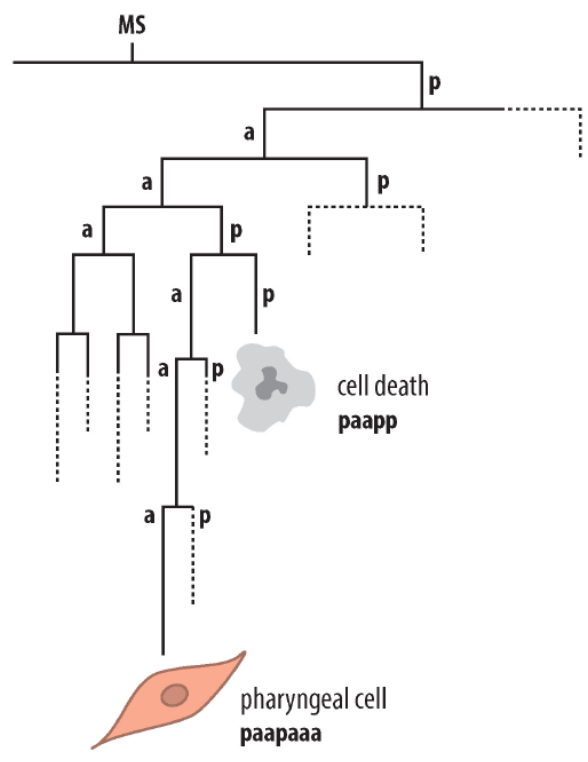
Compare gastrulation in C elegans with that in frog/fly embryos
Gastrulation in C elegans begins at only the 26 cell stage and involves much less cell movement than the other species.
What is the general role of Hox genes in nematodes?
Positional identity
What is unique about the organization of Hox genes in nematodes, and what do they encode?
They are present in a reduced cluster and encode transcription factors.
How do Hox genes exert their effects within the context of nematode development?
They act by regulating cell fate decisions within specific lineages, integrating directly with the nematode's lineage-based development system.
Why are the roles of Hox genes most functionally obvious during nematode larval development?
Because many cells are born post-embryonically, meaning positional identity must be actively reinterpreted during larval stages.