4.2.1 Biodiversity and Sampling
 Call Kai
 Learn
Learn Practice Test
 Spaced Repetition
 Match
Match Flashcards
 Knowt Play
1/49

Earn XP
Description and Tags
Practice: Simpson’s index of diversity
Name | Mastery | Learn | Test | Matching | Spaced | Call with Kai | Chat |
|---|
No analytics yet
Send a link to your students to track their progress
50 Terms
Bio-diversity definition
The variety of plant and animal life in the world or in a particular habitat; a high level of which is usually considered to be important and desirable
How is the bio-diversity in tropical, moist regions
Contain the most bio-diversity as they have:
High & consistent energy output (lots of solar radiation, highly reliable rainfall)
Stable climate conditions - allows for all year round growth and specialised evolutions
What are the three different forms of bio-diversity
Habitat biodiversity
Species biodiversity
Genetic biodiversity
What is habitat biodiversity
The number of different habitats found within an area
Each habitat can support different species
The more habitat biodiversity within an area, the greater the species biodiversity
What is species biodiversity
Species richness: The number of different species in a given ecosystem, region or particular area
Species Evenness: A comparison of the numbers of individuals of each species living in a community.
Mathematically defined as a diversity index - a measure of biodiversity which quantifies how equal the community is numerically
Ecosystems with a high species diversity are usually more stable as they are more resilient to environmental changes
What is genetic biodiversity
Refers to the variety of alleles that make up an individual species (i.e. genetic variation)
Alleles are different versions of the same gene
The more alleles that exist, the greater the genetic biodiversity
Greater genetic biodiversity within a species allows for better adaptation to a changing environment
Limited in populations that are very small or isolated which would cause genetic diseases caused by recessive alleles to become more common
What is sampling
Selecting and studying a small portion of the habitat carefully, using the numbers of individuals to estimate the population size for the whole habitat
Necessary to measure biodiversity in large and complex ecosystems as it would be impossible to count every organism
Strategies include:
Random sampling
Non-Random sampling (Opportunistic Sampling, Systematic sampling & Stratified sampling)
What is random sampling
Quadrat placed at randomly (coordinates selected using random number generator) chosen locations in a habitat
Used to measure abundance/number of a species in an area
What are the advantages and disadvantages of random sampling
Advantages:
Prevents bias in the data
Disadvantages:
May not cover all areas of a habitat equally
Species with a low presence may be missed (underestimate of biodiversity)
What is Opportunistic sampling
Selecting sampling sites or organisms based on convenience e.g. studying only the plants nearest to a footpath
What are the advantages and disadvantages of opportunistic sampling
Advantages:
Fast, easy & convenient; requires less planning and fewer resources
Disadvantages:
Highly biased and can lead to an overestimate of biodiversity; not representative of the whole ecosystem
What is systematic sampling
Belt transect: quadrat placed regularly along a transect line and number of individuals recorded
Line transect: position of species touching a transect recorded
Used when there is a change in environmental conditions over the area (eg,from one side of a river to another)
What are the advantages and disadvantages of systematic sampling
Advantages:
Useful when the habitat shows a clear gradient in an environmental factor
Disadvantages:
Only the species on the belt or the line may be recorded, other species may be missed (underestimate of biodiversity)
What is stratified sampling
Dividing a habitat into areas which appear different, and sample each area separately. Within each area, the quadrats would be placed randomly
For example:
If an area consisted of 50% woodland, 30% scrubland and 20% grassland, then 50% of quadrats would be in woodland, 30% on scrubland, 20% on grassland
What are the advantages and disadvantages of stratified sampling
Advantages:
Ensures all the different areas of a habitat are sampled and species are not underrepresented
Disadvantages:
Possibility that it may lead to over representation of some areas in the sample
What is animal sampling
Other techniques only work for plants or animals which are static
Other methods are used when sampling mobile populations such as:
Sweep nets
Pooters
Pitfall traps
What are sweep nets
The nets can be swept across vegetation, e.g. grass or tree branches, to catch flying insects and insects that live on leaves
After sampling the insects in the net can be counted and identified
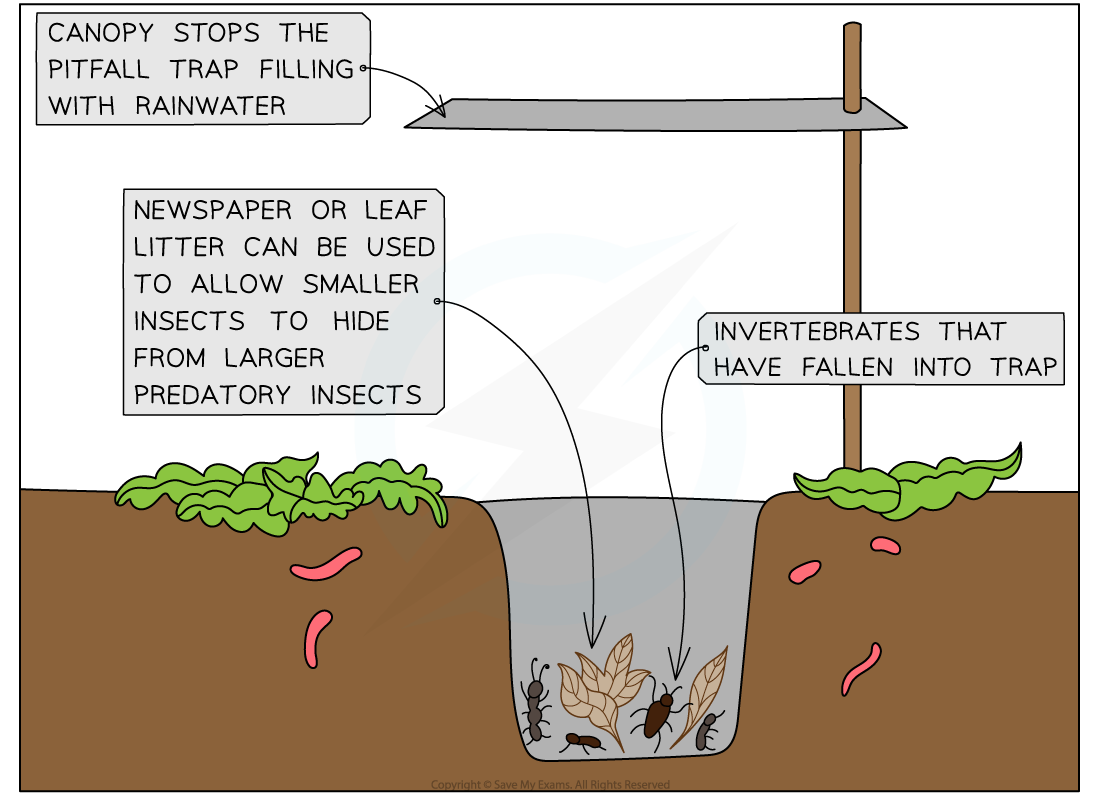
What are pitfall traps
Cans or jars that are sunk into the ground
Ground-dwelling invertebrates fall into the trap as they walk along the ground, and then cannot climb out again
A lid ensures that the trap does not fill with rainwater
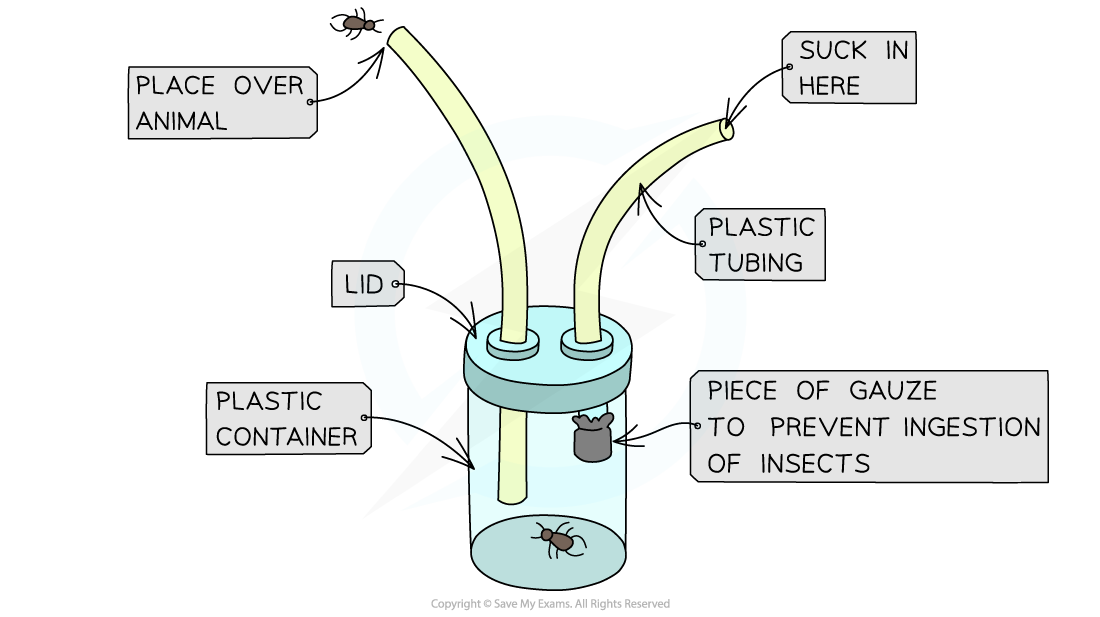
What are pooters
Pooters are small plastic or glass containers with two tubes extending from the lid
The tubes can be used to suck up small invertebrates
The first tube is placed over the insect and the second tube is used by the scientist to create suction
Once inside the container the sampled organisms can be easily viewed and identified
What is the Lincoln Index
An equation used to measure population size
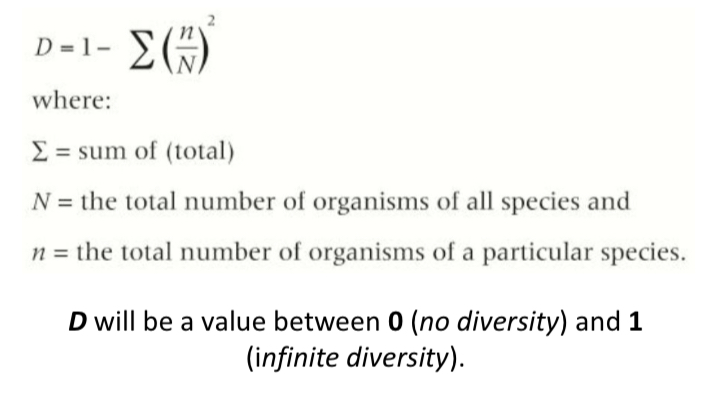
What is Simpson’s index of diversity
It takes into account:
Species evenness: the number of individuals within species within a certain area
Species richness: the number of species present
A higher ‘D’ value indicates a diverse habitat that will be able to withstand a small change to the environment as it may only affect one species that makes up a small part of the habitat
Habitats with low genetic diversity e.g. isolated populations include zoo’s, rare breeds, predigrees
What is a locus
The positions of a gene in a genome
What is a polymorphic gene
A gene with more than one allele
E.g. The human blood type, metabolic enzymes, haemoglobin types
How is genetic diversity measured
By calculating the percentage of loci in the population that have more than one allele
Genetic diversity = (no. of loci with more that allele/ total no. of loci) x 100
Proportion of polymorphic gene loci = number of polymorphic gene loci/total number of loci
What is the impact of deforestation on biodiversity
Loss of habitat (habitat diversity)
Reduction in species richness and/or species evenness (species diversity)
Often one type of tree is targeted
Migration of species to other locations/changing food web (species diversity and genetic diversity)
Individuals may need to find other suitable habitats
Other species who have not lost their habitats may suffer because they can’t find food or find themselves as more in demand prey
What is the impact of human population growth on biodiversity
Humans use many resources from the Earth e.g. land, water, wood
As the human population increases and countries become more economically developed, our requirement for natural resources also increases
This is having a harmful effect on many aspects of the environment, including aquatic and terrestrial ecosystems, and our atmosphere and climate
The damage to these ecosystems is negatively impacting the species and habitats contained within them
What is impact of agriculture on biodiversity
Loss of habitat (habitat diversity)
Clearing of hedgerows to make bigger fields
Replacement of trees with cropland
Reduction in species richness and/or species evenness (species diversity)
Replacement of native species with crop
Crops grown of one variety - monoculture (genetic diversity)
Pollution from pesticides/herbicides/factories
Killing non-targets species like bees - important pollinators
Eutrophication
What is a mono-culture
In order to feed an ever growing population, large areas of land are devoted to growing one specific type of crop
E.g. extensive corn fields in mid-west USA
What are the effects of a monoculture
Habitat loss: hedgerows are destroyed to make way for larger fields meaning fewer natural habitats for native wildlife
Loss of local plants and animals: many natural and local plants are destroyed when land is needed to grow food crops
Loss of heritage (traditional) varieties: can be destroyed by pesticides and herbicides used to increase yields
Describe the impact of climate change on biodiversity
Loss of habitat (habitat diversity) - e.g. polar ice caps melting
Reduction in species richness and/or species evenness (species diversity)
Distribution of species may change as environmental conditions change
Why should biodiversity be preserved
Ecological:
Avoiding the disruption of food chains/ natural cycles
Maintaining genetic diversity to enable species to survive
Protecting Keystone species
Economic:
Reducing soil depletion (continuous monoculture)
Preserving sources of fuel
Potential future uses by humans (medical/improving crops)
Ethical/Aesthetic:
Protecting Landscapes
Moral/Ethical responsibility
Tourism/Leisure
What is a keystone species
A species that has a disproportionately large effect on the ecosystem
Would have the greatest impact if they were lost
They are linked (directly or indirectly) to all other species and manage species richness/evenness of the habitat as a whole - interdependence of species
How can biodiversity be protected
In situ conservation - managing in natural habitats
Ex situ conservation - removing species from their habitats and protecting them in specialised environments
Give examples of in-situ conservation
Restricting Human Access
Controlling Poaching
Supplement feeding
Reintroduction of species
Culling or removal of invasive species
Halting succession:
Succession is the gradual change of an ecosystem over time and involves a shift in biotic and abiotic factors
This is interrupted to preserve immediate, high-diversity habitats (like heathland)
Advantages In situ conservation
Maintains genetic diversity of a species
Species can continue to adapt to changing environmental conditions
Food chains/webs are maintained
Protects the habitat rather that just the species
Cheaper than ex-situ conservation
What are the advantages to ex-situ conservation
Rare breeds can be protected from predators / changing environmental conditions to allow the species to survive
Captive breeding programmes can help the species size to increase
Animals bred in captivity can sometimes be released into the wild
Samples of plants or their seeds can be kept for research / future
uses
Give examples of ex-situ conservation
Botanic Gardens
Seed banks
Captive breeding programmes
What is the CBD conservation agreement
The Convention on Biological Diversity (CBD) was signed at the Earth Summit in Rio de Janeiro, Brazil in 1992
3 main goals:
The conservation of biological diversity by use of a variety of different conservation methods
The sustainable use of biological resources
The fair and equitable sharing of benefits arising from genetic resources
The countries that signed the convention agreed to:
Design and implement national strategies for the conservation and sustainable use of biodiversity,
Organise international cooperation and further international meetings
What is CITES conservation agreement
Convention on International Trade in Endangered Species of Wild Flora and Fauna
Global agreement signed by over 150 countries
Aims to control the trade of endangered species and their associated products
CITES categorizes endangered species into three forms:
Appendix I: species that are endangered and face the greatest risk of extinction - Red panda
Appendix II: species that will be facing extinction, unless trade is closely controlled - The Venus fly trap
Appendix III: species included at request of the country - The two-toed sloth in Costa Rica
There are different trading regulations that apply to each appendix
1: trade is banned
2: trade only granted with export permit
3: same as 2 but permits more common
Wha are the limitations of the CITES agreement
There are several concerns about the efficacy of CITES listings
When the trade of a certain endangered species becomes illegal, its price increases
The increased economic value of the species can be a major incentive for people to break the law
What is the CSS agreement
Countryside Stewardship Scheme
From the 1980s
Provided funding to farmers and private landowners in England who used environmental management strategies to protect and increase the natural biodiversity on their land
Was replaced by the Environmental Stewardship Scheme (ESS) in 2005
In order to qualify for the scheme, farmers and private landowners have to:
Provide and protect valuable wildlife habitats such as ponds surrounding farmed areas
Ensure their land is managed well
Protect any natural resources or historic features on their land
Conserve any traditional crops or livestock on their land
Provide visitor opportunities so people can learn about the countryside and how important it is in sustaining biodiversity
Move to 6.3.1. What is biomass
Biomass includes all the carbon containing compounds within a organism and so biomass can be equated to energy content
Energy available at each tropic level is measure in kilojoules per meter squared per year (kJm-² yr-^1)
It is measured per year to allow for changes in the photosynthetic production and feeding patterns
How is biomass lost
At each trophic level, some biomass is lost and so is unavailable to the organism at the next trophic level
These losses are due to:
Organisms need energy for life processes e.g. respiration
Dead organisms and waste material are only available to decomposers e.g. parts of animals and plants cannot be digested by consumers
Efficiency of biomass transfer formula

How efficient is energy at the producer level
Producers only convert a small % of the light energy they receive into chemical energy (biomass)
This is due to:
Approx. 90% of the light that falls on the plant is reflected
Other light is transmitted
Some of the light is of an unusable wavelength
Other factors may limit the rate of photosynthesis
A proportion of the energy is used for photosynthesis reactions
What is gross production
The total light energy that plants convert to organic matter
Some of this energy is then used for respiration, with the remaining energy converted to biomass e.g. cellulose, proteins, lignin
The energy converted to biomass is then available for the next trophic level - this is known as the Net Production
Net production = Gross production - Respiratory losses
Productivity definition
The rate at which energy passes through each trophic level
Primary productivity definition
The rate at which plants convert light energy into chemical potential energy
Gross primary production definition
The total amount of energy transferred by plants, from sunlight into plant tissues
Net primary production definition
The chemical energy that is left after the plants have supplied their own needs by respiration (i.e. the amount of energy available to pass on to primary consumer)