Developmental Psych (AP Psych)
 AP Practice
 Call Kai
1/79

Earn XP
Name | Mastery | Learn | Test | Matching | Spaced | Call with Kai |
|---|
No analytics yet
Send a link to your students to track their progress
80 Terms
cross-sectional studies
compares one cohort with another and is done within a shorter time period
longitudinal studies
studies the same group over a long period of time; it’s more time consuming and needs to account for drop-out rate; can see effects of changes in individuals over time
cohort effects
occurs when research results are skewed by shared social, cultural, or historical experiences of a specific generation (e.g. WWII, COVID-19 pandemic), rather than true age-related changes
continuity theories
development is gradual and difficult to notice changes
discontinuity/stage theories
there are stages and changes that occur dramatically and obviously (these stages are unchanging/universal)
maturation
refers to development that largely unfolds on its own, as according to a biological program in a reasonably supportive environment (mostly universal)
critical periods
a specific, limited maturational stage during which the brain is ready to acquire a specific skill or behavior such as talking or vision (usually happens during childhood). if missed, developing the ability later is more difficult or almost impossible.
socialization
refers to the impact of social environment on development. it is an ongoing process in which culturally desirable skills, attitudes, and behaviors are shaped by society.
teratogens, maternal illnesses, environmental factors, genetic mutations, hormones
prenatal influences
teratogens
(prenatal influence) agents that can reach embryo/fetus and cause harm prenatally
rooting reflex
when you touch a newborn on the cheek, he/she will turn and “root” for food source
fine motor skills
movement of small muscles for intricate tasks (e.g. eating, grabbing, drawing, stacking blocks)
gross motor skills
movement of large muscles for more “bigger” movements (e.g. walking, throwing, sitting)
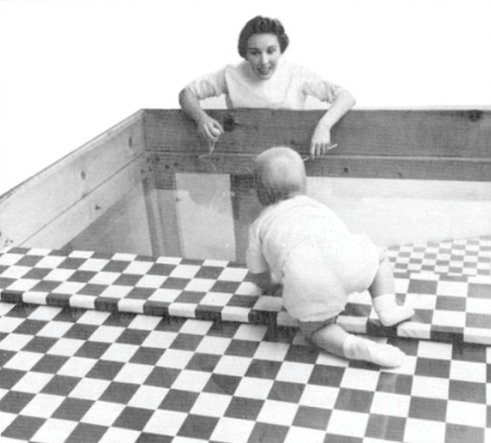
visual cliff
At around 6-14 months old, babies develop depth perception, which is tested by this experiment. Most infants refuse to cross the “____ ___”, showing that depth perception is linked to survival.
critical period for sensation
typically during the very first years of life (during infancy)
critical period for language acquisition
goes from the first few years of life to adolescence (and puberty)
phoneme
basic sounds of any language (there is a distinction across languages)
morpheme
smallest linguistic unit that carries meaning
semantics
the study of meaning in language, covering the interpretation of words, phrases, and sentences
syntax
the set of rules, principles, and processes that govern the structure of sentences in a language, such as word order and phrase arrangement
baby language
At this age, they can only communicate with one-word or cooing, babbling, or telegraphic speech.
overgeneralization
During language acquisition, kids typically apply regular grammar rules to words which those grammar rules do not apply.
ex: “I goed to the store!” (it should be “I went to the store”)
habituation
a baby decreases its response to a stimulus over continued exposure to it; they get “used to it”
infantile amnesia
the inability to recall autobiographical events from early childhood; a side effect of normal brain development
piaget theory
4 stages of cognitive development: 1. sensorimotor stage, 2. preoperational stage, 3. concrete operational stage, 4. formal operational stage
sensorimotor stage
birth - 2 yrs old
exploring and learning about environment through senses and motor abilities
object permanence (4-8 months), separation anxiety, stranger anxiety
object permanence
characteristic of the sensorimotor stage; understanding that things out of sight still exist
preoperational stage
2 - 7 yrs old
moves from parallel to pretend play, which shows symbolic thinking
language development, animism (inanimate objects have feelings)
begin as very egocentric but develop theory of mind towards age 4
symbolic thinking
one thing represents something else; characteristic of the preoperational stage
curse of knowledge
when a person develops specialized knowledge or understands a topic, they assume others share their knowledge; characteristic of the preoperational stage
ex: “dogs are fluffy and have tails”
“bro what dogs dont have fur”
egocentrism
inability to take/consider others’ perspectives; characteristic of the preoperational stage
theory of mind
ability to take/consider others’ perspectives; characteristic of the preoperational stage
concrete operational stage
7 - 11 yrs old
logical thinking, conservation, reversibility
conservation
idea that the amount of something does not change based on arrangement appearance; characteristic of concrete operational stage
ex: 3 × 2 = 2 × 3
reversibility
idea that things cane be changed and changed back; characteristic of concrete operational stage
formal operational stage
11+ yrs old
abstract and hypothetical thinking
can consider future possibilities and imaginary scenarios
social learning theory
focused on social interaction/context rather than biological maturation; learn gender behavior by observing, imitating, and receiving rewards/punishments
zone of proximal development
divides between what a child knows and can do on their own and what they have the “potential” to do with a supportive environment
scaffolding
developmental technique that uses temporary support (breaking down tasks, modeling, prompts) to help a learner master a skill beyond their current capability
ex: demonstrating to a kid how to tie their shoes
imprinting
animals (and sometimes humans) form a strong bond with the first thing they see, perceiving it as a “parent”
ex: Konrad Lorenz replaced a mother duck with himself. The baby ducklings imprinted on Lorenz and followed him around.
contact comfort
babies and children need physical touch and nurturance to form an attachment with their parent
strange situations
An observational study developed by Mary Ainsworth in the 1970s monitored children when with their mother, without their mother, and when the mother returned. This determined 4 attachment styles.
secure
attachment style; confidence, self-worth, accepts support
anxious
attachment style; clingy, highly emotional, seeking reassurance
avoidant
attachment style; distant, unemotional, avoids closeness
disorganised
attachment style; intense, push-pull, unpredictable
temperament
relates to (emotional) reactivity of nervous system of infants (e.g. high-reactive, low-reactive)
ACEs
Adverse Childhood Experiences; traumatic events that occurs before the age of adulthood; different in sociocultures around the world
ex: Romanian Orphanage Case Study
separation anxiety
often begins @ 6-9 months; distress when separated from parent/caregiver
authoritarian parenting
little warmth, high expectations, punishment, clear rules, emotionally distant, structured environments
authoritative parenting
responsive, clear standards, assertive, democratic, flexible, high expectations, reciprocal
permissive parenting
avoid confrontation, few rules, accepting, lenient/indulgent, non-directive, low expectations
uninvolved parenting
competing priorities, little time, absent, uninterested, neglectful, passive
Erik Erikson stages
Stage theory that focuses on the psychosocial development across lifespan, falls in 8 stages
stage 1
Trust vs. Mistrust: age 0-1; can a baby trust the world to fulfill his/her needs?; basic trust, effects can carry on for the rest of his/her life
stage 2
Autonomy vs Shame & Doubt: age 2-3; toddlers begin to control their bodies (toilet training); the word “no” can make a big impact on the toddler’s reaction; can they learn control or will they doubt themselves?
stage 3
Initiative vs. Guilt: age 4-6; turns from NO to WHY?; is curiosity encouraged or discouraged?
stage 4
Industry vs. Inferiority: age 6-puberty; school begins and we are evaluated by formal system/peers; do we feel good about accomplishments or “not good enough”?; can lead to inferiority complex
stage 5
Identity vs. Confusion: teenage yrs; trying out different roles; who am I? where do I fit in?; can lead to an identity crisis; role of familial identity
stage 6
Intimacy vs. Isolation: early adulthood yrs; examining priorities; developing relationships
stage 7
Generativity vs. Stagnation: middle adulthood yrs; have I created what I want in life or am I stuck?; midlife crisis
stage 8
Integrity vs. Despair: late adulthood yrs; was my life meaningful? do I have regrets?
diffusion
little sense of identity
ex: “I don’t know what I want to be when I grow up”
foreclosure
premature commitment to an identity
ex: “My parents are doctors so I’m going to be a doctor”
moratorium
more actively seeking meaningful identity
achievement
committed sense of self
gender identity
sense of being a boy or girl or a different gender than those two
microsystem
immediate, direct-contact groups to the child (Ecological Systems Theory)
ex: home, school, community
mesosystem
relationships between microsystem groups (Ecological Systems Theory)
ex: parents and peers
exosystem
environments that indirectly affect a person (Ecological Systems Theory)
ex: a parent’s workplace
macrosystem
cultural influences (Ecological Systems Theory)
ex: values, beliefs, economic and political systems
chronosystems
life stage and related events (Ecological Systems Theory)
ex: moving houses, economic recession, COVID-19 pandemic
social identity
the part of an individual’s identity that is derived from perceived membership in relevant social groups (e.g. sport’s team, family)
imaginary audience
an egocentric adolescent belief that everyone is watching and judging their appearance and behavior; high self-consciousness and social anxiety/embarrassment
personal fable
an egocentric adolescent belief where teenagers believe they are special, unique, and invulnerable to harm; they feel their experiences and emotions are entirely distinct from others', often leading to high-risk behaviors and a sense of being misunderstood
primary sex characteristics
male: testes, female: ovaries
secondary sex characteristics
male: deep voice, facial hair, increased muscle mass
female: breast development, widening of hips
spermarche
the first ejaculation of a male
menarche
the first menstrual period of a female
social clock
the cultural timetable and societal pressure to achieve major life milestones (e.g. getting married, graduating college, retirement)