Endocrine System
 Call Kai
 Learn
Learn Practice Test
 Spaced Repetition
 Match
Match Flashcards
 Knowt Play
1/79

There's no tags or description
Looks like no tags are added yet.
Name | Mastery | Learn | Test | Matching | Spaced | Call with Kai | Chat |
|---|
No analytics yet
Send a link to your students to track their progress
80 Terms
Water soluble hormones?
Amino acid-based hormones
* thyroid exception
Lipid soluble hormones?
Steroid & Thyroid hormones
Water soluble hormones: can & cannot?
Can: interact w/ receptors on the plasma membrane
Cannot: enter cell
Lipid soluble hormones: can & cannot?
Can: interact w/ intercellular receptors - activates genes
Cannot: interact with the plasma membrane
A hormone binds to a receptor. What is activated?
G protein becomes activated
G protein activates?
.
w/s: GPCR–cAMP signaling pathway
Adenylate cyclase protein
Adenylate cyclase does what?
.
w/s: GPCR–cAMP signaling pathway
Converts ATP into cAMP
What is cAMP
.
w/s: GPCR–cAMP signaling pathway
The 2nd messenger in the: GPCR–cAMP signaling pathway
cAMP does what?
.
w/s: GPCR–cAMP signaling pathway
Activates protein kinases
What do protein kinases do?
Donates phosphate
1st & 2nd Messengers?
.
w/s: GPCR–cAMP signaling pathway
Hormones
cAMP
What are hormones to a receptor?
1st messenger / signal
Steps: GPCR–cAMP signaling pathway
w/s
1. Hormone binds to receptor, activating the G protein
2. G protein activates adenylate cyclase
3. Adenylate cyclase converts ATP to cAMP
4. cAMP activates protein kinases
Steps: PIP2 - Ca signaling pathway
w/s
Hormone binds to receptor, activating G protein
G protein activates phospholipase C (PLC)
PLC cleaves PIP2 into two 2nd messengers
-
DAG - activate protein kinases
IP3 - causes Ca release from intercellular storage sites
-
Ca is also a 2nd messenger
1st & 2nd messengers?
.
w/s: PIP2 - Ca pathway
Hormones
DAG, IP3, Ca2+
Steroid hormone binds to?
.
l/s: genomic pathway
An intracellular receptor
The first thing the receptor-hormone complex does?
.
l/s: genomic pathway
Enters the nucleus / binds to a DNA sequence
What happens after the receptor-hormone complex binds to DNA?
.
l/s: genomic pathway
Initiates transcription resulting in mRNA
What does mRNA do?
Directs protein synthesis (in the ribosomes)
Steps: Genomic Pathway
Hormone binds to intercellular receptor
The receptor-hormone complex enters the nucleus
Binds to DNA, initiates transcription, mRNA created
mRNA leaves nucleus / directs protein synthesis in the ribosomes
Hormone release is triggered by what kind of feedback?
Negative feedback
Understanding: negative feedback / hormones
1. A change in the body disrupts homeostasis
2. An endocrine gland releases a hormone
3. The hormone travels through the blood and binds to its target cells
4. The target cells respond, correcting the imbalance
5. Once homeostasis is restored, hormone secretion decreases or stops
6. The response ends because the original stimulus is gone
Why do endocrine glands become stimulated? What is their function?
Synthesize / release hormones in response to 3 stimuli
3 endocrine gland stimuli
1. Humoral - mineral levels in the blood
2. Neural - sympathetic nervous system fibers (epi / noraepi release)
3. Hormonal - hormone triggers a gland so it can secrete their hormone (tropic)
Target Cell Specificity refers to?
How hormone levels influence the number/presence of receptors
2 ways the body manipulates Cell Specificity:
Up-regulation: increases the cell's sensitivity to hormones
Down-regulation: decreases the cell's sensitivity to hormones
Up-regulation Mechanism
Target cells form more receptors in response to low hormone levels
-
Effect: higher # of receptors in the cell, more hormones bind
(increases cell’s sensitivity to hormone)
Down-regulation Mechanism
Target cells lose receptors in response to high hormone levels
.
Effect: lowers # of receptors in the cell, fewer hormones bind
(decreases cell’s sensitivity to hormone)
Permissiveness?
When a hormone needs another hormone to stimulate a cell
Synergism?
When 2+ hormones produce the same effect on the target cell
Antagonism?
When 1+ hormones opposes the action of another hormone
Relationship btwn - Hypothalamus & Posterior Pituitary
The hypothalamus synthesizes 2 hormones that are stored and secreted in the posterior pituitary
Relationship btwn - Hypothalamus & Anterior Pituitary
Hypothalamus synthesizes inhibitory/release hormones
These hormones are sent to the anterior pituitary, where they stimulate or inhibit the release of pituitary hormones
Difference btwn the Anterior & Posterior Pituitary
Posterior - nervous tissue
hypothalamus transports hormones down nerve fibers to PP
.
Anterior - endocrine gland
hypothalamus secretes hormones into blood vessels that travel to AP
The 2 hormones that Hypo transports to PP?
ADH (antidiuretic hormone)
Oxytocin
Oxytocin?
.
Released from?
Triggers?
Target Cells?
Posterior Patuitary
Milk ejection & uterine contractions (positive feedback)
Mammary glands / muscle cells of the uterus
.
Acts as a neurotransmitter in the brain (PIP2 - Ca signaling pathway)
ADH (antidiuretic hormone)
Released from?
Triggers?
Target Cells?
Posterior Pituitary
Water retention
Kidney tubules
.
ADH release triggered by:
Pain, low BP, drugs
Osmoreceptors in the hypo monitor solute [ ]. When [ ] is high, PP secretes ADH
What Are Tropic Hormones?
Hormones that stimulate endocrine glands, causing them to release their own hormones
The 6 hormones that are synthesized/secreted in the AP?
1. PRL (prolactin)
2. GH (growth hormone)
.
4 tropic hormones
3. TSH (thyroid-stimulating hormone)
4. ACTH (adrenocorticotropic hormone)
5. FSH (follicle-stimulating hormone)
6. LH (luteinizing hormone)
.
**TSH/ACTH regulate the secretion of other hormones**
Few facts about AP hormones?
All are peptide hormones
Except for GH, they all activate target cells via cAMP
2 AP hormones regulate the secretion of other hormones
GH (growth hormone/somatotropin)
Released from?
Triggers?
Target Cells?
Tropic?
Posterior Pituitary
Increases metabolism / causes liver to break down glycogen into glucose
Liver
No
-
GHRH (hypo) - stimulates GH release in AP
GHIH (hypo) - inhibits GH release in AP
TSH (thyroid-stimulating hormone / thyrotropin)
Released from?
Triggers?
Target Cells?
Tropic?
Anterior Pituitary
Stimulates normal development / secretory activity of thyroid
Thyroid
Yes
-
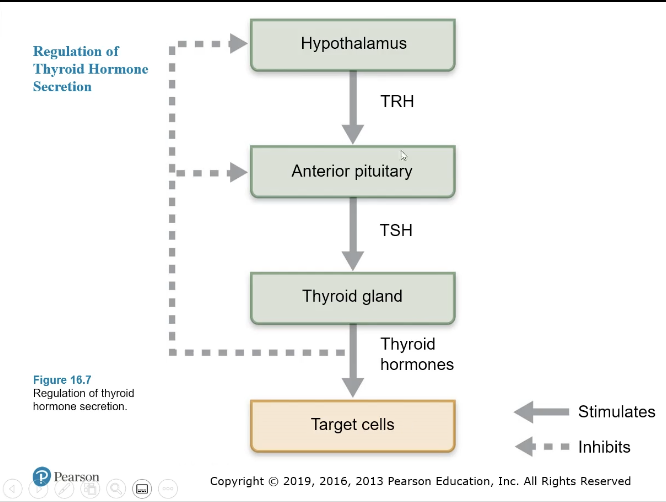
TRH (hypo) —> AP
TSH —> Thyroid Gland
Thyroid hormones —> target cells (many)
ACTH (adrenocorticotropic hormone)
Released from?
Triggers?
Target Cells?
Tropic?
Anterior Pituitary
Stimulates cortisol / androgen release
Adrenal cortex
Yes
.
CRH (hypo) —> AP
ACTH —> Adrenal Gland
Adrenal hormones —> target cells (many)
Gonadotropins: FSH (follicle-stimulating hormone)
Released from?
Triggers?
Target Cells?
Tropic?
Anterior Pituitary
Stimulates production of gametes (egg / sperm)
Ovaries / testes
Yes
.
GnRH (hypo) - stimulates FSH release in AP
Gonadotropins: LH (luteinizing hormone)
Released from?
Triggers?
Target Cells?
Tropic?
Anterior Pituitary
Production of sex hormones (estrogen / testosterone)
Ovaries / testes
Yes
.
GnRH (hypo) - stimulates LH release in AP
PRL (prolactin)
Released from?
Triggers?
Target Cells?
Tropic?
Anterior Pituitary
Milk production
Mammory glands
No
.
PIH (hypo) - inhibits PRL release in AP
Thyroid Gland - anatomy
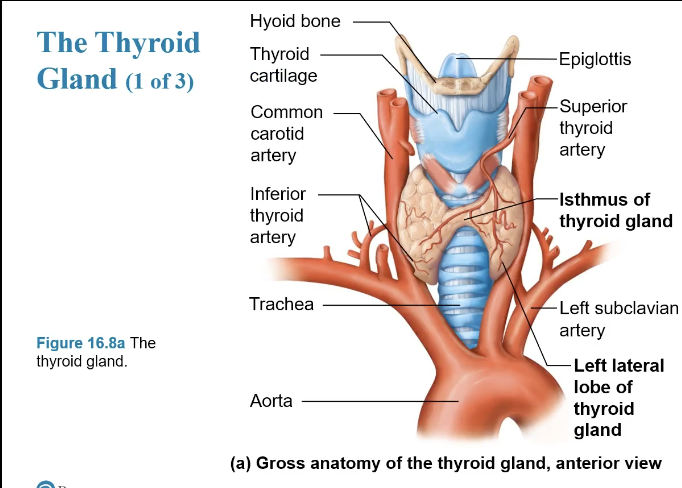
The two lobes rest on either side of the trachea
The isthmus is the connective tissue
Thyroid Gland - under a microscope
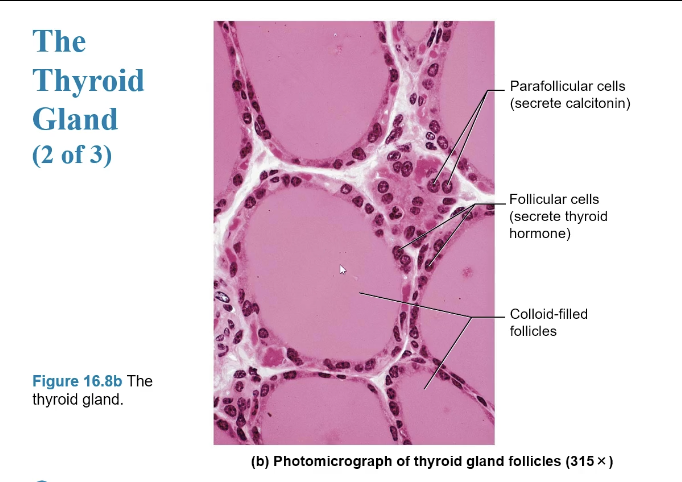
Follicular cells surround colloid-filled follicles
Parafollicular cells are found next to the follicular cells
Steps: synthesis of thyroid hormone
Thyroglobulin is synthesized and discharged into the colloid space
Iodide enters the space, oxidizes, becomes iodine
Iodine and tyrosine bind, forming DIT & MIT
DIT and MIT combine to form T3s and T4s
T3s and T4s eventually make their way to the blood
T4s get converted into T3 in order to stimulate cells
Thyroid Gland
Location?
Hormone?
Triggers?
Target Cells?
In the neck, on trachea
T3/T4 (secreted from the follicular cell)
Increases basal metabolic rate & heat production
Almost every cell in the body
Calcitonin (thyroid)
Released from?
Triggers?
Target Cells?
Parafollicular cells in thyroid glands (when Ca levels are high)
Lowers Ca levels
Osteoblast
.
Osteoblasts synthesize bone, taking Ca from the bloodstream, depositing it in the bone
Ca levels and blood decreases
Parathyroid Gland - anatomy
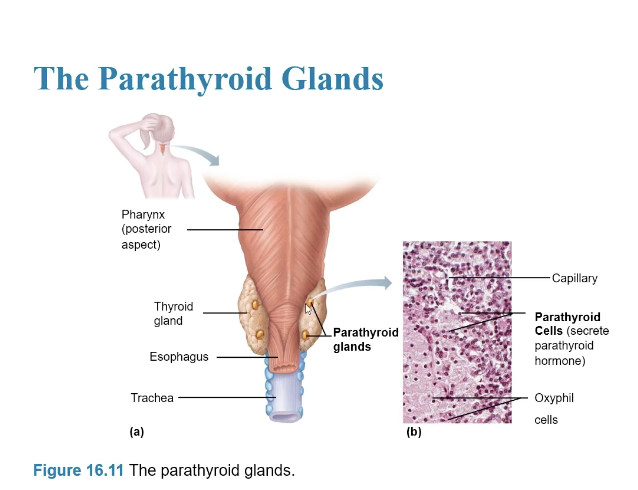
Located on the posterior side of the thyroid gland lobes
Parathyroid Gland
Location?
Hormone?
Triggers?
Target Cells?
Posterior side of the thyroid gland lobes
Parathyroid hormone (secreted from parathyroid cells)
Increases calcium levels in the blood
Many cells - osteoclasts, kidney, s. intestine
.
Osteoclasts degrade, causing calcium to be absorbed into the blood
Calcium levels increase
Adrenal Gland - anatomy
The adrenal gland sits on top of the kidneys (2 glands in 1)
1. Adrenal Cortex: 3 layers of tissue that synthesize/secrete hormones
2. Adrenal Medulla: nervous tissue (a part of SNS)
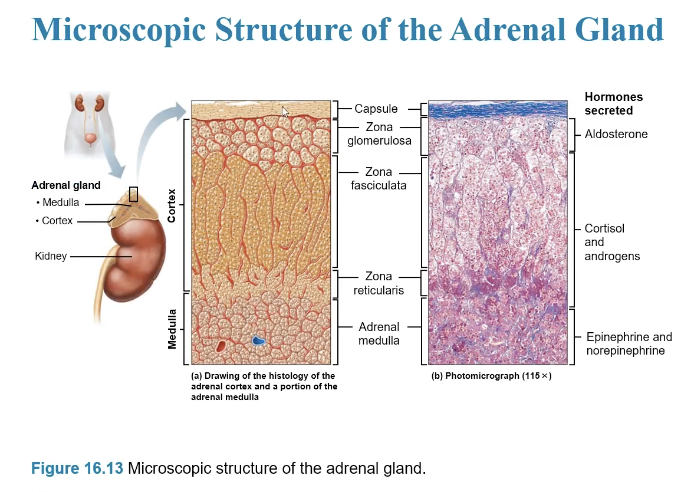
Adrenal Cortex 3 layers + hormone synthesis
Zona Glomerulosa - mineralocorticoids (aldosterone)
Zona Fasciculata - glucocorticoids (cortisol)
Zona Reticularis - gonadocorticoids (androgen)
Mineralocorticoids - aldosterone
Cortex Layer?
Triggers?
Target Cell?
Zona Glomerulosa
Sodium retention - kidney pumps Na back into the bloodstream
Kidneys
.
Psst! Clue: mineralocorticoids… Na is a mineral
Glucocorticoids - cortisol
Cortex Layer?
Triggers?
Target Cell?
Zona Fasciculata
Increases blood sugar (due to stress, exhaustion, poor diet)
Kidneys
Gonadocorticoids - androgen
Cortex Layer?
Triggers?
Target Cell?
Zona Reticularis
Support estrogen and testosterone production
Ovaries / testes
Adrenal Medulla
Hormones?
Triggers?
Target Cells?
Secretes epinephrine and norepinephrine (fight or flight situations) ***
.
Extra Info (not tested):
Vasoconstriction | ↑ heart rate | ↑ BP levels | Blood diverted to brain, heart, skeletal muscle
Tissues involved in the body's stress response
***ANP (atrial natriuretic)
Released from?
Triggers?
Target Cells?
Heart
Blocks renin / aldosterone secretion to decrease BP
Kidneys - zona glomerulosa
Pineal Gland
Location?
Hormone?
Triggers?
Target Cells?
Brain posteriorly
Melatonin
Day/night cycles, puberty
Fall asleep
Brain
Pancreas
Location?
Hormone?
Triggers?
Target Cells?
Behind stomach
Glucagon (alpha) | insulin (beta) | digestive enzymes (acinar)
Increases BP | decreases BP | promotes digestion
Liver | muscle, fat, liver
.
Pancreas is comprised of three types of cells
Acinar - exocrine cells
Alpha / beta - endocrine cells
Gonads
Location?
Hormone?
Triggers?
Target Cells?
Ovaries / testes
Estrogen plus progesterone / testosterone
Maturation of reproductive organs, breast development / sperm production, sexual characteristic development
Placenta
Secretes estrogens, progesterone, hCG (human chronic gonadotropin)
Thymus
Location?
Hormone?
Triggers?
Target Cells?
Upper chest / behind breast bone
Thymulin, thymopoietins, thymosins
Development of T-cells
Lymph nodes, spleen, lymphatic organs
Stimulus: Hypothalamus
Changes in the body's internal environment
Stimulus: Anterior Pituitary
Arrival of hormones secreted by the hypothalamus
Stimulus: Posterior Pituitary
Nerve impulses from the hypothalamus trigger release of ADH and oxytocin
Stimulus: Thyroid Gland
T3 / T4
TSH | TRH (hypo) —> TSH (AP) —> T3/T4 (thyroid gland)
-
Calcitonin
↑ Ca levels
Stimulus: Parathyroid Gland
↓ Ca levels
Stimulus: Thymus
Thymulin, thymopoietins, thymosins
Immune system development (T-cells)
Most active during childhood
Stimulus: Heart
↑ BP
Stimulus: Pineal Gland
Circadian sleep cycle
Stimulus: Adrenal Medulla
SNS stimulation
Stimulus: Adrenal Cortex
Mineralocorticoid - Aldosterone - RAAS, ↑K levels, ATCH
-
Glucocorticoids - Cortisol - ATCH
-
Gonadocorticoids - Androgen - ATCH
-
-
CRH (hypo) —> ATCH (ap) —> Cortisol (cortex)
Stimulus: Pancreas
Insulin (beta cells): ↑ BS
Glucagon (alpha cells) ↓ BS
Stimulus: Ovaries
FSH / LH
GnRH (hypo) —> FSH / LH (ap)
Stimulus: Placenta
Pregnancy
Stimulus: Testes
FSH / LH (anterior pituitary)
Stimulus: Kidneys
Erythropoietin: ↓ blood oxygen levels (hypoxia)
-
Renin: ↓ BP / ↓ blood volume