Chapter 9: Alcohol and Other Drugs
 Call Kai
 Learn
Learn Practice Test
 Spaced Repetition
 Match
Match Flashcards
 Knowt Play
1/8

There's no tags or description
Looks like no tags are added yet.
Name | Mastery | Learn | Test | Matching | Spaced | Call with Kai | Chat |
|---|
No analytics yet
Send a link to your students to track their progress
9 Terms
Alcohol and Other Drugs
Why it's dangerous
Driving under the influence of alcohol or drugs is extremely dangerous.
Alcohol and drugs impair judgment, reaction time, coordination, and decision-making.
Impaired driving puts your life and others' lives at risk.
Facts
In New York State, more than 40% of motor vehicle fatalities involve impaired driving.
Not every impaired driver crashes, but every impaired driver is dangerous.
Young drivers
Drivers under 21 are at higher risk because they have less experience with driving and alcohol/drugs.
Drivers under 21 make up about 4% of drivers but account for about 7% of impaired drivers involved in fatal crashes.
Penalties are more severe for underage drivers.
Laws and penalties
New York has strict DUI/DWI laws.
Enforcement is strict, and the chance of being caught and convicted is high.
Plea bargaining is limited for alcohol- and drug-related driving offenses.
Key takeaway
Never drive after drinking alcohol or using drugs. Impaired driving greatly increases the risk of crashes, carries severe penalties, and can cost lives.
What Alcohol Does
Effects of alcohol on driving
Slows reaction time.
Reduces clear vision, especially at night.
Impairs judgment of speed and distance.
Lowers inhibitions, making you more likely to take risks.
Weakens the skills needed for safe driving.
Night driving
Alcohol makes night driving even more dangerous.
Reduces your ability to recover from headlight glare, causing temporary blindness for longer periods.
Even one drink affects you
Alcohol begins affecting you with the first drink.
You do not have to feel drunk or be legally intoxicated for your driving to be impaired.
Judgment and decision-making
Alcohol makes it harder to recognize how impaired you are.
It can give you false confidence, making you think you're safe to drive when you're not.
It impairs your ability to make quick, safe decisions and react correctly to traffic situations.
Key takeaway
Alcohol affects your driving from the first drink by slowing reactions, impairing vision and judgment, increasing risk-taking, and making safe decisions more difficult—never drink and drive.
Other Drugs
How drugs affect driving
Prescription, over-the-counter, and illegal drugs can impair driving.
Drugs can affect:
Reflexes
Judgment
Vision
Alertness
Some medications (even cold or allergy medicine) can make driving unsafe.
Before driving
Read medication labels for driving warnings.
Ask your doctor or pharmacist if it is safe to drive while taking a medication.
Alcohol + drugs
Never mix alcohol with drugs or medications.
Alcohol can increase the effects of drugs, making impairment much worse.
Even one drink combined with some medications can affect you like several drinks.
Legal consequences
It is illegal to drive while impaired by:
Alcohol
Prescription drugs
Over-the-counter medications
Marijuana/cannabis
Illegal drugs (e.g., cocaine, LSD, heroin)
Key takeaway
Never drive if drugs or medications impair you, and never combine alcohol with drugs—it greatly increases the risk of crashes, serious injury, or death.
Alcohol, Other Drugs and the Law
Alcohol- and drug-related offenses
You can be arrested for:
Agg-DWI – Aggravated Driving While Intoxicated.
DWI – Driving While Intoxicated.
BAC of 0.08% or higher.
DWAI-Drug – Driving While Ability Impaired by Drugs.
DWAI – Driving While Ability Impaired by Alcohol.
Driving under the combined influence of alcohol and drugs.
Blood Alcohol Content (BAC)
BAC = the percentage of alcohol in your blood.
Measured by a breath, blood, urine, or saliva test.
Over 0.05% BAC: Legal evidence of impairment.
0.08% BAC or higher: Legally intoxicated (DWI).
0.18% BAC or higher: Aggravated DWI (Agg-DWI).
Chemical tests
A chemical test is not required for a conviction.
A police officer's observations of your:
Driving behavior
Appearance
Actions
can be enough evidence to convict you.
Penalties
If convicted of an alcohol- or drug-related offense:
Your driver license will be suspended or revoked.
Your license is taken immediately, even if you're allowed to drive for up to 20 more days.
Commercial drivers
Commercial driver's license (CDL) holders face stricter BAC limits and penalties.
Key takeaway
Driving under the influence of alcohol or drugs can result in arrest, license suspension or revocation, and severe legal penalties. A BAC of 0.08% is legally intoxicated, 0.18% is aggravated DWI, and police observations alone can be enough for a conviction.
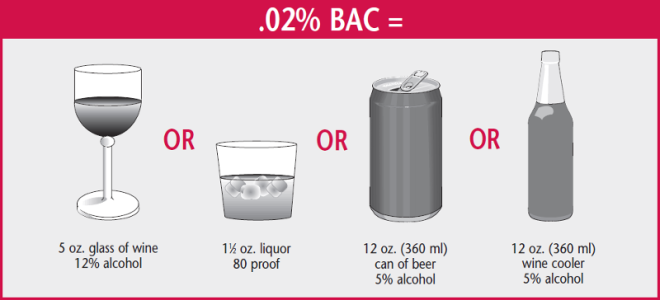
Your BAC (Blood Alcohol Content)
What affects your BAC?
How much alcohol you drink.
How much time passes between drinks.
Your body weight.
What does NOT affect your BAC?
The type of alcohol (beer, wine, or liquor).
How "fit" you are.
How well you think you can "hold your liquor."
Alcohol content
These all contain about the same amount of alcohol:
1.5 oz. liquor
5 oz. wine
12 oz. beer
12 oz. wine cooler
Important facts
For a 150-pound male, one standard drink raises BAC by about 0.02%.
On average, it takes about 1 hour for the body to eliminate the alcohol from one drink.
Women generally process alcohol more slowly, which can result in a higher BAC for longer.
Other important points
The more you drink in a short time, the higher your BAC.
Even one drink can impair driving ability.
Eating food slows alcohol absorption but does not prevent impairment.
Only time lowers your BAC.
Coffee, cold showers, and exercise do NOT make you sober or lower your BAC.
Key takeaway
BAC depends on how much you drink, how much time passes, and your weight. Beer, wine, and liquor affect BAC equally, and only time—not coffee or cold showers—can lower your BAC.
Chemical Tests
What are chemical tests?
Chemical tests measure BAC (Blood Alcohol Content) using:
Breath
Blood
Urine
Saliva
Police may request a chemical test if you are arrested for an alcohol or drug-related violation.
New York Implied Consent Law
By driving in New York, you have already agreed to take a chemical test if requested by law enforcement.
Refusing the test is a separate offense from being guilty of impaired driving.
Consequences of refusing a chemical test
Your driver license can be suspended when you appear in court for the charge.
Your refusal can be used as evidence against you in court.
If a DMV hearing confirms the refusal:
Your license can be revoked, even if you are later found not guilty of the alcohol/drug charge.
Key takeaway
New York’s Implied Consent law requires drivers to take chemical tests when requested after an alcohol/drug arrest. Refusing can result in license suspension or revocation, even if you are not convicted of the original charge.
The Consequences
Consequences of Impaired Driving
Driving under the influence can result in:
Large fines
Jail time
License suspension or revocation
Legal problems
DMV penalties can be severe, especially for repeat offenders.
Repeat Offenders (New York)
DMV reviews a driver's entire lifetime driving record before restoring a revoked license.
A license may be permanently denied if a driver has:
4 alcohol/drug-related offenses in their lifetime, OR
3 alcohol/drug-related offenses within 25 years + another serious driving offense.
Drivers with repeated offenses may face:
Longer waiting periods before getting a license back.
Restricted licenses only.
Required ignition interlock devices.
Zero Tolerance Law (Under Age 21)
Under 21 drivers cannot drive with any measurable BAC (0.02–0.07%).
First violation:
6-month license suspension
$100 suspension termination fee
$125 civil penalty
Second violation:
License revoked for at least 1 year or until age 21 (whichever is longer).
Illegal Alcohol Purchase
Using a driver's license or ID to illegally buy alcohol can result in:
Suspension of driving privileges.
Open Container Law
It is illegal for drivers or passengers to:
Drink alcohol in a vehicle on a public road.
Possess an open alcoholic container in a vehicle.
Consume marijuana/cannabis in a vehicle.
First offense penalties:
Fine up to $150
Mandatory surcharge and fees
Possible 15 days imprisonment
DWI / DWAI Penalties (New York) Agg-DWI (BAC 0.18% or higher)
1st offense:
Fine: $1,000–$2,500
Jail: Up to 1 year
License: Minimum 1-year revocation
2nd offense (within 10 years):
Fine: $1,000–$5,000
Jail: Up to 4 years
License: Minimum 18-month revocation
DWI / DWAI-Drug (BAC 0.08%+)
1st offense:
Fine: $500–$1,000
Jail: Up to 1 year
License:
DWI: Minimum 6-month revocation
DWAI-Drug: Minimum 6-month suspension
2nd offense (within 10 years):
Fine: $1,000–$5,000
Jail: Up to 4 years
License: Minimum 1-year revocation
DWAI (BAC over 0.05% to 0.07%)
1st offense:
Fine: $300–$500
Jail: Up to 15 days
License: 90-day suspension
2nd offense (within 5 years):
Fine: $500–$750
Jail: Up to 30 days
License: Minimum 6-month revocation
3rd offense (within 10 years):
Fine: $750–$1,500
Jail: Up to 180 days
License: Minimum 6-month revocation
Ignition Interlock Program & Leandra’s Law
Drivers convicted of DWI or Agg-DWI must install an ignition interlock device.
Device requires the driver to provide a breath sample before starting the vehicle.
Required for at least 12 months (unless modified by the court).
Repeat offenders may be required to complete alcohol treatment.
Leandra’s Law
Driving drunk with a child under age 16 in the vehicle can result in:
Class E felony
Up to 4 years in prison
Key takeaway
DUI/DWI offenses have serious consequences: fines, jail, license loss, ignition interlock requirements, and possible permanent license denial. Underage drivers have zero tolerance—any measurable BAC can result in penalties.
A Few Important Reminders
If you cause injury or death
Causing injury or death because of alcohol/drug-impaired driving can lead to serious criminal charges, such as:
Criminally negligent homicide
Aggravated vehicular homicide
Vehicular manslaughter
Vehicular assault
Penalties can include:
Thousands of dollars in fines
Up to 25 years in prison
Driving with a suspended or revoked license
You may face:
Mandatory fine of $200–$1,000
Jail time or probation
If you are impaired or intoxicated when arrested:
Maximum fine can be $5,000
Your vehicle may be seized
Financial consequences
Insurance may not cover all costs from a crash.
You may be sued for thousands of dollars.
Getting affordable liability insurance may become difficult for years.
You may also have expensive legal fees.
Other consequences
You may receive a criminal record.
A criminal record can make it harder to:
Get a job
Advance in your career
Key takeaway
Impaired driving can lead to life-changing consequences: criminal charges, jail time, financial problems, loss of driving privileges, and damage to your future.
How to Avoid Trouble
Plan before drinking
Make decisions before becoming impaired because alcohol affects judgment.
Choose a safe way home before drinking.
Safe choices
Use a designated driver who does not drink alcohol.
Rotate drivers among friends.
Stay overnight or ride with a friend who is sober.
Give your car keys to a sober friend who will not let you drive.
Use:
Taxi/cab
Rideshare
Public transportation
If you choose to drink
Drink slowly.
Alternate alcoholic drinks with non-alcoholic drinks.
Do not use marijuana/cannabis products before driving.
Do not make alcohol the main focus of an event.
If you drink too much, stop drinking several hours before leaving to allow your BAC to decrease.
Key takeaway
The safest way to avoid impaired driving is to plan ahead: have a sober driver, use alternative transportation, and never drive after drinking alcohol or using drugs.