DNA Damage and Repair
 Call Kai
 Learn
Learn Practice Test
 Spaced Repetition
 Match
Match Flashcards
 Knowt Play
1/27

There's no tags or description
Looks like no tags are added yet.
Name | Mastery | Learn | Test | Matching | Spaced | Call with Kai | Chat |
|---|
No analytics yet
Send a link to your students to track their progress
28 Terms
Mutation
an accidental, permanent change in a DNA sequence
Frameshift mutation
nsertion or deletion that is not
a multiple of 3 bases, usually leads to early stop
mutations that affect RNA
splicing often generate
frameshifts
What does In-frame deletion of UUC cause
cystic fibrosis
What does a mutagen do
promote changes in
DNA sequences
• Often these chemicals are also
cancer-causing carcinogens
Ames test
determines if a compound is a mutagen
• Uses a bacteria with inactivate enzyme of
the histidine biosynthetic pathway
• requires histidine in the growth media in
order to grow.
• cells that grow without histidine had a
spontaneous mutation
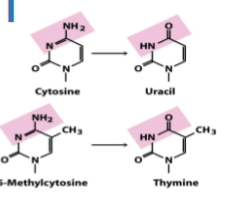
Deamination of C > U and 5-meC > T
Remove nitrogen
Reactive oxygen species (ROS)
generated by cellular respiration, and hydroxide free radical (•OH) inserts into
either G or T can lead to oxidation

Depurination
hydrolysis of the glycosidic
bond linking a purine base to the sugar-
phosphate backbone
• Yields an abasic (AP) site = site without base
How do alkylating agents impact DNA
Covalently modify DNA bases
• Environmental like sulfur mustard (mustard gas)
• Spontaneous alkylation by S-adenosylmethionine of G >
7-methylguanine
• unstable and can result in depurination
• Alkylation distorts the DNA double helix
What’s the most common DNA damage cause by UV radiation
Thymine dimers
Xeroderma Pigmentosum
caused by mutation in gene that codes for protein involved in nucleotide excision repair (NER)
usually supposed to remove thymine dimers caused by UV radiation
and fix distortions in DNA helix
Ionizing radiation
high-energy
radiation that can release electrons
from atoms generating ions which
can break covalent bonds
can cause single stranded or doubel stranded breaks that DNA ligase cant fix
The four phases of DNA repair
1. Recognition of the lesion.
2. Excision of the lesion.
3. Resynthesis of the DNA.
4. Ligation of loose ends.
Mismatch Repair (MMR)
corrects mismatched
base pairs mainly from errors in replication
MutL-MutS complex function in mismatch repair
recognizes the mismatch
MutH function in mismatch repair
identifies the parental GAmeTC strand
and newly synthesized strand
• MutH endonuclease nicks the unmethylated
strand
Mismatch repair mechanism after MutH endonuclease nicks unmethylated strand
• Exonuclease digests from nick
through the mismatch
• DNA Pol III fills the gap
• DNA ligase seals the nick
Base excision repair (BER)
repairs
mismatches resulting from damaged bases,
depurination, and single-strand breaks in
DNA.
DNA glycosylase
leaves the glycosidic
bond making an abasic site (AP site)
AP endonuclease
initiates repair of abasic
sites by making a single strand break in DNA
at the abasic site
Nucleotide Excision Repair (NER)
repairs lesions that
distort the DNA double helix, such as thymine dimers or
alkylation
Excinuclease
hydrolyzes two phosphodiester bonds, one
on either side of the distortion
What is the excinuclease in eukaryotes
XP excinuclease is a large complex that contains
XP-A through XP-G subunits plus TFIIH helicase
mutated in Xeroderma pigmentosum
What is the helicase in Eukaryotes
TFIIH
• Cockayne syndrome
Non-Homologous End Joining (NHEJ)
predominant
mechanism in G0 and G1 for repair of double-strand breaks
in mammalian cells
• error prone repair
Mechanism of Non homologous end joining
• Ku70/80 complex binds loose ends of DNA
• PKcs is a kinase that initiates bridging of the broken ends
• Other factors bind to and process the loose ends to produce
an area of “micro-homology” (sticky ends):
• Exonuclease will remove bases
• DNA pol μ and λ add bases (error prone terminal transferases)
• Artemis endonuclease removes any overhanging flaps
• DNA ligase seals the nicks
Homologous recombination repair (HRR)
repair a double-strand break in
DNA after DNA has been replicated
What does HHR need for repair
• Template for reaction is sister chromatid
• BRCA1/2 involved in strand invasion