PIA - MST1
 Call Kai
 Learn
Learn Practice Test
 Spaced Repetition
 Match
Match Flashcards
 Knowt Play
1/202

Earn XP
Description and Tags
MST1
Name | Mastery | Learn | Test | Matching | Spaced | Call with Kai | Chat |
|---|
No analytics yet
Send a link to your students to track their progress
203 Terms
name of the theories:
lens emits radiation which bounced off objects then return to the lens, leading to vision
light emitted from object and the retina was the receptive tissue
emission theory (or extramission theory)
intromission theory
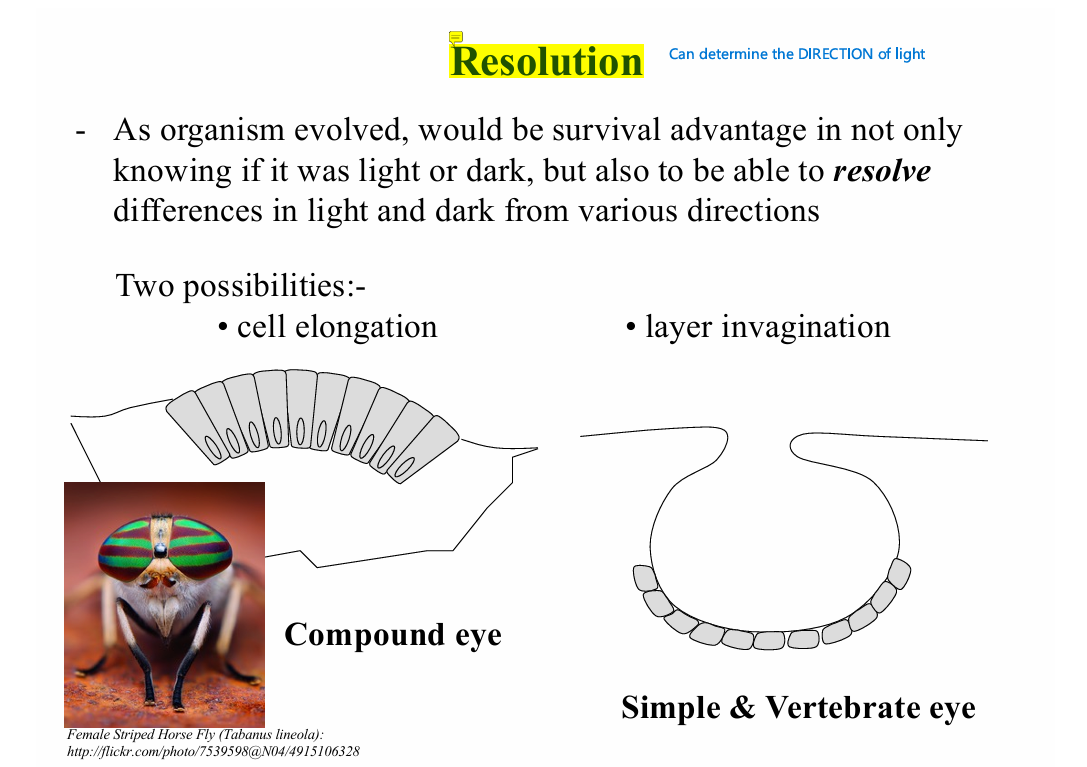
Evolution of vision (4 steps)
only light detection
light-sensitive cells
resolution (which direction the light is coming from, detection of form)
Two possibilities:
cell elongation (compound eye)
layer invagination (vertebrate eye)
movement (the light is moving)
colour
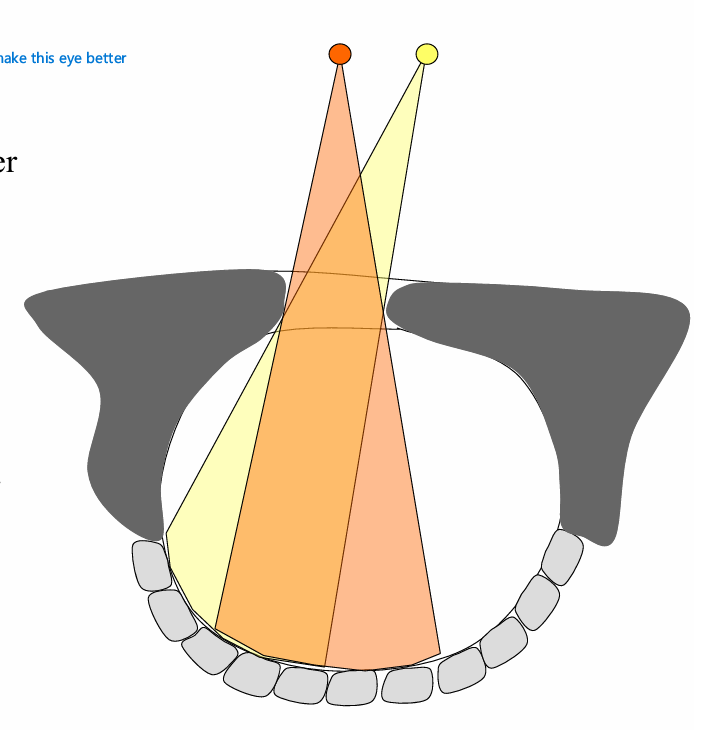
benefits of closing up eye invagination - evolution
keep dirt out blocking vision
IOP maintained at higher value than outside to maintain eye shape
this membrane began to bulge then act as lens, increasing resolution
What has most of the eye’s focusing power
Cornea (actually tear film i think)
+40D
Lens power is +20D when relaxed
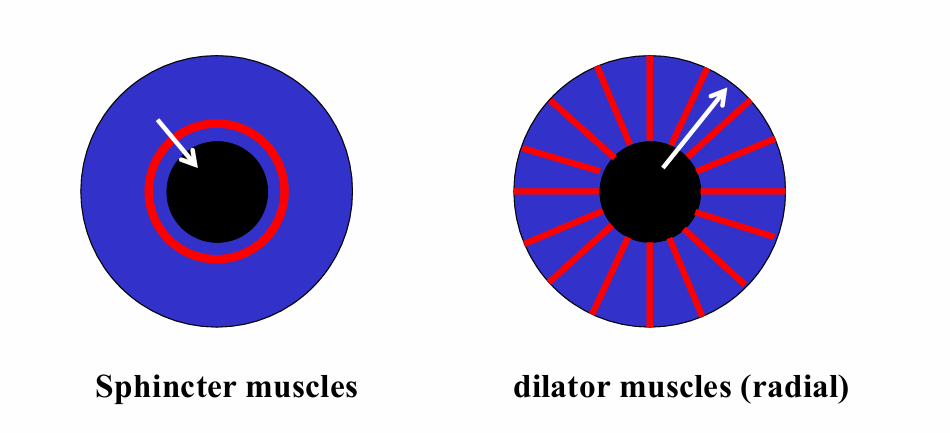
iris muscles
sphincter muscles: circular
dilator muscles: radial
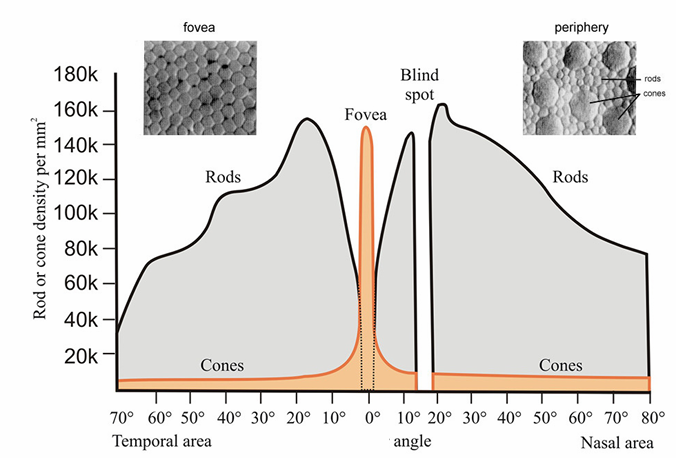
Draw diagram of where you’d find the 2 types of photoreceptors, where they’re densest, and how many do we have?
Rods
one type only
120 million
absent from fovea
Cones
3 types
6 million
densest in fovea (but some elsewhere as well)
no photoreceptors in blindspot
what do we need to see fine details?
need high density of cone photoreceptors
rapid decrease in cone density as move away from fovea should decrease resolving capacity of eye
what is wide, high resolution vision? How does our resolving capacity function at periphery?
it is an illusion, the actual area of high-detail (acute) vision is very small!
by about 5 degrees, resolving capacity of the eye is about a third of that at fovea
why do dim stars disappear when looked directly at
no rods in fovea, so at night, we have a blind spot in the fovea
where do signals from photoreceptors then travel through?
retinal ganglion cells
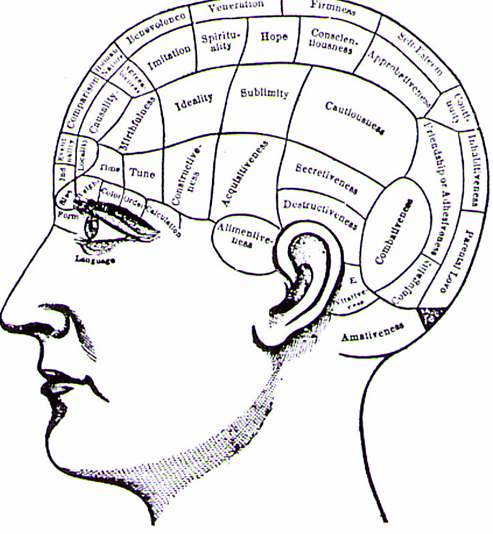
what is phrenology
Franz Joseph Gall: postulated that the brain consists of 35 domains or centres each corresponding to a specific mental function
centre for each function could increase in size as a result of use
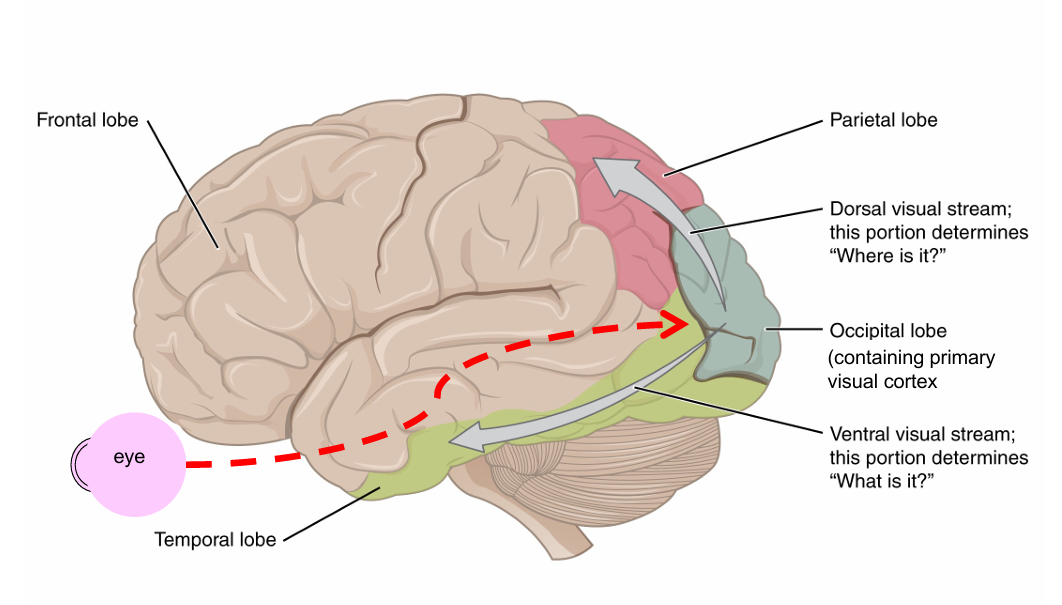
what is the primary visual cortex in the brain? Where does it project to?
Occipital lobe
projects ventrally to the temporal lobe
projects dorsally to the parietal lobe
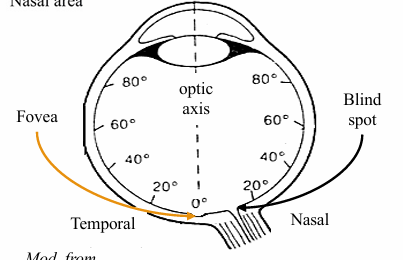
where is our blind spot in daytime and nighttime conditions? What degrees is this at?
daytime:
ON at 15 degrees
but with both eyes open the other eye usually compensates for the missing are
nighttime:
because there are no rods in the fovea, our blind spot is in our fovea at 0 degrees (even with both eyes open!)
define illusion
systematic visual & other sensed discrepancies from simple measurements with rules, photometers, clocks, etc.
Can occur in any sense, and can be combined across senses,
small objects feel considerably heavier than larger objects of exactly the same weight
suggests weight not purely determined by pressure and muscle senses, but also on visually judged size
An “illusion” can be though of as any mismatch between reality and final perception via the senses
what are the 4 main errors in language? What do they represent?
Ambiguity: “people like us” - are they similar to us or do they like us?
Distortion: “John is miles taller than his father”
Paradox: “John’s sister is a dark-haired blonde.”
Fiction: “John’s brother is a green man from Mars.”
** these are the same errors that our brain perceives while looking at illusions! different illusions represent different errors
FAP D
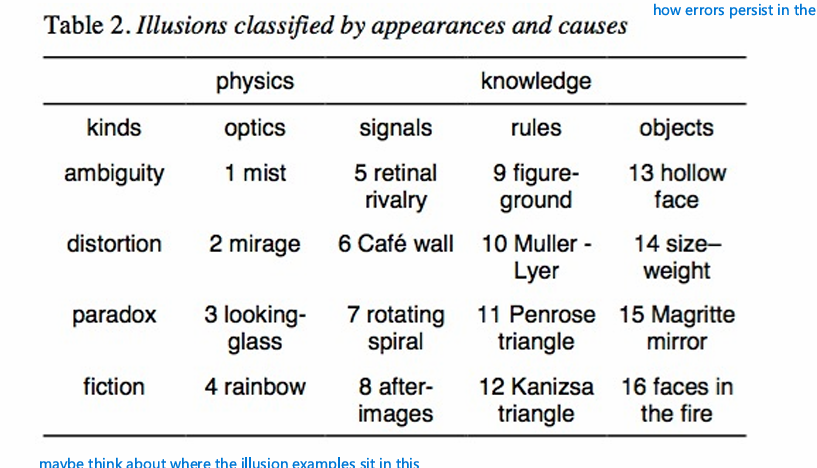
4 visual illusion kinds and causes (Classifications of illusions)
Kinds
ambiguity = more than one possible interpretation
distortion = something looks warped, bigger/smaller, tilted, etc.
paradox = looks impossible or contradictory
fiction = you see something that is not really there
Causes
Physics
These happen because of the incoming visual information itself.
optics = something in the optical path alters light before it reaches the retina
Example: mist, mirage, rainbow, magnifying glasssignals = something about sensory/neural signalling creates the effect
Example: retinal rivalry, afterimages, Café wall, rotating spiral
Knowledge
These depend more on interpretation, assumptions, or prior knowledge.
rules = general perceptual rules the brain uses
Example: figure-ground, Müller-Lyer, Kanizsa triangle, Penrose triangleobjects = knowledge about real-world objects/scenes
Example: hollow-face illusion, size-weight illusion, Magritte mirror, faces in the fire
Gestalts principles of grouping (5)
Proximity: objects close to one another appear to form groups
Similarity: objects similar to one another appear to form groups
Closure: tendency to see objects as closed forms, therefore see elements as linked despite gaps
Continuity: tendency to see segments as part of a continuous (but partly obscured) object
Common Fate: of moving objects, e.g. leaves of a tree in the wind
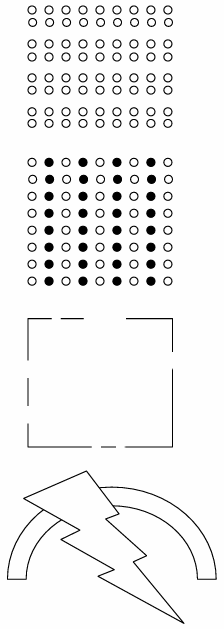
what is a challenge for illusions that lack a successful explanation
classification
phenomenological groups are how our lectures are structured i think
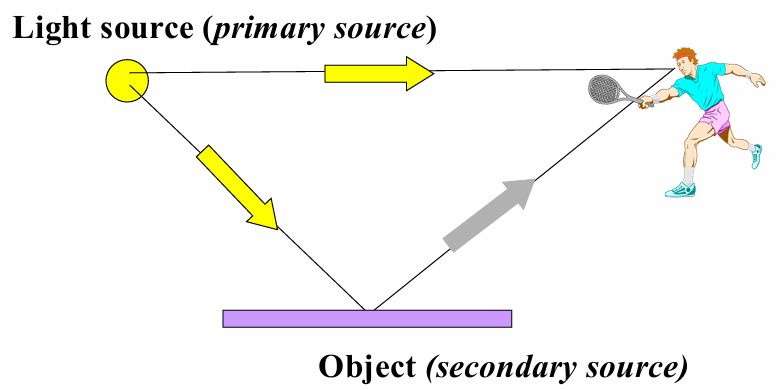
primary vs secondary light sources
primary sources: generate electromagnetic radiation
secondary sources: reflect or scatter incident radiation
most of what we see around = reflected light from secondary sources
modern civilisation = many new & diverse primary light sources beyond the sun, stars & fire which the ancients had
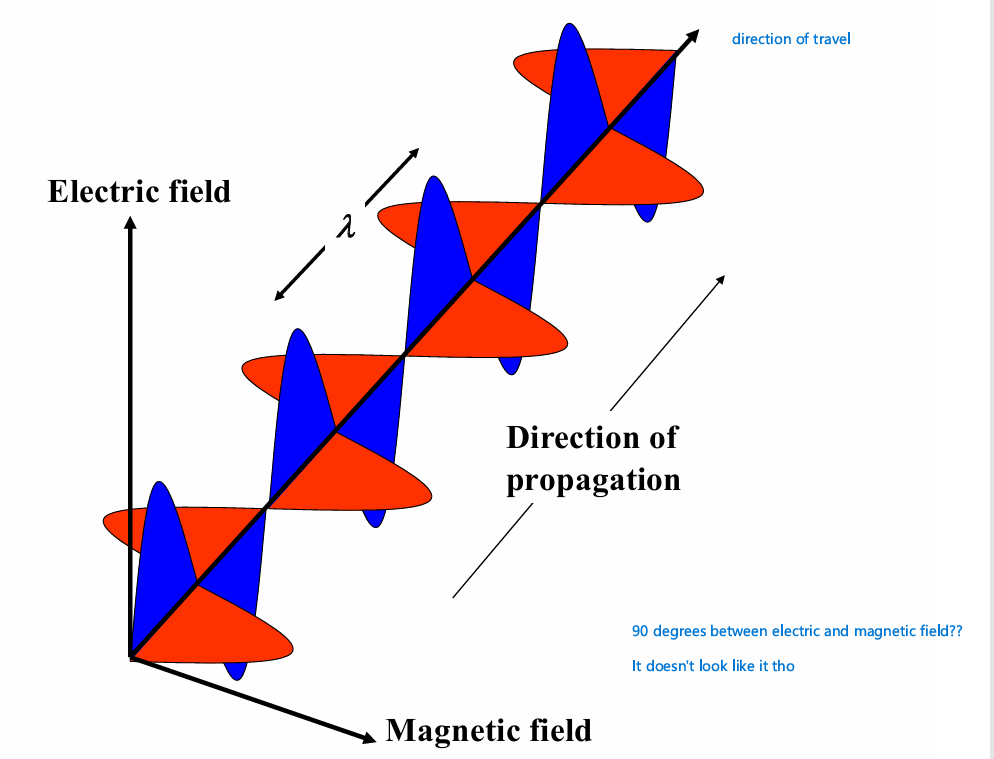
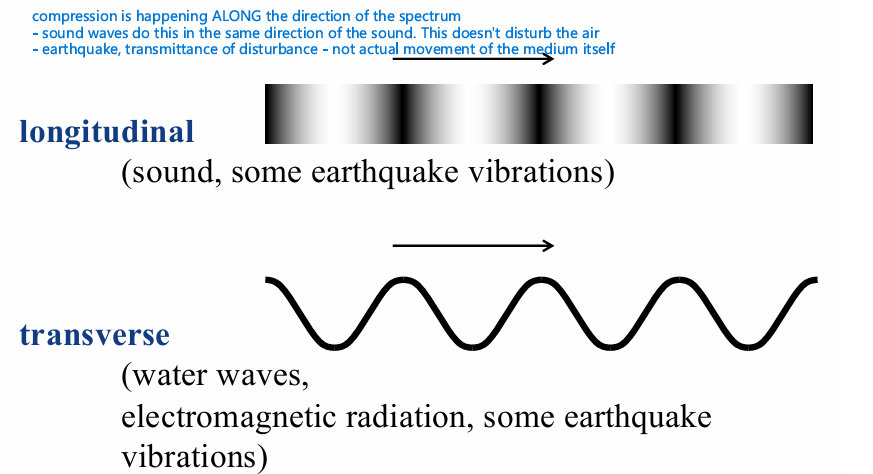
What are the 2 types of wave motion? Which one is aligned with electromagnetic radiation?
Longitudinal
Transverse*
electric and magnetic field (there is 90 degrees between)
wavelength and frequency calculation. What is the relationship between y and v
v = c/λ (or λ= c/v)
higher frequency = shorter wavelength
what is the speed of light in a vacuum?
c = 3x10⁸ m/s
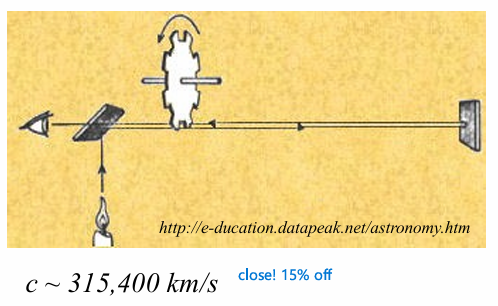
experiment that measured the speed of light
2 mirrors, cogwheel, light
Slow rotation: outgoing & returning light through same gap in cogwheel
Increase rotation speed: returning light hits cog tooth: light disappears from observer’s view
Further increase rotation speed: returning light now returns through next gap in cogwheel: light reappears!
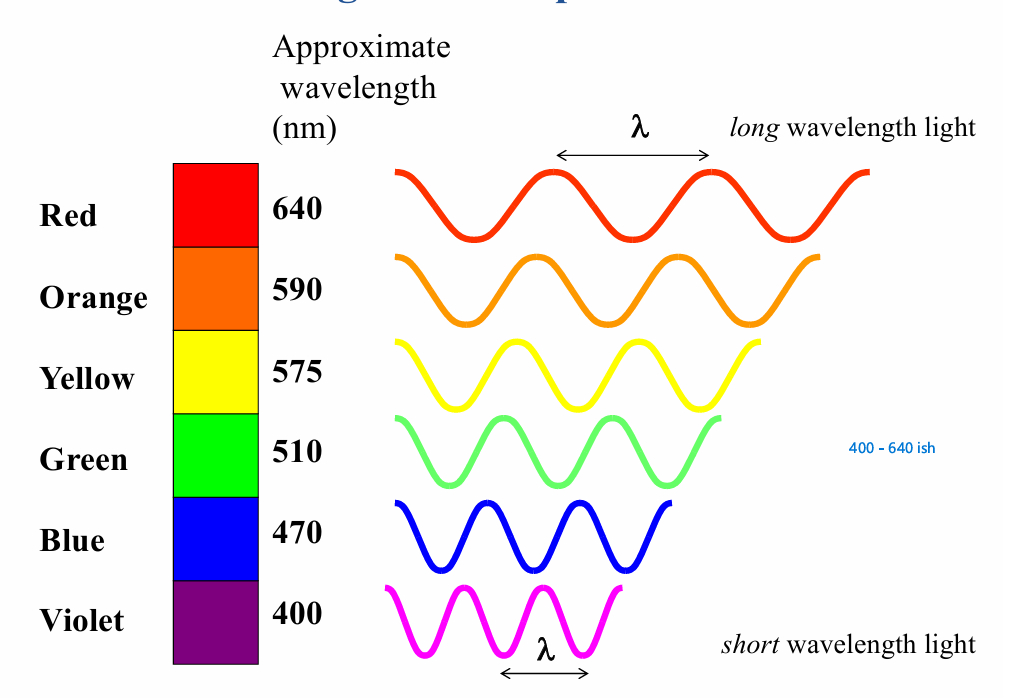
what is the range of wavelengths within the visible spectrum? What are the wavelengths of: red, orange, yellow, green, blue, violet
approx 400 - 700 ish…. (notes say 640)
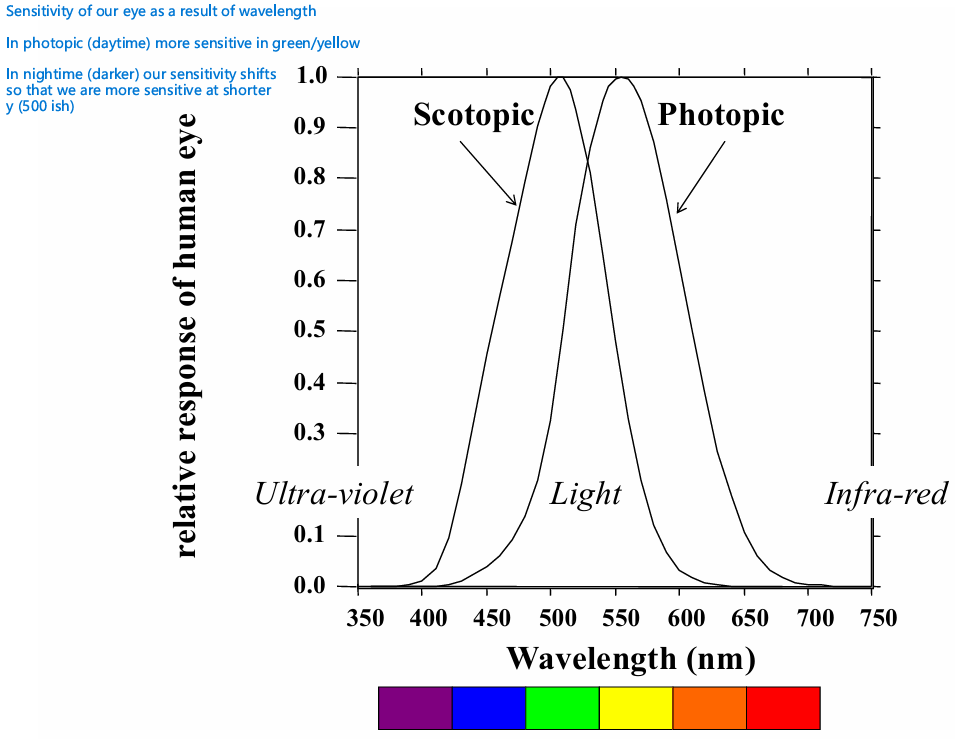
DRAW - the sensitivity of the eyes to different wavelengths in day and night is called what? How does our sensitivity shift in these conditions?
photopic sensitivity curve (V(λ) , for bright conditions), or
scotopic sensitivity curve ( V(λ)’ , for dim conditions)
in the nighttime our sensitivity shifts so that we are more sensitive to shorter wavelengths!
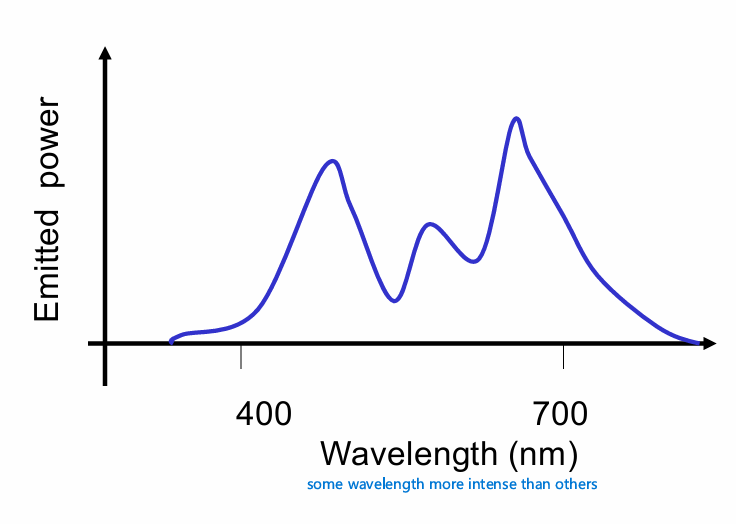
what is the spectrum of a light source?
the amount of energy or power at each wavelength
How much radiation we see from a light source depends upon (2 things)
the spectrum of the light source &
amount of overlap this spectrum has with spectral sensitivity of the eye (V(λ) curves)
monochromatic light vs. broad-band light
Monochromatic light
Single wavelength (or very small range)
Broad-band light
Wide range of wavelengths (even the whole visible spectrum)
Incandescent sources – which produce light because they are hot (e.g. sun, tungsten bulb) are one example of broad-band light sources
what is the peak sensitivity of the eye matched to?
the sun
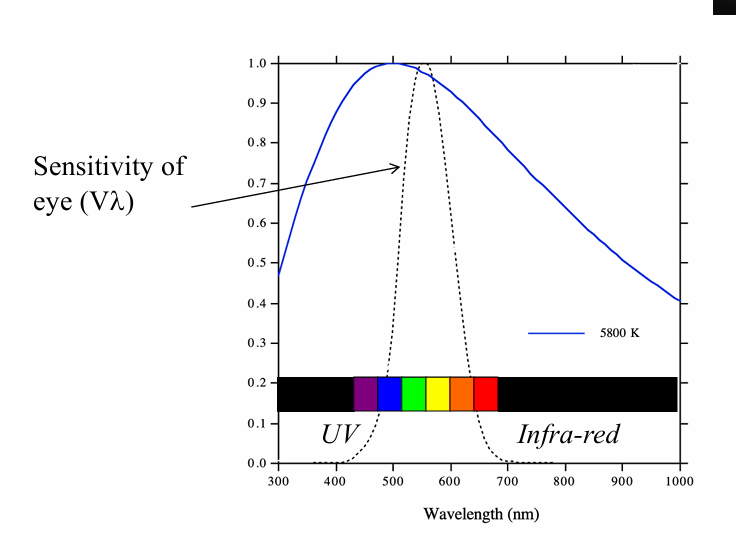
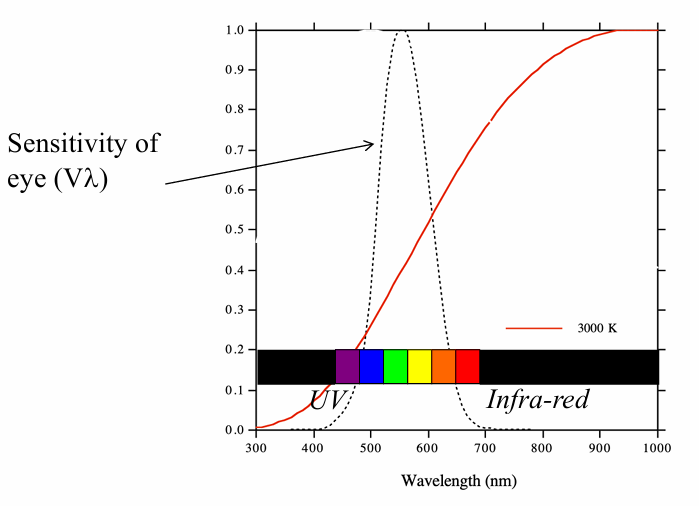
Is this an efficient or inefficient light source? Why?
inefficient
this is a tungsten bulb
produces most of its radiation in the heat domain (not in the visible spectrum)
This is misaligned with our peak sensitivity ☹
Draw the spectrum - How does increasing temperature shift the spectrum of an incandescent source? What does this do to its appearance? define colour temperature
As temperature increases:
Total emitted energy increases
Peak wavelength shifts shorter
The light appears bluer / cooler in colour
Colour temperature = what incandenscent source the ‘white’ appears to match (ex on monitor)
Higher colour temperature = cooler white, more blue
lower colour temperature = warmer white, more yellow/orange/red
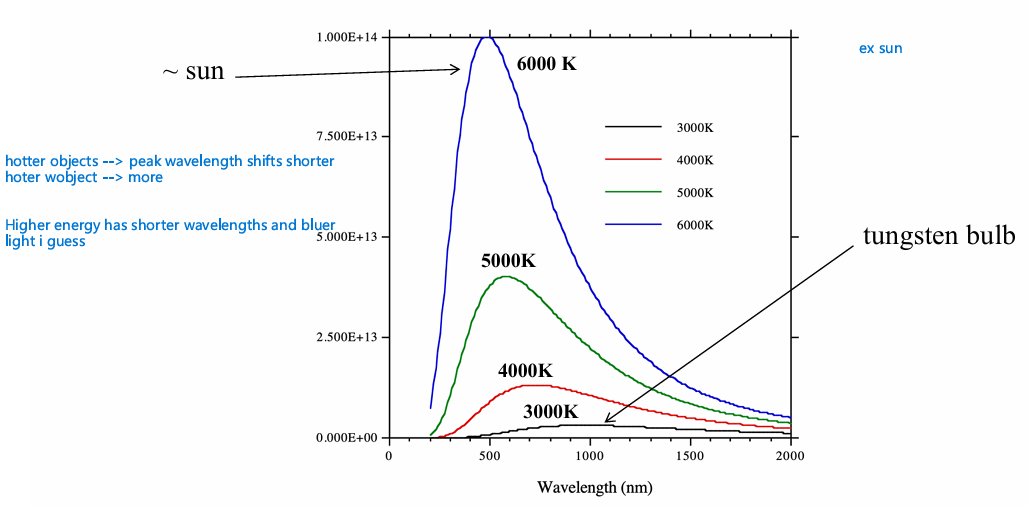
What is an incandescent source
Produce electromagnetic radiation because they are hot
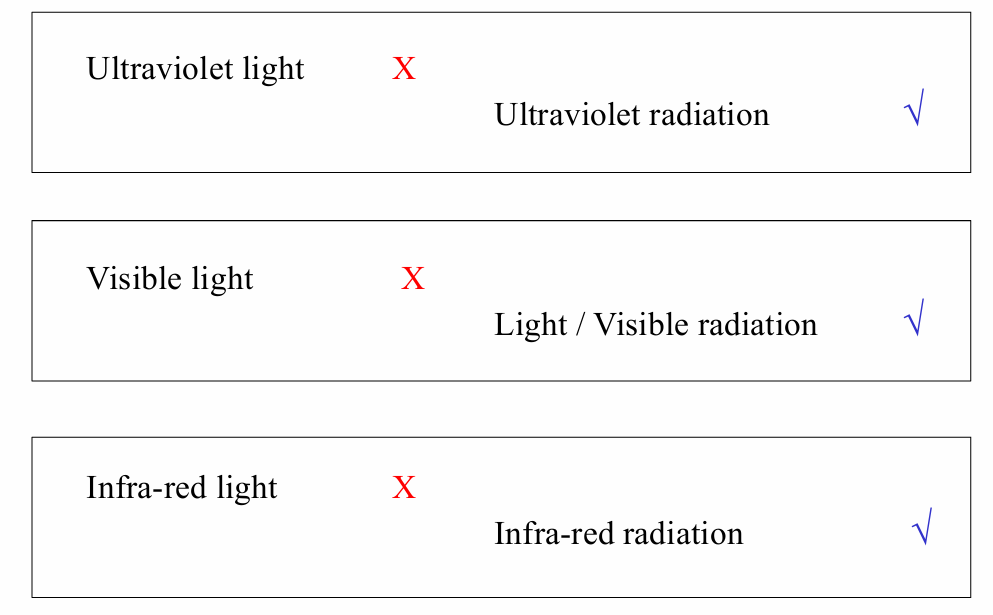
ultraviolet light or ultraviolet radiation?
be careful with terms
name of the function describing the human eye’s sensitivity to different wavelengths of light, and where does it have its peak sensitivity?
The V(λ) function, which has peak sensitivity for green yellow
The sun is an example of a
primary source that is incandescent.
illuminance and luminance definition
Illuminance: incident light (how much light has fallen ONTO an object)
Luminance: emitted or reflected light (how much light is coming off the object that has been illuminated)
describe the relationship between illuminance, reflectance, & luminance
luminance increases if:
illuminance increases, and/or
reflectance increases
illuminance and luminance units
Illuminace = lux
luminance = candelas/square metre (cd/m2)
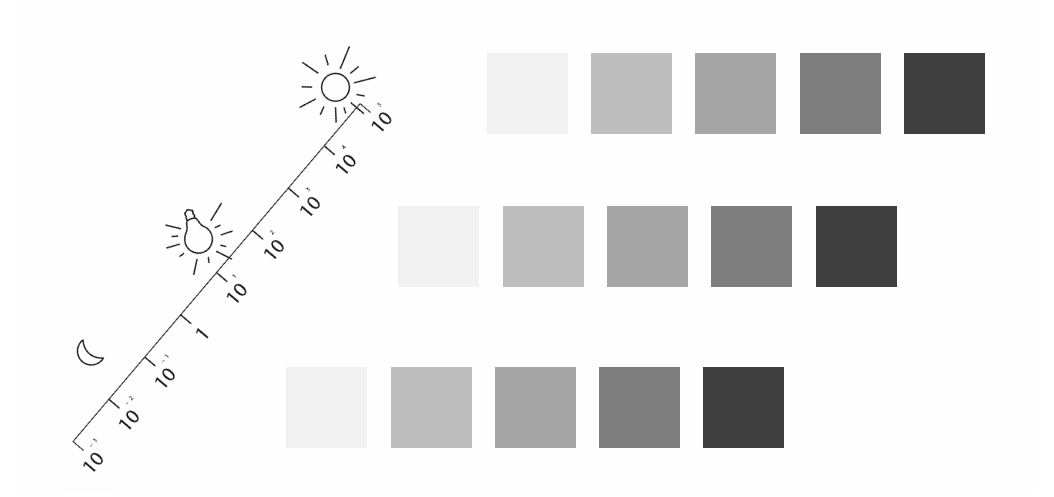
range of illuminances, range of reflectances, range of luminances
Range of reflectances in the natural world ~ 0.05 to 0.95
20-fold given a fixed level of illumination
Range of illuminances is huge
candle (at one metre) = 1 lux
Sun on earth’s surface = 50,000 lux
Range of luminances is huge! (proportional to reflectance x illuminance)
more illuminance and reflectance = more luminance
what is contrast. what is it a ratio of
Contrast = ratio ΔL/L where:
ΔL = the difference in luminance
L = the background luminance
In general, we detect an object if its contrast exceeds a certain threshold
why can’t we see stars during the day
because the contrast is very small so can’t see
ΔL/L is below threshold
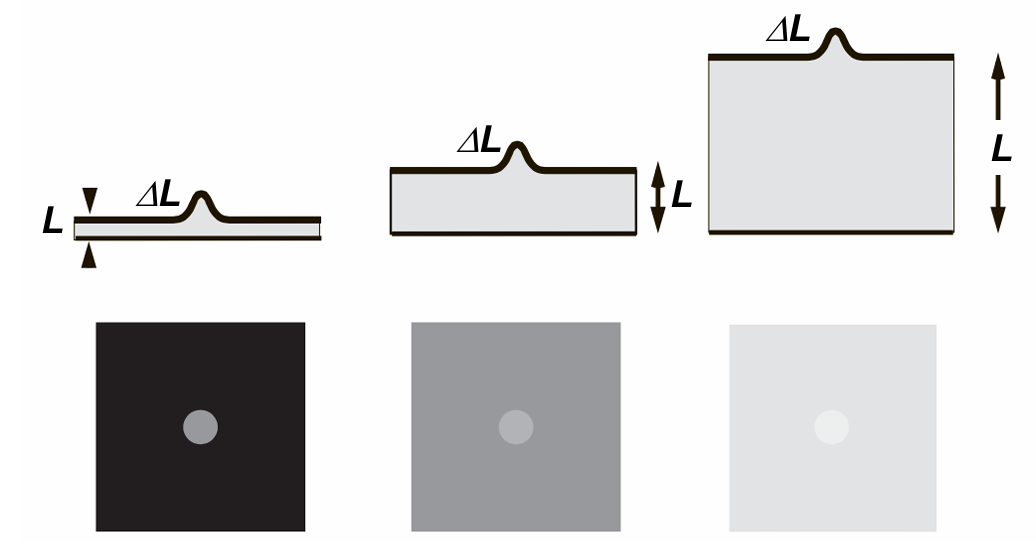
what does the point spread function determine?
the resolving capability of the eye. smallest resolving capability.
1’ = 1 minute of arc = 1/60th of a degree is the smallest
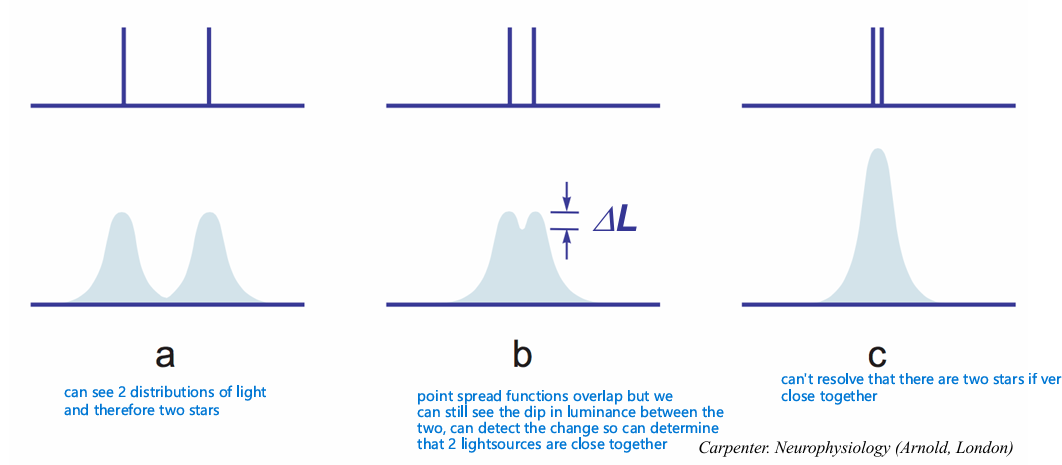
define resolution. Draw how the point spread function is a key factor in determine the resolving capability of the eye for high spatial frequencies (ex. draw two objects)
The ability to see critical detail in a scene, rather than simply detecting something is there
e.g. the ability to resolve that there are two stars, rather than one
the point spread function is a key factor in determining the eye’s resolving capacity for high spatial frequencies
what is the contrast sensitivity function (CSF). What does high contrast sensitivity mean? When does contrast sensitivity peak?
plotting contrast over spatial frequency
high contrast sensitivity = can detect a lower contrast changes
The visual has the highest contrast sensitivity at moderate spatial frequency levels meaning that moderate spatial frequency patterns can be seen at lower contrast levels.
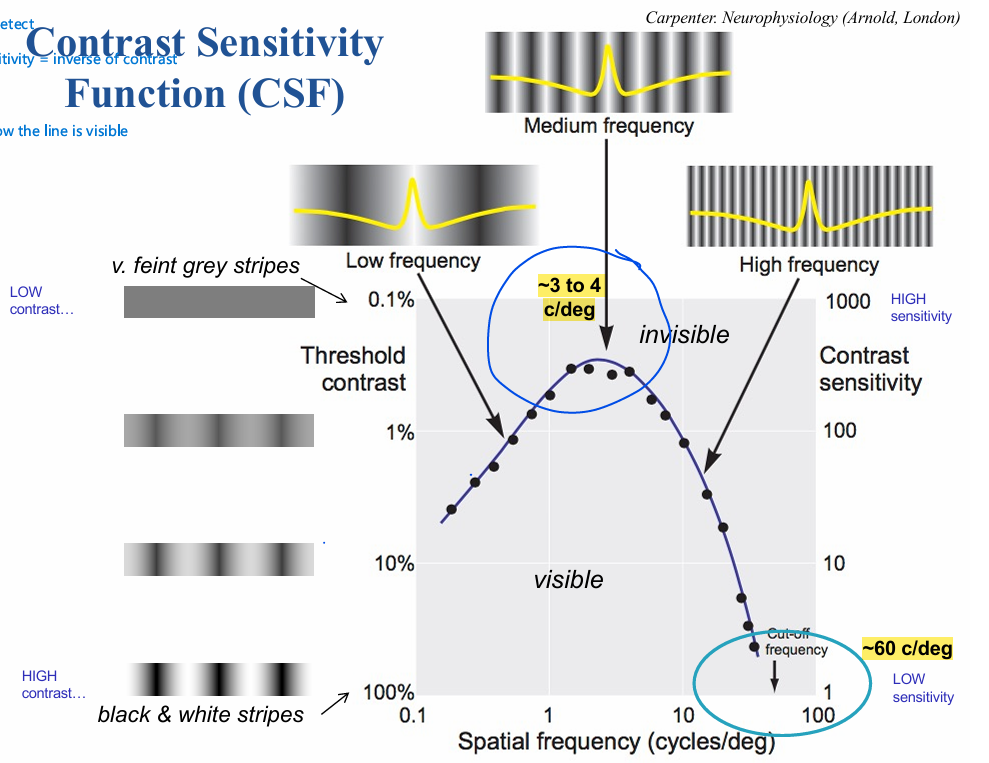
when does contrast sensitivity peak? what is the resolving capability of the eye?
CS peak: at 3-4 cycles/degree
resolving capability of the eye: 60 cycles/degree
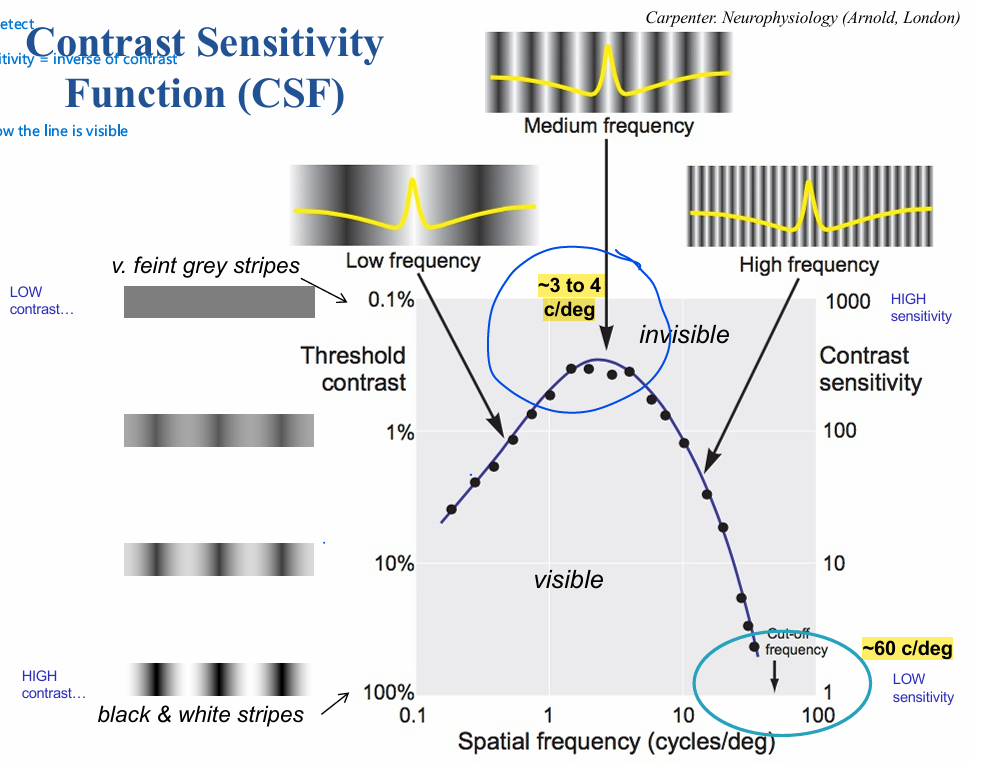
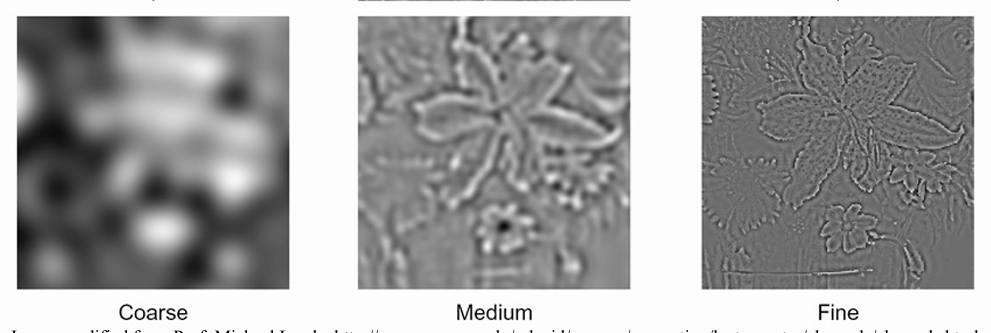
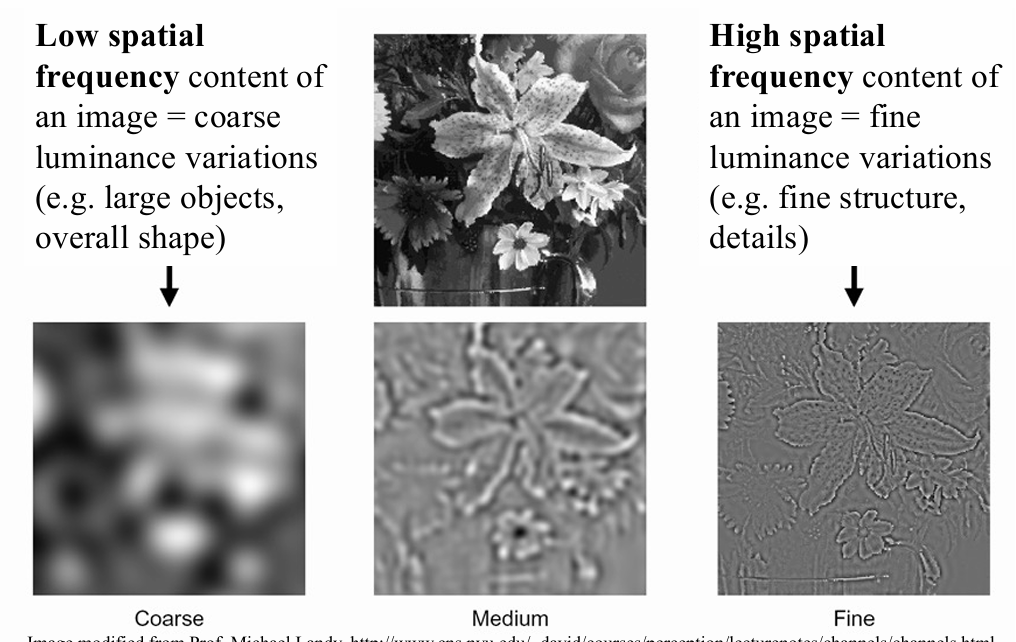
what does this picture show?
low to high spatial frequency
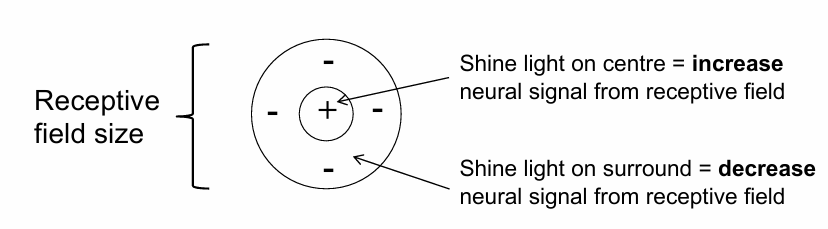
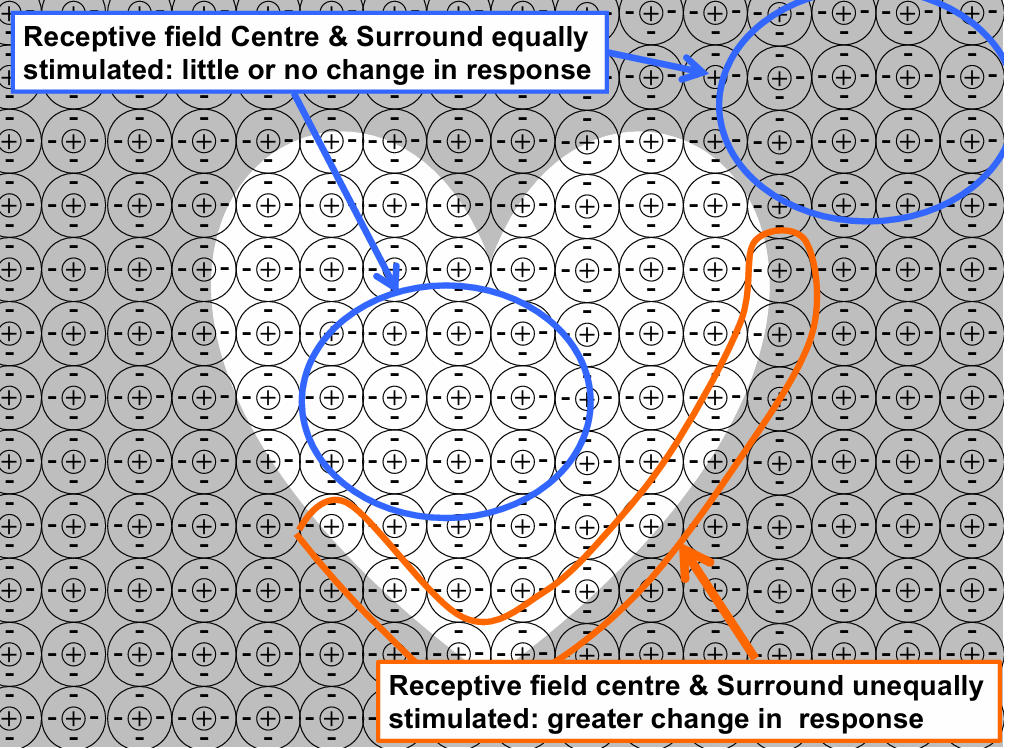
what is lateral inhibition. What if you uniformly illuminate the receptive field? what if you illuminate only the edge?
The retina is tiled with multiple, overlapping light-sensitive areas called receptive fields
Many receptive fields show centre/surround opponency, formed by the wiring between various retinal cells
Illuminate field uniformly: little change in neural signal from baseline firing rate, as centre (excitation) & surround (inhibition) influences cancel
The idea that one area can influence the activity from a neighbouring area is called lateral inhibition
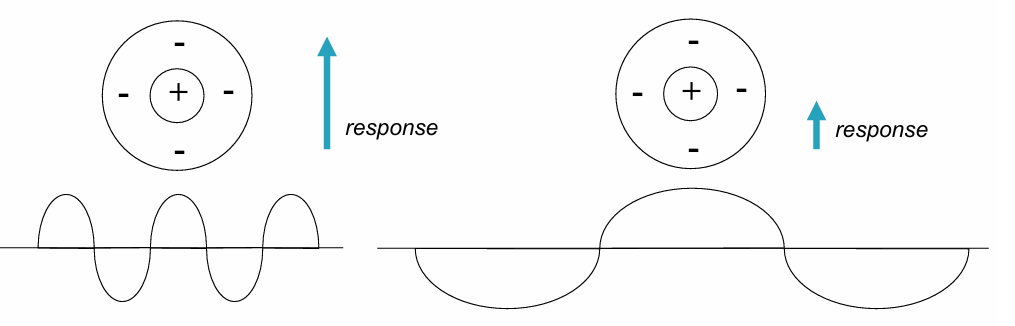
when are receptive fields maximally stimulated?
when viewing a grating whose details are of similar dimensions to the field (maximally stimulated) - difference in how the centre and surround are illuminated
as grating spatial frequency decreases, centre & surround are more equally stimulated by a single grating bar (retinal response decreases, need higher contrast stiumulus to reach perceptual threshold)
poor sensitivity to low spatial frequency gratings in the contrast sensitivity function is due to what?
lateral inhibition
poor sensitivity to high spatial frequency is due to point spread function i think
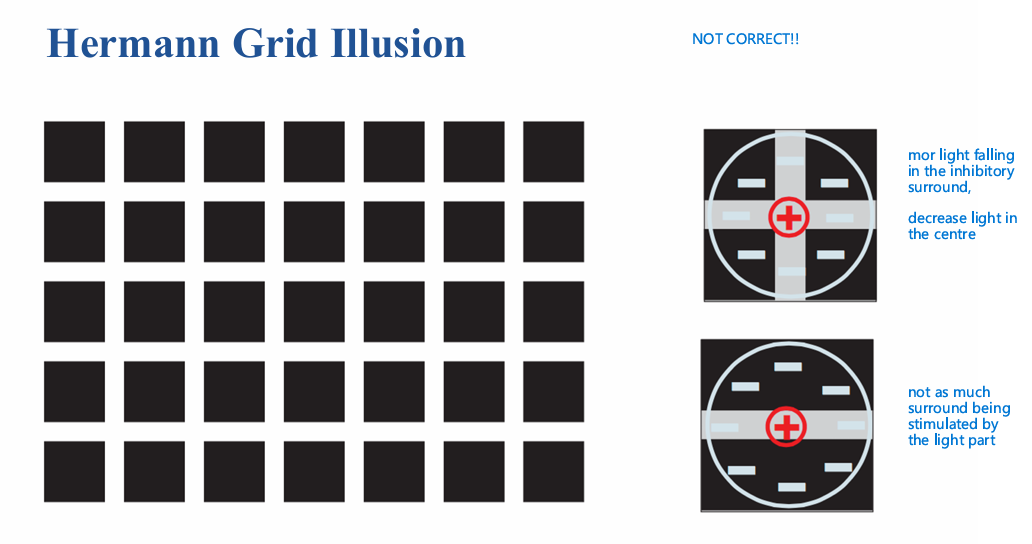
what is the Hermann Grid Illusion? Describe how it works.
how the visual system processes contours, edges, and line junctions
and the fact that this is stronger in peripheral vision
THE 2 SMALLER PICS TO THE RIGHT ARE NOT CORRECT - when the lines are curved the illusion collabses
What does lateral inhibition enhance? how?
edges (change!)
Lateral inhibition employed widely throughout the sensory system to help detect change
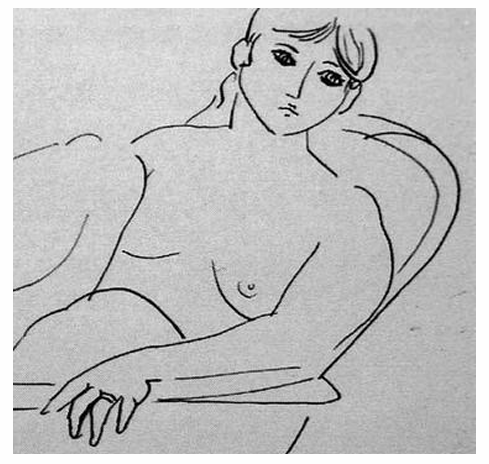
explain the puzzle of why a line drawing of an object is accepted by the visual system as a representation of the real thing
Lateral inhibition
Real object (e.g. a face) = area of colour, light & shade
Line drawing = thin black line corresponding to transitions between areas of colour, light & shade
under candlelight, white page with black text still looks white, even tho the luminance of the white page is less than black text in high illumination situations. WHY? describe how this works.
what is the visual system more concerned with encoding?
Adaptation!
visual system is more concerned with encoding reflectance’s of objects than their luminance’s, which change radically depending on illumination
key to minimising the influences of fluctuations in illumination (and therefore luminances) is the notion of adaptation
our visual system is sensitive to a wide range of luminances, but in a particular scene of a constant illumination, there is only about a 20 fold range of luminances!!
we can adjust our sensitivity to a particular scene to detect black and white to that particular scene
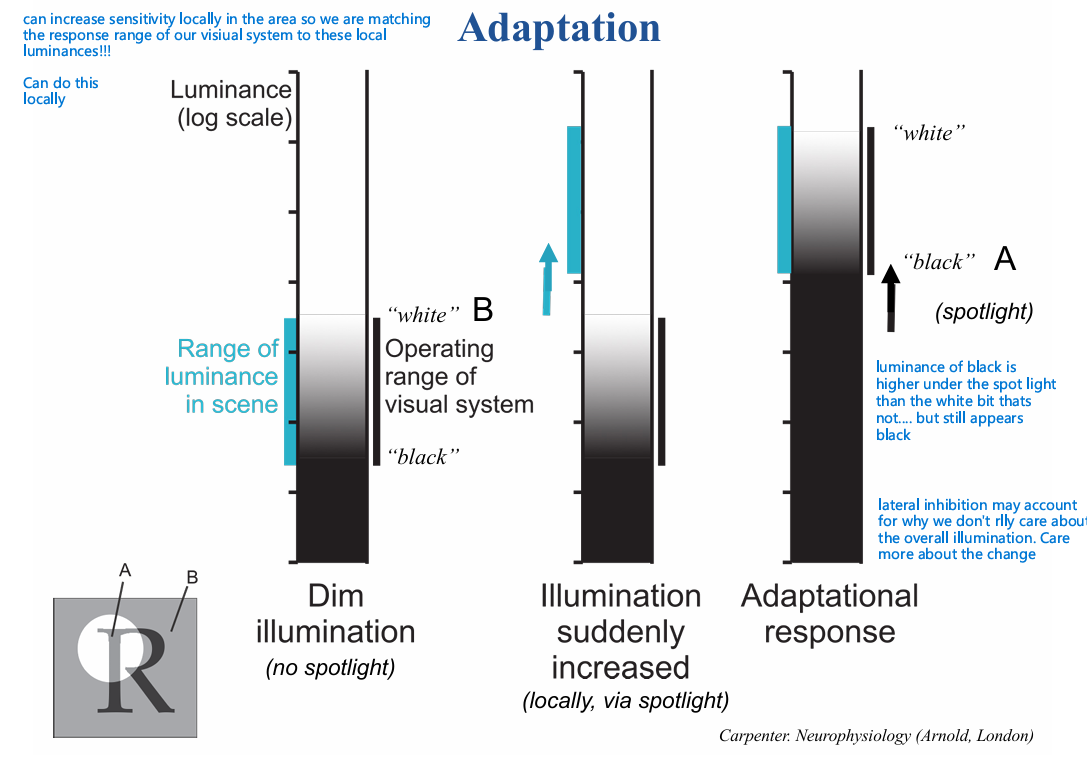
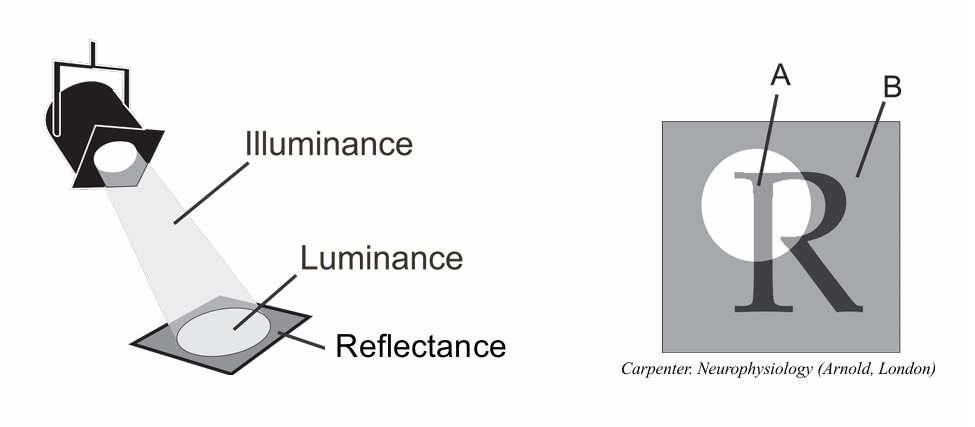
what does this suggest:
Brightly illuminated black (A) might have a luminance greater than dimly illuminated white (B
that adaptation can occur locally
can adjust the sensitivity of our visual system to match the local luminances
difference between lightness and brightness
lightness = perceived reflectance (so black, grey and white I think)
brightness = perceived luminance
we would not say lightness and brightness in vision science because these are perceived
what is lightness constancy?
• Lightness of real objects illuminated in a natural environment is largely independent of the overall level of illumination
• e.g. a book appears to have same lightnesses (print & page) under bright or dim light
lightness = perceived reflectance
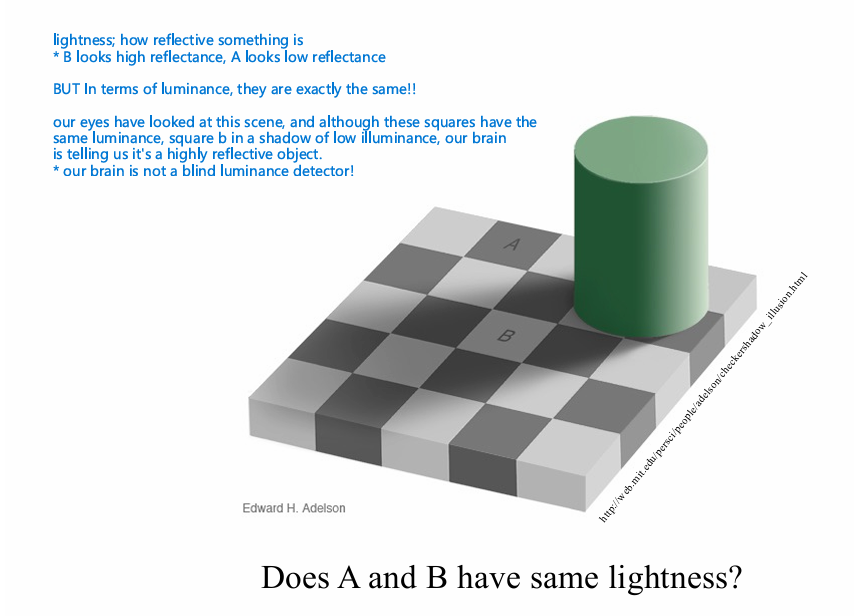
what is lightness constancy?
give an example
lightness = reflectance
brightness = luminance
A and B don’t have the same lightness (reflectance), but the same luminance…. (i think)
the actual luminance is exactly the same (but because it is under the shadow the white square higher reflectance than the black square that isn’t)
can occur locally!!
what two things regarding how we perceive light can occur locally?
lightness constantcy
adaptation
define simultaneous contrast
an object of moderate reflectance may appear lighter or darker according to whether it is surrounded by a region that is considerably darker or brighter than the object itself
inside square with darker contrast on outside lighter .
i think this can kinda be explained by the anchoring theory
lightness is a relative judgement (need a light comparison for it to look black, vice versa i think)

what is the anchoring theory?
A theory that describes how our eyes detect white or grey or black
In a variety of experimental contexts, the highest luminance is perceived as white in a particular scene
provides an “anchor” to which other perceived shades are tethered
what can simultaneous contrast be described by?
Lateral inhibition
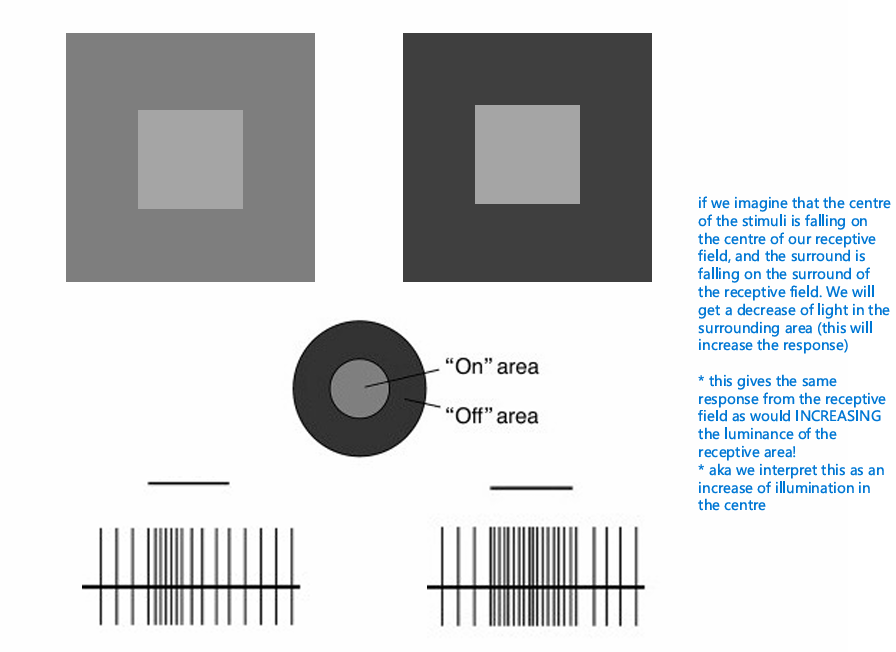
antagonistic mechanisms responsible for brightness and darkness sensations
on and off centre cells (lateral inhibition and central inhibition)
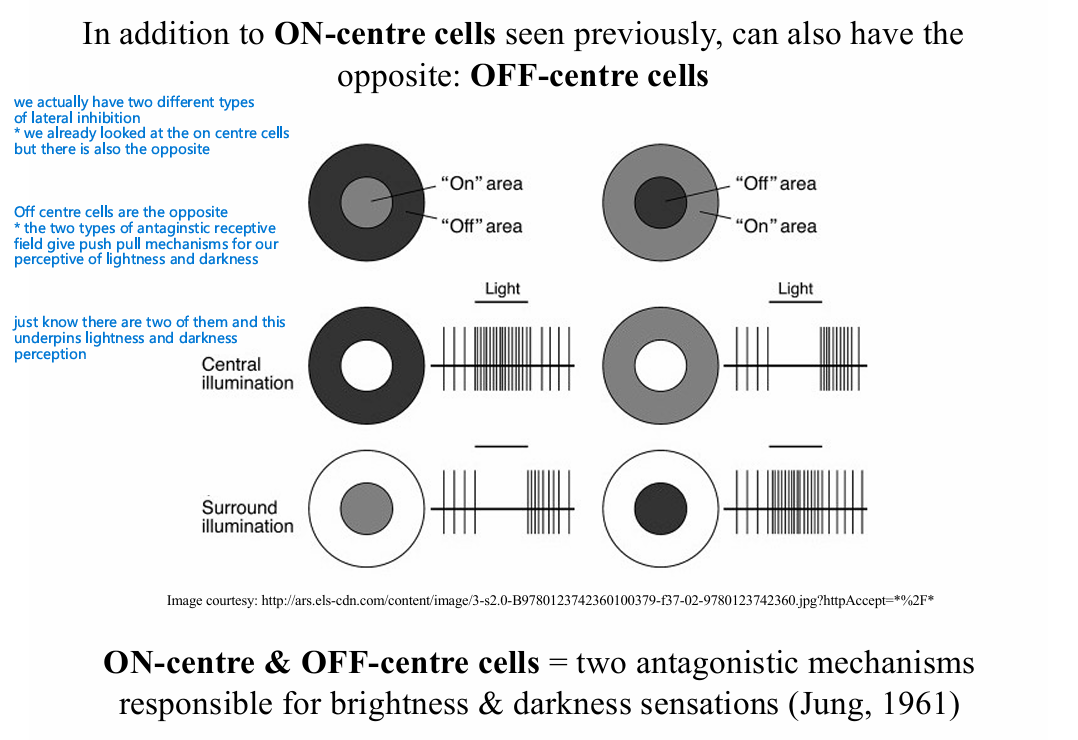
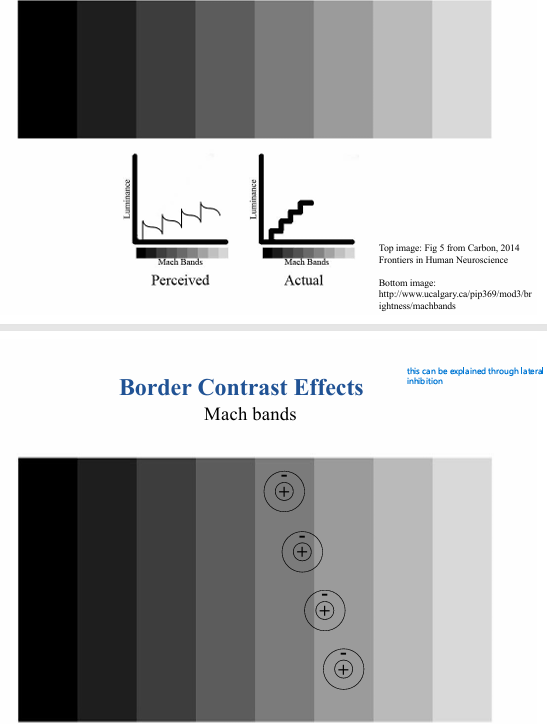
describe Mach bands effect, what is it caused by?
example of the broader contrast effect (caused by lateral inhibition)
bands of exactly the same luminance
the luminance itself is thought to be constant, but the side of the bands to the left look brighter
Bands to the right, less activated in the surround, more response!
poorer sensitivity if the change is over a longer area - Craik-O’Brien-Cornsweet illusion also describes this

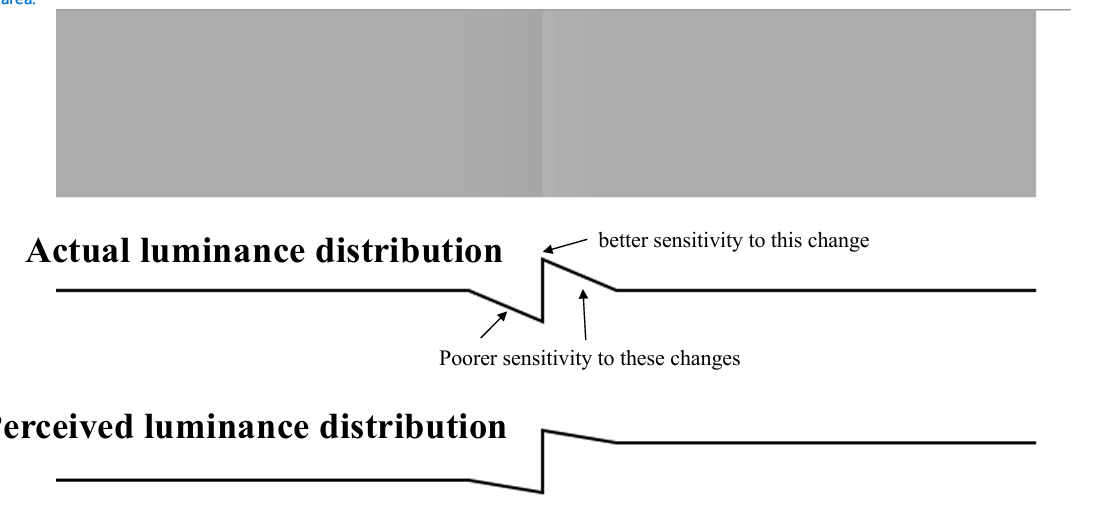
describe this illusion (Craik O’Brien-Cornsweet illusion)
Broader contrast effects: lateral inhibition
looks like you have a dark luminance rectangle on the left and higher luminance on the right
the actual luminance is the same (except in the middle)
transiently decrease the luminance on the right near the middle, increase on left near the middle
because the changes are over a larger area, the centre surround isn't that responsive.
sensitivity to broad course gratings not that high. Our brain doesn't tend to notice the change over the area.
how do artist portray differing lumination when they only have about 20 fold to work with?? (the reflectances of the colours)
2 ways
Gradual shifts in scene luminance between areas are not well signalled by eye, and so don’t need to be accurately represented (like the Craik O’Brien-Cornsweet illusion)
this can explain why sometimes a painting can be a more accurate representation of what we see compared to a photograph
Countershading
alter the lightness of an object by manipulating the background in the opposite direction
ex bow with light background looks darker
what illusions can be described by lateral inhibition (5)
line drawing
simultaneous contrast
mach bands (broader contrast)
Craik-O’Brien-Cornsweet illusion (broader contrast)
Countershading
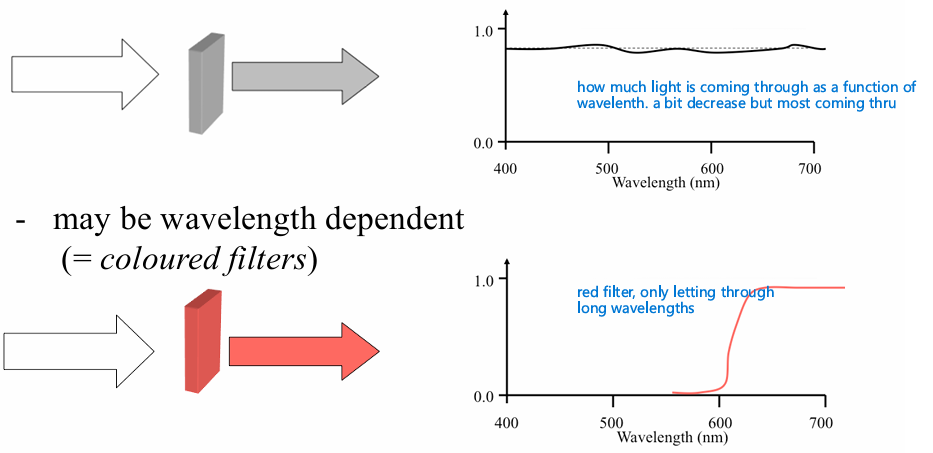
define transparency, transmittance and translucent
Transparency: Object that allows light to pass through without being scattered
Transmittance = amount of light out / amount of light in
transmittance can be wavelength dependent (coloured filters)
Translucent: object that allow light to pass through but scatter the light (ex. privacy screen)
what causes a scission? describe it. What does it infer
Double belongingness causes a scission
example:
the grey superposition region is separated into 2 componenets
a transparent grey, belonging to the bar
an underlying white surface, belonging to the cross
infers transparency
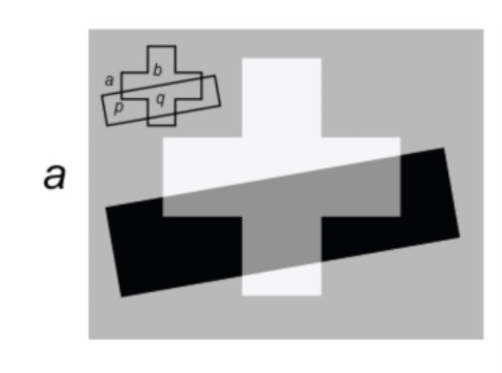
what does double-belongningness depend upon?
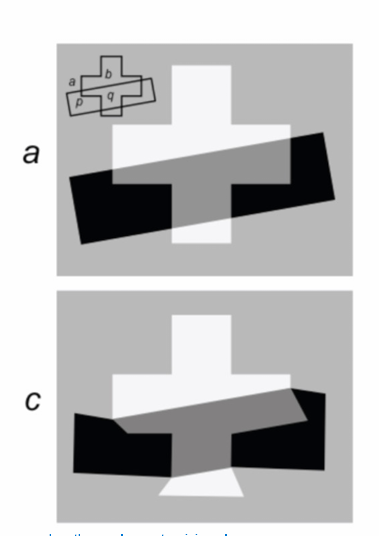
Locally: good continuation of contours at crossing points
Globally: improvement in form regularity
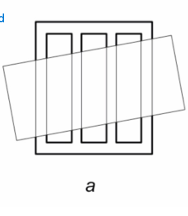
in c, the contour is irregular and weakens the percept of transparency
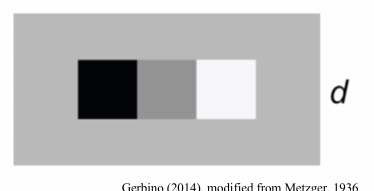
why does d not look transparent?
this is compatible with a percept of overlapping transparent rectangles
HOWEVER, interpreting the grey area as transparent doesn’t imrpove the shapes. Doesn’t agree globally (i don’t think)
what is phenomenal transparency?
phenomenal transparency = perceived as transparent
physically transparent = actually transparent
physical transparency is NOT sufficient for phenomenal transparency
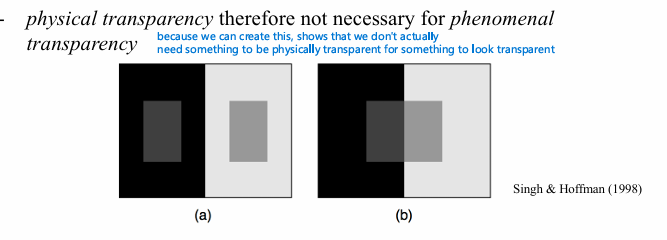
2 conditions for perceiving transparency
Geometric conditions
Topological: spatial arrangement of various areas (which regions touch which?)
Figural: shapes of various areas (do the contours and shapes support one surface lying over another?)
Global: improvement in form regularity
Local: good continuation of contours at crossing points
Photometric conditions
concern the presumed reflectance or luminance of various objects
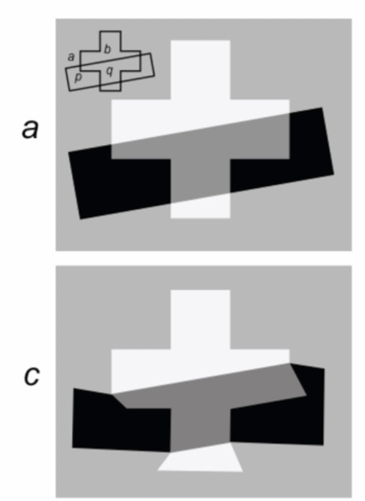
what transparency cue is weakened in (c) compared with (a)?
Looks transparent? (a) yes, (c) weaker
Main cue: good continuation at crossing points
Category: 1) geometric, 2) figural (local)
Why: In (c), the contours do not maintain a constant trajectory at the crossing, so the overlap region is less strongly interpreted as a transparent layer. In (a), p & q group together to form a layer
double belongingness of 2 of the 4 regions depends on geometric constraits
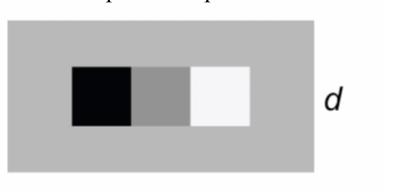
why doesn’t this image appear transparent?
does not support improvement in overall form regularity / simpler global organization
Category: does not support global
Meaning: Transparency is not supported because when layered it is not more regular and coherent.
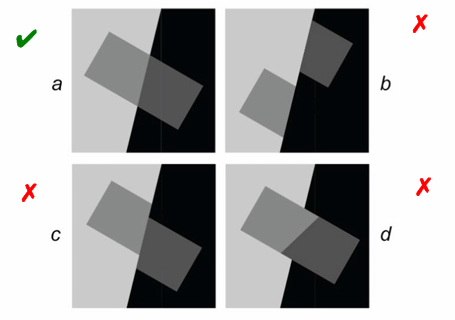
what condition for transparency does figure (a) support?
Supports: reciprocal contact and correct contact relations
Category: geometric, topological (spatial arrangement)
Meaning: The two subregions of the transparent layer should contact each other, and each should contact only one of the remaining regions.
what are X-junctions and T-junctions - what transparency cue do they support? What indicates transparency?
X-junctions = strong cue for transparency (left)
T-junctions = typically indicates occlusion by opaque surface (right)
x-junctions are a critical LOCAL factor!! (figural - local)
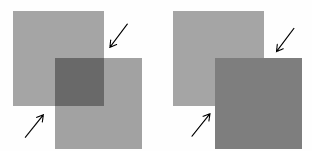
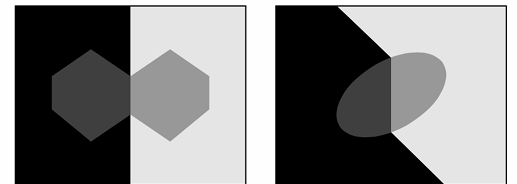
what transparency condition does the right image support?
Supports: good continuation of the transparent layer boundary
Category: geometric, figural (local)
Meaning: Transparency is strongest when the contour of the front transparent layer remains smooth and consistent.
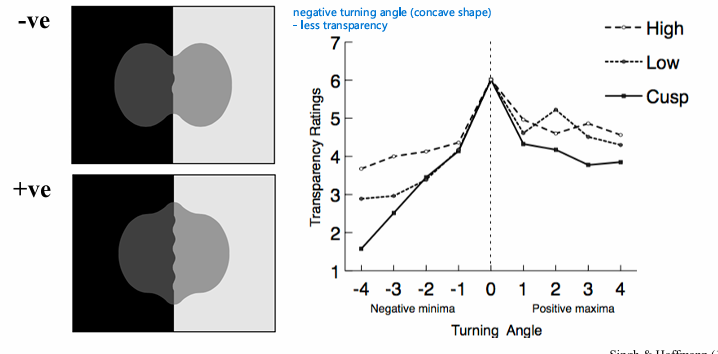
do negative turning angles in the layer boundary increase or decrease the perception for transparency? Why?
decrease
more complicated
even when local contour continuation is preserved, negative turning angles in the boundary of the transparent layer make the whole layer shape less coherent, so transparency is perceived less strongly.

what condition for transparency does the left image support?
Global (figural)
improvement in form regularity
what are the 2 conditions for transparency in Metelli’s model? What conditions are these?
Photometric conditions: concern the presumed reflectance or luminance of various objects
Condition 1: Polarity Constraint
p-q must have the same sign as a-b
i.e. if region a is darker than region b, then region p must be darker than region q
Condition 2: Magnitude constraint
| p – q | must not be greater than | a – b |
i.e. central region must have a smaller reflectance difference than surround
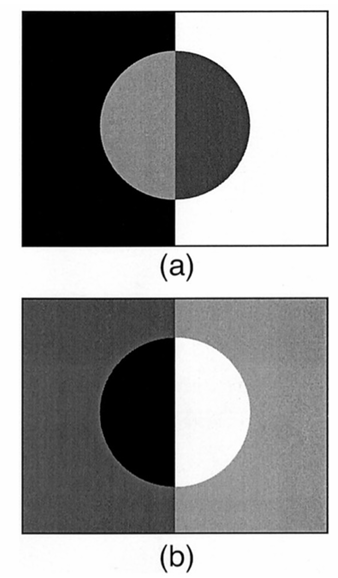
what constraints are violated in image (a) and image (b)
Photometric conditions: concern the presumed reflectance or luminance of various objects
(a): Metelli’s polarity constraint violated (p is lighter than q and does not look transparent)
(b): Metelli’s magnitude constraint violated (| p – q | is larger than | a – b |, aka we have a greater difference in reflectance in the transparent layer)
metelli’s model limitation
a black episcotister appears more transparent than a white one, despite identical physical transmittance
Evidence that transparency more related to image contrast in the transparent layer
how to achieve percept of translucency?
translucency: when some of the rays scatter
translucency can be perceived with thinner lines
do low or high spatial frequency deformations give stronger transparency impression?
low frequency
what overrides cues that would — on their own —suggest transparency is not present
Motion
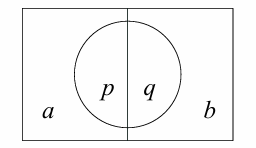
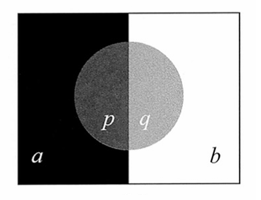
In Metelli’s Episcotister Model for transparency, there are four zones whose reflectances can be designated a, b, p & q, as shown below
metelli’s episcotister model for transparency are an attept to interpret transparent objects by relating them to the appearance of rapidly rotating disc with a gap. These are the rules he came up with
reflectance p – q has the same sign as a – b;
reflectance | p – q | must NOT be greater than | a – b |
2 types of texture
Tactile texture
patterns of bumps & dips we can feel with our fingers (e.g. rock, bark, skin, wall paint)
Visual texture
variations in the light intensity reaching our eyes
can also come from variations that don’t give tactile texture
ex. rock composition (quartz vs mica)
water waves
patterns of surface colour (paint)
what characteristics make textures easier to segment than others?
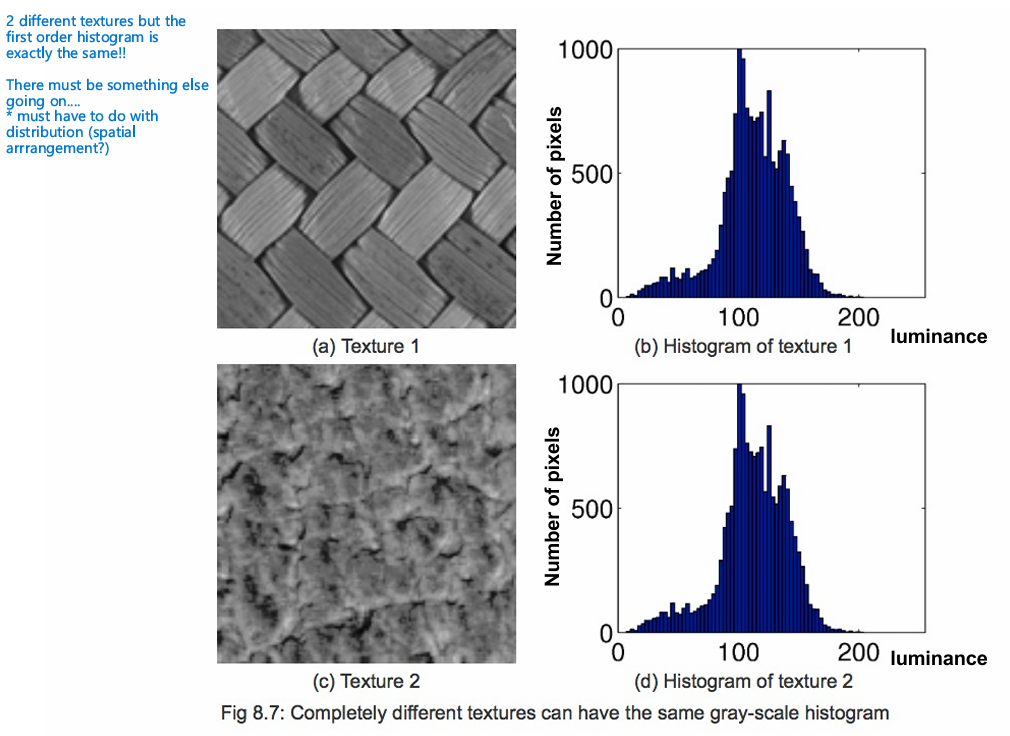
what does a first order histogram do? are differences in in 1st order pixel statistics necessary for texture segmentation?
quantifies how commonly pixels of various grey levels (luminances) occur in an image
does not tell you where the pixels are in space
image: two completely different textures that have the same first order histogram
differences in first order pixel statistics are not necessary for texture segmentation.
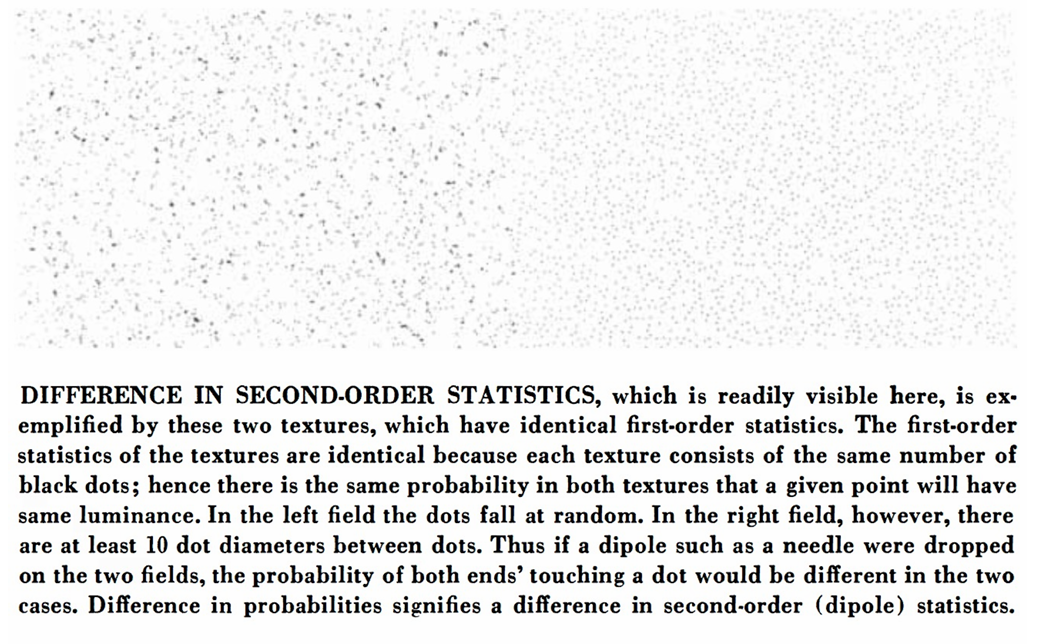
what are 2nd order statistics in texture segregation? Are 2nd order statistics necessary for texture segmentation?
2nd order statistics give us some information about separation and orientation by looking at pixel pairs.
not necessary or sufficient for texture segmentation
what is the texton theory - texture segmentation
rather than simply orientation, segmentation depends on other “textons” such as closure, curvature, line endpoints, junctions.
difficult to quantify, often based on verbal descriptions of image features rather than actual measurements
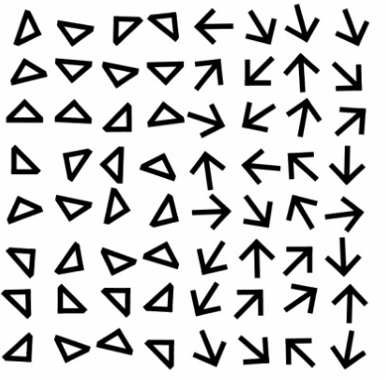
what does texture segmentation arise from? Like how do we process it?
more than one type of processing
image processing methods - based on how our visual system is thought to process information
statistical differences between regions, such as first- or second-order image statistics
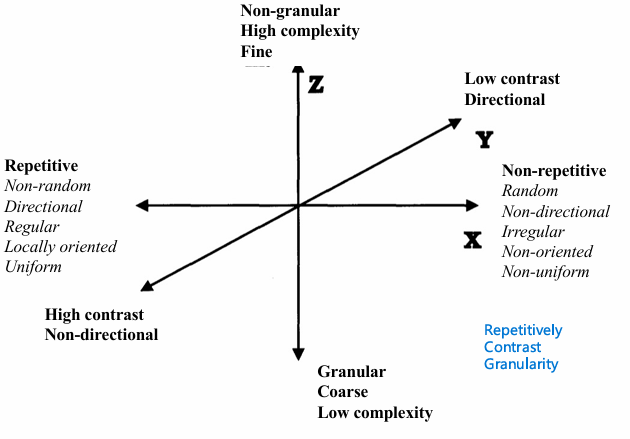
3 most significant dimensions to textures
Repetitively
non-random, directional, regular, locally oriented, uniform
random, non-directional, irregular, non-oriented, non-uniform
Contrast
directional
non-directional
Granularity
fine
course
define crowding. Where is crowding most prominent?
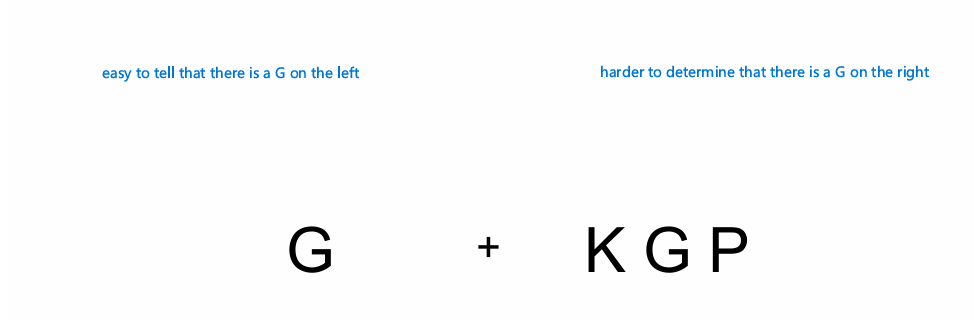
an impairment in the ability to resolve a target when it is surrounded by irrelevant targets: e.g. reading a single letter, versus reading a letter in a string of letters
Crowding is most prominent in peripheral vision, where visual acuity is better for single letters than for strings of letters
where do we assume texture processing operates by default? what theory supports this?
in the periphery
crowding supports this because crowding represents texture processing in the periphery
peripheral vision does not represent every item precisely and separately
surface lightness vs. gloss
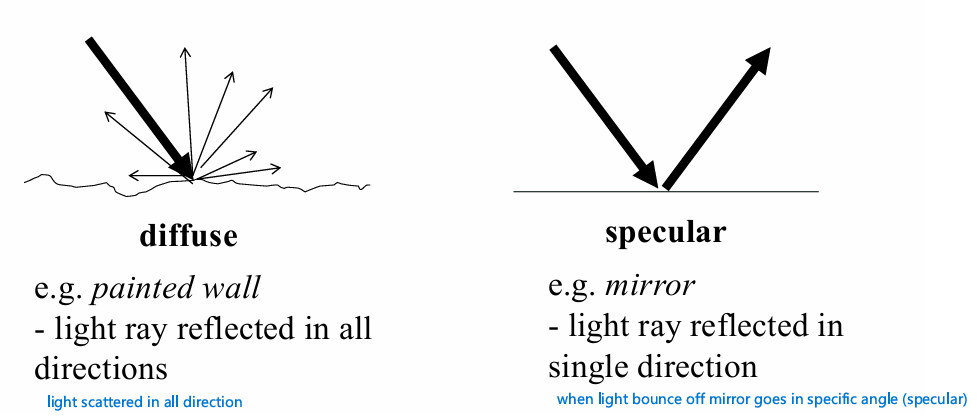
Surface lightness: typically understood as the percept relating to the diffuse reflectance of a surface
Gloss: relating to the specular (mirror-like) component of reflection
what will flat, convex and concave mirrors do?
Size of the reflection will depend upon the size of light source, and the curvature of the specularly reflecting surface:
Flat: reflected image same size as light source
Convex: reflected image smaller than light source
Concave: reflected image larger than light source
Higher curvature = more magnification or minification
2 conditions for gloss perception
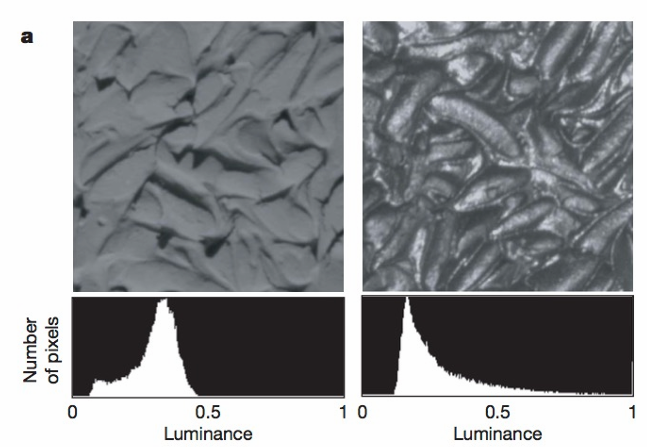
frequency of luminance pixels: strong positive skey in first image histogram (frequency of grey levels)
location: specular highlights & reflections must appear in areas of high curvature)
how quickly can we perceive a boundary between different textures. What phenomenon is the boundary between two textures?
Can perceive a boundary between different textures in <0.2 s
boundary is not literally in the image: is a Gestalt phenomenon from grouping texture elements
Which words best complete the blanks in the following sentence? A ____ reflecting surface that is ____ in shape will produce an elongated highlight that is a visual cue to gloss.
specularly, cylindrical