Radiation Detector Types
 Call Kai
 Learn
Learn Practice Test
 Spaced Repetition
 Match
Match Flashcards
 Knowt Play
1/54

Earn XP
Description and Tags
Subgroup I: Radiation Physics and Detection
Name | Mastery | Learn | Test | Matching | Spaced | Call with Kai | Chat |
|---|
No analytics yet
Send a link to your students to track their progress
55 Terms
All detectors work on the principle that
radiation can ionize and excite matter
Radiation interacts with matter and the interactions lead to a
transfer of energy
types of clinical detectors
scintillation
semiconductors
types of health physics detectors
gas-filled
scintillation
photographic emulsion (film)
optically stimulated luminescent (OSL)
thermo luminescent (TLD)
gas filled detectors
radiation ionizes the gas molecules contained in the detector
ion pairs are created
the detector contains two electrodes, positive and negative
a voltage difference exists between the two electrodes that causes the ion pairs to feel an electrostatic pull
the detector uses the electric field to collect and measure the number of ion pairs that are produced in the gas volume
the behavior of the ion pairs is dependent upon the applied voltage across the gas volume
In a gas-filled detector, a voltage difference exists between the two electrodes that causes the ion pairs to feel ___
an electrostatic pull
How does a gas-filled detector measure radiation?
The detector uses the electric field to collect and measure the number of ion pairs that are produced in the gas volume.
What are the two gas-filled detector operation modes?
current mode and pulse mode
current mode (gas-filled detector)
electric field causes ions to flow
detector can measure the flow of charges
measures rate of ionization
current mode (gas-filled detector) equation
Current (I) = charge (Q) / time
In current mode (gas-filled detector), the amount of current produced in the detector is ___ to the radiation exposure rate.
directly proportional
pulse mode
measures each individual quantum that interacts
output is pulses per unit time (counts per minute)
high count rates will result in loss of counts
In pulse mode (gas-filled detector), the measured cpm in the detector is ___ to the radiation exposure rate.
directly proportional
In pulse mode (gas-filled detector), a high count rate will result in
a loss of counts
gas-filled detectors in a nuclear medicine department
Geiger-Mueller survey meters, ionization chambers, cutie pies, dose calibrators
ionization chamber region of response
applied voltage sufficient to collect all primary ion paris, no recombination
current measuring devices
current proportional to number of ion pairs
can distinguish between alphas and betas
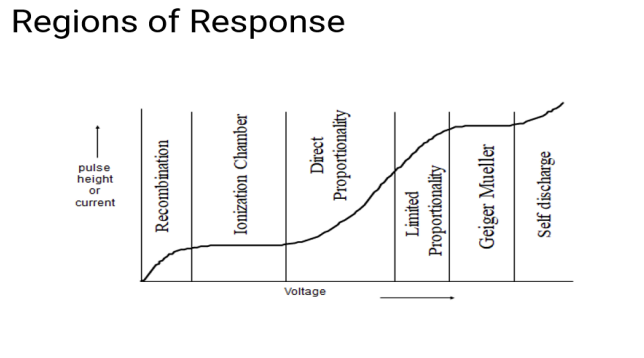
ionization devices in a nuclear medicine department
dose calibrators, cutie pies, pocket dosimeters
dose calibrator
gas-filled well ionization chamber
gas is pressurized to increase detection sensitivity
current measured by electrometer
pushbutton selector used to adjust the electrometer readout in activity
cutie pie (ionization chamber)
low sensitivity, high range; 0-500 R/hr
slow response
low energy dependence
filling gas is air
can directly measure exposure (mR, R) or exposure rate (mR/hr, R/h)
exposure
amount of charge produced in mass of air
Geiger Mueller region of response
gas amplificatoin on the order of 106 to 108
pulse size is NOT proportional to the initial ionization
usually operated in pulse mode
GM discharge must be quenched
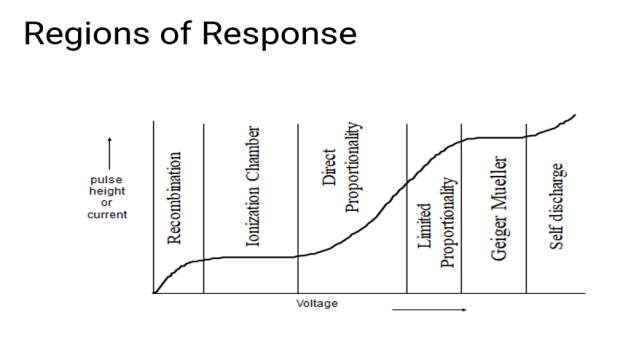
quenching a GM meter can be accomplished two ways:
electronically or chemically
electronically quenching a GM meter
lower the anode voltage until all positive charges have been collected (aka external quenching)
chemically quenching a GM meter
incorporating a quenching agent in the detector filling gas (aka self-quenching)
self-quenching agents
organics and halogens
Geiger-Mueller devices
GM survey and area meters
very sensitive, can measure background
0-200 mrem/hr
fast response
CPM or mR/hr display
energy dependent
What are GM devices used for?
surveying and detection
What device is best for accurate dose measurement?
ionization chamber
What device is best for detecting low levels of radiation?
Geiger Mueller survey meter
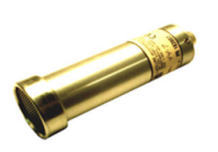
thin end window (for GM survey meter)
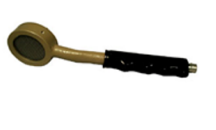
pancake (for GM survey meter)
scintillation
a material that converts kinetic energy of ionizing radiation into a flash of light
luminescence
emission of light following absorption of energy
two types of luminescence
fluorescence and phosphorescence
fluorescence
prompt emission of visible light
phosphorescence
delayed emission of visible light
If using a luminescent detector, it should convert energy through ___ rather than ___.
fluorescence, phosphorescence
classes of scintillators
organic
plastics
liquids
inorganic
NaI(Tl) - Thallium activated Sodium Iodide
CsI(Tl) - Thallium activated Cesium Iodide
BGO - Bismuth Germinate
GSO - Gadolinium Oxyorthosilicate
LSO - Lutetium Oxyorthosilicate
clinical scintillators
gamma cameras, uptake probes, PET scanners
health physics scintillators
well counter, uptake probe
how inorganic scintillators function
electrons are available in discrete bands of energy in a crystal lattice
radiation deposits energy in the scintillator, resulting in many ionizations
electrons from ionizations will be elevated to the conduction band
return to valence band results in emission of a photon
visible light photons are easily detected
inorganic scintillator valence band
represents electrons bound at lattice sites
inorganic scintillator conduction band
represents electrons that will never be found in a pure state
inorganic scintillator forbidden band
represents electrons that will never be found in a pure state
To enhance the probability of visible photons being emitted during de-excitation in an inorganic scintillator, ___ are added to the scintillator.
small amounts of impurities
activators (inorganic scintillator)
impurities in the scintillator that create special sites in the lattice
scintillators are characterized by ___
decay time, the time it takes for the scintillation light to emerge
Shorter decay times in inorganic scintillators are ___
desirable as they allow for separation of events
semiconductor detector characteristics
generate a lot of information (10x more than air-filled detectors)
takes little energy to form an electron-hole pair
excellent energy resolution due to limited statistical fluctuations
types of semiconductors
HPGe - high purity geranium
SiLi - lithium silicon
CZT - cadmium zinc telluride
how semiconductors function
electrons are available in descrete bands of energy in a crystal lattice
valence bands represent electrons bound at lattice sites
ionizing radiation interacts with lattice and deposits energy and releases electrons
electrons leave behind holes
an electron-hole pair is created
by applying an electrical potential to the semiconductor, a depletion area is created
charges are collected in the depletion areas
the charge or current generated in the semiconductor are proportional to the energy deposited in the depletion area
semiconductors are also known as
solid state detectors
semiconductors conduction band
represents electrons that freely migrate, these electrons leave behind holes
A semiconductor operates essentially as a ___
solid state ionization detector
In a semiconductor, the charge or current generated are ___ to the energy deposited in the depletion area.
proportional