GOV- EXECUTIVE AND JUDICIAl BRANCH
 Studied by 0 people
 Call Kai
 Learn
Learn Practice Test
 Spaced Repetition
 Match
Match Flashcards
 Knowt Play
1/89

There's no tags or description
Looks like no tags are added yet.
Name | Mastery | Learn | Test | Matching | Spaced |
|---|
No study sessions yet.
90 Terms
What is the Executive Branch?
The President
What Article of the constitution provides rules about the Executive Branch?
Article II. It is the branch of government responsible for implementing and enforcing the laws, managing the federal government
What does the executive branch play a crucial role in?
foreign policy, national security, and domestic affairs
Does the Executive Branch consist of more people besides the president, even though the president is the main person of the Executive Branch?
Yes.More than just the President, including members of the armed forces, the Executive Branch employs more than 4 million Americans throughout federal agencies
President role #1- Chief Executive
enforcing federal laws, overseeing federal agencies, and making sure government programs are running properly.
The President also appoints the head of federal agencies such as the FBI and the Secretary of Defense.
President role #2- Commander in chief
in charge of the U.S. Armed Forces. Makes key military decisions, directs military operations, and ensures the nation's security. President can send troops somewhere in case of an emergency.
President role #3- Chief Diplomat
represents the US in relations with other countries. This includes meeting with foreign leaders, negotiating treaties, and making agreements that affect U.S. foreign policy.
True or false: while the president can make treaties, they have to be approved by the senate
true
President role#4- Chief Legislature
can offer ideas new laws, influence Congress to act on important issues, and veto bills (reject them)
The President__________
also delivers the "State of the Union" address to outline national priorities and suggest laws
President role#5-Head of State
serves as the symbol of the United States and its values.(preforming ceremonial duties)
President role#6-Economic Leader
works with congress to create the federal budget
President role#7-party leader
the leader of their political party (Democratic, Republican, etc.). This involves supporting party members running for office, fundraising, and promoting the party’s main goals and values
What are the requirments for becoming a president?
has to be at least 35years old.
Be a natural born citizen(did not need to go through naturalization)
must have lived in the U.S for at least 14 years.
What is the vice presidents roles?
presides over the Senate, casting tie-breaking votes when needed.
assumes the presidency if the President is unable to serve
often advises the President on specific policy areas, working with relevant departments and advocating for the President's agenda
advocates for the presidents agenda
What is the cabinet?
advisory body made up of the heads of the 15 executive departments
How are members of the cabinet appointed?
Appointed by the President and confirmed by the Senate.
Each Cabinet member is head of a specific_________________
federal office or agency
what does the secretary of state do?
handles international affairs for the federal government
What is an attorney general in charge of?
The justice department
who is the current Vice President?
J.D vance
What is the Electoral College? How is it set up? How does it work on election day?
A process the founding fathers established in the constitution-election of thepresident by a popular vote of qualified citizens.
538 electors, Majority of 270 electoral votes electoral votes required to elect president.
voting day held.every 4 years.
True or false? when you vote for a presidental candidate you are actually voting for your candidate’s preferred electors
true
How many Electoral Votes does a State Have?
number of US House of Reps member+number of senators(always equal 2)= Total electoral vote has.
Impeachment
The process of bringing charges against a government official for wrongdoing. A trial may be held, and the official may be removed from office
Impeachments can only occur if it is
a constitutional reason
Who has the power to Impeach?
The House of Representatives has the sole power to impeach the President, Vice President, or other civil officers of the United States.
This means they vote on whether to formally accuse the individual of "high crimes and misdemeanors,"
These are offenses that undermine the Constitution or the public trust. This process is similar to bringing formal charges in a criminal trial
What happens after the house of representatives votes to impeach?
The Senate then holds a trial to determine guilt or innocence.
The Chief Justice of the US Supreme Court presides over the trial
Senators act as jurors
The members of the House of Representatives acts as the prosecution, presenting evidence and arguing for removal from office
The accused individual has the right to a defense counsel and can present their own case
For a removed from office_______ majority vote in the senate is required
2/3 majority
What happens if the senate agrees with the house of rep for impeachment?
the person is removed immediently.
what are presidental roles and responsibilities?
formal duties assigned to the President by the Constitution
The basic responsibilities the President must carry out
Examples: Commander in Chief, Chief Diplomat, Chief Executive etc
They outline what the president is required to do as the head of the executive branch.
How is the NH executive branch set up?
Governor, Executive Councilors, and state agencies
NH Govenor
top executive official in the state
What is the NH govenors main job?
to ensure that state laws are followed
work closely with the Executive Council and various state agencies to manage NH government
Two year terms
Why is NH unique?
it has a five-member Executive Council that shares power with the Governor.
What can the NH executive Council do?
Appoints judges, commissioners, and agency leaders with the governor.
can veto the Governor’s decisions,( act as a check on the govenor’s power),
two-year-terms
How can the president influence lawmaking?
Proposing legislation- reccomend laws/policy changes, work with members of congress to draft them.
Thretening to veto- presidents power to veto is strong influence over congress. If congress knows that a president will veto a bill, they may coose to adjust it to make it more acceptable.
setting the agenda- push specific issues by discussing them publically
How does the president influence public opinion?
speak directly to the american people through social media. sharing specific messages-can shape the way people think about issues and rally support. m edia could help amplify the presidents message.
How does public opinion influence the president?
if public opinion favors or opposes a specific policy- president must adjust their stance to align with the majority
who does the president nominate?
federal judges, supreme court justices, appellate court judges, and district court judges.
How can the presidents choices shape the judicial system for decades?
they choose the judges that would serve for a lifetime
what is a key way presidents have expanded their influence?
executive orders
what is an executive order?
not a law. make a rule about an existing law. PRESIDENTS CAN MAKE A RULE ABOUT A POWER THEY ALREADY HAVE
How can presidents expand their influence through executive orders?
acting swiftly on pressing issues without wating for congress, setting national policy directions within the framework of existing laws. shaping federal agency priorties to align with their personal or party agendas.
What is the Judicial Branch?
the courts and justice system
What article of the US constitution establishes the Judicial Branch?
Article III
What is the Judicial Branch responsible for?
interpreting and understanding laws passed by Congress and the President
The Judicial Branch looks at the_________________________ ensuring that laws are____________with the constituion
relationship between laws and the American people, fair and align
What does the judicial Branch do?
The Judicial Branch highlights the constitutions role as the supreme law of the land. never interpret the law based on oppinion, but based on the constitution. This branch acts as a “check”
True or false: the constitution created the supreme court but there is more to the judicial branch. It includes all the courts in the country from local courts up to the U.S suprreme court, which is the highest court in the country.
True
congres______that are not the supreme Court
creates lower federal courts
broken into___________court systems
state and federal
Both State and Federal courts are overseen by Judges or Justices, who_______ over the court,________, listen to arguments from both sides of a case, and_______
preside, ensure order and fairness, and interpret the law
if you have commited a state crime where would you go? what if you have done a crime multiple times?
state court, federal court
What does the federal court system deal with?
cases that envolve federal laws(apply to everyone)
Main Parts of Federal Court System
District Courts
Courts of Appeals
Supreme Court
What type of cases do federal courts deal with?
constitutional right is being taken away, crimes that cross state values
1st part of a federal court-district court
“trial courts” most federal cases start here. 94 district courts in the U.S, Handle crimes under federal law, cases involving the U.S. Constitution, and disputes between people from different states when a large amount of money is involved
Trial courts include_______
the district judge who tries the case and a jury (12) that decides the case
2nd part of the federal court-the court of appeals
if you think a decision is unfair from the “trial of courts” you come to the court of appeals.
court of appeals cont.
“circut court” 13 appelat courts in the u.s- there job is to figure out whetere the process was fair. ( DO NOT HAVE A JURY)
if the court of appeals does not have a jury, what does it have instead?
3 judges- an odd number so that there is no tie.
3rd part of the federal court- supreme court
decide what cases they want to hear. will only hear cases if it has a question within the constitution- one that has not been decided on for a while.
true or false- supreme court justices serve for life, making them super fair( allows them to apply the law with no bias)
true.
Each state has its own court system to deal with issues and cases that involve state laws. These laws are____________, so they can be________. Here’s how state courts are typically structured:
created by each states governments, can be different from state to state
state court part 1- trial courts
similar to federal district courts, where cases start out. They handle criminal cases(theft, assult) and civil cases(lawsuits)
state court part 2- appellate courts
handle appeals from the trial courts. People can go to these courts if they believe the trial court made a legal mistake.
state court part 3-state supreme court
highest court in a state. Makes final decisions on state law, although if a federal issue is involved, the U.S. Supreme Court might review it.
State courts deal with cases that involve state laws, such as family law (like divorce and custody), state criminal cases (e.g., robbery, murder), and traffic violations
federal vs state courts
Federal courts handle federal law and cases that cross state boundaries, while state courts handle cases involving state laws
federal vs state courts(2)
Federal law applies across the entire U.S., while each state has its own laws, which only apply within that state
federal vs state courts(3)
Federal courts are for federal issues and are the same across the country
State courts handle local matters based on each state’s unique laws
what is the supreme courts role in the federal and state courts?
The U.S. Supreme Court can review decisions from both federal and state supreme courts, but only if the case involves a federal or constitutional issue.
What is the best-known power of the supreme court?
judicial review
What is judicial Review?
The ability of the Court to declare a Legislative or Executive act in violation of the Constitution
Judicial review is NOT found in the constitution itself. The court gained this power in the supreme court case of ___________—
Marbury v Madison 1803
Mabury v Madison 1803
established judicial review. (supreme court giving themself the job of educating all the laws) landmark cause of the u.s supreme court that was decided on february 24, 1803
Marbury v Madison was the in which the court_________
first, declared an act of congress unconstitutional
Marbury v Madision maintained the status of the judicial branch as ____ to the other two branches
equal
Marbury v Madison established that the supreme court is the________
ultimate interpreter of the Constitution
It asserted that the court can invalidate laws and acts that it finds________to the Constitution
do not conform
This principle fits in well with the government’s_______________ whereby each branch of government can constrain the actions of the other branches.
system of checks and balances
Judicial Review is the tool that gives courts the power to interpret the Constitution, and ________and ________ are two different ways judges might choose to use that tool
Judicial activism and judicial restrain
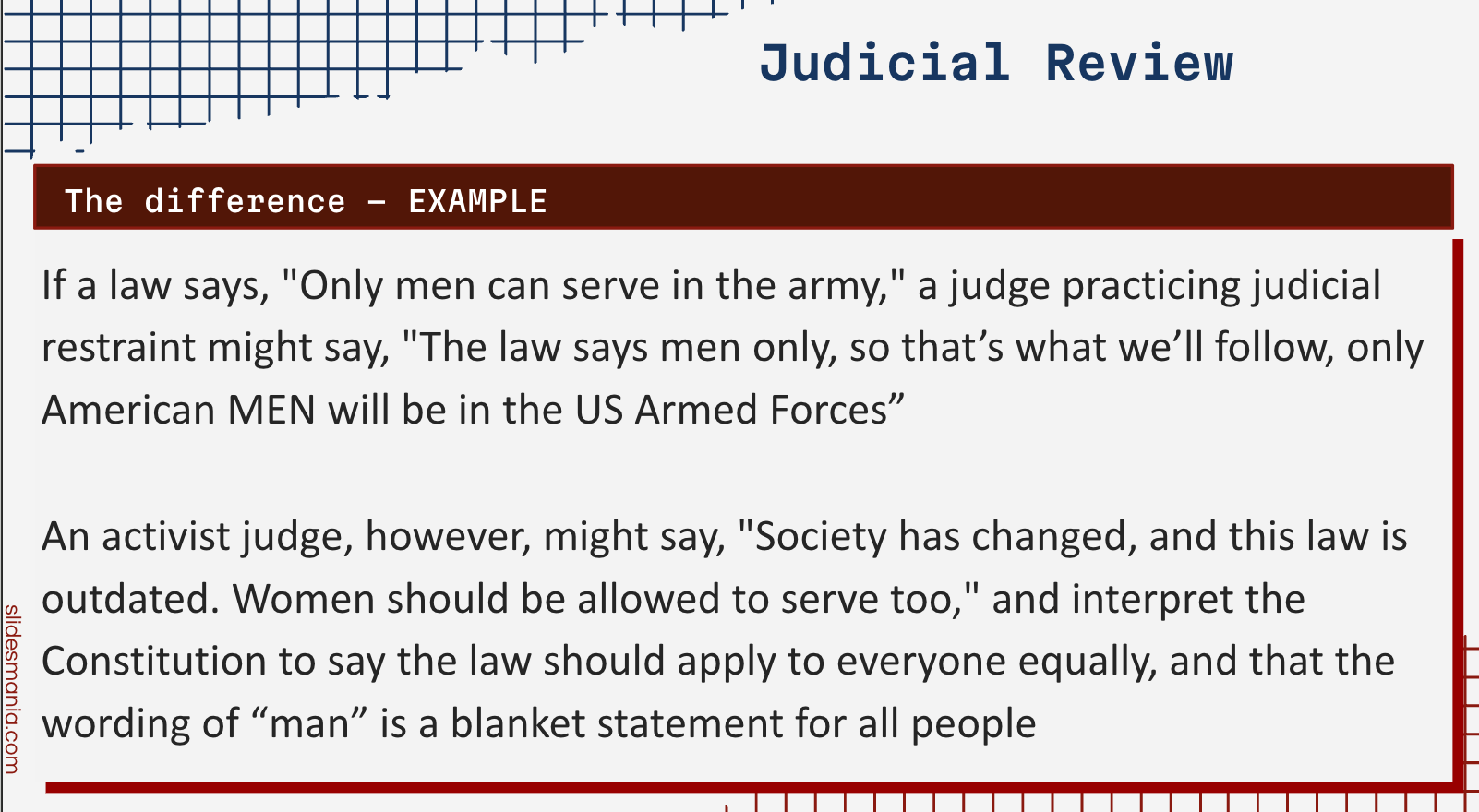
Judicial Restraint
when judges try to stick closely to the original words and intent of the Constitution and existing laws
Judges using judicial restraint usually__________
avoid making decisions that would create new policies or laws and are more cautious with judicial review
judicial restraint judges interpret the constitution as it is, this…
Believes this helps maintain a balance of power and prevents the judiciary from becoming too powerful
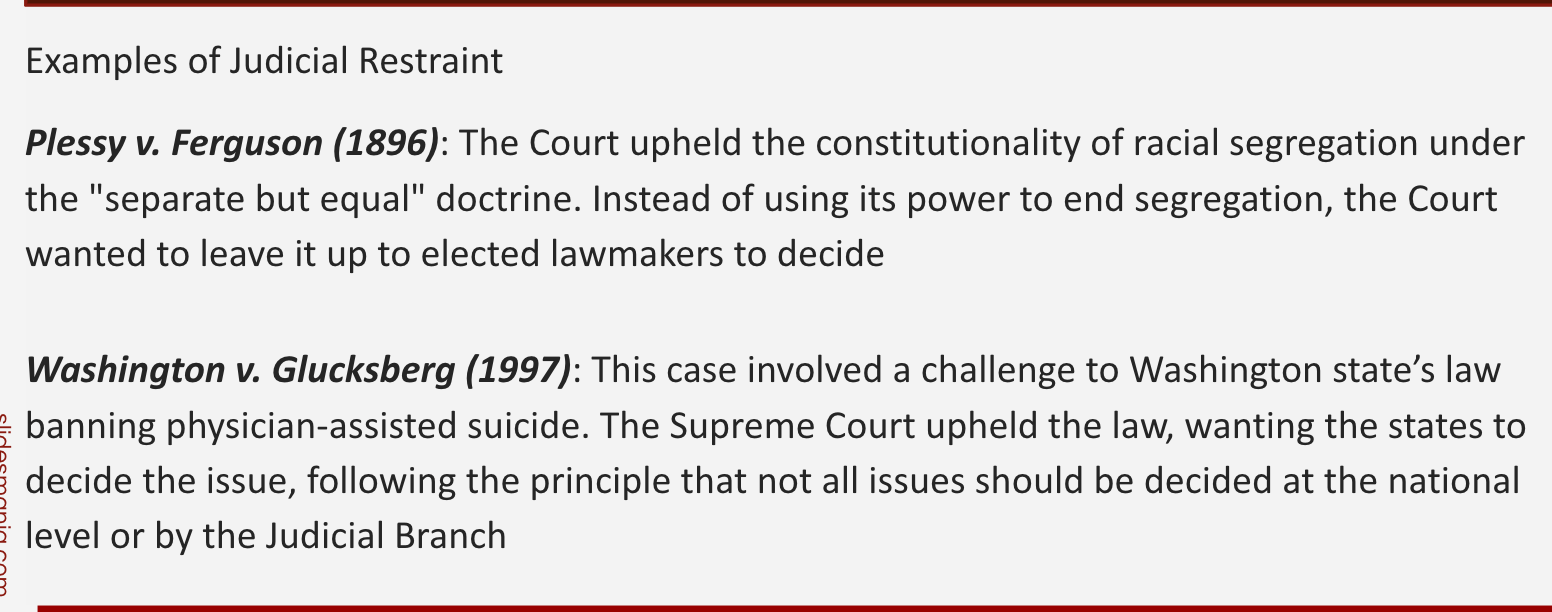
examples for restraints
judicial activism
when judges take a more active role in shaping laws that reflect certain social issues or changes in values
Judges using judicial activism
may use judicial review to make bold decisions that change the way laws are applied or interpreted and might make decisions that expand or protect rights, especially if they feel elected officials aren’t addressing these issues
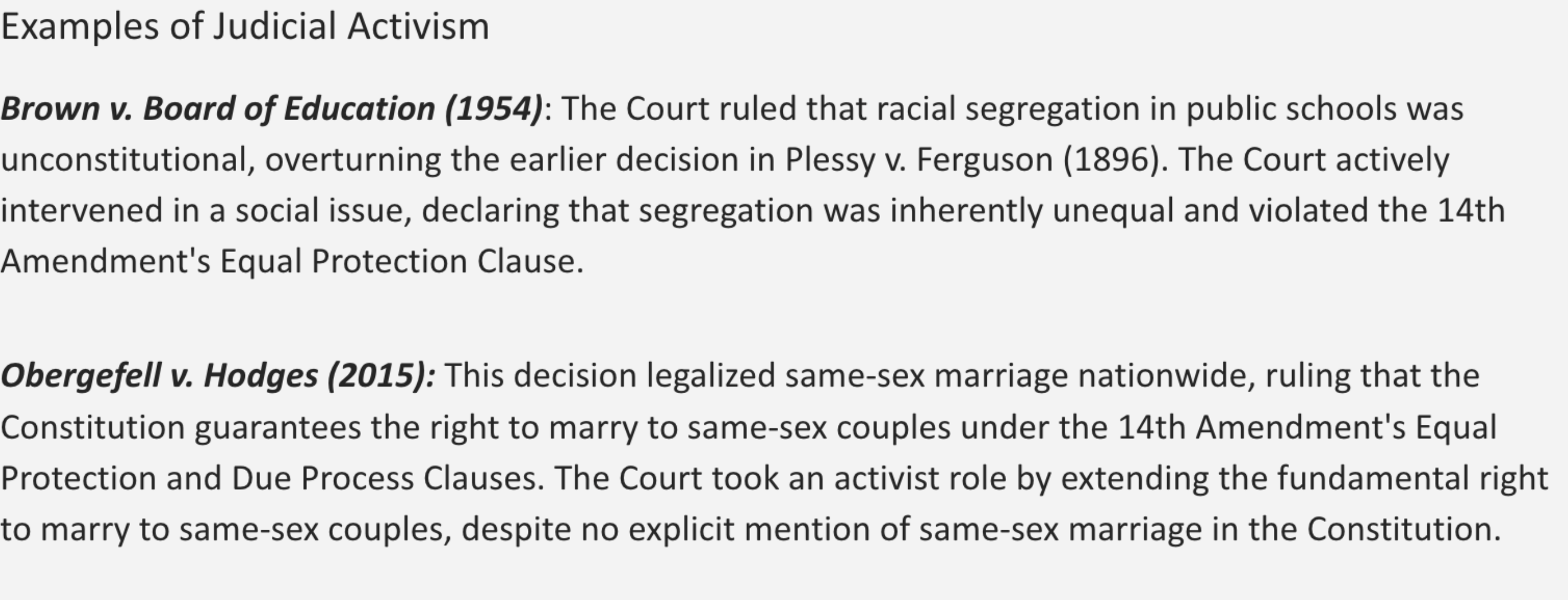
example of judicial activism
example of both