Surveillance RADAR and Stealth Engineering
 Call Kai
 Learn
Learn Practice Test
 Spaced Repetition
 Match
Match Flashcards
 Knowt Play
1/11

There's no tags or description
Looks like no tags are added yet.
Name | Mastery | Learn | Test | Matching | Spaced | Call with Kai |
|---|
No analytics yet
Send a link to your students to track their progress
12 Terms
Surveillance RADAR
Scan sky to locate targets
Antenna with narrow beam gives good angular resolution but means more scan positions
Hemisphere of sky contains 2π steradians
In practice do not need to scan the full hemisphere
Gain of antenna = 2 * Number of beam positions = 2 * (2π/∆θ∆φ)
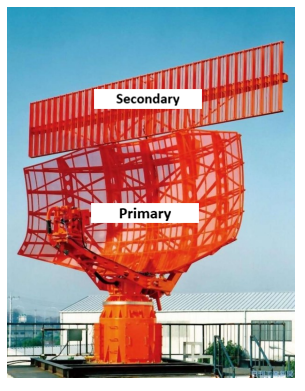
Airport Surveillance RADAR
Primary Surveillance RADAR
Works like traditional RADAR
Non-cooperative targets
Mechanical rotation
Antenna has a ‘fan-beam’ pattern
Secondary Surveillance RADAR
Works with cooperative targets
Transponder on aircraft sends details on location, speed, heading
Mechanical rotation
Tracking RADAR
Lock on to a target and provide continuous information
Tracking RADARs use an error signal to control the pointing angle of the antenna main beam
Can use phased array RADAR or older (less expensive) techniques
Sequential Lobing
Antenna has 2 displaced main beams: Lobe A at time 1 and lobe B at time 2
When the two returns are equal, target on tracking axis.
Need 4 beams for azimuth and elevation tracking
Conical Scan
Conical scanning is similar to sequential lobbing but rotate and a main beam that is off-set from tracking axis.
If target is off the rotation axis, then the output signal will vary in amplitude.
Monopulse RADAR
Uses two (azimuth tracking) or four (azimuth and elevation) simultaneous beams.
Received signal processed too give a sum output and a difference output
Stealth Technology
Also known as Low Observable technology (LO technology)
Techniques to make an object less detectable by sensors
Object - Aircraft, Ships, Submarines, People, Land vehicles, Missiles, Windfarms
Sensors - RADAR RF, Thermal, Visual, Acoustic
RADAR Stealth
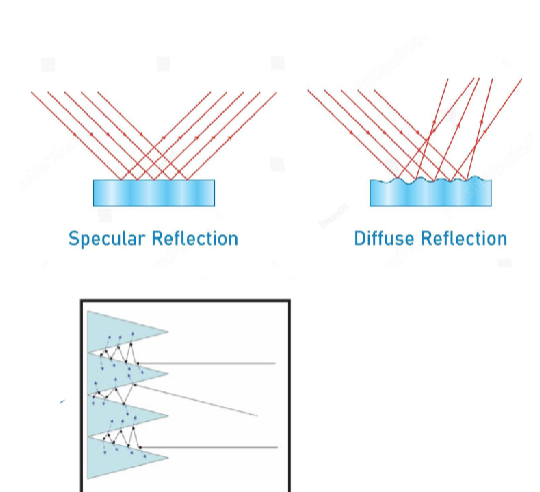
Involves reducing the target RADAR Cross Section (RCS)
Geometrical shaping and careful design – about 99%
Coatings – paints , composite structures
“Meta-surfaces” and “Active” surfaces.
Aerodynamics and Stealth engineering have different requirements – most stealth aircraft are unstable
RADAR Cross Section (RCS)
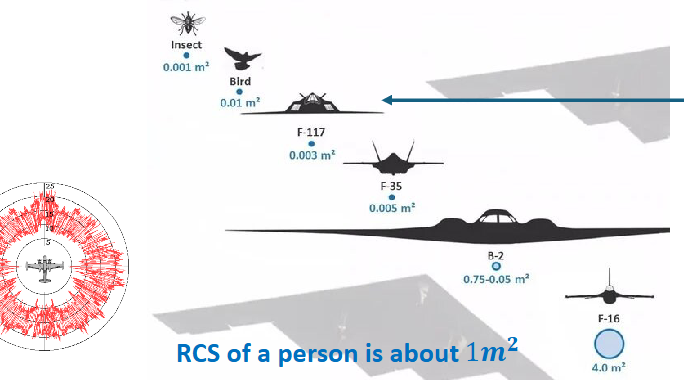
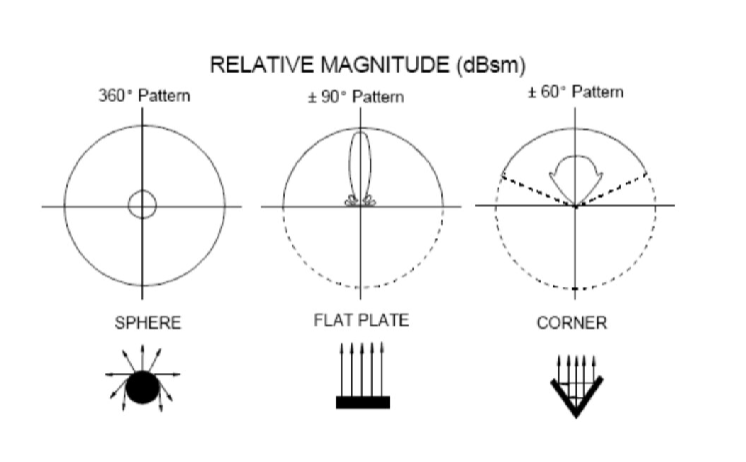
RCS of geometric shapes
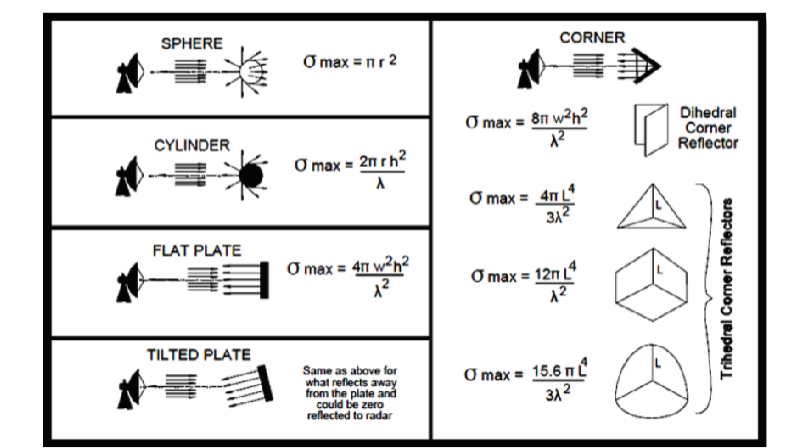
RCS vs angle variation of geometric shapes
RADAR Absorbing Materials (RAM)