Chapter 5.2: Carbohydrate Catabolism in the Presence of Oxygen Releases a Large Amount of Energy
 Call Kai
 Learn
Learn Practice Test
 Spaced Repetition
 Match
Match Flashcards
 Knowt Play
1/28

Name | Mastery | Learn | Test | Matching | Spaced | Call with Kai | Chat |
|---|
No analytics yet
Send a link to your students to track their progress
29 Terms
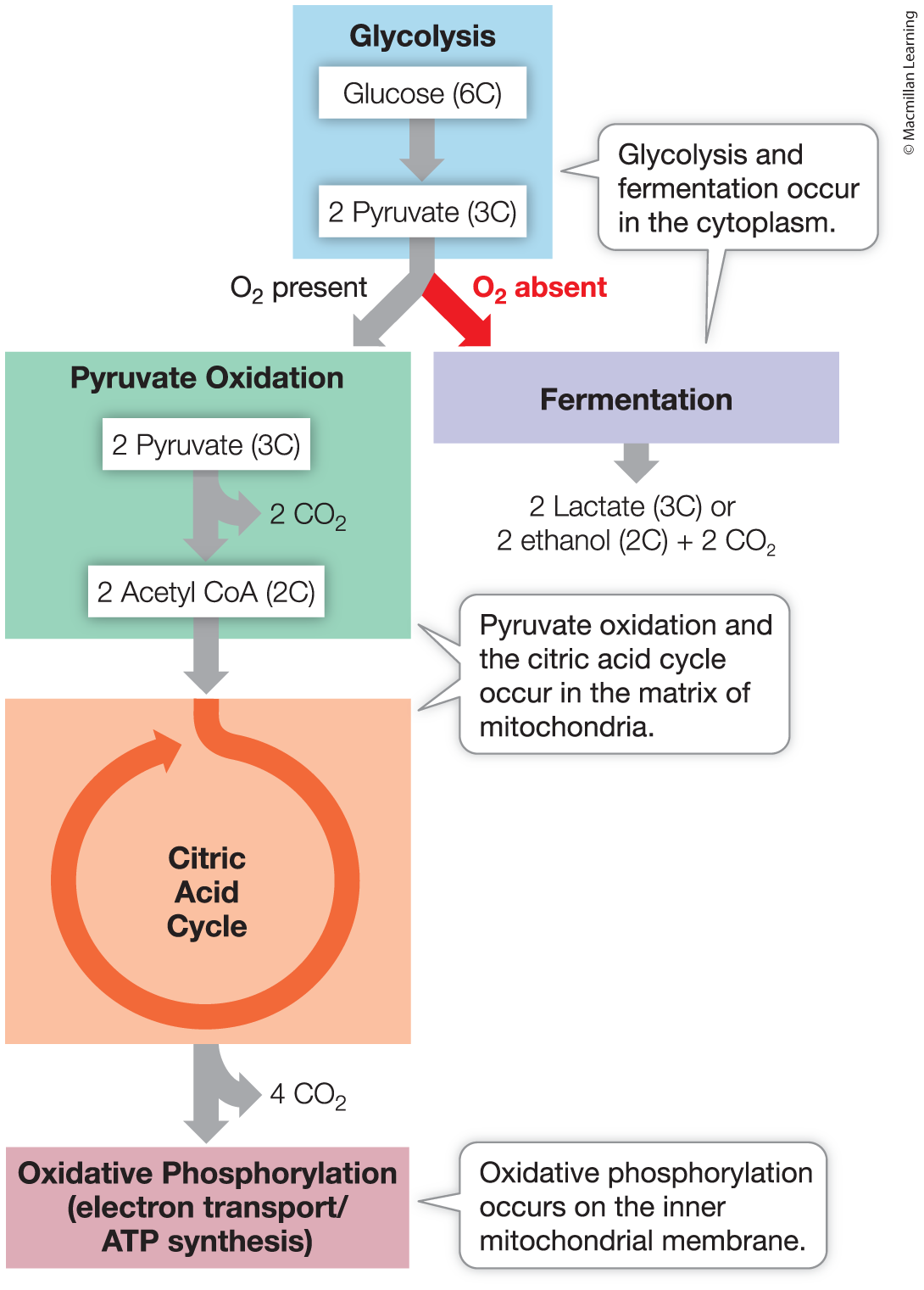
Cellular respiration
The set of metabolic reactions used to harvest energy from molecules like carbohydrates, fueling endergonic reactions through the oxidation of molecules
Kilocalorie
A measure of energy often used for cellular reactions; measured as heat in a laboratory

Aerobic respiration
The type of cellular respiration that occurs with oxygen, comprising glycolysis, pyruvate oxidation, the citric acid cycle, and oxidative phosphorylation to release high levels of energy through the oxidation of glucose
This process is relatively very efficient, with 34% of the released energy converted to ATP through a series of smaller reactions and 30 ATP molecules produced

Glycolysis
The first stages of both cellular respiration and fermentation, utilizing the 6-carbon glucose in a series of reactions to form two 3-carbon pyruvate, ATP, and NADH molecules

Glycolysis stage 1
The part of glycolysis where glucose is hydrolyzed and phosphorylated by 2 ATP molecules to form fructose, which then forms 2 molecules of glyceraldehyde 3-phosphate

Fructose
The intermediate product of the first stage of glycolysis formed out of a glucose molecule, hydrolyzed and phosphorylated by 2 ATP molecules, before cleaved to form two molecules of glyceraldehyde 3-phosphate (G3P)
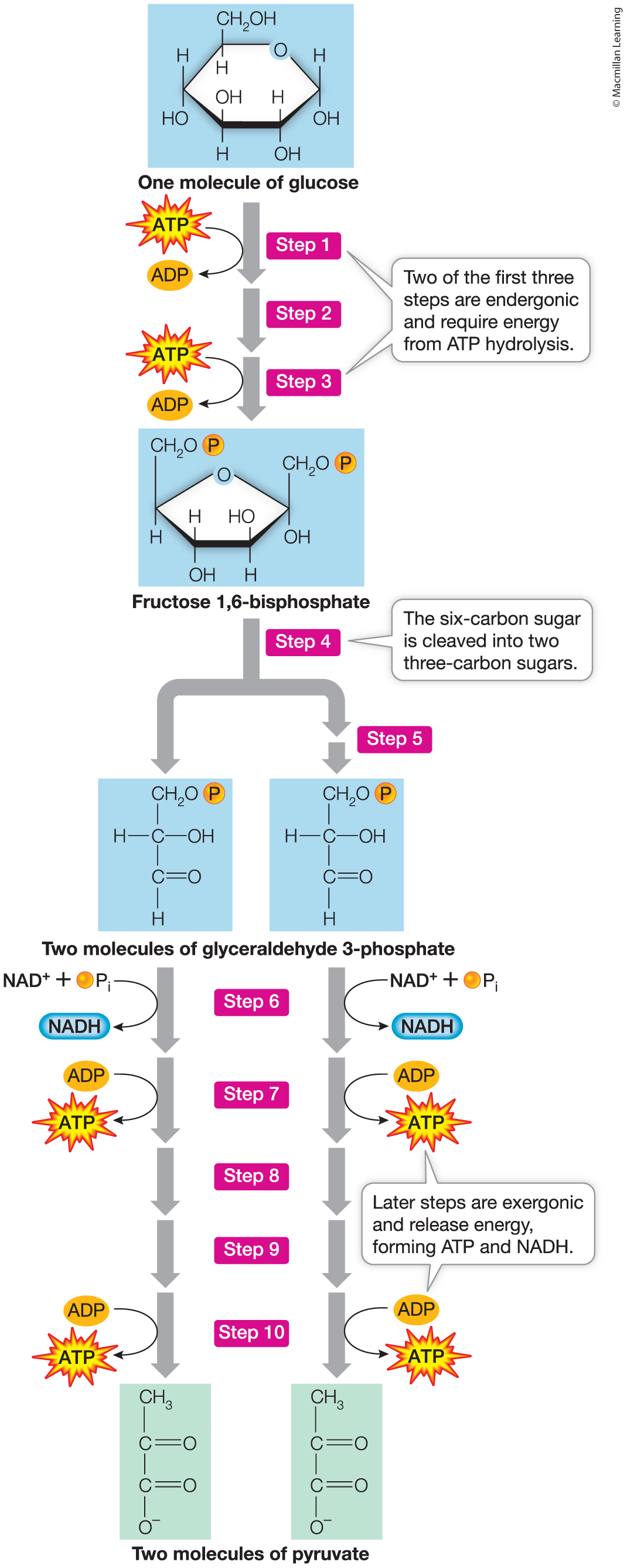
Glyceraldehyde 3-phosphate (G3P)
The final product of the first stage of glycolysis as two molecules, formed by cleaving a phosphorylated and hydrolyzed fructose molecule into two phosphate-containing sugars
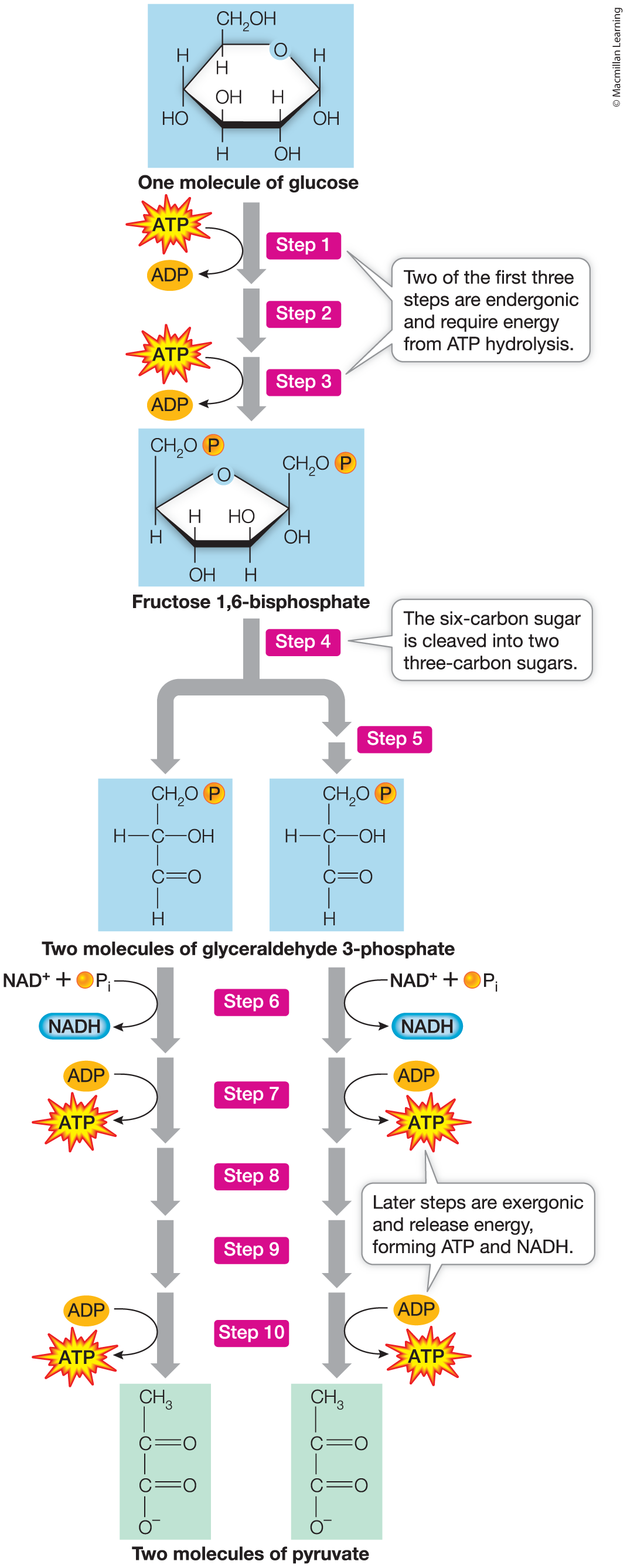
Glycolysis stage 2
The part of glycolysis where two molecules of G3P are phosphorylated and used to reduce NAD+ to NADH, then using the two phosphate groups available on both molecules to phosphorylate two ADP molecules into ATP (making four ATP cumulatively) and leave two pyruvate molecules

Substrate-level phosphorylation
The addition of a phosphate group from G3P molecules to form ATP from ADP twice, being left with two pyruvate molecules at the end of glycolysis

Pyruvate
The 3-carbon molecule formed as the end-product of glycolysis, used for aerobic respiration or fermentation depending on the presence of O2

Pyruvate oxidation
The second stage of cellular respiration where two 3-carbon pyruvates reduce one molecule of NAD+ and oxidize into two 2-carbon acetyl CoA molecules and two CO2 molecules
Help produce 3 net ATP molecules

Mitochondrial matrix
The inside of the mitochondria organelle found in eukaryotes, serving as the site of pyruvate oxidation
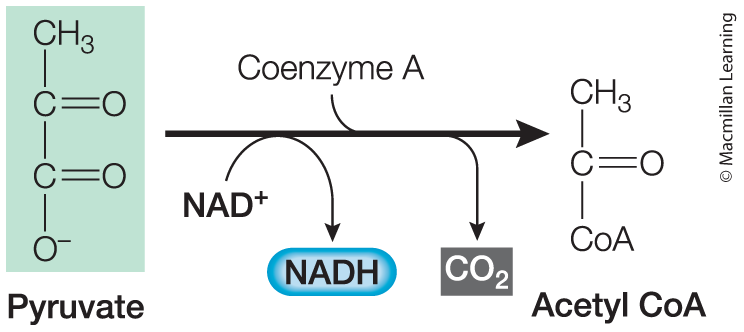
Acetate
The intermediate product of pyruvate oxidation as a 2-carbon molecule formed after the reduction of NAD+ into NADH by pyruvate, later being bound to coenzyme A to form acetyl CoA
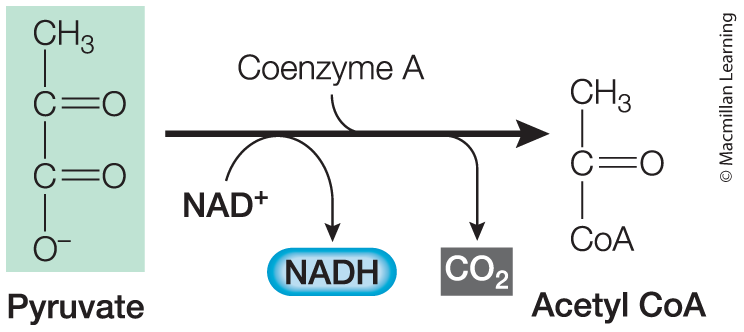
Acetyl CoA
The end product of pyruvate oxidation formed out of coenzyme A and one molecule of acetate, catalyzed by the pyruvate dehydrogenase complex, before being used in the citric acid cycle
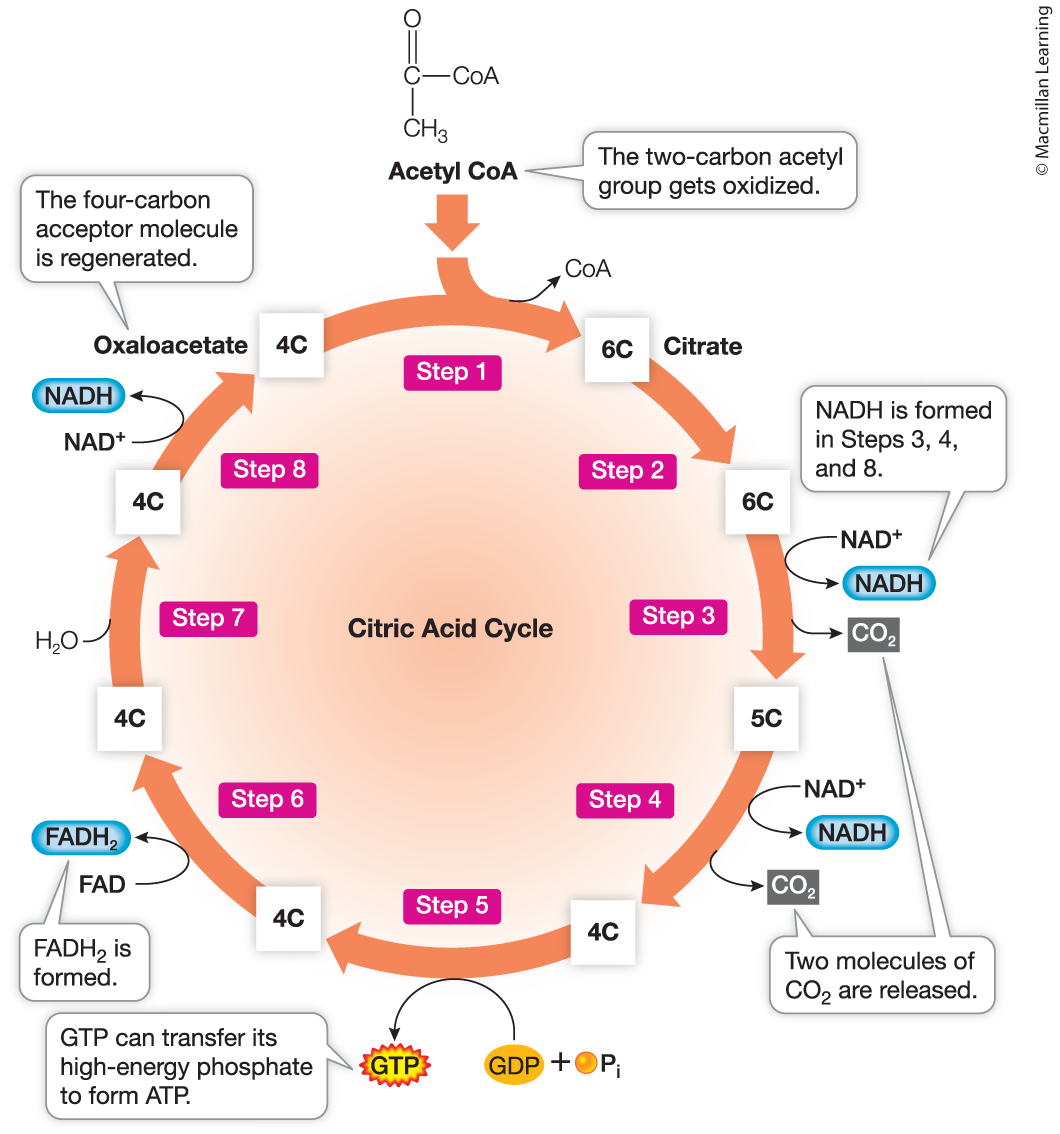
Citric acid cycle
The third stage of cellular respiration where the two 2-carbon acetyl CoA molecules are completely oxidized to form CO2 and products for oxidative phosphorylation, using the released energy to reduce three molecules of NAD+ and one molecule of FAD, as well as synthesize one molecule of GTP
These help make 9 molecules of ATP, for 18 total per molecule of glucose

Guanine triphosphate (GTP)
A high-energy compound produced via phosphorylation of GDP in the citric acid cycle, used to drive endergonic reactions or phosphorylate ADP into ATP
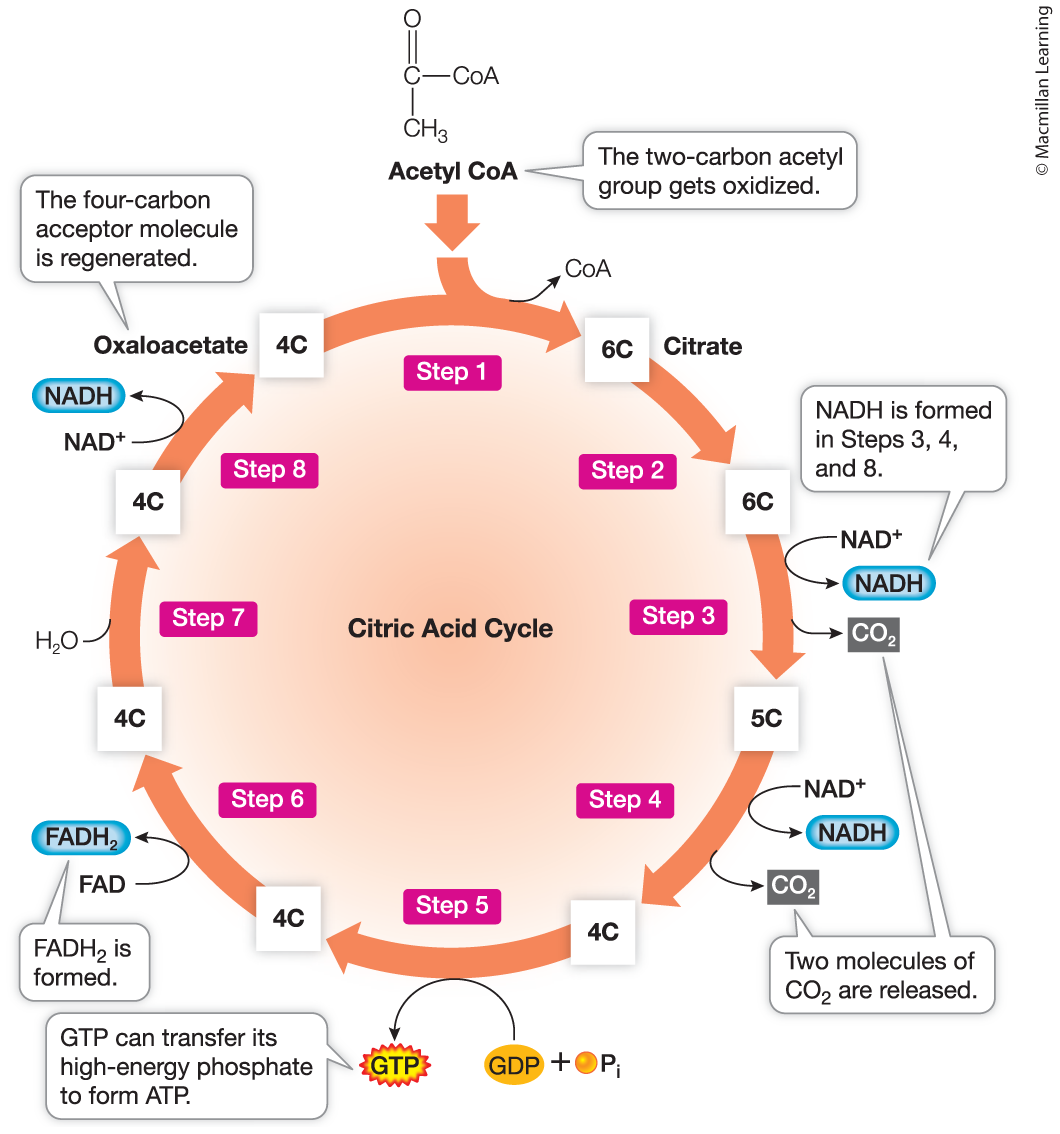
Oxaloacetate
A molecule formed out of the acetyl group of acetyl CoA, forming the starting material of the citric acid cycle and reforming for two cycles total

NADH and FADH2
The two coenzymes that are reduced during the citric acid cycle, forming three and one molecule respectively for use with oxygen in oxidative phosphorylation

Oxidative phosphorylation
The fourth and final stage of aerobic respiration, utilizing H+ ions from oxidated NADH and FADH2 molecules to form a proton gradient in electron transport and using the resulting diffusion for ATP synthesis in chemiosmosis
Forms 9 ATP molecules in total per molecule of glucose

Electron transport
The first stage of oxidative phosphorylation, where NADH and FADH2 molecules are oxidized and the resulting electrons are passed through mitochondrial membrane proteins for energized active H+ transport
Utilizes oxygen as an electron acceptor to become reduced and form water for motion
ATP synthase
A protein in the inner mitochondrial membrane that uses the H+ gradient to drive ATP synthesis via chemiosmosis at up to 100 molecules per second; this is present in much of life and relies on gradients
Presence of an alternate channel allows for energy to be used for heat instead of ATP generation
Chemiosmosis
The movement of ions across a membrane from higher to lower concentration; H+ performs this through the mitochondrial membrane protein ATP synthase
Proton-motive force
The potential energy of the proton gradient present during oxidative phosphorylation, driving chemiosmosis for ATP synthase
Feedback inhibition
Type of regulation where the product of a pathway binds to and inhibits an enzyme at the early step of the pathway, reducing production to an equilibrium
Seen in aerobic respiration to control total ATP and glucose levels, regulating processes quickly
Gene transcription
A potential method of regulation where the cell can modify levels of enzymes produced through expression

Fermentation (anaerobic respiration)
The breakdown of glucose without oxygen in the cytoplasm, only partially oxidizing glucose without chemiosmosis and repeatedly re-oxidizing NAD during the formation of pyruvate to allow glycolysis to continue
Has substantially smaller energy outputs, with only 2% efficiency
CO2 and ethanol or lactate
The products of fermentation in plants or animals, respectively, formed out of pyruvate from glycolysis
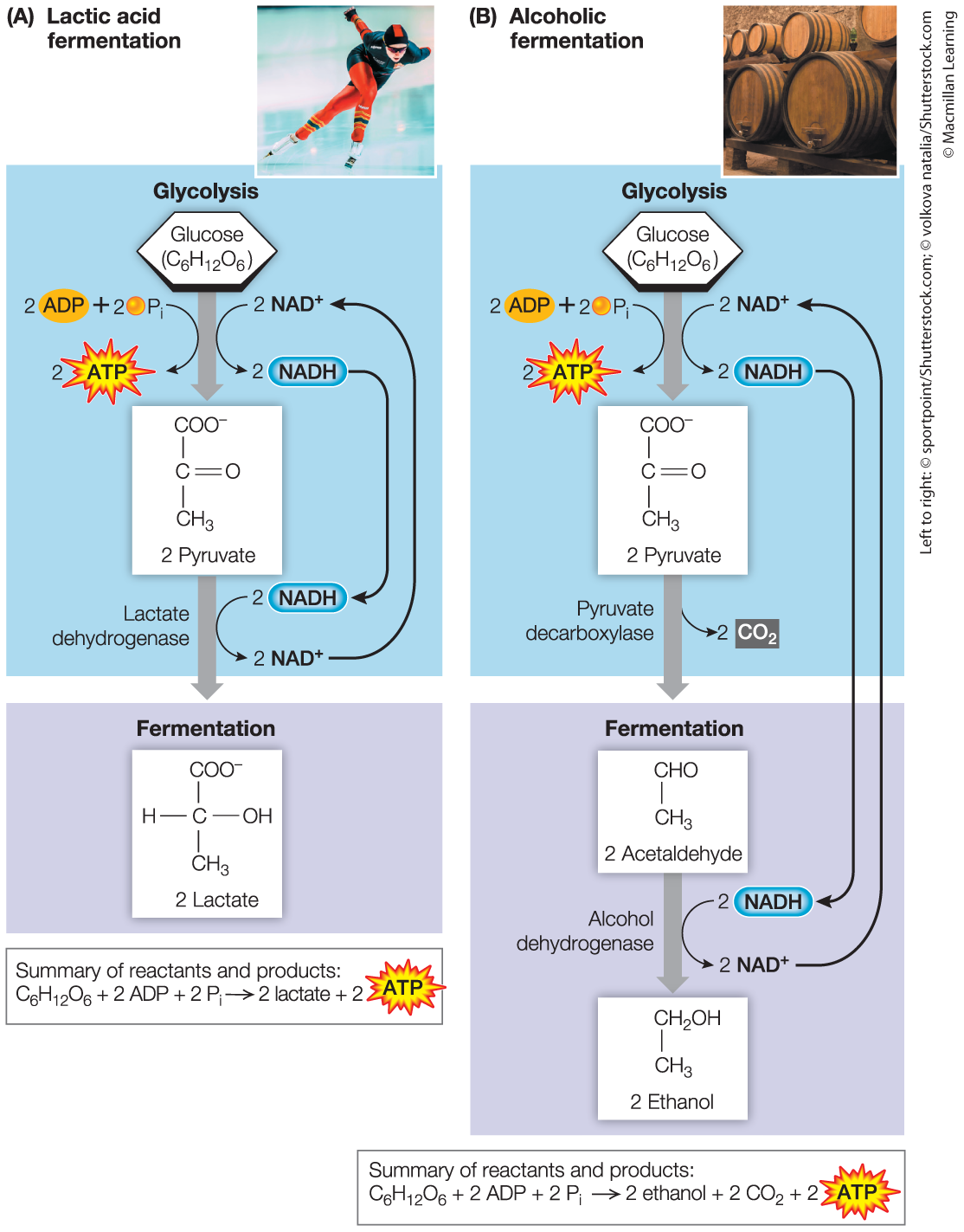
Lactic acid fermentation
Type of fermentation with pyruvate serving as the electron acceptor for NADH after forming 2 ATP, producing lactate; this is found in vertebrate muscle tissue as O2 is depleted and glycogen is used
The resulting lactate can be reconverted to pyruvate once oxygen returns

Alcoholic fermentation
Type of fermentation with pyruvate being converted to ethanol and acetaldehyde (intermediately formed out of pyruvate) serving as the electron acceptor for NADH
The resulting ethanol can be reconverted to pyruvate once oxygen returns