portfolio construction
 Call Kai
 Learn
Learn Practice Test
 Spaced Repetition
 Match
Match Flashcards
 Knowt Play
1/109

There's no tags or description
Looks like no tags are added yet.
Name | Mastery | Learn | Test | Matching | Spaced | Call with Kai | Chat |
|---|
No analytics yet
Send a link to your students to track their progress
110 Terms
Name the costs associated with an equity portfolio.
Management fee, performance fee, administration fee (custodian, depository), marketing, trading costs.
What categories are more likely to be managed using a passive approach?
Large-cap (market more likely to be efficient), narrow sectors without enough securities.
Criteria for benchmarks
transparency, rules-based, and investable.
Explain buffering and packeting.
Buffering is setting a range around breakpoints that define whether a stock belongs in an index. Packeting is assigning portions of a firm’s shares in an index.
Formulate HHI and effective number of shares.
HHI is summation of squared weights. Effective number of shares is 1 over HHI.
Reconstitution vs rebalancing
Reconstitution is changing the constituents. Rebalancing is changing their weights.
Who keeps dividends in stock lending?
Dividends are returned to the lender, and lender rebates return on cash collateral to borrower.
Differentiate pure indexing, enhanced indexing, active management
Pure indexing matches benchmark exactly. Enhanced deviates slightly. Active can deviate significantly.
PVBP
modified duration x price x 1bp (0.0001)
How to estimate duration/convexity of a portfolio of bonds?
summation over ModDur_j x MV_j/MV
Explain duration times spread.
Spread usually changes in proportional percentage points. So DTS is modified duration times the current spread.
Formualte dispersion and convexity in terms of cash flows.
Dispersion=∑wi(ti−D)². Convexity=∑witi(ti+1)/(1+y)², which is simply second derivative of price wrt yield, divided by P.
Formulate coupon income, rolldown return, View of Benchmark Yields, Views of Currency Value Changes
Coupon yield=Annual coupon payment/Current bond price. Rolldown return=(Bond Price_end-Bond Price_beginning)/Bond Price_beginning. This includes pull to par as well as yield curve shape effects. The sum of coupon yield and rolldown return is rolling yield. View of Benchmark Yields=E(∆Price based on investor’s views of yields and yield volatility)= (–ModDur × ∆Yield) + [½ × Convexity × (∆Yield)² ]. E(ΔPrice based on investor’s views of yield spreads)= (–ModSpreadDur × ∆Spread) + [½ × Convexity × (∆Yield)² ]. Views of Currency Value Changes is given.
Leverage on a futures contract formula
(Notional value - margin)/margin
How to compute dollar interest using repo rate?
Principal amount × Repo rate × (Term of repo in days/360)
cash-driven vs security-driven repos
cash-driven features “general collateral” and are usually tri-party. In security-driven, the lender is looking for a specific security. These are usually bi-party.
Formulate Rebate rate. What is the difference of repo and securities lending?
Rebate rate = Collateral earnings rate – Security lending rate. In security lending, the lender may demand the security back at any time.
Tax loss harvesting
Delay realizing gains and realize losses as soon as possible.
How are coupons/capital gains taxed in mutual funds?
Coupons are taxed the time they are received, regardless of whether the coupons are reinvested. Capital gains tax depends on the country. United states uses a pass-through system, where gains are taxed the moment they’re realized in the fund.
Differentiate asset-driven liabilities (ADL) vs LDI (liability driven investing)
With ADL, the assets are given, and the liabilities are structured to manage interest rate risk; whereas with LDI, the liabilities are given, and the assets are managed.
classification of liabilities
Type I: known cash flow amounts and timing. Type II: Known amounts but unknown timing (callable bond). Type III: unknown amount but known timing (variable-rate bonds). Type IV: unknown amount and timing (insurance).
Defeasance
Defeasance is a financial strategy where a borrower nullifies debt by allocating adequate cash or bonds, removing it from the balance sheet.
Cash-in-advance constraint.
Securities are not to be sold to meet obligations. This can be a problem for cash-flow matching portfolios if liability payments are level over time.
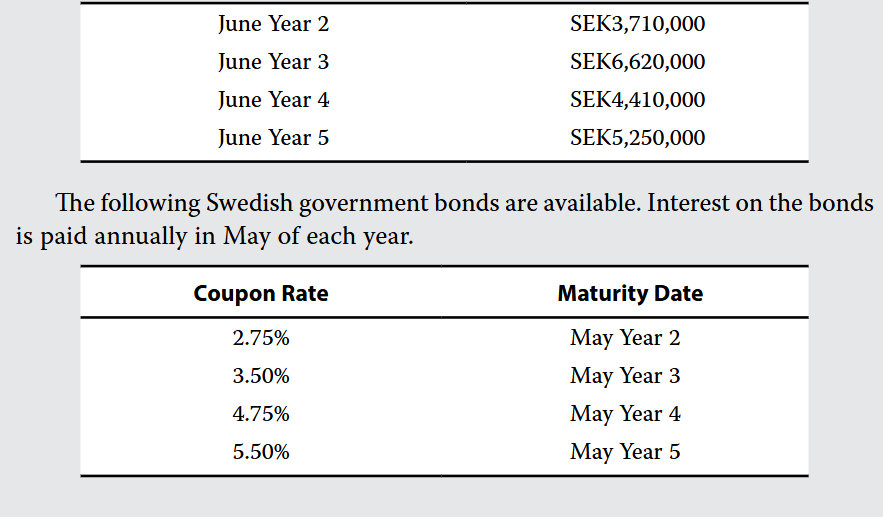
How much in par value for each government bond will Alfred need to buy to defease the debt liabilities, assuming that the minimum denomination in each security is SEK10,000?
5,250,000/1.055=4976303, which is 4,980,000 of the last bond.
(4410000-4980000 x 0.055)/1.0475=3948544, which is 3,950,000 of the penultimate bond.
(6620000-4980000 x 0.055 - 3950000 x 0.0475)/1.035=5950217, which is 5,950,000 of the second bond.
Lastly, a required par of 2,958,856 is needed for the first bond, which is 2,960,000. The extra can be used to cover the 217 shortfall in the year 3 obligation.
Ladder portfolio vs barbell. Whats the benefit of ladder?
Ladder spreads pars evenly along the maturities, rolling matured bonds into the longest end. Its convexity is lower than that of barbell (concentrated around short/long ends). Ladder provides liquidity at any point, as there is always a bond very close to maturity.
convexity formula from duration and dispersion
(Dur² + Dur + Dispersion)/(1+yield)²
Describe the roles/properties of timber in a portfolio.
Timber provides growth (the tree grows over time) and inflation-hedging properties, as the investor has the option to sell during high prices. However, mature timbre market is volatile, and timbre is subject to natural disasters.
back-fill bias
Reporting returns to a database only after they are known to be good returns
Evaluate the claim that alternative investments are better risk mitigators than bonds
Over the short-term, bonds reduce volatility more (bonds have negative correlation with equity when inflation is limited). Over the longer term, the higher return of alternatives reduces risk of not meeting goals.
What is the issue with using risk factor asset allocation for alternative assets?
Alternative asset returns contain idiosyncratic risks. Regressing returns on risk factors shows lower r² for alternative assets.
List the pros/cons of traditional approaches vs risk-based approaches.
Traditional is easy to communicate, conveys liquidity clearly, but may overestimate diversification or obscure main drivers of risk. Risk-based provides risk-factor identification but risk factors need to be converted to actual investments and their measurements may be subjective.
Describe the methods of exposure to alternative assets
1: Direct investment in a limited partnership. 2: FOFs 3: SMAs/fund of ones 4: publicly traded funds (mostly for hedge funds)
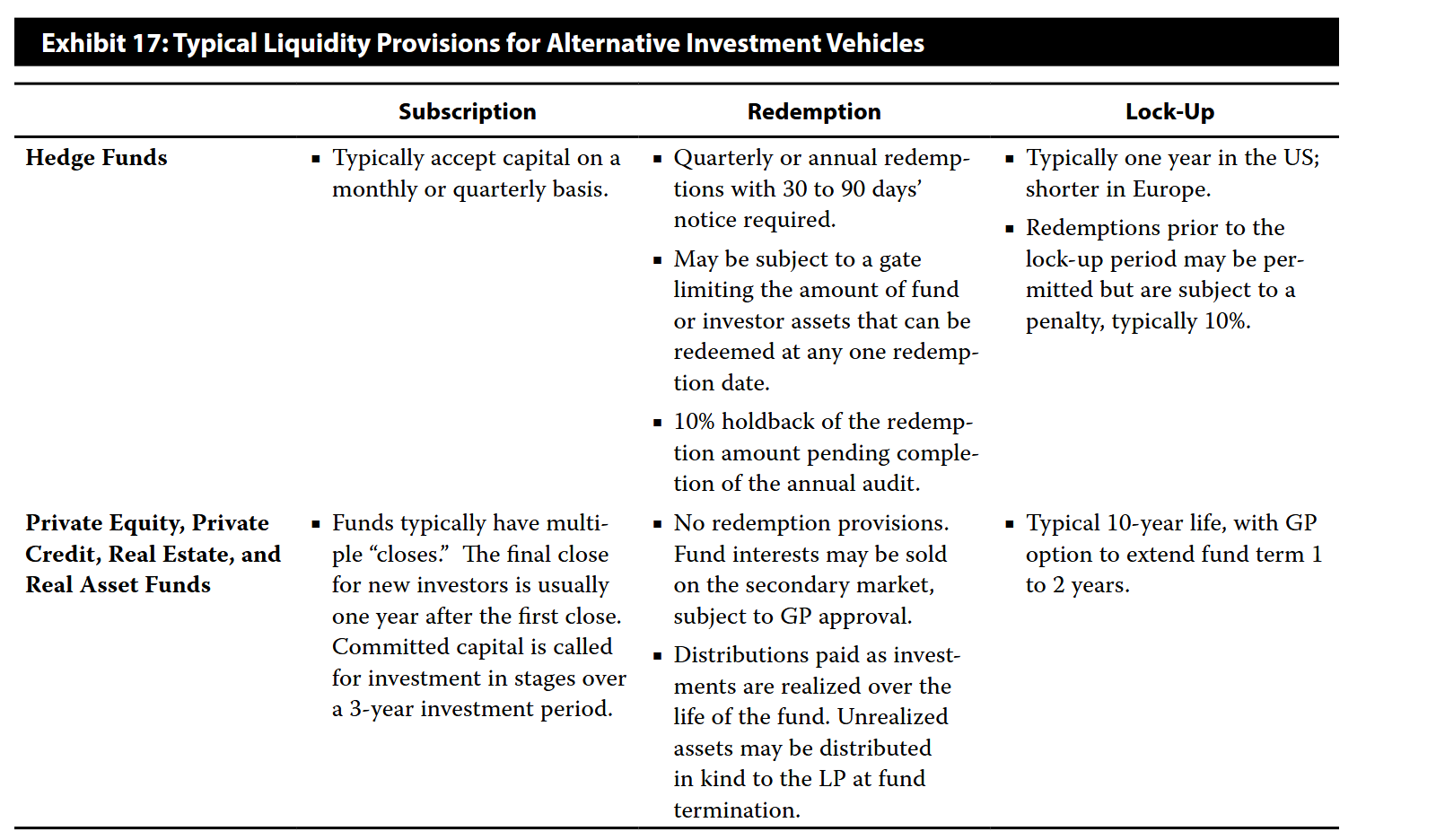
Explain the liquidity provisions for hedge funds vs private credit/equity/real estate
Remember, however, that second market exists to offload partnership interests, albeit at a discount and requires GP approval
what fees must the investor consider in alternatives?
Besides maangement/performance, sometimes accounting/legal/administrative fees are passed through separately. Tax considerations must be included as well.
What other considerations must the investor take into account?
whats the likelihood that the investor can invest in top alt managers? what’s the likelihood that the investor can conduct due diligence? what resources does the investor have to evaluate the program?
Vintage year diversification
Investing in funds with different vintage years over years, as pe returns heavily depend on vintage year.
Define commingled funds.
Mutual funds/limited partnerships are examples of commingled funds. Investors pool money together.
What’s a rule of thumb for investment horizon in private markets?
Less than 15 years horizon should not consider the private markets.
Explain the transparency issues with alts
No legal requirements mandate the reporting frequency/contents. Investors should also make sure that NAV is calculated by independent administrators.
how to detect smoothing in return series?
By detecting statistically significant serial correlation.
Simulating for skewness/fat tails
Solve the normal distribution parameters of the distinct regimes and the overall state probabilities. Then, generate normally distributed random scenarios based on the different means and covariances estimated under the two (or more) regimes with the appropriate frequency of the estimated probability of being the quiet or hectic regimes.
mean-CVaR optimization
At a return level, what’s the portfolio allocation with the lowest CVaR (compared to lowest volatility as in mean-variance)? CVaR is well suited for investors concerned about downside risk and alter allocations significantly on fat tails/negative skewness.
caveats of risk-factor approach
Correlations among risk factors may shift, as well as factor sensitivities of asset classes. Both of these require monitoring, which might not be well suited for a small, infrequent staff.
formulate capital contributions, distributions, and NAV
Ct = RCt × (CC − PICt). Dt = RDt[NAVt–1 × (1 + G)], where RDt = (t/L)B, NAVt = [NAVt–1 × (1 + G)] + Ct − Dt
what happens if the bow parameter is increased, and more iintial years require no distributions?
NAV grows a higher peak, and cash flow is negative for longer.
While waiting for capital calls, how is committed capital invested?
Through the liquid, public counterpart (public equities for PE, REITs for private real estate,etc)
How to validate assumed parameters for alternative fund cash flows?
Verify against the fund’s history. Additionally, create a bear case scenario, as capital calls accelerate and distributions slow during crisis.
What benchmarks are used for alts? What are the pros/cons?
custom index proxies (e.g., a static return premium over cash or equity index) or rely on peer group comparisons. Index proxies are arbitrary, and providers of peer group comparisons use different rules.
Distinguish MOIC, TWR, and IRR
TWR ignores cash flows and only compounds returns each period. IRR is the rate such that the time-discounted cash flows equal 0. MOIC is (Distributions + NAV) ÷ Paid-in capital.Monitoring the Firm and the Investment Process
Monitoring the Firm and the Investment Process includes assessing what?
key person risk, alignment of interests, style drift, risk management, client/asset turnover, client profile, service provider.
UBIT
Unrelated business income tax arises when a US tax-exempt organization engages in activities that are not related to the tax-exempt purpose of that organization.
Explain the tax benefits associated with timber.
Sales are taxed at capital gains rate.
Components of wealth are
Personal property, financial assets, real assets, rights
Define aggregate wealth and net wealth
Aggregate wealth is the total value of all assets owned. Net worth is the difference between assets and liabilities whose values are relatively easy to measure (this means rights are often excluded).
Define investable wealth and investable net worth
Financial and other assets that are readily available for investment. Investable net worth is liquid assets, such as savings accounts and investment accounts, minus short-term liabilities.
Does economic growth mean broad income growth?
No, it can be concentrated in hands of the few.
Differentiate GNI and GDP.
Gross national income (GNI) measures the total income earned byresidents of a country, including income earned abroad. Grossdomestic product (GDP) instead counts only income generatedfrom goods and services produced domestically.
wealth creation vs transfer
Wealth creation comes from production. Wealth transfer such as inheritance, gambling, lottery, is a zero-sum game.
Globally, what percent of wealth is controlled by the top 10%? Top 1 %?
Top 10% controls 82%, and top 1% controls 46%.
Formulate Gini Coefficient and the Lorenz curve
Gini ranges from 0-1, with 0 being everyone equal and 1 being total wealth being in the hands of only 1 person. Lorenz curve is graphing cumulative percentage of households (ordered poorest to richest) to cumulative wealth. Diagonal maps to Gini of 0. Wealth inequality shows up as sagged curves below the diagonal.
Discuss the factors that a manager considers with respect to identifying countries in which individuals are likely to have greater economic opportunities for income and wealth growth.
(1) technological advancements that contribute to productivity improvements; (2) shifts towards free market capitalism; (3) business privatization (transfers of state-owned assets to private ownership); (4) increases in business formation, especially entrepreneurial ventures that lead to job creation, innovation, and economic growth worldwide; and (5) economic and business deregulation. Additionally, asset price appreciation in real terms is a factor driving wealth growth in countries and regions.
The seven financial stages of life
Education (0-25), early career (25-35), career development (35-50), peak accumulation (50-60), pre-retirement (60-65), early retirement (65-75), late retirement (75+)
Formulate human capital
sum p(st)wt-1(1+gt)/(1+rf+y)^t, where w is labor income from employment
Compare the wealth profiles of a wage earner vs entrepreneur
The wage earner's total wealth declines over his lifetime. His wealth is front-loaded with human capital, so income after retirement depends heavily on pension and investment portfolio. The entrepreneur, however, increases his total wealth over time as his business compounds in value. His wealth is much less dependent on pension after retirement.
At what stage of the wealth life cycle does accumulated or total wealth typically achieve its maximum level?
Pre-retirement.
Differentiate planned vs unplanned goals.
Planned goals have reasonably defined horizon and amount. These include primary residence, vehicle, or luxury item, family events such as weddings, education such as college or professional education,wealth transfer through gifts and bequests, and philanthropy. Unplanned goals, such as property damage or medical conditions are less quantifiable.
Differentiate inflation-hedge asset vs asset that outpaces inflation
Inflation-hedged asset protects purchasing power during periods of inflation. An asset that outpaces inflation has a return higher than the rate of inflation.
Define risk perception
The third leg besides risk capacity and risk tolerance, it is how an investor perceives risk relating the current investment climate.
Marginal tax rate
In a progressive tax system, tax rate on the last dollar is known as the marginal tax rate.
Define accrual taxes and deferred taxes.
Accrual taxes are levied and paid on a periodic basis, usually annually. Deferred taxes can be postponed until some future date.
Define tax drag
Comparing the accumulation with and without the impact of taxes gives the tax drag. Divide the difference in final wealth by the gain in the tax-exempt portfolio.
Formulate FVIF (future value interest factor) on a deferred-tax account.
(1 + R)^T – [(1 + R)^T – 1] × t_CG = (1 + R)^T (1 – t_CG) + t_CG. Notice that tax is calculated on the gain.
Formulate FVIF if the asset starts at T=0 with a capital gain.
(1 + R)T(1 − tCG) + tCG − (1 − B) × tCG
Formulate FVIF accounting for tax and inflation
[(1+R(1-t))/(1+inflation)]^T.
Formulate FVIV accounting for tax, inflation, and capital gain at T=0.
[(1 + R)^T(1 − tCG) + tCG*B]/(1+inflation)^T
Formulate FVIF given tax rate on income, tax rate on capital gains
[1 + (R_INC × (1 − t_X)) + R_CAPITAL]^T − ( R_CAPITAL / [(R_INC × (1 − t_X)) + R_CAPITAL] ) × t_CG × ( [1 + (R_INC × (1 − t_X)) + R_CAPITAL]^T − 1 )
Explain sections of the IPS
Background: Client info, account breakdowns.
Investment objectives: Identify goals and order of importance, cash inflows/outflows. Investment parameters: risk tolerance, time horizon, asset class preference, liquidity preference, other investment preferences, constraints, portfolio asset allocation.
Portfolio management: manager levels of authority and rebalancing policies.
Duties/Responsibilities: maintain IPS, monitor third-party providers, monitor performance.
IPS Appendix: modeled portfolio behavior and capital market expectations.
Patel requires 200,000 per year, with annual increases for inflation, during retirement. During his retirement, Patel will receive pension payments of 50,000 per year with annual increases for inflation. Patel also receives annual income of 120,000 from a small business that is valued at 1 million. He will continue running his business during retirement. Patel holds a portfolio of securities valued at 4 million with a cost basis of 1 million. Patel expects an annual pretax capital gains return of 6.5% per year on his securities portfolio. The capital gains tax rate is 20%. The dividend yield on the portfolio is 2%, taxed at 40%. Patel plans to buy a house and live there for 10 years. His budget is 1.7 million. He expects an 8% annual pretax appreciation and to pay capital gains tax of 20% on sale.
1: Are distributions from the portfolio enough to cover the shortfall between retirement needs and anticipated income? What about in 10 years given 5% annual inflation?
2: Should Patel sell half his securities to buy the vacation home from a wealth perspective in 10 years?
1: Patel faces 30k shortfall. Income on the portfolio is 0.02×0.6×4=48k, which is sufficient. In 10 years, however, the income from the business becomes 120k/1.05^10=73.7k. The shortfall becomes 150-73.7=76.3k. The portfolio will grow to 4×(1.065/1.05)^10=4.61M, which generates 55.3k after-tax income. This is no longer sufficient to cover the shortfall.
2: Selling half of the portfolio yields 1.7M after-tax proceeds. In 10 years, the vacation home yields [(1.08^10)*0.8+0.2]*1.7=3.276M. The 2M of stocks yields [(1.065^10)*0.8+0.2]*2=3.403M. Patel should not sell half his portfolio to fund the vacation home.
Differences between institutional investors and retail are
scale, long investment horizon, regulatory frameworks, governance framework, principal-agent issues.
Summarize the 4 common investment approaches used by institutional investors.
1: Norway model. 60/40, tight tracking to benchmarks. 2: Endowment model: high alt exposures, outsourcing, and active management. 3: Canada Model: Insourcing. 4:LDI-driven approach.
Name stakeholders in DB plan
Employer, employees, investment staff/committee/board, government (in case the sponsor defaults), shareholders.
what is a mature DB plan?
One with the majority of participants as retirees. This means lower risk tolerance as cash flows are due soon.
Define vesting in pension plans.
The employee has earned an irrevocable right to the pension benefits accrued so far, even if they leave the employer.
What broad trend exists in pension plan asset allocations in the past 20 years?
Decreased allocation to equities and increased for alternatives.
What discount rate is used in public pension plans, as defined by GASB?
The discount rate is the expected return on assets. Note this contrasts with GAAP/IFRS, where discount rate on liabilities uses IG corporate bond yields.
Explain the 5 main types of SWFs.
1: Budget stabilization funds. The goal is to support government budget by hedging against commodity price volatilities. Invest in bonds/debt. 2: Development funds. The goal is to invest in the nation’s infrastructure and support overall economic growth. 3: Savings funds. The goal is to transform proceeds from the sale of non-renewable natural resources into long-term wealth. These invest in risky, illiquid assets. 4: Reserve funds. CB buys foreign monies from local firms by printing money, issues money-stabilization bonds (drying up money supply), and the reserve funds invest the foreign monies in high-yielding alts. 5: Pension reserve funds. Funded during economic booms, these funds aim to reduce future burdens from healthcare, social security. Invest heavily in equities and alts.
Describe the liquidity needs of these SWFs.
Stabilization funds have the highest liquidity need. Development funds, savings funds have very low liquidity needs. Reserve funds sit in between, as some liquidity might be needed in case of a currency crisis. Pension reserve funds’ liquidity needs depend on the current cycle.
What’s the governing body for SWFs?
Internation Forum of SWFs established the Generally Accepted Principles and Practices (GAPP).
State the investment objectives of the SWFs.
Stabilization funds: deliver returns in excess of inflation with a low probability of a negative return in any given year.
Development Funds: Achieve a real rate of return in excess of real domestic GDP or productivity growth.
Savings funds: maintain purchasing power of the assets in perpetuity.
Reserve funds: eliminate negative cost-of-carry from the money-stabilization bonds.
Pension reserve funds: maximize the likelihood of being able to meet future unfunded pension, social security, and/or health care liabilities of plan participants as they arise.
4 types of foundations are:
Community (1): Many small public donors → grants out to local community causes.
Operating (2): Donor/family funded → runs its own charitable program (e.g. a museum), doesn't grant out.
Corporate (3): Funded by company profits → grants out to causes, often business-aligned.
Private grant-making (4): One individual/family → grants out to chosen charities anywhere. Most big US foundations.
What is MPT?
Modern portfolio theory, including for instance diversification. Foundation/endowment trustees are required to follow MPT.
3 elements of tax-exempt status are
Gifts and donations to endowments and foundations are usually tax-deductible for the donor.
Income and capital gains on foundation/endowment assets are usually tax-exempt.
Payouts are tax exempt if the receiving institution is exempt from income tax.
Three types of endowment spending policies
Constant growth rule: fixed amount annually adjusted for inflation.
Market value rule: percentage of a moving-average of portfolio value.
Hybrid rule: a weighted sum of the above two.
Compare foundations with endowments
Foundations in the US are required to pay out 5% annually. They thus have more liquidity needs. Endowments, however, typically draw 2-4%.
Foundations have much less investment experience in-house.
Foundations can raise money beyond the founding gift, but the new money must be spent on a flow-through basis.
Foundations support the entire budget of their organizations.
Explain limited-life foundations.
A limited-life foundation is designed to spend itself down to zero by a set deadline, rather than existing forever.
Higher Education Price Index (HEPI)
Average relative level in the prices of a fixed market basket of goods and services typically purchased by colleges. This is what university endowments use to measure against inflation.
Define liquidity risk band.
Total NAV allocated to illiquid investments plus uncalled commitments to total fund AUM.
How do large university endowment funds differ from small endowment funds?
Large funds allocate significantly more to alts.
How do private foundations differ from community foundations in terms of asset allocation?
Private foundations invest more heavily in alts.
Why do banks/insurances benefit from economy of scale?
Most activities (such as extension of credit, underwriting health or property risks) are independent with each other. That means that volatility scales with the inverse of N.