Membrane Physiology
 Call Kai
 Learn
Learn Practice Test
 Spaced Repetition
 Match
Match Flashcards
 Knowt Play
1/57

There's no tags or description
Looks like no tags are added yet.
Name | Mastery | Learn | Test | Matching | Spaced | Call with Kai | Chat |
|---|
No analytics yet
Send a link to your students to track their progress
58 Terms
What is a cell membrane?
a thin layer of lipids that separates the aqueous fluids of the interior and outside environment
What type of MEMBRANE is the cell membrane?
a phospholipid bilayer
What are the functions of physiological membranes?
-physical isolation and compartmentalization of function
-regulation of exchange with the environment
-communication between the cell and its environment
-structural support
-generation of gradients - form the basis of excitable cells
Membrane phospholipids are organized into a bilayer with...
a polar hydrophilic head and 2 non-polar hydrophobic fatty acid tail
Phospholipid bilayer forms a...
sheet
Micelles are...
droplets of phospholipids and are important in lipid digestion
Liposomes have a...
aqueous center
Phospholipids consist of/are...
-amphipathic = nonpolar and polar components
-glycerol backbone with 2 fatty acids attached extends to one side (nonpolar)
-phosphate group extends to the opposite side (polar)
What do SATURATED lipids contain?
single bonds
When do SATURATED lipids freeze?
at higher temperatures
What do UNSATURATED lipids contain?
-one or more double bonds
-kinks within the fatty acid chain
When do UNSATURATED lipids freeze?
decreased freezing temperatures
What do sphingolipids contain?
-fatty acid tails
-phospholipid or glycolipid head structure
-longer tails than phospholipid structures and stick up above the phospholipid membrane
-generate a lipid raft in which many proteins are embedded
-they stick out of the membrane
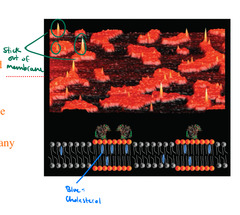
What does cholesterol do in the physiological membrane?
-they are hydrophobic
-allow for impermeability of the membrane to water-soluble molecules
-maintain flexibility of the membrane over a wide range of temperatures

What happened in 1972?
the fluid mosaic model of biological membranes introduced
What are the functions of the diverse protein groups in the physiological membranes?
channels for solute transport, carriers, receptors, enzymes, anchors, cell makers, etc.
Proteins make up about _____ of the mass of cellular membranes
1/3
Each membrane expresses between _____ to _____ proteins
10, 50
The types of proteins that membranes express are...
integral and peripheral proteins
Concept map of cellular membrane

How many liters of fluid does a typical male contain?
40
How many liters of fluid does a typical female contain?
34-36
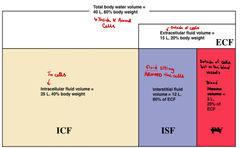
Total body water volume is...
40 L, 60% body weight

Intracellular (in cells) fluid volume (ICF) is...
25 L, 40% body weight

Extracellular (outside of cells) fluid volume (ECF) is...
15 L, 20% body weight

Interstitial fluid (fluid sitting around the cell) volume (ISF) is...
12 L, 80% of ECF

Blood (outside of cells but in the blood vessels) volume is...
3 L, 20% of ECF
What is transcellular fluid (the forgotten volume)?
-body compartment separate from intra and extracellular fluid
-not normally considered in measurements of body water
-not always fixed, trans = transitioning
-TOO DIFFICULT TO ACCOUNT FOR
What are examples of transcellular fluid?
cerebrospinal fluid (CSF), volume in bladder, fluid in GI tract, etc.
What is the dilution principle?
-compartment volumes are measured by determining the volume of distribution of a tracer
-a known amount of tracer is added and time is allowed for uniform distribution
-fluid within compartments is assessed for tracer compartments
What is the 1st way to calculate VOLUME OF COMPARTMENT?
amount of tracer added / concentration of tracer
An ideal tracer has the following properties...
1. Be non-toxic
2. Be rapidly and evenly distributed through the compartment and NOT ENTER any other compartment
3. Not be metabolized
4. Not be excreted during the equilibration period
5. Be easy to measure
6. Not interfere with body fluid distribution
During the equilibration period within the body...
the kidneys will form urine and SOME OF THE TRACER may be eliminated and we NEED TO ACCOUNT FOR THIS
What is the 2nd way to calculate VOLUME OF COMPARTMENT?
amount added - amounted excreted / concentration of sample
What is the VOLUME OF COMPARTMENT equation units?
Volume mL/L = Mass g/mg - Mass g/mg / Mass per volume g/L mg/mL
What body compartment does ANTIPYRINE indicate for?
total body water (TBW)

What body compartment does TRITIATED WATER indicate for?
total body water (TBW)

What body compartments have NO INDICATORS?
intracellular fluid (ICF) and interstitial fluid (ISF)
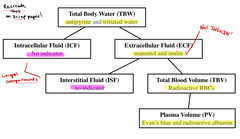
What body compartment does MANNITOL indicate for?
extracellular fluid (ECF)

What body compartment does INULIN indicate for?
extracellular fluid (ECF)

What body compartment do RADIOACTIVE RBCs indicate for?
total blood volume (TBV)

What body compartment does EVAN'S BLUE indicate for?
plasma volume (PV)

What body compartment does RADIOACTIVE ALBUMIN indicate for?
plasma volume (PV)

How do you calculate HEMATOCRIT?
volume of RBCs / volume of blood
How do you calculate VOLUME OF BLOOD?
volume of plasma / 1 - Hct (hematocrit)
What is the composition of Na+ (sodium) IN THE CELL?
10 mM
What is the composition of K+ (potassium) IN THE CELL?
150 mM
What is the composition of Ca++ (calcium) IN THE CELL?
3 mM
What is the composition of Cl- (chloride) IN THE CELL?
2 mM
What is the composition of Na+ (sodium) OUTSIDE THE CELL?
140 mM
What is the composition of K+ (potassium) OUTSIDE THE CELL?
4 mM
What is the composition of Ca++ (calcium) OUTSIDE THE CELL?
5 mM
What is the composition of Cl- (chloride) OUTSIDE THE CELL?
105 mM
What relationship does Na+ (sodium) and K+ (potassium) in regards to concentrations inside and outside the cell?
opposite relationships
more K+ IN, less K+ OUT
less Na+ IN, more Na+ OUT
What relationship does Ca++ (calcium) and Cl- (chloride) in regards to concentrations inside and outside the cell?
same relationship
less Ca++ and Cl- IN
more Ca++ and Cl- OUT
What does calcium (Ca++) do as a biological signal?
-participation in cellular signaling as a second messenger molecule
-metabolic regulation
-involved in muscle excitation-contraction of smooth, skeletal, and cardiac muscle tissue
-structural building block of bone and teeth
-essential for blood clot formation
MOST OF THESE PROCESSES UTILIZE CHANGES TO CALCIUM CONCENTRATION TO INITIATE THEIR EVENTS, TIGHTLY REGULATED
How much extracellular calcium (Ca++) is there and how much of it is FREE?
5 mM total, 2.5 mM free (ionic)
How much intracellular calcium (Ca++) is there and how much of it is FREE?
2.5 mM total, 0.0001 M free (ionic), 99.9% bound (usually to a protein in the endoplasmic reticulum and unable to use during transport)