Chapter 18: The Chemistry of Aryl Halides, Vinylic Halides, and Phenols. Transition-Metal Catalysis
 Call Kai
 Learn
Learn Practice Test
 Spaced Repetition
 Match
Match Flashcards
 Knowt Play
1/92

There's no tags or description
Looks like no tags are added yet.
Name | Mastery | Learn | Test | Matching | Spaced | Call with Kai | Chat |
|---|
No analytics yet
Send a link to your students to track their progress
93 Terms
aryl halides
halogen bound to carbon of benzene ring
vinylic halides
halogen bound to carbon of double bond
Do aryl and vinyl halides participate in SN2 reactions?
no
If the LG is attached to sp3 carbon, SN1 and SN2 are (possible/impossible).
possible
If the LG is attached to sp2 carbon, SN1 and SN2 are (possible/impossible).
impossible
Why don’t vinylic halides undergo SN2 reactions?
nucleophile must backside attack through the plane of the alkene (geometrically impossible)
carbon undergoing substitution rehybridizes from sp2 to sp (high energy cost → slow rate)
van der Waals repulsions
Why don’t aryl halides undergo SN2 reactions?
nucleophile must backside attack through the plane of the benzene (geometrically impossible)
carbon undergoing substitution rehybridizes from sp2 to sp (high energy cost → slow rate)
van der Waals repulsions
Do vinyl halides participate in elimination reactions?
yes, but very difficult; requires harsh conditions (heat/very strong bases);
they can do base-promoted β-elimination reactions
What is the rate determining step in SN1 and E1 mechanisms for aryl and vinylic halides?
formation of carbocation (intermediate)
Vinylic and aryl cations are considerably (more/less) stable than alkyl carbocations.
less
Why are vinylic and aryl cations considerably less stable than alkyl carbocations?
the e- deficient carbon is sp hybridized
the vacant 2p orbital is not conjugated w the π e- system of the double bond
Nucleophilic aromatic substitution of aryl halides typically follow ____-order kinetics.
second;
rate = k[aryl halide][nucleophile]
What are the requirements for nucleophilic aromatic substitution of aryl halides?
strongly e- withdrawing substituents, most commonly NO2 groups at ortho and para positions, to stabilize the anionic intermediate
More nitro groups at ortho and para positions → (more/less) reactivity
more
draw the mechanism for nucleophilic aromatic substitution of aryl halides
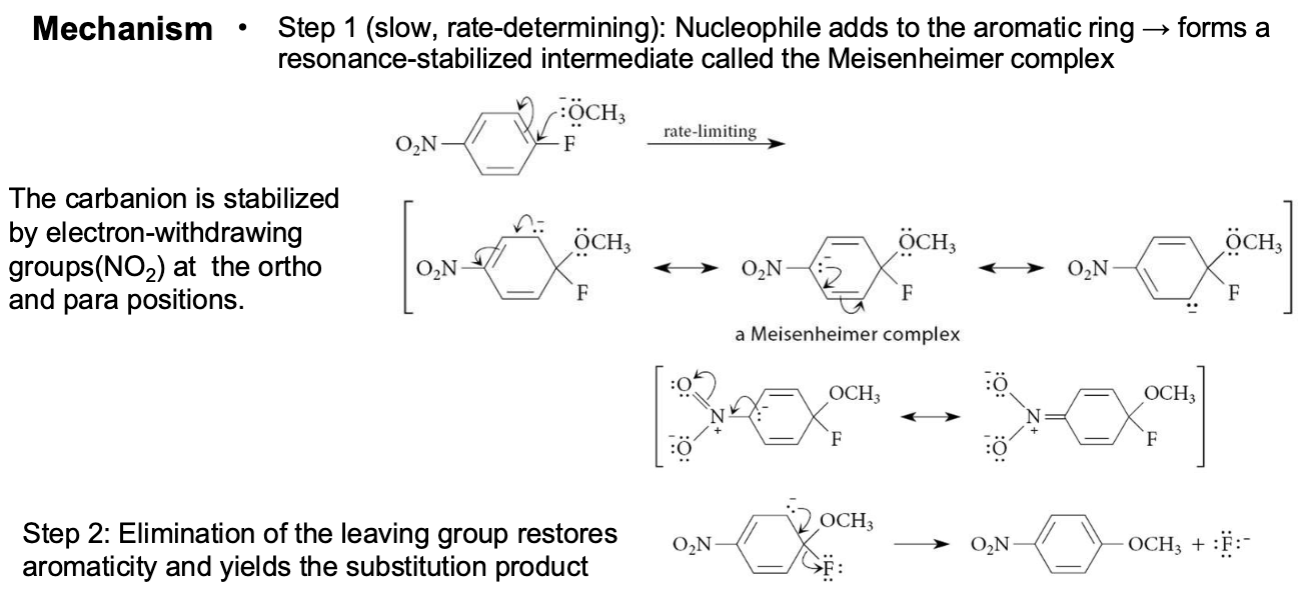
What is the reactivity trend for nucleophilic aromatic substitution of aryl halides?
fluorine is highly EN and exerts a very strong inductive e- withdrawing effect;
more susceptible for nucleophilic attack;
strongly stabilizes the negatively charged Meisenheimer intermediate
What is the substrate for SNAr?
aromatic
What is the substrate for SN1?
alkyl, benzyl, or allyl
What is the substrate for SN2?
alkyl, benzyl, or allyl
What is the mechanism for SNAr called?
addition-elimination
What is the substrate for SN1 called?
carbocation
What is the substrate for SN2 called?
backside attack
Does SNAr need an e- withdrawing group?
yes (usually)
Does SN1 need an e- withdrawing group?
no
Does SN2 need an e- withdrawing group?
no
What is the SNAr intermediate?
Meisenheimer complex
What is the SN1 intermediate?
carbocation
What is the SN2 intermediate?
none
Which orbitals do transition metals fill?
n s orbital and (n - 1) d orbital;
since they have similar energies, you can think of these two together as valence e-
ex: Ni → [Ar]4s23d8 = a 10-electron valence atom
What are groups surrounding transition metals called?
ligands
All ligands are Lewis ____.
bases
Metal-ligand compounds are called…
coordination compounds or transition-metal complexes
What are the four steps to evaluate transition metal complexes?
classify ligands
specify formal charge
calculate the oxidation state
count electrons around the metal
Neutral 2-electron donor → L- or X-type ligand?
L
Donates a lone pair to the metal → L- or X-type ligand?
L
Remains neutral before and after coordination → L- or X-type ligand?
L
Bonding electrons belong completely to the ligand → L- or X-type ligand?
L
When dissociated from the metal with their electrons, this ligand is neutral → L- or X-type ligand?
L
Anionic 1-electron donor → L- or X-type ligand?
X
Carries a negative charge in the ionic description → L- or X-type ligand?
X
Contributes one electron to the covalent bond from the ligand and one from the metal → L- or X-type ligand?
X
One electron belongs to the metal and one to the ligand → L- or X-type ligand?
X
When dissociated from the metal, it takes the electrons on the bond and gets a negative charge → L- or X-type ligand?
X
Can ligands operate as both L- and X-type ligands?
yes, π electrons can coordinate to metals;
ex: cyclopentadienyl anion has one X-type bond and two L-type bonds
NH3 → L- or X-type ligand?
L
H2O → L- or X-type ligand?
L
R3P → L- or X-type ligand?
R = alkyl, allyl
L
C=O → L- or X-type ligand?
L
CH2=CH2 → L- or X-type ligand?
L
N≡CCH3 → L- or X-type ligand?
L
benzene → L- or X-type ligand?
L3
halogens (F, Cl, Br, I) → L- or X-type ligand?
X
H- → L- or X-type ligand?
X
acetate → L- or X-type ligand?
X
alkyl → L- or X-type ligand?
ex: CH3
X
C≡N → L- or X-type ligand?
X
CH2=CH—CH2 (allyl) → L- or X-type ligand?
LX
cyclopentadienyl → L- or X-type ligand?
L2X
oxidation state of M =
(number of X-type ligands) + overall charge
draw the mechanism for ligand dissociation-association
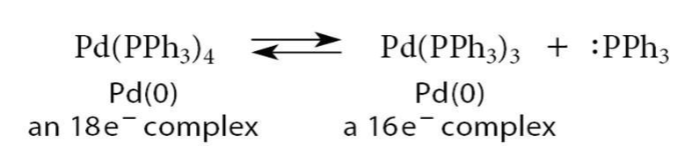
draw the mechanism for ligand substitution (analogous to SN1 or SN2)
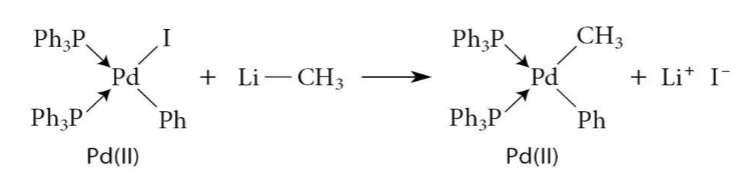
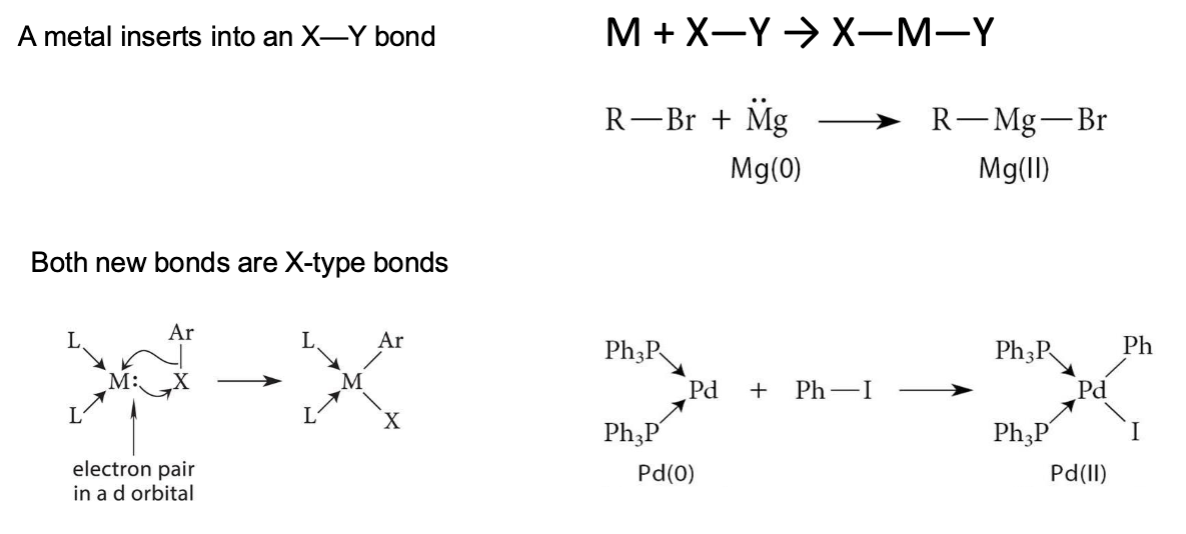
draw the mechanism for oxidative addition
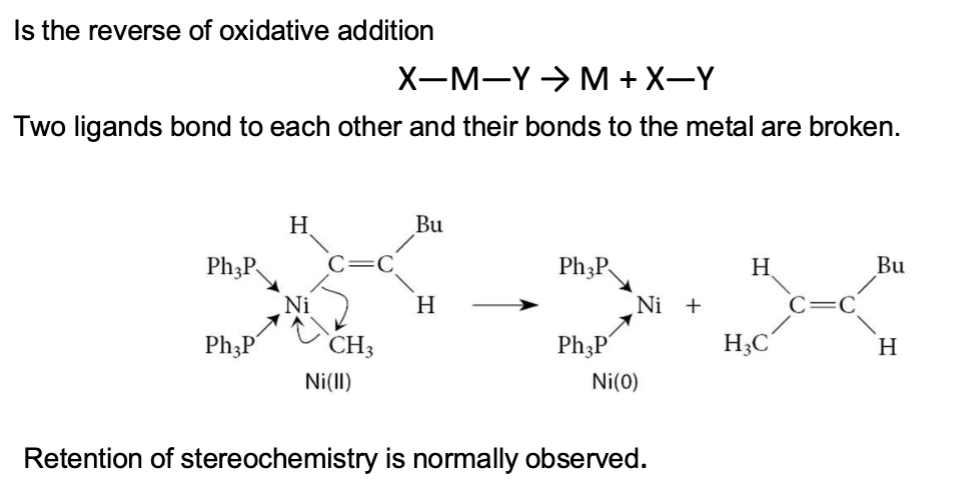
draw the mechanism for reductive elimination
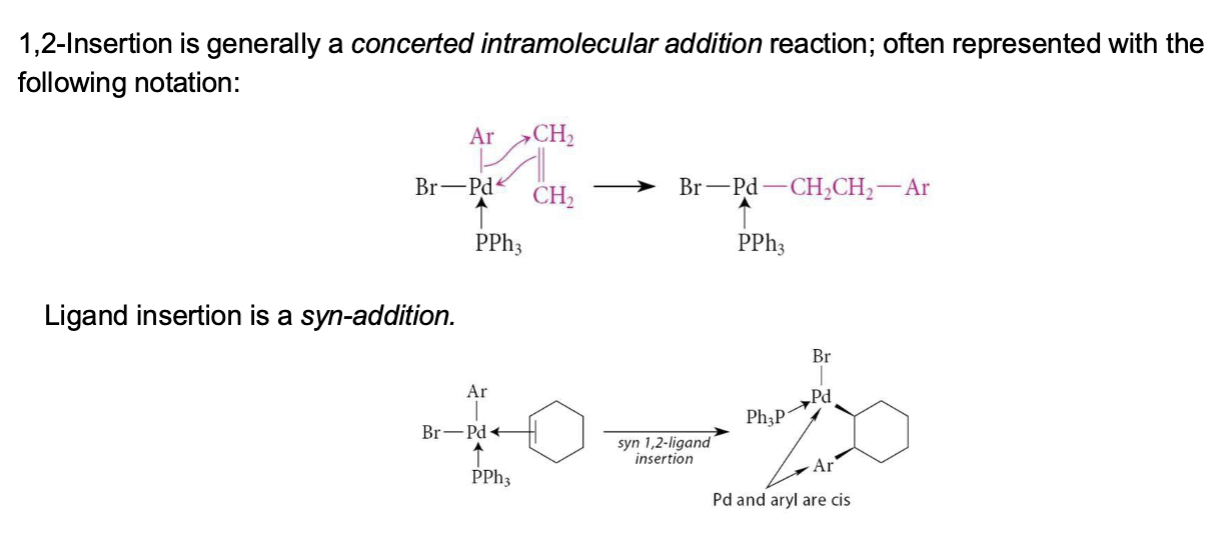
draw the mechanism for ligand insertion (syn-addition across the double bond)
draw the mechanism for β-elimination
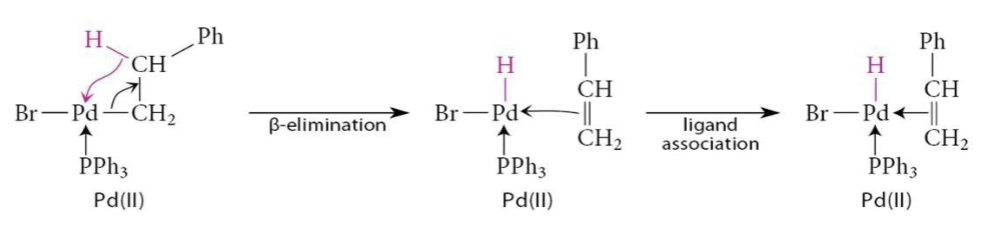
What is required for β-elimination?
an empty orbital on the metal
β-elimination is a __-elimination.
syn
Does β-elimination change oxidation states?
no
Heck reaction
palladium-catalyzed [ Pd(0) ], C—C bond-forming reaction between an aryl or vinyl halide and an alkene, producing a substituted alkene
In the Heck reaction, what can occur after syn insertion across a noncyclic alkene?
internal rotation
Can cyclic alkenes internally rotate?
no, prevented by the ring
What is the Suzuki coupling?
coupling of an aryl or vinyl boronic acid with an aryl or vinyl group
What is the Suzuki coupling catalyzed by?
Pd(0)
What is necessary for the Suzuki coupling?
base (typically NaOH or Na2CO3)
Does the orientation change with the Suzuki coupling?
no, orientation is unchanged
syn
What are two ways to produce boronic acids?
Grignard/organolithium reagent
hydroboration
draw the mechanism for making boronic acid using a Grignard reagent
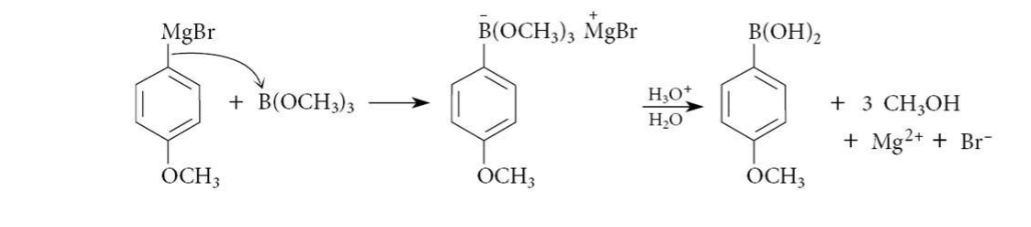
draw the mechanism for making boronic acid using hydroboration

draw a reaction to illustrate the use of a vinylic catechol borane coupling with a vinyl halide to form a conjugated diene
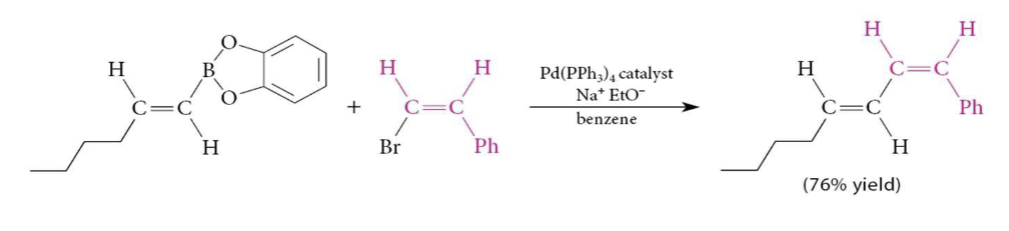
What are the 6 methods used to form C—C bonds?
addition of carbenes and carbenoids to alkenes
reaction of Grignard reagents with ethylene oxide and lithium organocuprate reagents
reaction of acetylenic anions with alkyl halides or sulfonates
Diels-Alder reaction
Friedel-Crafts alkylation and acylation reactions
Heck and Suzuki coupling reactions
phenol
a hydroxy group is bound to an aromatic ring
Like alcohols, phenols can…
ionize
Phenols are (more/less) acidic than regular alcohols.
more
Why are phenols more acidic than regular alcohols?
the conjugate base is stabilized by resonance
Substituents can affect phenol acidity by which effects?
polar and resonance effects
Phenoxides, like alkoxides, can be used as…
nucleophiles
The phenoxide ion is a good (nucleophile/electrophile) for SN2.
nucleophile
Is Ar—OH reactive in substitution reactions?
no
Do phenols participate in E1 reactions?
no
What does treatment of a phenol ether with HBr give? Show the mechanism.
phenol and alkyl bromide
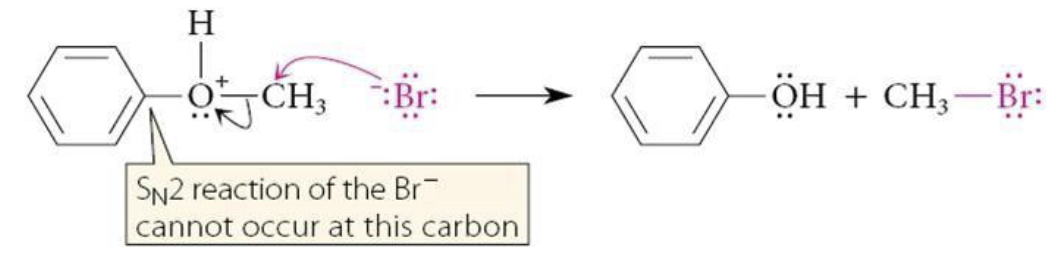
What does treatment of a phenol with HBr give?
no reaction
Phenol is highly reactive in ___ reactions.
electrophilic aromatic substitution
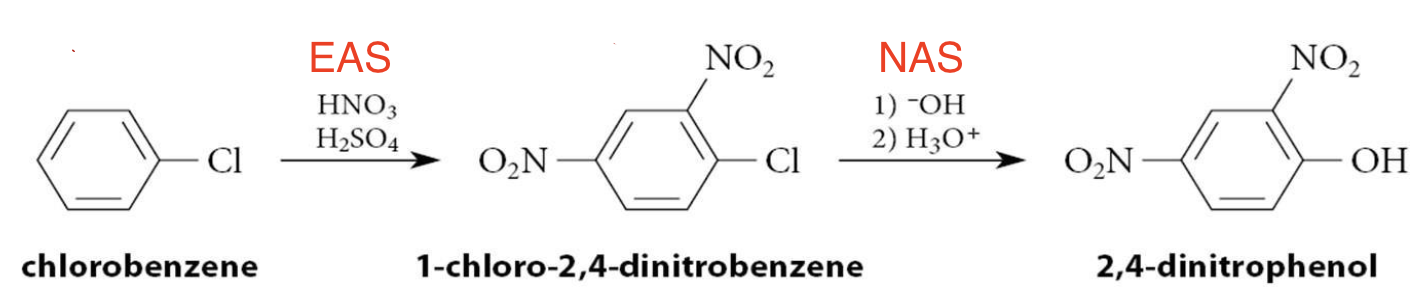
Is direct nitration of phenols under harsh conditions or using nitrate chlorobenzene first then using NAS to replace —Cl with —OH the preferred method of nitration of phenol? Show the mechanism.
using nitrate chlorobenzene first then using NAS to replace —Cl with —OH