ap bio summer test
 Call Kai
 Learn
Learn Practice Test
 Spaced Repetition
 Match
Match Flashcards
 Knowt Play
1/37

There's no tags or description
Looks like no tags are added yet.
Name | Mastery | Learn | Test | Matching | Spaced | Call with Kai | Chat |
|---|
No analytics yet
Send a link to your students to track their progress
38 Terms
organic molecules
biological molecules that contain carbon and hydrogen
atomic number
amount of protons
covalent bond
a pair of electrons are share between two atoms
electronegativity
an atoms ‘greed’ for electrons. higher electronegativity —> more drawn to electrons
polar covalent bond
electrons shared unequally between 2 atoms
nonpolar covalent bond
covalent bond where electrons are shared equally (i.e. gassses; O2, H2, N2)
ionic bond
chemical bond where 2 ions with opposite electrical charges associate with each other due to differences in charges.
often a large difference in electronegativity; atom with larger electronegativity steals electrons from the one with less
formed between a metal and nonmetal; one becomes pos other becomes neg
polymers
long chains build from monomers
monomers
small repeating subunits
proteins
speed up chemical reactions
produce structural support for the cell
amino acids
subunits that make up proteins
folds / structure determines the function
nucleic acids
encoding & transmitting genetic information. 2 types
deoxyribonjucleic acid —> dna
ribonucleic acid —> rna
long polymers made of nucleotides
carbohydrates
sugars with energy stored in the chemical bonds; when bonds are broken energy is released
lipids
fats ; organic molecules that are hydrophobic
hydrogen bond
interaction between hydrogen atom w/ a slight pos charge and electronegative atom of another molecule (opposites attract)
cohesion
water’s ability / tendency to stick to itself
a result of hydrogen bonding
creates high surface tension (why leafs float on top of water instead of sinking)
adhesion
tendancy of water to stick to things other than itself
surface tension
measure of the difficulty of breaking the bonds on the surface of water
specific heat
amount of heat required per unit of mass of a substance to raise the temperature by one degree celcius
hydrogen bonds cause water to have a high specific heat
heat capacity
amount of heat required to convert 1g of a liquid into a gas without changing the temp
why sweating and the evaporation of sweat from your body have a large cooling effect
acids & bases
acids —> donate H+ to solutions
bases —> accept H+ and remove them from solutions (NaOH)
pH
measure of the concentration of H+ atoms
pH = -log[H+]
dehydration synthesis reaction
a water molecule is removed as a covalent bond is formed
used when building larger molecules from smaller solutions
forms covalent bonds
hydrolysis reactions
break covalent bonds by using water as a solevent (adding H2O)
one of the products of the reaction gains a H+ atom while the other gains a OH group
functional groups
groups of 1 or more atoms of particular chemical properties regardless of what they are attached to
hydroxl -OH
polar b/c O is electroneg. hydrophilic
comonly found in carbohydrates, proteins, nucleic acids
carboxyl -COOH
polar, negative charge @ pH of cell, hydrophobic
commonly found in fatty acids, amino acids, proteins
RNA & DNA sugars
ribose - 5 carbon sugar, component of nucleic acid and rna
deoxyribose - 5 carbon sugar, component of nucleic acid and dna
most carbohydrates contain only C, H, O and possibly N, P
difference between the two sugars is ribose has an OH group on one of the carbons while deoxyribose only had H

disaccharide
2 simple sugars linked by a covalent bond
i.e. sucrose C12H22O12
glycosidic bonds
covalent bonds that connect monosaccharides
formed by dehydration synthesis (h2o produced as a product)
plasma cell membrane
made up of a double layer of phospholipids
proteins inside

triglycerol
lipid used for energy storage
made of glycerol joined with three fatty acids

glycerol
three carbon molecule with a hydroxl group on each carbon

fatty acid
chain of carbon atoms attached to carboxyl group at the end (-COOH)
can be acidic, nonpolar, polar, basic
joined by dehydration synthesis
constant motion of e- that leads to different + / - charge regions
saturated fatty acid
contains no double bonds
max amount of hydrogen atoms attached to each central carbon
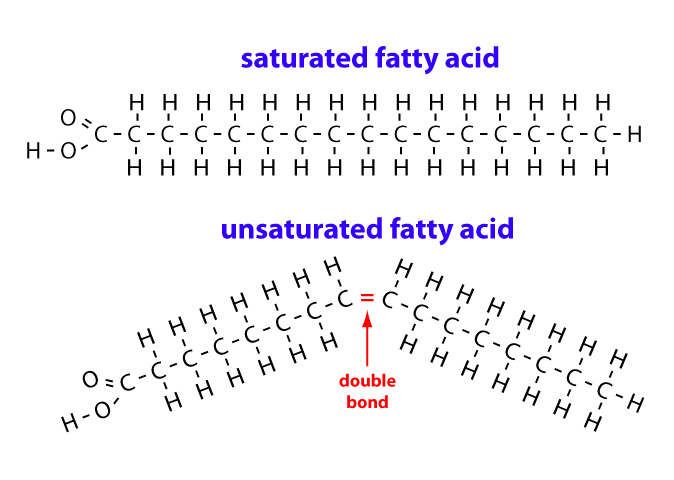
unsaturated fatty acid
contains a C--C double bond

van der waals forces
interaction of temporary polarized molecules due to charges
only in effect when molecules are close to each other
helps to stabalize molecules
weak attractions due to opposite forces (s+ / s-)
steroids
second type of lipid
cholesterol —> found in animal products, 20 carbon atoms that form 4 rings
starting molecule for building hormones
phospholipids
glycerol backbone attached to fatty acids
make up most cell membranes
have both hydrophobic and hydrophilic regions
head is hydrophilic, tail is hydrophobic
