Lecture 1
 Call Kai
 Learn
Learn Practice Test
 Spaced Repetition
 Match
Match Flashcards
 Knowt Play
1/47

There's no tags or description
Looks like no tags are added yet.
Name | Mastery | Learn | Test | Matching | Spaced | Call with Kai | Chat |
|---|
No analytics yet
Send a link to your students to track their progress
48 Terms
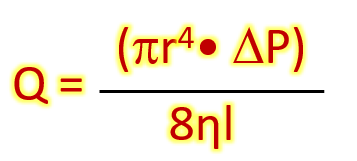
Poiseuille’s Law
Q = Laminar Fluid Flow, not turbulent
Poiseuille’s Law
R
Radius (greatest impact)
4 powered = 16x
Poiseuille’s Law
∆P
Difference in pressure (gradient)
Poiseuille’s Law
η
Viscosity
Dilution
↑ temp = ↓ viscosity
Poiseuille’s Law
L
Length of tube
Poiseuille’s Law
Numerator vs Denominator Relationship
Numerator is proportional to Flow
Denominator is inversely proportional to Flow
Examples of Poiseuille’s Law
r - 1
∆P - 2
n - 2
l - 2
r = large bore IV
∆P = pressure bag / pole height
n = NaCl dilution / fluid warmer
l = less IV tubing / PIV vs CVL
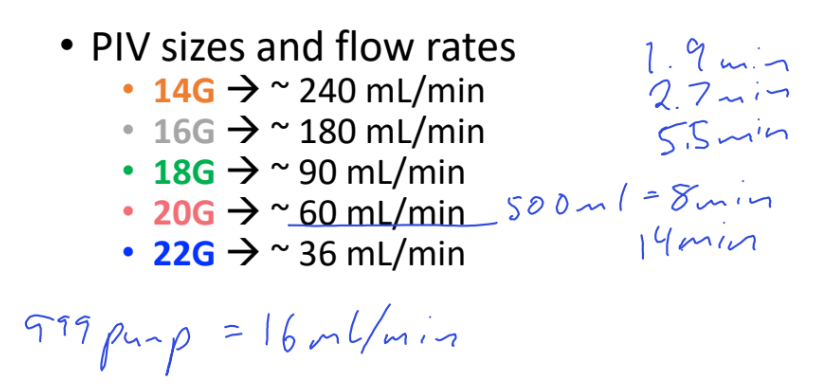
PIV sizes and Flow Rates
(nice to know)
Reynold’s Number
if flow is laminar or turbulent (Poiseuille’s Law + accounts for density)
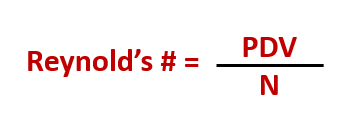
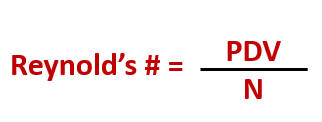
Reynold’s Number Variables?
P = density of fluid (density = mass/volume)
D = diameter of tube (2r)
V = linear velocity of fluid
N = viscosity
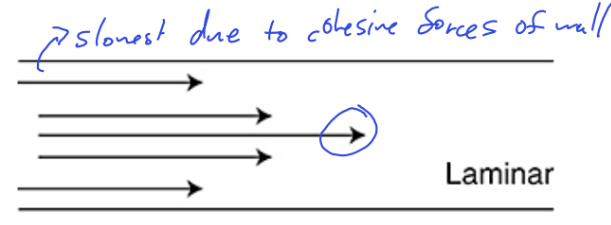
Reynold’s Number Laminar Flow
< 2000
Dependent on gas viscosity (Poiseuille’s law)
Parallel pattern & fastest in center due to cohesive forces slowing the sides down
Examples = Terminal bronchioles & Systemic circulation
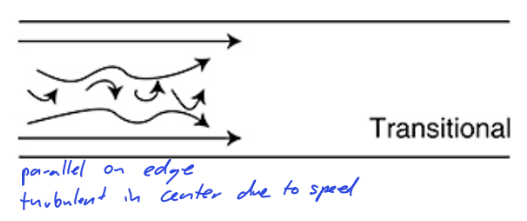
Reynold’s Number Transitional Flow
2000 – 4000
turbulence > cohesive forces
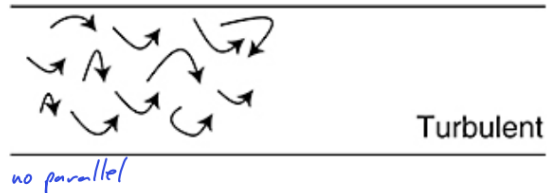
Reynold’s Number Turbulent Flow
> 4000
Dependent on gas density (Graham’s law)
Orifice (glottis or annular space when FGF is high)
High gas flow
Acute angle (>25 degrees) or branching (medium bronchi)
Bernoulli’s Principle - 2
flow through a temporary constriction in a tube
VELOCITY ↑
PRESSURE E (pressure must drop if velocity ↑ d/t the conservation of energy law)
Must always be inversely proportional!!!
Doesn’t account for friction & assumes no change in density or flow rate
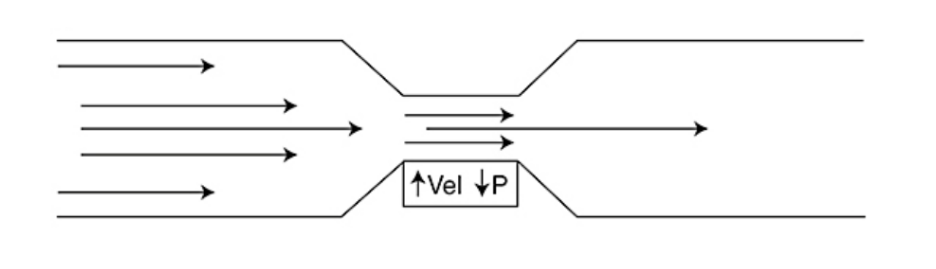
Venturi Effect
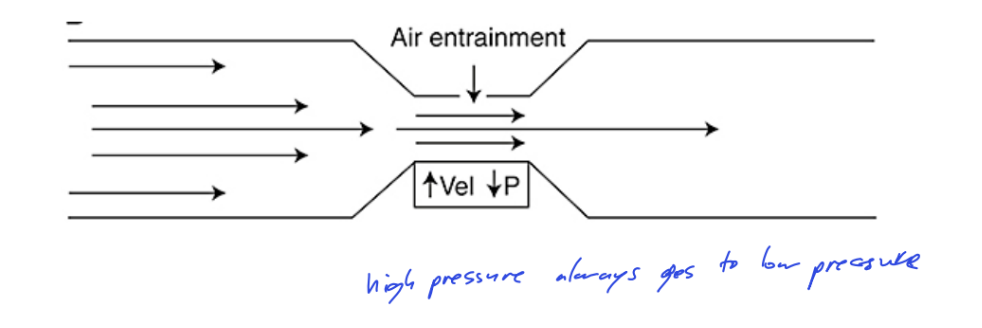
↓ pressure at constriction + hole in constriction = air entrained into flow
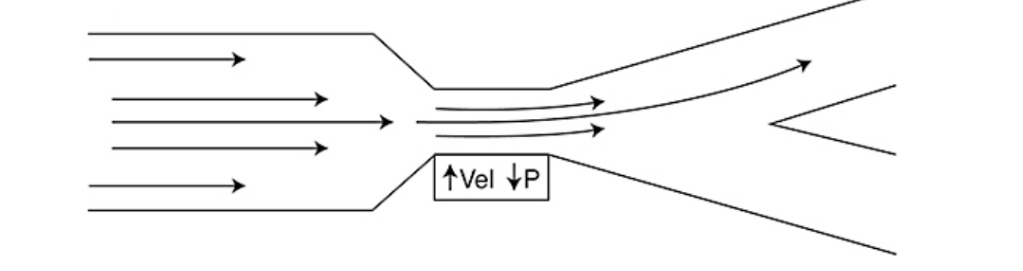
Coanda Effect
describes how fluid follows a curved surface after a constriction in a tube
After constriction, pressure ↑ and velocity ↓ at different points
Flow will prefer route with lower pressure
Laplace
Definition
3 variables
In cylinders and spheres, describes relationship between:
Wall tension (T): stress force exerted over a given area
Pressure (P)
Radius (r)
Sphere has half the tension, hence the division by 2
Careful: Density is NOT involved!

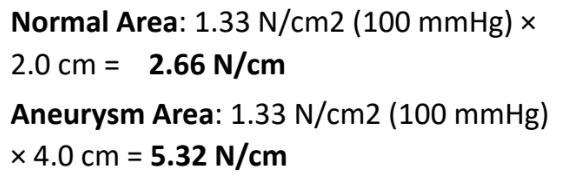
Laplace (Cylinder)
AAA
r is less impactful here compared to Poiseuille’s law
Laplace (Sphere)
Saccular Brain aneurysm
↑ BP = ↑ radius = ↑ wall tension = ↑ r/o rupture
Goal = prevent rise in BP during induction w/ esmolol, meds, >30 HOB
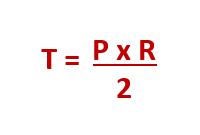
Laplace (Sphere)
Cardiac Ventricle
↑ pressure = ↑ radius = ↑ wall tension = ↑ contractility (Frank-Starling)
Compensation for ↑ wall tension = ↑ wall thickness (concentric) = smaller sphere = less tension
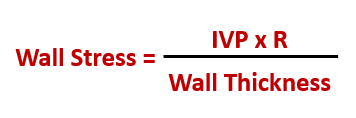
Laplace (Sphere)
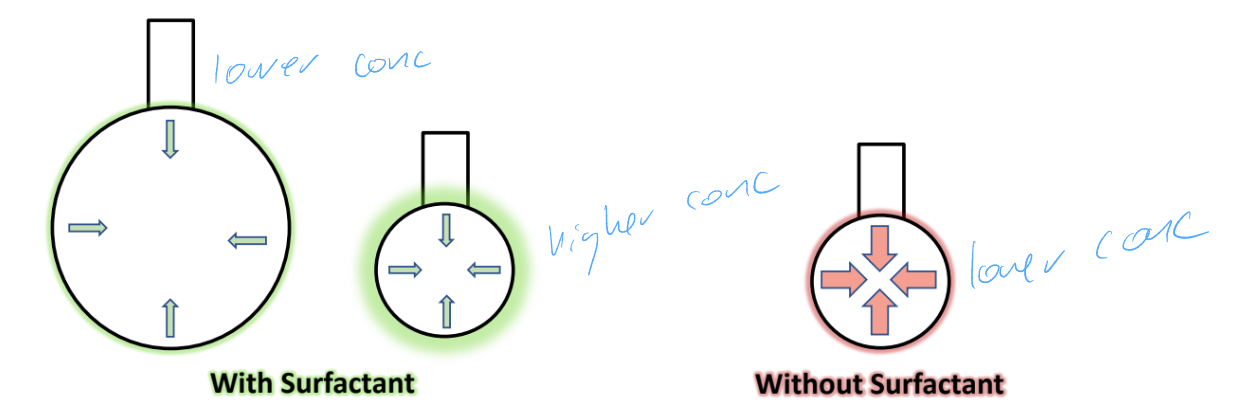
Surfactant in Alveoli
Surfactant lowers surface tension in the alveoli
Each alveolus has equal amounts of surfactant, which means its more concentrated in smaller alveoli
Normal tendency is for alveoli to collapse! surfactant prevents that
Le Chatelier’s Principle
If a system is disturbed by Δ temp, pressure, concentration, etc., then the system will tend to shift its equilibrium position, or else it dies
In physiology we call this homeostasis
Entropy
Unidirectional movement of energy from high to low concentration s/t to a gradient (always from high concentration to low concentration) - PASSIVE
↑ gradient difference = ↑ energy flow speed
Solubility
Definition
Affected by 3 things
The maximum amount of one substance (solute) that dissolves into another substance (solvent)
Affecting by:
Intermolecular interactions b/w substances (IMForces)
Temperature
Pressure
Remember, it is state dependent
Solubility of Solids & Liquids
IM
Temp
Pressure
Intermolecular Interactions
↑ b/w substances with similar electron configurations (“like dissolves like”)
Example: similar polarity b/w salt and water = salt dissolves into water
Temperature
To dissolve solute, energy must be added to break bonds
Endothermic rxn = energy consumed > energy released (most common)
↑ temperature = ↑ solubility- remember this applies to both solid and liquids!
Exothermic rxn = energy consumed < energy released
↑ temperature = ↓ solubility
Pressure
Very little or no influence on solid/liquid solubility
Solubility of Gases
IM
Temp
Pressure
Intermolecular Forces
Weak in gases
Temperature
Gas solubility into liquid inversely related to temperature
↑ temp = ↑ kinetic energy = ↑ gas escaping liquid = ↓ gas dissolved in liquid
Short explanation: ↑ temp = ↓ gas solubility in liquid - inverse to solid and liquids
Pressure
Solubility directly proportional to pressure
Partial pressure: percent gas compared in total atm pressure
Normal atm at sea level = 760 mmHg!!!
Dalton’s Law of Partial Pressures
Formula
Pressure Definition
Total pressure = sum of partial pressures (in % decimals = adds up to 1) exerted by each gas in the mixture
P total = P1 + P2 + etc
“Pressure” in the Kinetic Molecular Theory is d/t molecular collisions against container wall
↑ molecules = ↑ collisions = ↑ pressure
In the example that is just for the atm, in a tank it could be up to 2000 psi, so put 2k where 760 is to get partial pressure
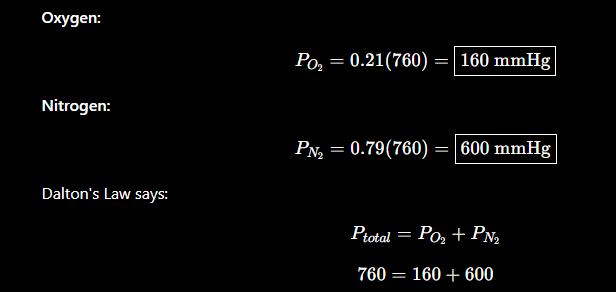
Dalton’s Law in Application
Determining Volatile anesthetic concentration
Calculate partial pressure of unmeasured gas
Converting partial pressure to volumes percent (and vice versa)
Liquid = (solute volume / solution volume) x 100 - NTK
Gas = (partial pressure / total pressure) x 100
Part / whole x 100
MAC
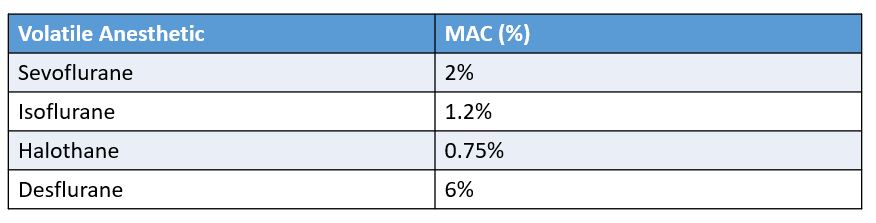
MAC: Minimum Alveolar Concentration (at 1 atm) of volatile anesthetic (gas alone) in which 50% of patients will not respond to noxious stimuli (movement)
Calculating Volatile Partial Pressure
1 MAC of Sevoflurane = 2%
You must understand that 2% of 100% of each controlled/closed loop breath the pt takes because they are hooked up to anesthesia machine (AM)
2% of 760 mmHg = 15.2 mmHg
Psevobrain = 15.2 mmHg = 1 MAC
What makes up the other 98% of the gas mixture? w/e gas you got turned on in the machine
Vapor vs Gas
Critical Temp
Gas
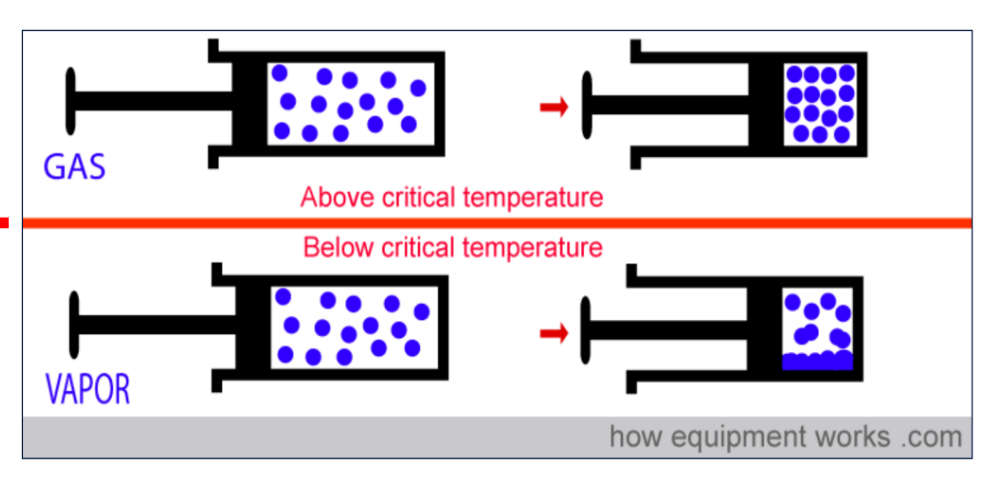
A substance in its gaseous state, ABOVE its critical temperature
Above CT, a gas cannot be liquefied, regardless of infinite pressure
Vapor
A substance in its gaseous state, BELOW its critical temperature
Below CT, a gas can be compressed = liquefied
The distinction describes whether liquefaction is possible, not whether pressure is currently being applied
All of the VA covered critical temps are crazy high above 150℃, so all VA fall under “Vapor”
Volatile Anesthetics & Partial Pressures
Volatile Liquid: liquids with high vapor pressure at room temp = it evaporates fast AF
At equilibrium, partial pressures are equal across compartments
Palveoli = Pblood = PCNS
Ex. Sevoflurane vaporizer dial at 2% = Psevoalveoli = Psevoblood = PsevoCNS
In a perfect world this will happen with enough time
This concept is different from blood: gas partition coefficients
Vapor Pressure (VP)
Definition
Condition
Factors influencing VP - 2
What has no effect on VP
In a closed container, the pressure exerted as gas molecules escape the liquid
Equilibrium → molecules entering solution = molecules leaving solution
To have VP, vapor must be in contact with liquid in container = means there is saturated vapor pressure
Factors influencing VP:
Temperature: ↑ temp = ↑ VP (directly proportional) - boiling water vs letting it evaporate
VP is constant while temperature remains the same
Intermolecular Forces: ↓ IMF = ↑ VP (inversely proportional)
High intermolecular attraction = ↓ VP (water)
Low intermolecular attraction (like VA) = ↑ VP
Unlike diffusion, gas/liquid surface area has no effect on vapor pressure
Vapor Pressure & Boiling Point
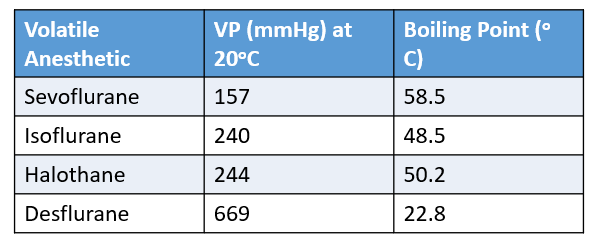
Boiling Point: temperature at which VP = atm pressure above liquid
Boiling point varies based on atmospheric pressure
760 at 0 elevation = sevo bp @58.5℃
226 at 30k elevation = sevo bp @28℃
Boiling point tends to be inversely proportional to vapor pressure
Not a strict rule because elevation still has NO effect on VP
20℃ is Room temp! 68℉
BP on table is at 760 mmHg
Vapor Pressure & Solubility
Vapor pressures are dependent on the solubility of the gas
Vapor pressure and solubility are inversely related - NO EXCEPTIONS, HARD RULE
This is different than applying external pressure to a container
This is r/t a vapor’s solubility into a liquid
↑ temp = ↑ kinetic energy = ↑ VP = ↓ solubility
Vapor Pressure & Solubility Coefficient
Coefficient: quantity constant for a given substance under specified conditions that serve as a measure of some of its properties
Solubility Coefficient: Numerical value expressing the volume of a gas (solute) that will dissolve into a given volume of liquid (solvent) per given pressure
Application: at equilibrium, ratio of gas that dissolves into blood vs remaining in alveoli
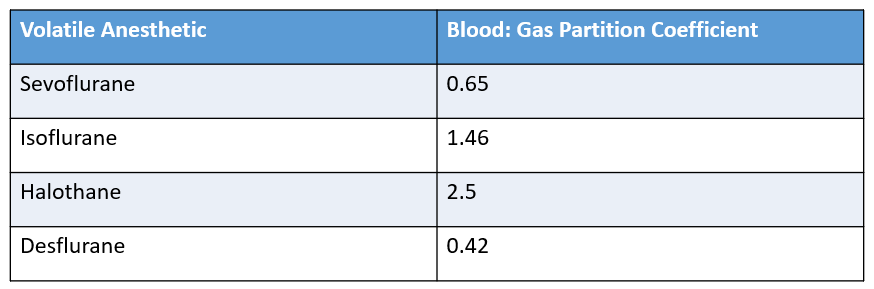
Ostwald Solubility Coefficient of VA table
this is all at 37℃ (98.6℉) the typical temp of human body
Remember: this is a RATIO so at equi
(gas in blood/gas left in alveoli)
Ostwald Solubility Coefficient Visual
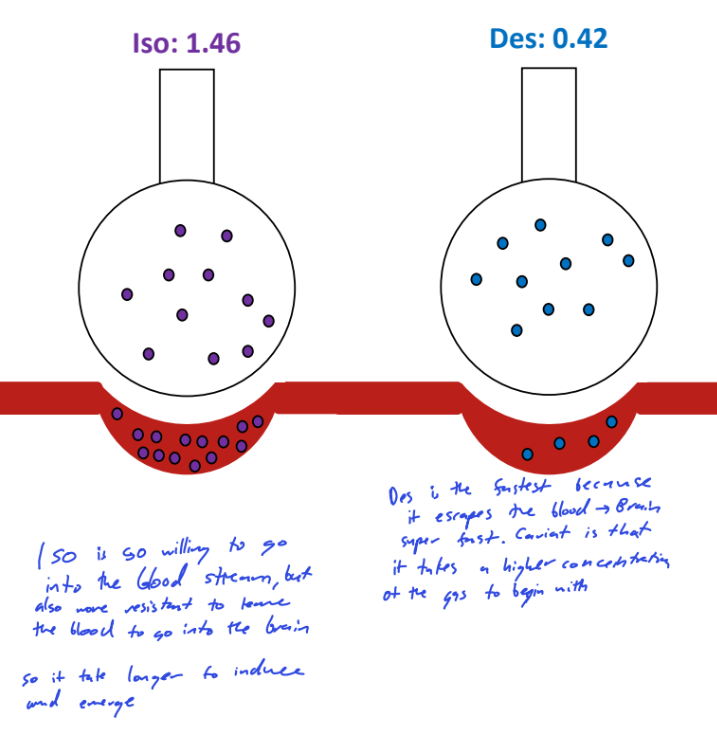
iso vs des
Remember: this is a RATIO so at equi (gas in blood/gas left in alveoli)
1.46 means ↓ Isoalveoli = ↑ Isoblood = ↓ IsoCNS (MAC 1.2%)
Longer to induce, dont give too much
0.42 means ↑ Desalveoli = ↓ Desblood = ↑ DesCNS (MAC 6%)
Faster to induce, but need to give more
If you look at the graph, it checks out
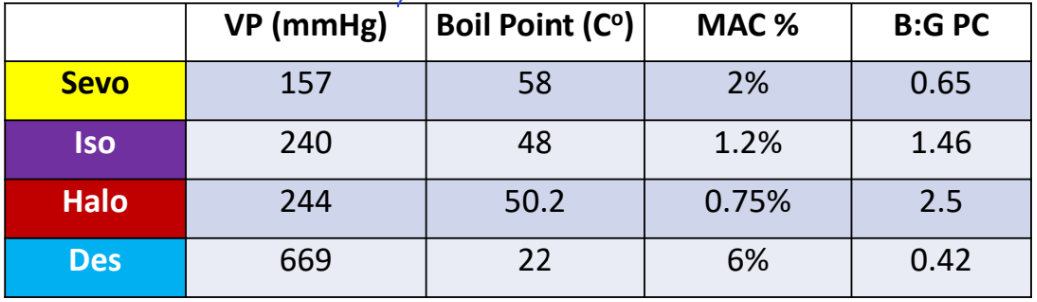
Agent | MAC | Coef |
|---|---|---|
Halothane | 0.75% | 2.5 |
Isoflurane | 1.2% | 1.46 |
Sevoflurane | 2% | 0.65 |
Desflurane | 6% | 0.42 |
Volatile Anesthetic Table
“see I have drugs”
ordered by VP
DS is the correct config of the last column
Vaporizer Output
What happens if a VA with a higher vapor pressure is added to a vaporizer calibrated for a lower vapor pressure? The concentration of VA delivered to the patient will be….?
Higher concentration → overdose
“Higher Lower High”
Opposite scenario?
Lower concentration → underdose
“Lower Higher Low”
Henry’s Law
“At a constant temperature, the amount of gas dissolved in a solution is directly proportional to the partial pressure of that gas over the solution”
↑ gas pressure = ↑ dissolved in liquid
Application: Increasing the partial pressure of a volatile anesthetic, oxygen, or carbon dioxide increases the amount of that gas dissolved in blood.
Temperature is inversely proportional to gas solubility
↑ temp = ↓ solubility - easier for VA to leave the body
↓ temp = ↑ solubility - more difficult for VA to leave the body
Application = emergence from VA is prolonged in hypothermic patient
Henry’s Law Solubility Coefficients
what are the two?
Number?
Multiplied by?
Carried by?
Oxygen = 0.003 mL/dL/mmHg
Calculating O2 dissolved in blood = 0.003 x PaO2 (80-100 mmHg on ABG)
O2 is mostly transported by hemoglobin, not dissolved in blood
Carbon Dioxide = 0.067 mL/dL/mmHg
Calculating CO2 dissolved in blood = 0.067 x PaCO2 (35-45 mmHg on ABG)
CO2 is ~20x more soluble than O2
Application: hyperventilation will ↓ PaCO2 faster than it will ↑ PaO2
CO2 is mostly transported by bicarbonate or hemoglobin
both add up to 0.070
Diffusion - 4
Random, yet passive, molecular movement through space to minimize a concentration gradient using entropy and Brownian motion
Brownian motion: inherent kinetic energy of molecules
Kinetic energy → allows free molecular movement
Molecular weight : ↓ weight = ↑ velocity
Temperature is directly proportional to kinetic energy
↑ temperature = ↑ kinetic energy = ↑ rate of diffusion
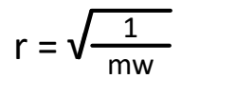
Graham’s Law
Formula?
Relationship?
Rate of effusion of a gas through an orifice is inversely proportional to the square root of its molecular mass
In other words, a gas’ molecular weight determines it diffusion rate
↑ molecular weight = ↓ rate of effusion
Part of Fick’s Law
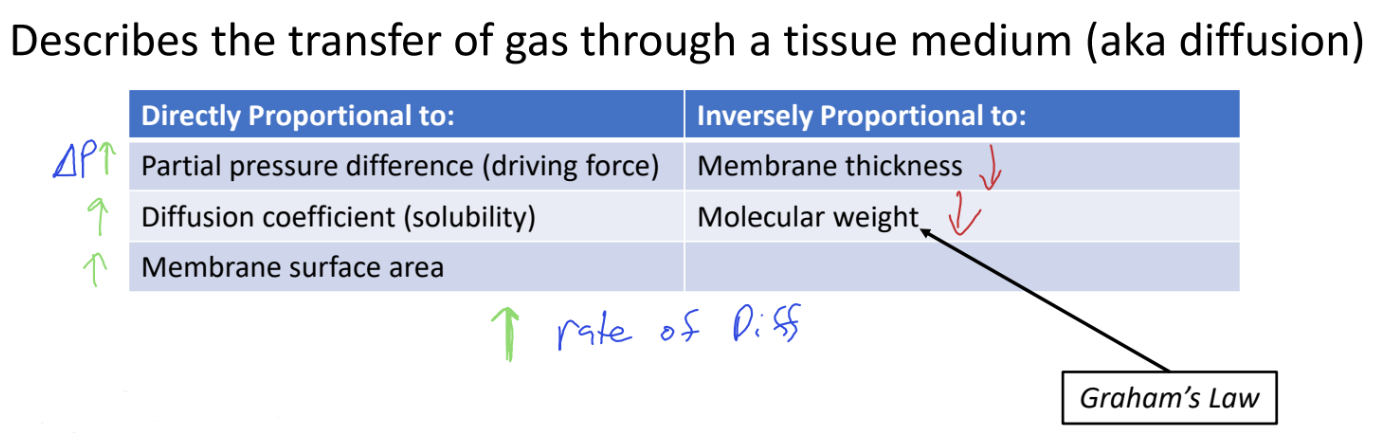
Fick’s Law of Diffusion
Describes the transfer of gas through a tissue medium (aka diffusion)
Applications:
•Diffusion hypoxia
•COPD patients retaining CO2
•Drug transfer across the placenta
Osmosis
Osmotic Pressure
Oncotic Pressure
Osmosis: movement of water across a semipermeable membrane to equilibrate a concentration gradient
Semipermeable membrane is only permeable to water, not solutes
Osmotic Pressure: the Force needed to prevent osmosis
Oncotic Pressure: Osmotic pressure exerted by proteins/electrolytes in capillaries
Mostly albumin
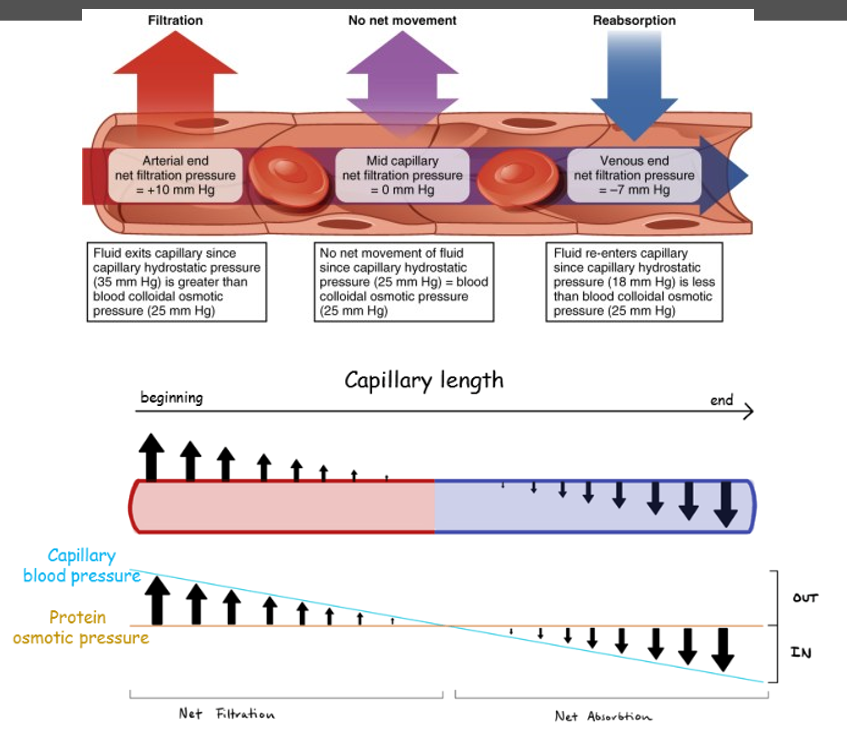
Oncotic pressure pulls water in (~28 mmHg)
Hydrostatic pressure pushes water out
Hydrostatic pressure failures - 4
Hypertension: More intravascular pressure increases hydrostatic pressure and can cause edema.
Heart failure: Blood backs up in the veins, increasing capillary hydrostatic pressure instead of decreasing and causing edema.
Fluid overload: More intravascular volume increases hydrostatic pressure and can cause edema.
Standing: Gravity increases hydrostatic pressure in the legs, contributing to ankle swelling.
Oncotic Pressure Visualization - 2
Hydrostatic − Oncotic = Net Pressure
which could be either filtration, no movement, reabsorption
Hydrostatic pressure is the ONLY thing that changes, oncotic stays constant