Principles of Flight - Chapter 4 Vocabulary
 Call Kai
 Learn
Learn Practice Test
 Spaced Repetition
 Match
Match Flashcards
 Knowt Play
1/26

Earn XP
Description and Tags
Vocabulary flashcards defining fundamental aerodynamic concepts, atmospheric parameters, physical laws, and airfoil terminology from Chapter 4: Principles of Flight.
Name | Mastery | Learn | Test | Matching | Spaced | Call with Kai | Chat |
|---|
No analytics yet
Send a link to your students to track their progress
27 Terms
Atmosphere
An envelope of air that surrounds the Earth and rests upon its surface, composed of 781% nitrogen, 21% oxygen, and 1% other gases.
Viscosity
The property of a fluid that causes it to resist flowing due to the tendency of individual fluid molecules to adhere to each other.
Friction
The resistance that one surface or object encounters when moving over another, causing air molecules to adhere to a wing surface at a microscopic level.
Boundary Layer
The layer of air molecules that adhere to the wing surface because of friction and have a relative velocity near zero.
Drag
The force that resists airflow over a wing, caused by the combined effects of friction and viscosity.
Atmospheric Pressure
The force exerted equally in all directions on bodies within the air due to the weight of the atmosphere, equal to approximately 14.70psi or 1,013.2mb at sea level under standard conditions.
International Standard Atmosphere (ISA)
A worldwide standard reference established by ICAO where sea level conditions are defined as a temperature of 59∘F (15∘C) and a pressure of 29.92"Hg (1,013.2mb).
Standard Temperature Lapse Rate
The rate at which temperature decreases with altitude in a standard atmosphere, approximately 3.5∘F or 2∘C per 1,000feet up to 36,000feet.
Standard Pressure Lapse Rate
The rate at which pressure decreases with altitude, approximately 1"Hg per 1,000feet of altitude gain up to 10,000feet.
Pressure Altitude
The height above the Standard Datum Plane (SDP), indicated when the altimeter barometric scale is set to 29.92"Hg.
Standard Datum Plane (SDP)
A theoretical level where the weight of the atmosphere is 29.92"Hg (1,013.2mb) as measured by a barometer.
Density Altitude
Pressure altitude corrected for nonstandard temperature variations, representing the vertical distance above sea level in the standard atmosphere at which a given density is found.
Relative Humidity
The amount of water vapor contained in the atmosphere, expressed as a percentage of the maximum amount of water vapor the air can hold at a given temperature.
Newton's First Law of Motion
Law stating that every object persists in its state of rest or uniform motion in a straight line unless compelled to change that state by forces impressed on it.
Newton's Second Law of Motion
Law stating that force equals mass times acceleration (F=m×a) for a constant mass, or the change in momentum per change in time.
Newton's Third Law of Motion
Law stating that for every action, there is an equal and opposite reaction.
Bernoulli's Principle
Principle stating that as the velocity of a moving fluid (liquid or gas) increases, the internal pressure within the fluid decreases.

Venturi Tube
A tube with an inlet that narrows to a constricted throat and widens at the outlet, demonstrating Bernoulli's Principle as fluid velocity increases and pressure decreases at the constriction.
Airfoil
A structure designed to obtain reaction upon its surface from the air through which it moves or that moves past such a structure.
Camber
The curvature of the upper and lower surfaces of an airfoil profile.
Leading Edge
The rounded forward end of an airfoil profile that faces forward in flight.
Trailing Edge
The narrow, tapered rear end of an airfoil profile.
Chord Line
A straight reference line drawn directly through an airfoil profile connecting the extremities of the leading and trailing edges.

Mean Camber Line
A reference line drawn from the leading edge to the trailing edge of an airfoil that is equidistant at all points from the upper and lower surfaces.
Center of Pressure (CP)
The average point of pressure variation along an airfoil for a given angle of attack, through which aerodynamic force acts.
Downwash
The downward and backward flow of air leaving the top surface of an airfoil that meets the flow from the bottom at the trailing edge.
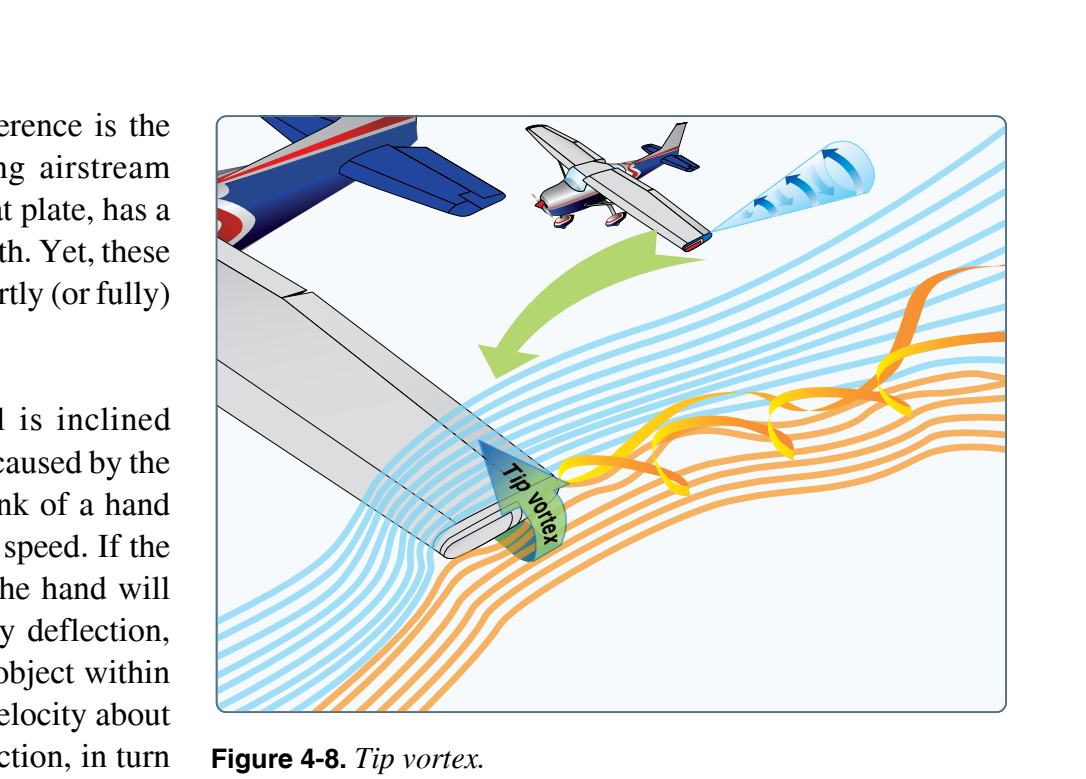
Tip Vortex
A rotating airflow generated at the wingtip when high-pressure air beneath the airfoil pushes around the tip to the low-pressure area on top.