Filipino Family and Its Characteristics, Care or Normal Families, Care of Families at Risk
 Call Kai
 Learn
Learn Practice Test
 Spaced Repetition
 Match
Match Flashcards
 Knowt Play
1/85

There's no tags or description
Looks like no tags are added yet.
Name | Mastery | Learn | Test | Matching | Spaced | Call with Kai | Chat |
|---|
No analytics yet
Send a link to your students to track their progress
86 Terms
Family
It is considered the basic unit of society and the primary unit of health care in community nursing.
Nuclear Family
Extended Family
Single-Parent Family
Blended Family (Reconstituted Family)
Joint Family
Childless Family
Foster Family
Adoptive Family
Same-S*x Family
9 Types of families
Nuclear family
Father, Mother, and Children
Also called traditional family
Extended family
Nuclear family + relatives
Single-Parent Family
One parent only family
Blended Family
Two families joined together
Joint Family
Multiple generations living together
Childless Family
Couple without children
Foster family
A family that provides temporary care for children who cannot live with their biological parents.
Adoptive Family
Parents legally assume responsibility for a child who is not biologically theirs
Same-s*x family
Family composed of same-s*x partners raising children or living together
Physical Function
Economic Function
Reproductive Function
Socialization Function
Emotional Function
Educational Function
Protective Function
7 Functions of the family
The family provides care, support, and socialization
Game Changer:
What is the key concept of family?
Family development
Game Changer:
___ is a continuous process where families face predictable tasks at each stage
Evelyn Duvall’s Family Development Theory
Theory where Duvall identified 8 stages of the family life cycle based on presence and age of children and family developmental tasks
Beginning Family
Childbearing Family
Family with Preschool Children
Family with School-Age Children
Family with Teenagers
Launching Family
Middle-Aged Parents
Aging Family
Family Life Cycle: Stages and Tasks (Duvall)
Beginning Family
Newly Married Couple
Family Task:
Establish a mutually satisfying marriage
Adjust to living together
Develop financial stability
Plan for children
Childbearing Family
Birth of First Child – 30 Months
Family Task:
Adjust to parenthood
Adapt to infant care
Establish roles as parents
Provide physical care for infant
Family with Preschool Children
First Child: 2½–6 Years
Family Task:
Meet needs of preschool child
Encourage development and independence
Socialize children
Maintain marital relationship
Family with School-Age Children
First Child: 6–13 Years
Family Task:
Support educational development
Encourage achievement
Promote peer relationships
Maintain communication
Family with Teenagers
First Child: 13–20 Years
Family Task:
Allow increasing independence
Adjust family relationships
Support adolescent identity development
Prepare for children leaving home
Launching Family
First Child Leaves Home Until Last Child Leaves
Family Task:
Release young adults
Maintain supportive relationships
Adjust to reduced family size
Develop new interests
Middle-Aged Parents
Empty Nest to Retirement
Family Task:
Maintain marital relationship
Adjust to aging parents
Prepare for retirement
Maintain social involvement
Aging Family
Retirement to Death of Both Partners
Family Task:
Adjust to retirement
Cope with aging changes
Maintain relationships
Accept loss and bereavement
Genogram
Game Changer:
It is a family medical history map.
A ___ is a graphic representation of a family tree that shows:
Family structure
Relationships
Health history
Patterns across generations
□ Male
○ Female
◇ Unknown gender
Symbols used in genogram
Marriage/partnership
Horizontal line in genogram
Parent-child relationship
Vertical line in genogram
Close relationship
Double line in genogram
Distant relationship
Broken line in genogram
Conflict relationship
Zigzag line in genogram
Genogram
Ecomap
Family APGAR
Family Assessment Tools
Ecomap
Game Changer:
A diagram showing family relationships with…
• Community
• Organizations
• Social support systems
Assesses:
• External resources
• Stressors
Family APGAR
Game Changer:
Measures family function developed by Gabriel Smilkstein.
A – Adaptation
Ability to use resources during problems
P – Partnership
Sharing decisions and responsibilities
G – Growth
Personal development supported by family
A – Affection
Emotional relationships
R – Resolve
Commitment of time and resources
Family A.P.G.A.R. meaning
Family Coping Index
Assesses:
• Family ability to manage problems
Areas:
• Physical independence
• Therapeutic competence
• Knowledge of health condition
• Emotional competence
• Family interaction
Friedman Family Assessment Model
Structural
• Family composition
• Roles
• Relationships
Developmental
• Family life cycle stage
Functional
• Communication
• Coping
• Decision-making
Maglaya’s Typology of Nursing Problems in Family Nursing Practice
Game Changer:
This states that family nursing problems are classified into
Wellness Condition
Health Deficit
Health Threat
Foreseeable Crisis
Wellness condition
A state where family has potential for improvement.
Examples:
Readiness for enhanced nutrition
Desire to improve health practices
Health Deficit
A failure in health maintenance.
Examples:
Presence of illness
Poor nutrition
Untreated hypertension
Health Threat
A condition that may lead to illness.
Examples:
Smoking
Poor sanitation
Unsafe environment
Foreseeable Crisis
Expected developmental events requiring adjustment.
Examples:
Pregnancy
Marriage
Birth of a child
Retirement
Assessment
Diagnosis
Planning
Implementation
Evaluation
Family Nursing Process
normal or healthy family
A ___ is one that is able to:
Maintain physical and emotional well-being
Perform expected family roles
Adapt to developmental changes
Solve problems effectively
Utilize available resources
Assessment determines the family’s strengths, resources, health practices, and areas for improvement.
Family Structure Assessment
Family Developmental Assessment
Physical Health Status Assessment
Family Function Assessment
Environmental Assessment
Socioeconomic Assessment
Areas of Family Health Assessment
Family Structure Assessment
Identify the assessment
Who are the members of the family?
Who makes decisions?
Who provides support?
Tool: Genogram
Family Developmental Assessment
Identify the assessment
Determines:
• Current family life cycle stage
• Developmental tasks being accomplished
Based on:
• Evelyn Duvall’s Family Development Theory
Example:
Family with infant
• Adjustment to parenthood
• Infant care
• Role changes
Physical Health Status Assessment
Identify the assessment
Individual Health
• Medical history
• Current illnesses
• Immunization status
• Nutrition
• Lifestyle practices
Family Health Practices
• Health-seeking behavior
• Preventive care
• Use of health services
Family Function Assessment
Identify the assessment
Communication
• How family members express feelings
Decision-making
• Who makes important decisions
Roles
• Responsibilities of members
Coping ability
• Response to stress
Tool:
• Family APGAR
Environmental Assessment
Identify the assessment
Assess:
Home Environment
• Safety
• Cleanliness
• Ventilation
• Lighting
Sanitation
• Water supply
• Waste disposal
• Toilet facilities
Community Resources
• Health centers
• Schools
• Social support
Tool:
• Ecomap
Socioeconomic Assessment
Identify the assessment
Includes:
• Income
• Employment
• Education
• Access to healthcare
• Social support
Nursing diagnosis
A ___ identifies the family’s health strengths, potential problems, and readiness for improvement. Normal families commonly have wellness diagnoses rather than illness-focused diagnoses.
Problem
Related Factors
Evidence
Nursing Diagnosis Format
Example: Readiness for enhanced family processes related to desire to improve family communication as evidenced by expressed interest in strengthening family relationships.
Planning
___ involves establishing goals and selecting appropriate interventions to maintain and improve family health.
Family-Centered Approach
Establish Priorities
Principles of Family Care Planning
Family-Centered Approach
Principle of family care planning where the family is included in:
• Identifying needs
• Setting goals
• Making decisions
Establish Priorities
Principle of family care planning where we consider
A. Nature of Problem
• Health promotion
• Prevention
• Treatment
B. Modifiability
• Can the family change the situation?
C. Preventive Potential
• Can intervention prevent future problems?
D. Family Resources
• Available support and abilities
S – Specific
M – Measurable
A – Achievable
R – Relevant
T – Time-bound
Meaning of S.M.A.R.T. planning
Wellness
Game Changer:
Healthy families commonly have ___ nursing diagnoses.
Planning
Game Changer:
___ should involve the family as an active partner.
Evaluation
Game Changer:
___ focuses on changes in family health behaviors and achievement of goals. It determines whether nursing interventions achieved desired outcomes.
Were Goals Achieved?
Did Family Demonstrate Improved Health Behaviors?
Did Family Utilize Resources?
Did Family Improve Coping and Function?
Family Evaluation Questions
healthy family
Game Changer:
"A ___ wants to improve lifestyle practices and communication"
• Readiness for Enhanced Family Processes / Health Management.
Structure Evaluation
Process Evaluation
Outcome Evaluation
3 types pf evaluation
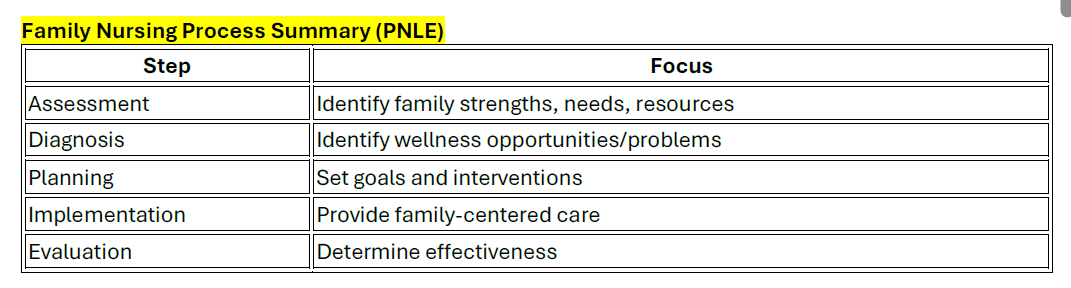
Family Nursing Process Summary (PNLE) Review
A – Assess the family
D – Diagnose family needs
P – Plan goals
I – Implement interventions
E – Evaluate outcomes
Family A.D.P.I.E. meaning
Families at risk
___ is a family that has an increased possibility of experiencing health problems, developmental difficulties, or inability to perform health-related functions because of internal or external factors.
They do not necessarily have an illness; they have factors that increase the chance of health problems.
Biological/Health Risks
Environmental Risks
Socioeconomic Risks
Family Functioning Risks
Lifestyle Risks
Types of Family Risk Factors
Risk factors
Family strengths
Available resources
Health needs
Ability to cope
The goal of Assessment of At-Risk Family’s Health Status is to identify these factors
A – Adaptation
P – Partnership
G – Growth
A – Affection
R – Resolve
Game Changer:
Family A.P.G.A.R. (At Risk)
Communication - Ability to express needs
Roles - Responsibilities of members
Coping Mechanisms - Response to stress
Support System - Availability of assistance
How do we assess Family function (at risk)?
Family APGAR
What tool do we use to assess Family function (at risk)?
Individual Health Conditions
Preventive Health Practices
Maternal and Child Health
Health Status Assessment for Families at risk
Housing
Space
Ventilation
Safety
Sanitation
Water source
Toilet facilities
Garbage disposal
Assess availability of:
Health centers
Social services
Support programs
Environmental Assessment
Inability
Nursing diagnoses for families at risk focus on the family’s ___, risk, or readiness related to health management.
To reduce risks, strengthen family capacity, and promote health
Goal for Planning of At-Risk Family Care
Nature of the Problem
Modifiability
Preventive Potential
Family Resources
Prioritize Family Problems (at risk)
Family at risk
Game Changer:
• ___ = increased possibility of health problems due to risk factors.
• Assessment focuses on risks, strengths, resources, and coping abilities.
• Genogram = family structure and hereditary health patterns.
• Ecomap = family connection with community resources
Preparation
Introduction
Assessment
Intervention
Termination
Documentation
6 Steps of home visit
Manage health problems
Game Changer:
Priority nursing intervention for families at risk is to strengthen family ability to ___.
Health Behavior Changes
Family Ability to Manage Problems
Environmental Improvements
Achievement of Goals
Evaluation criteria for families at risk
Home visits
Game Changer:
___ are essential in assessing actual family conditions.
Evaluation
Game Changer:
__ of families at risk focuses on improved health behaviors and reduced risks.
A – Assess risks
T – Teach health practices
R – Reduce hazards
I – Improve coping
S – Strengthen resources
K – Keep evaluating
Game Changer:
A.T. R.I.S.K. Family Care meaning
self-reliance
Game Changer:
Family at Risk Nursing Goal: "Move the family from risk → resilience → ___."
Health Threat
Health Deficit
Foreseeable Crisis
Family At Risk Nursing Problems (Maglaya Classification)