Psyc 101: Research & Methods Vocabulary
 Call Kai
 Learn
Learn Practice Test
 Spaced Repetition
 Match
Match Flashcards
 Knowt Play
1/60

Earn XP
Description and Tags
Comprehensive vocabulary flashcards covering research methods, statistical measures, journal article structures, neuroimaging tools, and research ethics from Psyc 101 lectures.
Name | Mastery | Learn | Test | Matching | Spaced | Call with Kai | Chat |
|---|
No analytics yet
Send a link to your students to track their progress
61 Terms
Scientific Method
A systematic, cyclical research process involving observation, question formulation, hypothesis development, experimentation, data analysis, and drawing conclusions.
The Monty Hall Problem
A probability puzzle illustrating how human intuition can be wrong, where switching your door choice increases your chance of winning to 66.67% compared to staying at 33.33%.
Operant Conditioning
A behavioral theory stating that human and animal behaviors are shaped, maintained, or eliminated through their consequences (reinforcement and punishment).
Descriptive Statistics
Statistical procedures used to summarize, organize, and describe the main characteristics and features of a dataset.
Mean
A measure of central tendency calculated as the mathematical average of a set of data points.
Median
A measure of central tendency representing the middle score in an ordered dataset, calculated as the mean of the two middle values when the number of data points is even.
Mode
A measure of central tendency defined as the value that appears most frequently in a dataset.
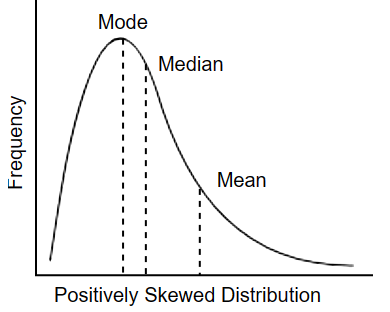
Positively Skewed Distribution
A distribution of scores where the tail extends off toward the higher positive values, resulting in a mean that is greater than the median and mode.
Negatively Skewed Distribution
A distribution of scores where the tail extends off toward the lower negative values, resulting in a mean that is lower than the median and mode.

Range
A measure of variability calculated as the difference between the highest and lowest scores in a dataset.
Standard Deviation
A measure of variability indicating how much scores differ from one another; a low value means scores are close to the average, while a high value means they are widely spread out.
Normal Distribution
A symmetric, bell-shaped probability curve where approximately 68% of the data falls within one standard deviation of the mean.
Correlational Data
Data indicating that changes in one variable are accompanied by changes in another variable, without establishing a causal link.
Correlation Coefficient (r)
A numerical statistic (r) ranging from −1.0 to +1.0 that measures the strength and direction of a relationship between two variables.
Third-Variable Problem
A limitation in correlational research where an unmeasured extraneous variable causes the observed association between two variables.
Confounding Variable
An unmeasured or extraneous factor that affects both the independent variable and dependent variable, potentially distorting the research findings.
Experimental Data
Data obtained by directly manipulating independent variables to observe their effect on dependent variables in order to establish cause-and-effect relationships.
Independent Variable (IV)
The variable in an experiment that is directly manipulated or varied by the experimenter.
Dependent Variable (DV)
The outcome variable measured by the experimenter to assess the effect of manipulating the independent variable.
Control Group
The group in an experiment that does not receive the experimental treatment or manipulation, providing a baseline comparison.
Experimental Group
The group in an experiment that receives the specific independent variable manipulation or treatment being evaluated.
Statistical Significance
The calculated odds or probability (represented by a p-value) that an observed experimental outcome occurred purely by chance.
Abstract
A concise summary section at the beginning of a research paper that outlines the main goal, methodology, key findings, and conclusion of the study.
Introduction / Literature Review
The initial section of an academic article that provides background on prior research, establishes the study's context, and states the explicit hypotheses.
Method Section
The section of a research paper detailing exactly how the study was conducted, including descriptions of subjects, materials, and procedures.
Results Section
The section of an academic paper that reports the detailed quantitative outcomes of statistical tests alongside relevant tables and figures.
Discussion Section
The section of a research paper that interprets the statistical results, evaluates hypotheses, notes study limitations, and suggests future research.
Review Article / Meta-analysis
A journal article type that synthesizes and evaluates prior published research projects rather than reporting on a single original experiment.
Case Study
A descriptive, in-depth research method focused on a single individual or a rare/unique situation.
Case Study of Genie
A famous case study of a child who suffered severe abuse and isolation, demonstrating that she was never able to fully recover her language abilities.
Case Study of Henry (H.M.)
A case study of an individual who underwent brain surgery for severe epilepsy; the procedure reduced his seizures but caused permanent amnesia.
Case Study of Phineas Gage
A classic case study of a railroad worker who survived an iron rod driven through his skull and frontal lobe, resulting in decreased impulse control, frequent outbursts, and increased drinking.
Naturalistic Observation
A descriptive research method involving the systematic recording of behaviors in their natural environment without intervention or manipulation.
Observer Bias
A distortion in data collection occurring when a researcher's unconscious expectations cause them to see or record what they want or expect to see.
Psychological Assessments
Standardized instruments and measurement tools evaluated for reliability and validity to assess psychological traits and abilities.
Reliability
The consistency, stability, and repeatability of a test or measurement tool across multiple administrations.
Validity
The extent to which an instrument or assessment accurately measures the specific construct it is intended to measure.
Survey
A research technique collecting self-reported data from a representative sample using structured questionnaires or interviews.
Representative Sample
A sample group selected for a study that accurately reflects the key demographic characteristics of the overall target population.
Archival Research
A research method that utilizes pre-existing historical documents, records, or data sets to answer new scientific questions.
Positive Correlation
A correlational relationship where two variables change in the exact same direction together.

Negative Correlation
A correlational relationship where two variables move in opposite directions, with one increasing as the other decreases.

Longitudinal Study
A research design in which data is collected repeatedly from the exact same group of individuals over an extended period of time.
Cross-Sectional Study
A research design comparing multiple segments or age groups of a population at a single point in time.
Transcranial Magnetic Stimulation (TMS)
A non-invasive procedure that uses targeted magnetic fields to temporarily stimulate or disrupt activity in specific cortical regions of the brain.
Wilder Penfield
A neurosurgeon in the 1950s who used direct electrical brain stimulation to discover that each part of the motor and sensory cortex connects directly to a specific body part.
Single Neuron Recording
A neurophysiological technique that measures electrical voltage changes and responses from an individual brain cell.
Structural Neuroimaging
Neuroimaging techniques (such as CT and MRI) designed to visualize the static physical anatomy and structure of the brain.
Functional Neuroimaging
Neuroimaging techniques (such as EEG and fMRI) designed to measure dynamic operational brain activity over time.
Computed Tomography (CT)
A structural neuroimaging technique that utilizes X-rays to construct detailed cross-sectional images of internal brain structures.
Electroencephalogram (EEG)
A functional neuroimaging method using an electrode cap placed on the scalp to measure electrical activity and event-related potentials (ERPs).
ERPS: a measured brain response that is the direct result of a specific sensory, cognitive, or motor event
Magnetic Resonance Imaging (MRI)
A structural neuroimaging method utilizing strong magnetic fields and radio waves to generate detailed structural images of soft brain tissue.
Functional Magnetic Resonance Imaging (fMRI)
A functional neuroimaging technique measuring brain activity by detecting subtle changes in blood oxygen levels.
Blood Oxygenation Level Dependent (BOLD) Signal
The blood oxygenation measurement detected by fMRI to infer localized neural activity in specific regions of the brain.
Active brain cells need more oxygen
Diffusion Tensor Imaging (DTI)
A structural neuroimaging technique providing detailed views of white matter fiber tracts connecting different grey matter areas in the brain.
Participant Bias
A bias that occurs when study participants alter their natural behavior or responses because they know they are being observed or hold expectations about the research.
Confirmation Bias
The cognitive tendency to seek out, interpret, and favor information that confirms pre-existing beliefs while ignoring evidence that refutes them.
Institutional Review Board (IRB)
An administrative body tasked with reviewing, approving, and monitoring human subject research to enforce ethical standards and protect participant safety.
Informed Consent
An ethical requirement ensuring research participants are fully informed about study procedures, potential risks, and benefits, and are free from coercion.
Debriefing
An ethical post-experimental procedure where researchers fully explain the true purpose and nature of a study to participants after completion.
Empirical method
Relies on direct, systematic observation and measurable evidence rather than pure theory or gut feeling