(Module 39) The Von Thünen Model
 View linked note
 Call Kai
 Learn
Learn Practice Test
 Spaced Repetition
 Match
Match Flashcards
 Knowt Play
1/5

There's no tags or description
Looks like no tags are added yet.
Name | Mastery | Learn | Test | Matching | Spaced | Call with Kai | Chat |
|---|
No analytics yet
Send a link to your students to track their progress
6 Terms
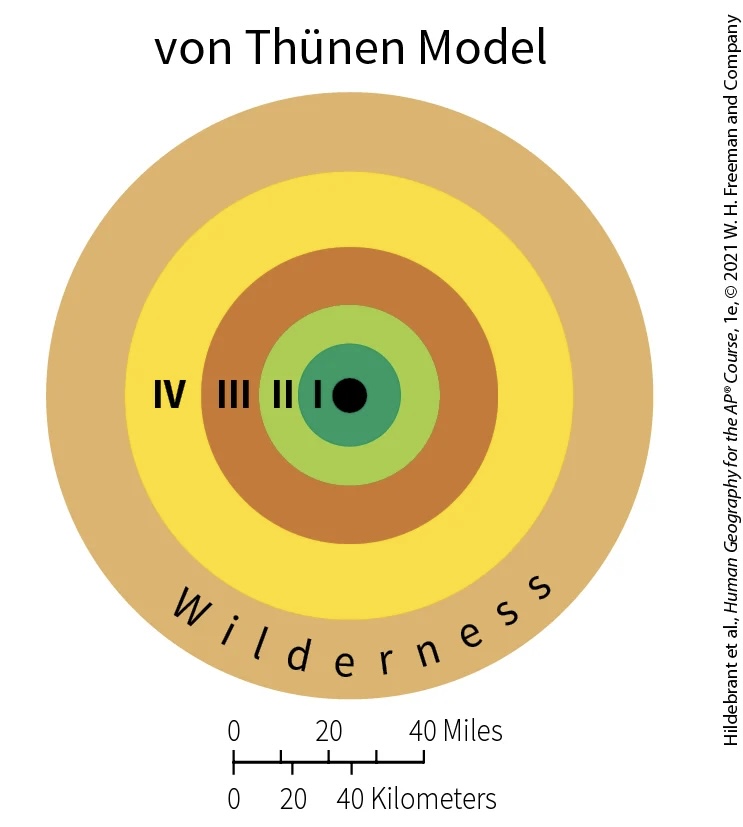
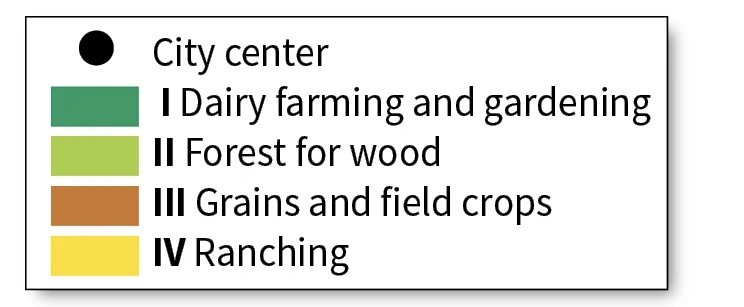
What agricultural products are produced at each ring in the Von Thünen Model and why?
Dairy farming and market gardening. Farms specializing in intensive agriculture and producing products such as milk and vegetable were in or near the city center or marketplace. Spoiled quickly so needed to be close to markets.
Forests for wood. Forests were import sources of firewood for heating and cooking. Wood in any form is bulk and difficult to transport, so timberland was located close to the market.
Grains and field crops. Grain farming, an extensive agricultural practices, was located further away from the market. Grains last longer are lighter and less bulky than wood and timber products so they are less costly to transport from longer distances, Producing grains required vast worlds which were available at a lower cost further away from the market.
Livestock ranching: is another extensive agricultural practices, was located even further away from the market, since herds survived on the coarse, patchy grassland at the edge of the wilderness.
Hinterland
The areas surrounding a city (e.g., zones 1-4 in the Von Thünen Model).
Underlying Assumptions of the Von Thünen Model.
There are no trade connections with the outside world.
There is only one, centrally located market.
Soil and climate are uniform.
Terrain is flat throughout with no rivers.
All farmers located the same distance from the market have equal access to it.
All farmers seek to maximize their profits.
The Von Thünen Model:
A model Von Thünen developed in the 1820s to explain how distance from a market and costs of transportation affect the spatial distribution of intensive and extensive agricultural practices.