(Module 39) The Von Thünen Model
Underlying Assumptions of The Von Thünen Model:
There are no trade connections with the outside world.
There is only one, centrally located market.
Soil and climate are uniform.
Terrain is flat throughout with no rivers.
All farmers located the same distance from the market have equal access to it.
All farmers seek to maximize their profits.
The Von Thünen Model:
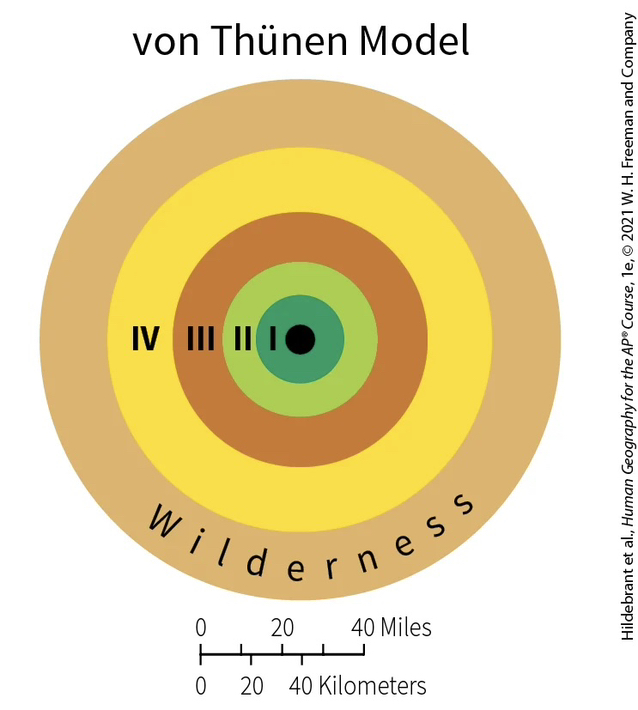
Using the assumptions and a series of rings, called concentric zones, Von Thünen developed a model in the 1820s to explain how distance from a market and costs of transportation affect the spatial distribution of intensive and extensive agricultural practices. Industrialization had not yet greatly impacted Germany, hist home country, there was no way to refrigerate any type of product,
The Four Rings:
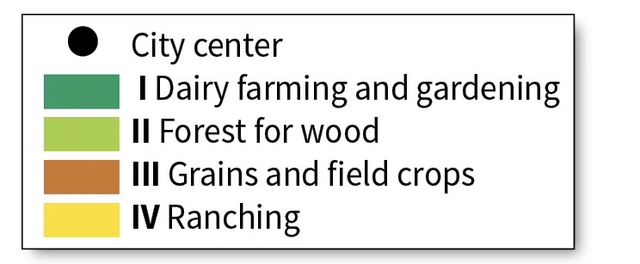
Dairy farming and market gardening. Farms specializing in intensive agriculture and producing products such as milk and vegetable were in or near the city center or marketplace. Spoiled quickly so needed to be close to markets.
Forests for wood. Forests were import sources of firewood for heating and cooking. Wood in any form is bulk and difficult to transport, so timberland was located close to the market.
Grains and field crops. Grain farming, an extensive agricultural practices, was located further away from the market. Grains last longer are lighter and less bulky than wood and timber products so they are less costly to transport from longer distances, Producing grains required vast worlds which were available at a lower cost further away from the market.
Livestock ranching: is another extensive agricultural practices, was located even further away from the market, since herds survived on the coarse, patchy grassland at the edge of the wilderness.
Historical Patterns of Agricultural Production:
Hinterland: The areas surrounding a city (e.g., zones 1-4 in the Von Thünen Model).
Farmers in the hinterland raised wheat, rye, corn, meadow grass, and livestock.
Farmers located within the city or adjacent to it provide dairy products and fresh produce.
Applying the Bid-Rent Theory:
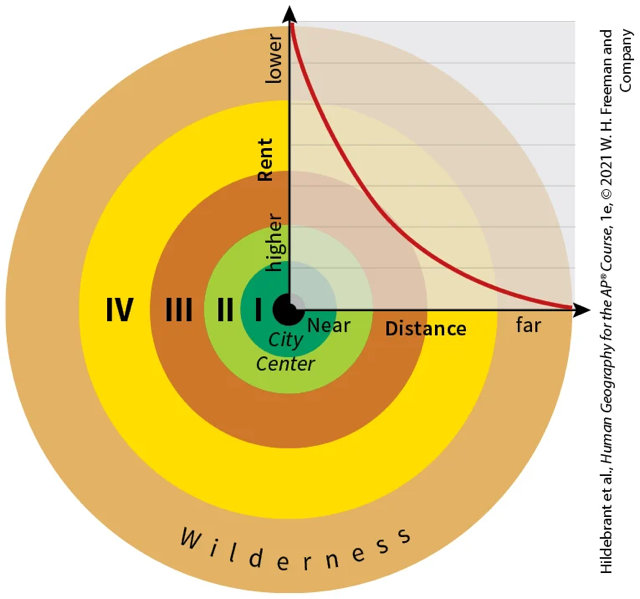
The rent cost decrease as you go further from the city center and vice-versa; Howevery
Contemporary Application of the Von Thünen Model:
A) Applied to the USA: Assume that NYC is the only available market and there is no variation in climate or terrain. Placement of the zones has changed little from Von Thünen’s original model (forests are the outlier).
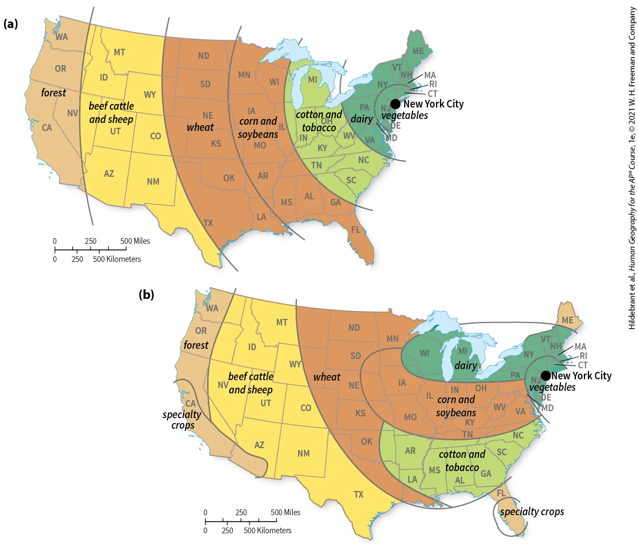
B) Variations in Climate: Placement of the rings is more horizontal because primary climate zones run east-west, not north-south. Note: the addition of speciality crops.
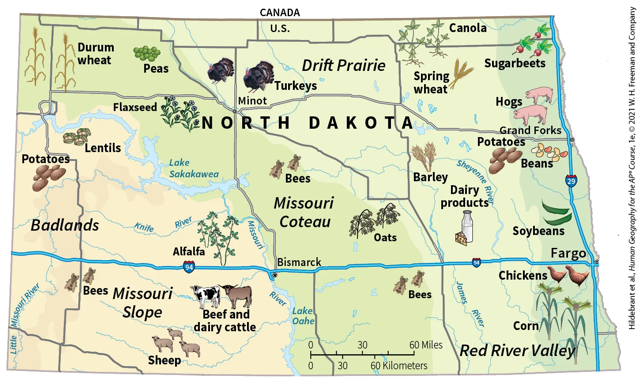
Scales of Analysis: Looking at North Dakota alone we see there are many variations not reflected on the national map.