WMAN 313 Exam 1
 Call Kai
 Learn
Learn Practice Test
 Spaced Repetition
 Match
Match Flashcards
 Knowt Play
1/83

There's no tags or description
Looks like no tags are added yet.
Name | Mastery | Learn | Test | Matching | Spaced | Call with Kai | Chat |
|---|
No analytics yet
Send a link to your students to track their progress
84 Terms
Controlled Experiment
Experimental groups are compared with a control group that lacks the factor being tested
Ecology
Refers to a scientific endeavor not environmental activism
Environmental Science
incorporates concepts from the natural sciences (Including ecology) and the social sciences to focus on how people affect the environment and how to address environmental problems
Spatial scales
small, large
Temporal scales
short, long
Population
A group of individuals that belong to the same species and live in the same area that interact with one another
Community
All the different populations of different species that live together in an area
Biotic
living
Abiotic
Non-living
Ecosystem
A biological community of interacting organisms and their physical environment.
Landscapes
Areas with substantial differences, typically including multiple ecosystems
Biosphere
All life on Earth plus parts of the Earth in which life exists
Evolution
* change in genetic characteristics in a population overtime
* organisms gradually accumulate differences from their ancestors (descent with modification)
Adaptation
characteristic that increases an organism's chance of survival
Natural Selection
individuals that have certain inherited traits tend to survive and reproduce at higher rates than others
Producers (autotrophs)
Organisms that make their own food
Net Primary Production
Energy captured by producers minus amounts lost as heat in cellular respiration GPP - Respiration
Consumers (heterotrophs)
obtain energy by consuming other organisms
Nutrient Cycle
Continuous flow of nutrients into and out of stores in the ecosystem
Photosynthesis formula
6CO2 + 6H2O + sunlight ---> C6 H12 O6 + 6O2
carbon dioxide, water, and light gets you glucose and oxygen
Hypothesis
A testable prediction, often implied by a theory
Weather
current conditions, temperature, precipitation, day to day
Climate
Long-term description of weather, based on averages and variations measured over decades
- determines geographic distribution of organisms
Conduction
kinetic energy is transferred by molecules in direct contact with one another
Convection
Energy transfer by movements of air or water currents
Thermal layers of aquatic ecosystems
Epilimnion, Hypolimnion, Thermocline
Epilimnion layer
Warmer water layer close to the surface. It absorbs the most sunlight
Hypolimnion layer
Bottom zone of most cold and dense water
Thermocline layer
Separates Top (Epil) from Bottom (Hypo) layer of fresh water. The transition area
Turnover
Seasonal changes in warm and cool water layers in lakes. (complete mixing)
Salinity
concentration of dissolved salts in water
Acidity
ability of a solution to act as an acid—a compound that gives up protons (H+) to a solution.
Alkalinity
ability of a solution to act as a base-a compound that takes up up (H+) or gives up hydroxide ions (OH-)
Hypoxia
Low oxygen saturation of the body, not enough oxygen in the blood
Biomes
Tropical rainforest, tropical seasonal forests and savannas, deserts, temperate grasslands, temperate shrublands and woodlands, temperate deciduous forests, temperate evergreen forests, boreal forests (taiga), tundra
Lotic systems
flowing water, streams and rivers
Photic zone
sunlight region near the surface of water
Littoral zone
a shallow zone in a freshwater habitat where light reaches the bottom and nurtures plants
Benthic zone
The bottom surface of an aquatic environment.
Hyporheic zone
substrate below and adjacent to stream
Lentic zone
the open sunlit surface that extends to where the point at which the sun does not shine,
Lentic ecosystems
lakes and still waters
Ectotherms
an animal that warms itself mainly by absorbing heat from its surroundings
Endotherm
an organism that is internally warmed by a heat-generating metabolic process
Torpor
dormant state, body temp and basal metabolic rates are low to conserve energy
Hibernation
Long-term torpor that is an adaptation to winter cold and food scarcity.
Genes
DNA segments that serve as the key functional units in hereditary transmission.
Allele
Different forms of a gene
Genotype
Genetic makeup of an individual, represented by letters
Change in allele frequencies in a population overtime
Evolution
Descent with modification
principle that each living species has descended, with changes, from other species over time
- natural selection can be responsible for the modification part
Natural selection is like a sorting process
the population will evolve but individuals will not
Mutation
source of new alleles, change in DNA
Mechanisms that cause allele frequencies to change overtime
Natural selection, genetic drift, gene flow
Phenotype
observable characteristics that are influenced by the genotype
Directional Selection
individuals on one phenotypic extreme are favored (type of natural selection)
Stabilizing selection
individuals with an intermediate phenotype are favored (type of natural selection)
Disruptive selection
individuals at both phenotypic extremes are favored (type of natural selection)
Genetic drift
occurs when chance events determine which alleles are passed to the next generation
Gene flow
alleles move between populations via movement of individuals or gametes
Adaptive evolution
traits that confer advantages tend to increase in frequency overtime
Speciation
one species splits into two or more
Adaptive radiation
increased diversity of the surviving groups
Coevolution
reciprocal evolutionary change in interacting species
Convergent evolution
Evolution toward similar characteristics in unrelated species
Divergent evolution
when two or more species sharing a common ancestor become more different over time
Parallel evolution
independent evolution of similar traits, starting from a similar ancestral condition
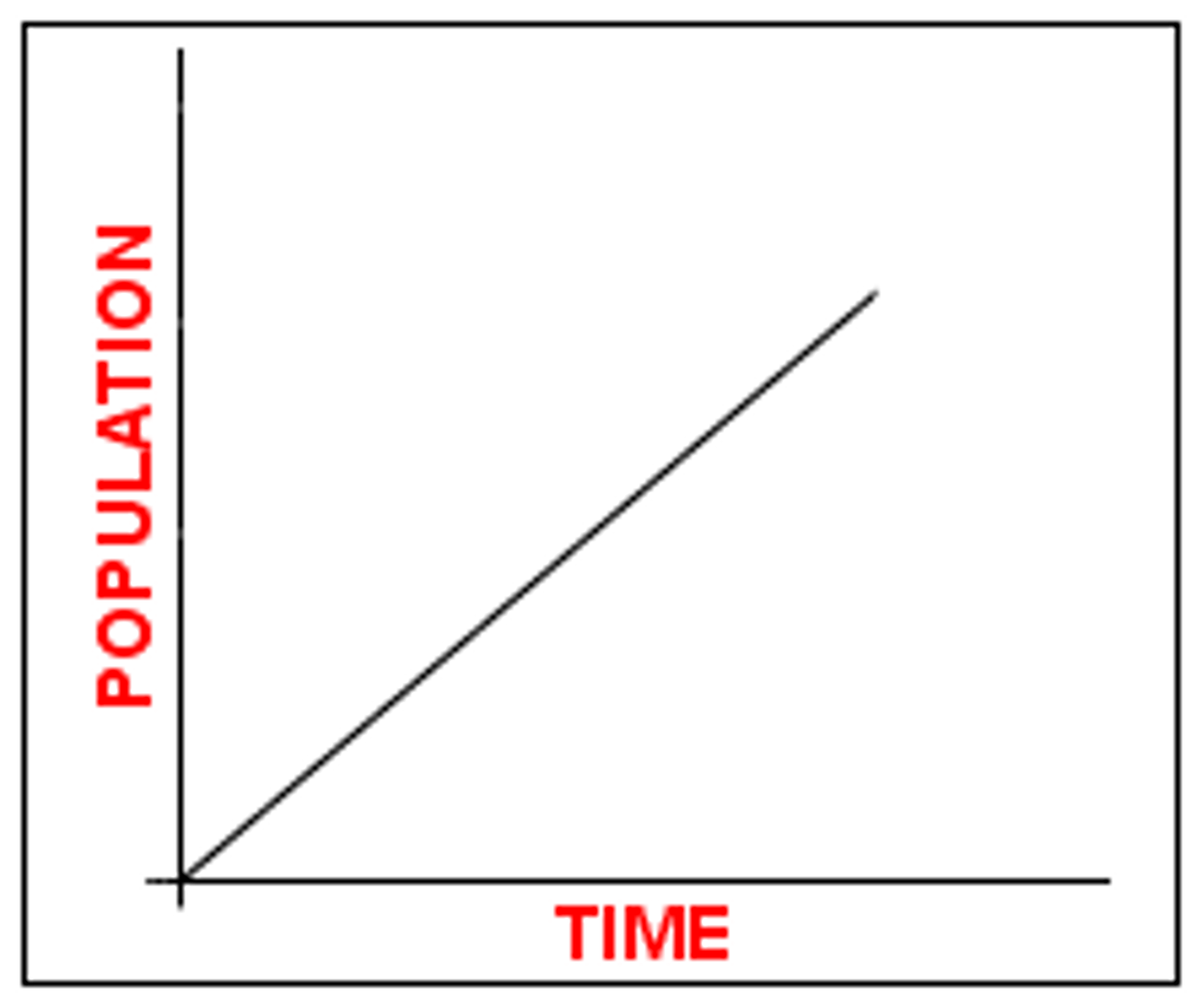
Linear growth
expansion that increases by the same amount during each time interval.
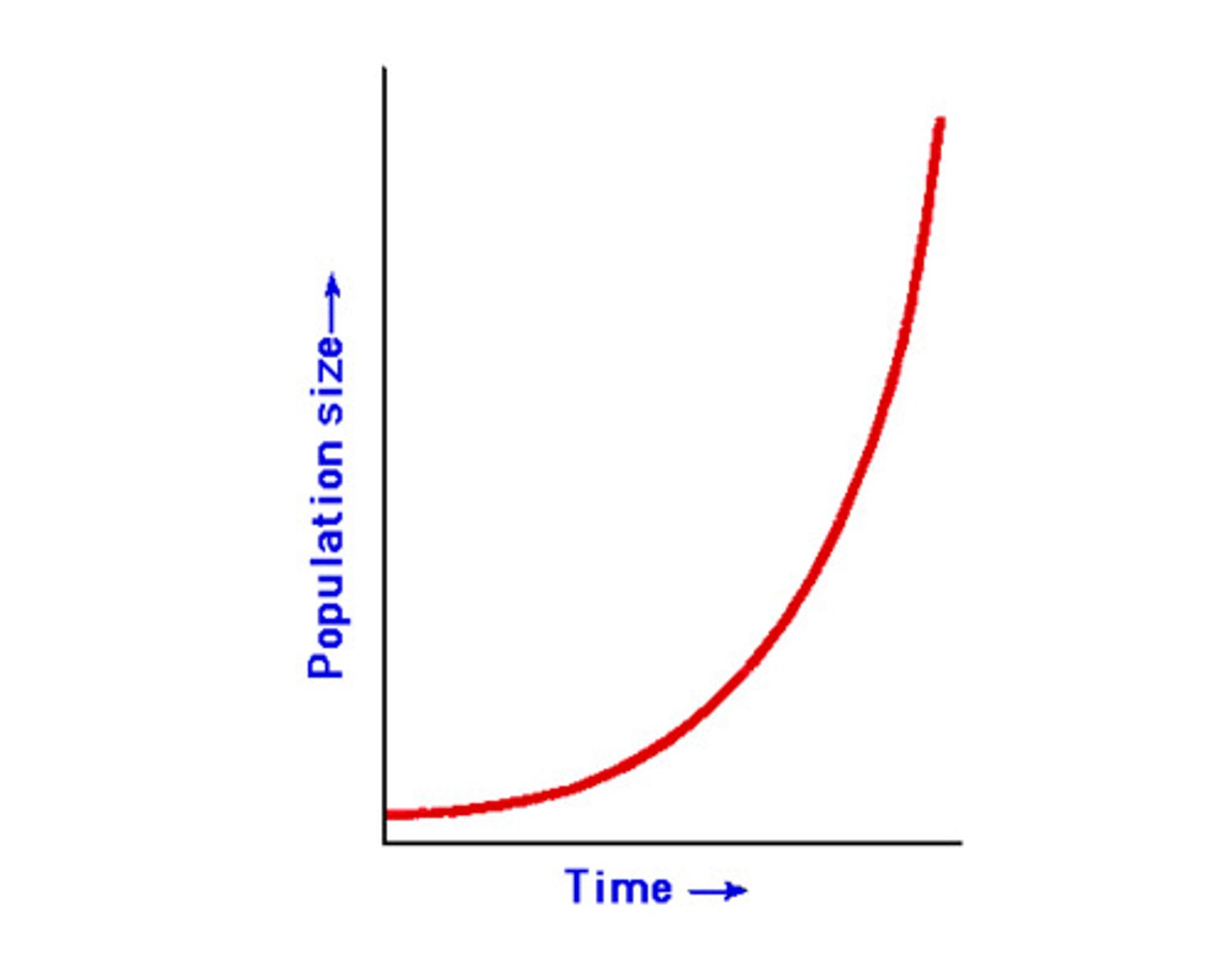
Exponential growth
growth whose rate becomes ever more rapid in proportion to the growing total number or size.
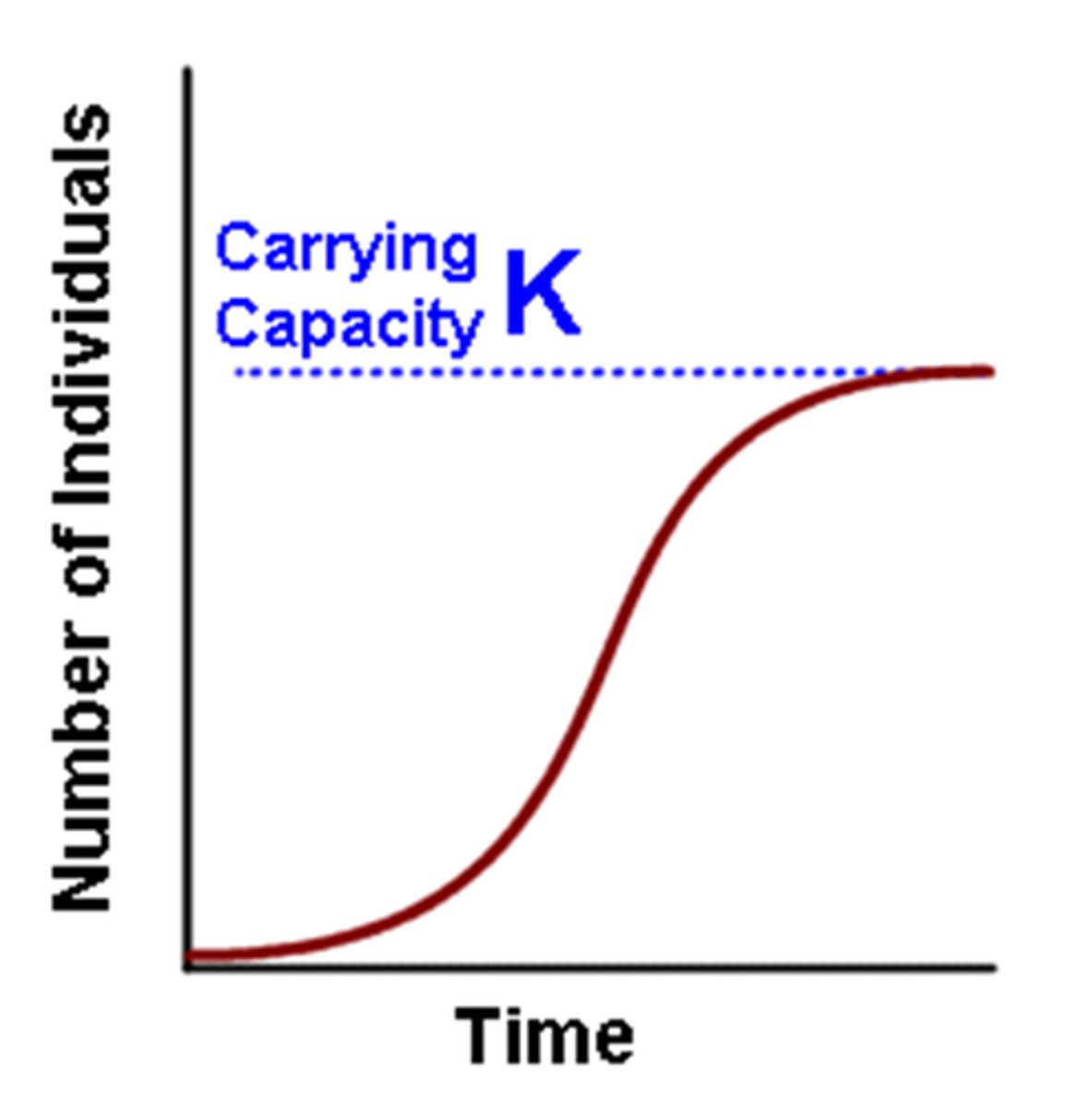
Logistic growth
Population growth that is controlled by limited resources
Limitations of logistic growth
- can misestimate K in shifting environments
- assumes a constant carrying capacity
change in population =
growth rate (r) times population size (N) times 1-N over K (carrying capacity) - Harvest(H)
Total mortality
Z = M+H
Z (total mortality) M(natural mortality) H(harvest)
Lincoln-Petersen Estimator
N=M(n)/R
N(population estimation) M(number of total marked individuals) n (number of individuals captured in a sample) R(number of marked individuals recaptured)
Assumptions of mark recapture
Immigration/emigration, lost mark, survival, trap shy, trap happy, poorly mixed
Optimal Forage Theory
animals will maximize the amount of energy acquired per unit of feeding time
- as foraging effort increases, energy will increase rapidly at first but then eventually net energy will decrease with no more benefit
- animals should prefer high-energy low handling time food items
Marginal Value Theorem
an animal should stay in a profitable patch until the rate of energy gain has decline to match the average rate for the whole habitat
asexual reproduction
process by which a single parent reproduces by itself
Sexual reproduction
a reproductive process that involves two parents that combine their genetic material to produce a new organism
Sexual selection
when individuals select mates based on heritable traits
K selected species
a species with a low intrinsic growth rate that causes the population to increase slowly until it reaches carrying capacity
-producing few, large offspring, investing heavily in parental care
r selected species
a species that has a high intrinsic growth rate, which often leads to population overshoots and die-offs
- short lived, mature quickly, low juvenile survival rates
good indicator species
- highly sensitive to environmental changes
- well-understood ecology
- be able to monitor frequently
- amphibians, stonefly larvae
Q10
For every 1 degree increase in Body temp, there is a corresponding 10% increase in metabolism. if the value is 2 or 3 it indicates that the respiration rate doubles or triples for every 10 degree rise.