MIDTERM PREP
 Studied by 0 people
 Call Kai
 Learn
Learn Practice Test
 Spaced Repetition
 Match
Match Flashcards
 Knowt Play
1/89

There's no tags or description
Looks like no tags are added yet.
Name | Mastery | Learn | Test | Matching | Spaced |
|---|
No study sessions yet.
90 Terms
Cognitive Psychology
Scientific study of mind and mental function, including learning, memory, attention, perception, reasoning, language, conceptual development, and decision making.
Learning
The process of acquiring, through experience, new and relatively enduring information or behaviors.
Non-Associative Learning
Learning information about an external stimulus
Associative Learning
Whenever a person/animal forms an association among various stimuli and/or responses
Habituation
Lengthy or repeated exposure to a stimulus which eventually leads to a DECREASED individual response. (Non-Associative Learning)
Sensitization
Lengthy or repeated exposure to a stimulus which eventually leads to an INCREASED individual response
Behaviorism
(Associative Learning) Psychology as an empirically rigorous science focused on observable behaviors and not unobservable internal mental processes
Pavlov
Medical degree
Studied digestive system (of dogs)
Nobel prize in physiology
Experiments on conditioning
Classical (Pavlovian or Respondent) conditioning
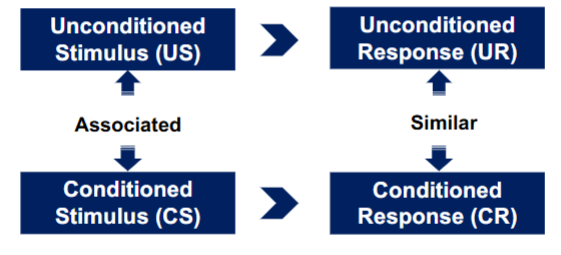
Form of learning in which reflex responses are associated with new stimuli
Based on what happens BEFORE the response
Unconditioned Stimulus
Reliably triggers a response
Unconditioned Response
Triggered by unconditioned stimulus
Neutral Stimulus
Triggers NO response
During Conditioning
The unconditioned stimulus is paired with the neutral stimulus and results in the unconditioned response. This is repeated until the state of acquisition, where there is an association between the two stimuli that has been created.
After Conditioning
The old neutral stimulus has become a CONDITIONED stimulus because it now elicits the conditioned response
Process of classical conditioning
John B. Watson - The Little Albert Experiment (1920)
Applied the principles of CC to humans.
Human emotions and behaviors as a bundle of conditioned responses, more specifically of conditioned emotional responses.
Watson and Raynor conduced the Little Albert experiment, whereby they conditioned a 9-month old baby to associate rats (Conditioned stimulus) with a loud noise (unconditioned stimulus) and fear them (Conditioned response)
Little Albert
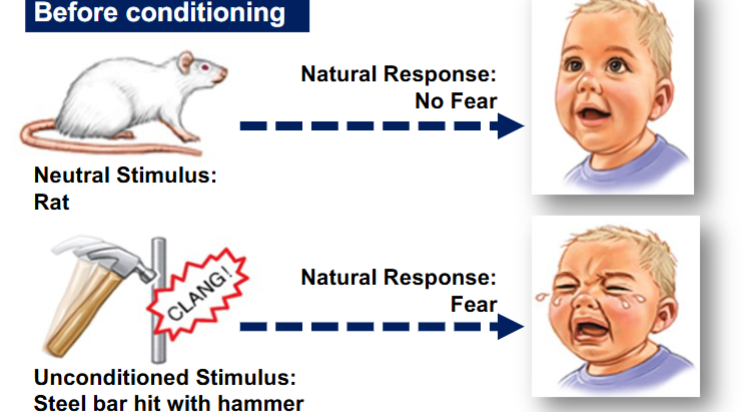
Little Albert Contd
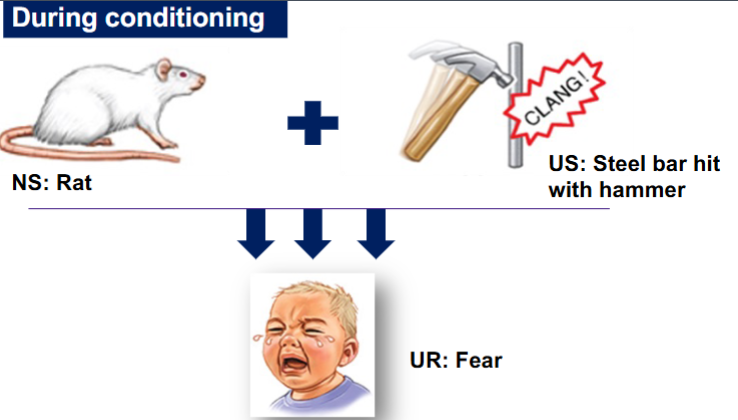
Little Albert Finished
Issues with:
The ethical standards of the study
The rigor of the experiment
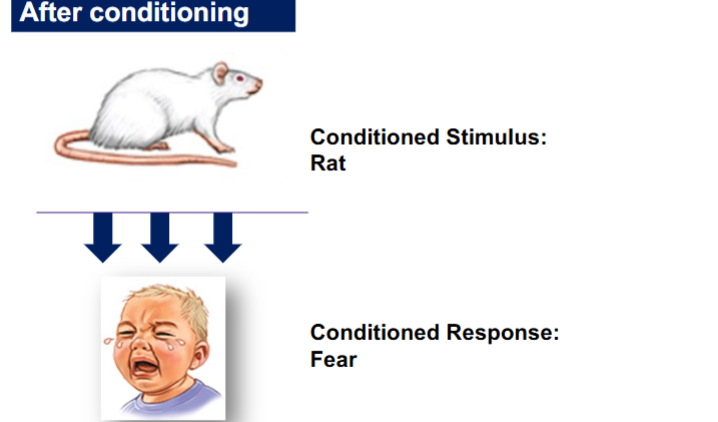
Phobias - CC
PHOBIA may begin as CONDITIONED EMOTIONAL RESPONSES
CERs can spread to other stimuli
Conditioned fears respond to desensitization
Many of our likes and dislikes and fears are acquired as conditioned emotional responses
Widely exploited by advertisers who pair their products with positive images and music
Acquisition
Process of acquiring a new response, when conditioned response strength increases
Ideally, the unconditioned stimulus immediately after conditioned stimulus, optimal delay between both from ½ to 5 seconds.
Extinction
Disappearance of the conditioned response when the unconditioned stimulus no longer follows the conditioned stimulus.
Spontaneous Recovery
Return of a learned response after apparent extinction
Stimulus Generalization
Tendency to respond to stimuli similar to but not identical to a conditioned stimulus
Stimulus Discrimination
Ability to respond differently to various stimuli
Operant (Or instrumental) Conditioning
Form of learning in which behavior is strengthened if followed by a REINFORCER or diminished if followed by PUNISHER
Based on what happens AFTER the response.
Involves associating one’s own behavior with consequences
Law of Effect
Behaviors followed by satisfying consequences are more likely to be repeated, while behaviors followed by annoying consequences are less likely to be repeated (Edward Thorndike)
Operant Reinforcer
Event that follows a response and increases the probability of it occurring again
Positive Reinforcement (Operant reinforcer)
Strengthens responses by PRESENTING A REWARDING stimulus after a desired event
Negative Reinforcement
Strengthens the response by REMOVING AN UNPLEASANT stimulus after a desired event.
Primary Reinforcers
An innately reinforcing stimulus, such as one that satisfies a biological need (Hunger, rest, etc.)
Secondary (or Conditioned) Reinforcers
A stimulus that gains its reinforcing power via its association with a primary reinforcer
Reinforcement Schedule
A pattern that defines how often a desired response will be reinforced
Continuous Reinforcement
The desired response is reinforced every time it occurs
Partial (Intermittent) Reinforcement
Responses are sometimes reinforced and sometimes not reinforced
Partial-Reinforcement Effect
Finding the operant responses reinforced on a partial schedules are more resistant to extinction
Punisher
Event that follows a response and DECREASES its probability of occurring again.
Positive Punishment
DECREASES responses by PRESENTING AN AVERSIVE stimulus after an undesired event
Negative Punishment
Decreases the response by REMOVING A DESIRABLE or PLEASANT stimulus after an undesired event
Limitations of behaviorist views
An animal’s capacity for conditioning is limited by its biology (Not all associations are learned equally)
Learning not solely about conditioning and association, rewards, and punishments
Learning can occur through observing others’ behavior (Not always needing to do something to learn)
Human cognition (i.e., thoughts, perspectives, and expectations) and social context critical for learning
Observational Learning
The acquisition or modification of a behavior after exposure to at least one performance of that behavior
Modeling
The imitation of behavior through OL
Vicarious Conditioning
Learning the consequences of an action by watching others being rewarded or punished for performing the action
Vicarious Contd
The emotional attitudes we develop towards foods, political parties, ethnic groups, etc., are probably conditioned by direct and second-hand experiences (i.e., vicariously)
Decision Making
Attempting to select the best alternative among several options
Bounded Rationality
The idea that in decision-making, rationality of individuals is limited by
The information they have,
the cognitive limitations of their minds (i.e., cognitive misers), and
the finite amount of time they have to make a decision
Heuristic
Shortcut used to reduce the amount of thinking needed to make decisions
Availability heuristic
Tendency to make a decision based on information that comes most easily to mind
Representativeness heuristic
Tendency to place people or objects in a category if they are similar to the concept that is the prototype
Leads to faulty reasoning if base rate is not taken into account
Bias
Systematic pattern of deviation from norm or rationality in judgement, whereby inferences about others and situations may be drawn in an illogical fashion
Framing
How information is presented affects how that information is perceived and influences decisions
Paradox of Choice
When too many options are available, especially when all of them are attractive, we experience conflict, indecision, and a form of cognitive paralysis(Maximizers vs. Satisfiers (i.e., “good enough” choice)
Developmental Psychology
Scientific study of how humans change over the life span
From conception until death
Three domains of change
Physical
Socio-emotional
Cognitive
Contextual Theories
Emphasize the role of sociocultural context in development
Sociocultural Theory
How culture is transmitted from one generation to the next via everyday social interactions
Social dimension of cognitive development and cultural context of development
Learn to act as member of society because of participating in cooperative dialogues and guidance from adults & more-expert peers.
Biological Systems Theory
Development results from ongoing interactions b/w biological, cognitive, and socioemotional changes within individual and their changing contexts (Ontogenetic development (i.e., within individual)
Dynamic Systems Theory
Children’s developmental domains, maturation, and environment as an integrated system, ever changing, resulting in developmental change and emergence of new abilities.
Germinal Period
Conception to 2 weeks after
Division of the zygote and implantation in the uterine wall
Embryonic Period
3 to 8 weeks after conception
Brain, spine, major organs, and bodily structures bein to form in the embryo
Fetal Period
9 weeks after conception until birth
Brain continues developing; bodily structures are refined; fetus grows in length/weight and accumulated fat for birth
Teratogens
Environmental substances that can harm prenatal development
Greek “tera” = “monster'“
During pregnancy, development could be affected by:
Alcohol; Caffeine; Nicotine
Recreational drugs
Rubella, syphilis
Radiation mercury
Effects: Micro-/macrocephaly, hydrocephalus, heart defect, vascular disruption, mandibular/ear abnormalities, spina bifda, limb defects, neural tube defects, etc.
Cephalocaudal Development
Growth occurs from top down
Proximodistal Development
Growth occurs from the center of the body outward
Inborn Motor Reflexes
Basic automatic responses to stimuli that aid survival
Rooting reflex
Sucking reflex
Grasping reflex
Sensory development
Infants get information from the world by hearing, seeing, smelling, tasting, and perceiving touch. Not all sensory abilities have the same development
Taste: 2 hours old infants prefer sweet tastes
Hearing: Infants hear well at birth
Vision: Poor vision at birth
Maturation
Physical development of the brain and body that prepares an infant for voluntary movement
Changes in the brain:
Formation of synapses b/w neurons
Over time and with experience, synaptic connections refined to preserve most important connections
Problematic when environments not stimulating
Early attachment
Fundamental need to form strong connections with caretakers
In the late 1950s, psychologists believed that the care an infant needed was based primarily on getting food from the mother
Harry Harlow’s monkey attachment experiment
Attachment bonds formed when caregivers provide for: Physical needs vs. comforting contact
Attachment styles
Separation anxiety
occurs in all human cultures
Strange situation test
(Mary Ainsworth) Revealed different attachment styles
Secure attachment
Avoidant attachment
Ambivalent attachment
Secure attachment
Infants confident enough to play in unfamiliar environment if caregiver present
Infants readily comforted by caregiver in times of distress
Insecure attachment
Avoidant attachment: Infants somewhat willing to explore unfamiliar environment, but with little interest in caregiver
Ambivalent attachment: infants unwilling to explore unfamiliar environment with mixed feelings about the caregiver (Ex: Cry when caregiver leaves but not consoled upon their return)
Theory of mind
Capacity to understand that other people have minds and intentions
as infants and children acquire theory of mind, they develop the ability to think in increasingly sophisticated ways
Piagets Theory of Cognitive Development
Jean Piaget investigated how the way children think changes
For him, infants change how they think as they form new schemas, or ways of thinking about how the world works
Piaget underestimated the ages at which certain skills develop
Cognitive development understood in terms of trends rather than strict stages
Schemas
Ways of thinking about how the world works
Assimilation
Process used to incorporate new information into existing frameworks for knowledge
Accommodation
Process used to create new frameworks for knowledge or to drastically alter existing ones to incorporate new information that otherwise would not fit
Sensorimotor stage (Birth to 2 years)
Acquisition of information through senses and motor skills
Object permanence developed during this stage
Preoperational stage (2-7 years)
Reasoning based on intuition and superficial appearances rather than logic
Law of conservation
Centration
Egocentrism
Law of conservation
A child’s understanding that certain properties of an object, like its mass, number, or remain the same even when its appearance changes
Centration
Tendency in young children to focus on a single prominent aspect of a situation while ignoring other important features
Egocentrism
Inability to see things from another persons perspective. (Child hides their eyes behind their hands, so since they can’t see, no one else can)
Concrete operation stage (7-12 years)
Begin to think about and understand logical operations, and no longer fooled by appearances
Formal operational stage (12 to adulthood)
Think abstractly, and able to formulate and test hypotheses through logic
Language
0 to 60k words
System in which sounds and symbols are used according to grammatical rules
Phonemes, morphemes; syntax
Babbling
Intentional vocalization, often by an infant, with no specific meanings
Telegraphic speech
Rudimentary sentences with missing words and grammatical markings, though follow logical syntax and convey meaning
Over regularization
Incorrect use of a regular syntax rule where exception to a rule should be used