ENE 108 Midterm Prep
 Studied by 1 person
 Call Kai
 Learn
Learn Practice Test
 Spaced Repetition
 Match
Match Flashcards
 Knowt Play
1/41

There's no tags or description
Looks like no tags are added yet.
Name | Mastery | Learn | Test | Matching | Spaced |
|---|
No study sessions yet.
42 Terms
What is a crisis?
Any event or occurrence typically happening abruptly, that has the potential to create an unstable or dangerous environment.
What does A D T F stand for in the context of incident training?
Accelerated Decision Time Frame
Mission Critical Operations are unique because they allow an organization to deliver its product or service without:
a. Interruption
b. Integrity
c. Profit
d. Procedures
a. Interruption
What systems make up critical infrastructure? (Select all that apply)
Power
Safety
Security
HVAC
Landscaping
Power
Safety
Security
HVAC
What elements in a data center tie together the critical systems? (Select all that apply)
Policies and procedures
Drawings
Networking and IT
Break Time
Documentation
Policies and procedures
Drawings
Networking and IT
Documentation
What is the difference between policies and procedures?
a. Procedures are guidelines for activities that result in a reliable outcome, while policies are specific actions for accomplishing a task in a safe, reliable manner.
b. Policies are guidelines for activities that result in a variable outcome, while procedures are specific actions for accomplishing tasks in a safe, reliable manner.
c. Policies are guidelines for activities that result in a reliable outcome, while procedures are specific actions for accomplishing tasks in a safe, reliable manner.
d. Policies are specific actions that result in a reliable outcome, while procedures are guidelines for accomplishing a task in a safe, reliable manner.
c. Policies are guidelines for activities that result in a reliable outcome, while procedures are specific actions for accomplishing tasks in a safe, reliable manner.
What is the mission critical mindset?
a. Having a vast technical knowledge of every single component of a mission critical system.
b. Having a broad understanding of the different components of a mission critical system and how they work individually within the system.
c. Having minimal technical knowledge about the components of a mission critical system, but a good work ethic.
d. Having a broad understanding of how the various components work individually and interact collectively within a mission critical system.
d. Having a broad understanding of how the various components work individually and interact collectively within a mission critical system.
When evaluating and selecting the proper location for a new data center, what is the first and likely most important decision that needs to be made about the site?
a. The potential transportation access to the site.
b. The geographic location of the site and the resultant natural threats.
c. The possible man-made threats to the site.
d. The available government subsidies for building the site.
b. The geographic location of the site and the resultant natural threats.
If a mission critical function stopped working it would cripple a business.
True
False
True
A watt is the mathematical equivalent of 10 amps x 1 volt.
True
False
False
Define the acronyms below.
FACP
VESDA
EPO
P.A.S.S.
FACP: Fire Alarm Control Panel
VESDA: Very Early Smoke Detection Apparatus
EPO: Emergency Power Off
P.A.S.S.: Pull Aim Squeeze Sweep
Define double interlock preaction system?
A double interlock preaction system is a fire suppression system that requires an independent electrical and mechanical signal to operate
What are the two main components, contained within a pre-action rig, that are primarily responsible for holding back the water in the equalizing line?
A solenoid and a dry pilot actuator
The dry pipe in a data center is typically filled with?
____________ Or _____________
Air Or Nitrogen
Which of the following is NOT a part of the fire triangle?
a. Electricity
b. Oxygen
c. Fuel
d. Heat
a. Electricity
While performing a filter inspection, what type of test is used to check the filter integrity?
a. Color Test
b. Luminosity Test
c. Date Inspection
d. Sniff Test
b. Luminosity Test
From the text- Which fire detection system functions by sensing the intense light signals that are emitted by a fire?
a. Fire alarms
b. Smoke and heat detection
c. Beam detection
d. Flame and flash detection
d. Flame and flash detection
From the text-Which type of fire suppression system functions by dispensing water throughout the affected space in order to reduce the heat below the point of combustion?
a. Sprinklers
b. Fire extinguisher
c. Foam
d. Clean agent
a. Sprinklers
Define the acronyms below.
CRAH
CRAC
WSE
ASE
CRAH: Computer Room Air Handler
CRAC: Computer Room Air Conditioner
WSE: Water-Side Economizer
ASE: Air-Side Economizer
What is the definition of blowdown?
Blowdown is the type of water treatment where used or dirty water is removed from a system while new, clean water is added.
List three sources of data center make up water
Reclaim, City water, Well, Rainwater
What is the definition of a heat exchanger?
A heat exchanger is a component that allows heat to transfer from one fluid to another without the two fluids coming into contact with one another.
Which group helps define ideal temperature and operating conditions in a data center?
a. NFPA
b. ASHRAE
c. NEC
d. OSHA
b. ASHRAE
Condenser water flows through what two components of mechanical infrastructure? (Select all that apply.)
a. CRAH
b. Air Handling Unit
c. Evaporator
d. Condenser
e. Cooling Tower
d. Condenser
e. Cooling Tower
From the text- Which type of preventative maintenance for HVAC systems involves checking, cleaning, and (as needed) replacing the components of the HVAC system that remove impurities that may disrupt the air flow in the system?
a. Testing, adjusting, and balancing
b. Belt maintenance
c. Filter maintenance
d. Coil maintenance
c. Filter maintenance
Which secondary system is used to create and maintain proper atmospheric moisture levels in a critical space?
a. Process water
b. Humidity control
c. Vacuum
d. Compressed Air
b. Humidity control
True or False: CRAH units undergo preventative maintenance quarterly (or semi-annual) and annually.
False
True
True
True or False: A water cooled type of cooling system directly cools the air being supplied to an occupied space by utilizing a refrigerant that absorbs the heat directly from the air.
False
True
False
The DC bus voltage is higher than incoming AC voltage on a UPS. What is this typical voltage and why is it higher?
Typical DC bus voltage is 540v. This is because potential always flows from high potential to low potential. In a UPS, this ensures the rectifier is always supplying float voltage to the batteries.
Generators are rated in one of three duty ratings. They are:
Prime
Standby
Continuous
Define the following terms using three words each:
Open Transition
Closed Transition
Open Transition - Break before make
Closed Transition - Make before break
The theory of operation by which a UPS operates is typically known as:
a. Double interlock theory
b. Delta energy theory
c. Dual zone theory
d. Double conversion theory
d. Double conversion theory
What four major components make up a double conversion UPS (select all that apply)?
a. Molded case breaker
b. Static Switch
c. DC Bus/Batteries
d. Rectifier
e. Inverter
b. Static Switch
c. DC Bus/Batteries
d. Rectifier
e. Inverter
What components are typically found in a data center electrical lineup (select all that apply)?
a. Switchgear
b. UPS
c. RPP
d. PDU
e. Incoming utility transformer
a. Switchgear
b. UPS
d. PDU
e. Incoming utility transformer
Define the following:
Rectifier _______________
Inverter ________________
PDU ____________________
Static Switch __________
UPS ____________________
RPP ____________________
Rectifier: Converts incoming AC to DC for the DC bus and input to the inverter
Inverter: Converts DC to a clean three phase AC signal before power leaves the UPS
PDU (Power Distribution Unit): Electrical component responsible for transforming 480v to 208v via a step down transformer
Static Switch: Responsible for monitoring UPS output voltage and transferring a UPS safely to bypass if there is an issue with the inverter
UPS (Uninterruptible Power Supply): Provides uninterrupted, conditioned power to the data center load
RPP (Remote Power Panel): Provides a means of power distribution in a data center by means of a breaker panel
From the text-Which of the following represents the greatest common source of utility power?
a. Nuclear
b. Oil
c. Solar
d. Natural Gas
e. Coal
e. Coal
True or False: Upon a loss of utility in a data center, the generator will automatically start and resupply the main switchgear with power.
True
True or False: A UPS battery has a 12V discharge rating, but while at rest can read up to 13.5 volts of potential.
True
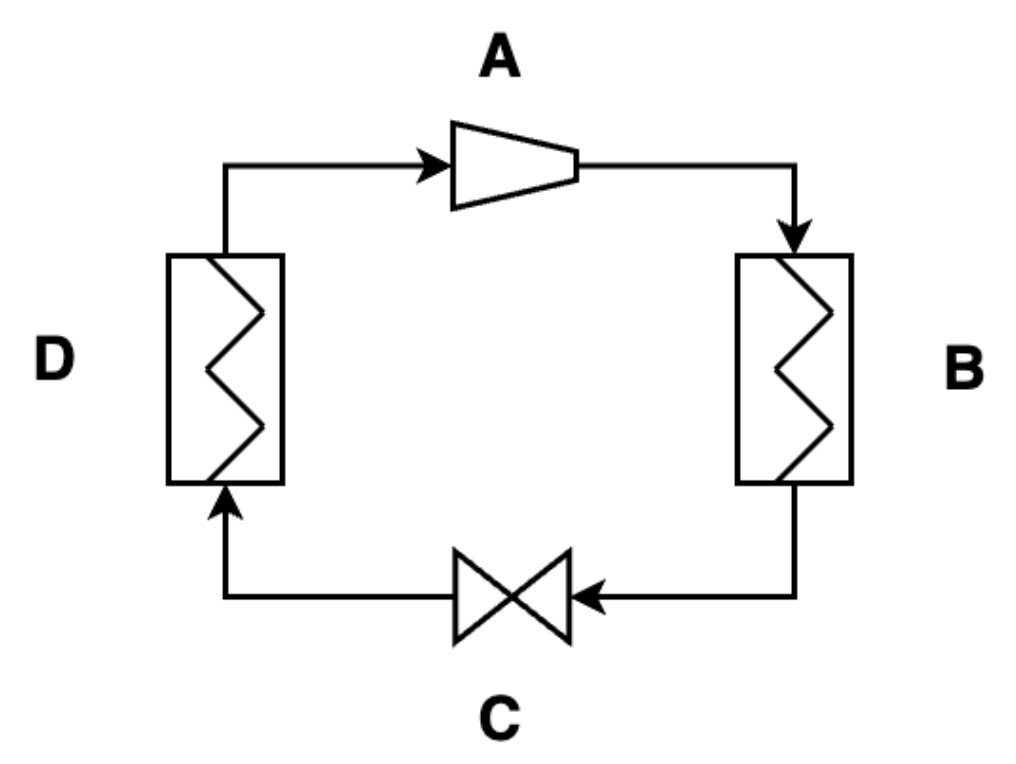
Here is a diagram of the vapor compression cycle. Name each part of the cycle (A, B, C, & D) AND write a brief description of what happens to the refrigerant in that part of the cycle.
It typically starts at D (The Evaporator), where the heat coming in from the chilled water at the chilled water coil from the CRAH/CRAC unit is indirectly transferred to the refrigerant in the evaporator. This comes out as a low pressure/low temperature vapor that quickly goes into A (The Compressor), which compresses the low pressure/low temperature vapor into a high pressure/high temperature vapor, which then gets sent to B (The Condenser), which ejects the heat from the high pressure/high temperature vapor using condenser water, which goes right to a cooling tower outside where the heat can be released into the atmosphere. Back at the Condenser, the high pressure/high temperature vapor gets condensed into a high pressure/high temperature liquid, which then gets regulated by C (The Expansion Valve) so it can release that same high pressure/high temperature liquid as a low pressure/low temperature liquid/vapor mixture, which then gets sent back into the evaporator to repeat the heating removal cycle.
What are the two main purposes of air conditioning.
1. To take heat from a place where it is not wanted, to a place where it does not matter.
2. Humidity Control.
.
.
.
.