Lecture 10: Hemoglobin
 Call Kai
 Learn
Learn Practice Test
 Spaced Repetition
 Match
Match Flashcards
 Knowt Play
1/23

There's no tags or description
Looks like no tags are added yet.
Name | Mastery | Learn | Test | Matching | Spaced | Call with Kai | Chat |
|---|
No analytics yet
Send a link to your students to track their progress
24 Terms
what is the role of hemoglobin?
delivers oxygen from the lungs to the tissue
binds oxygen in lungs
release oxygen in tissues
transports CO2 from tissues to lungs
what is the most abundant in muscle tissues? what does it do?
myoglobin serves as oxygen storage
binds oxygen tightly
releases it only when oxygen supply is low
why do hemoglobin and myoglobin need heme to bind O2?
normal protein side chains don’t have direct affinity for O2
components of heme? what are necessary factors for each component??
protoporphyrin
generally planar
4 N atoms that are equatorial
central Fe atom
oxidation state must be 2+ for it to bind O2 (3+ can’t)
where do the proximal and distal His bind to the heme?
proximal His → 5th nitrogen ligand (lower axial)
distal His → 6th is O2 (upper axial)
what are the 2 purposes of distal His bonding to the heme?
it H bonds to the oxygen which prevents oxidation of Fe2+ to Fe3+
free heme has increased affinity to bind carbon monoxide (CO) but with distal His, sterically it clashes, so it reduces the binding to it
what does binding affinity measure?
strength of interaction between ligand L and receptor R
what is important about the dissociation constant when measuring affinity?
it is an inverse relationship
small KD → strong association → high affinity

structure of myoglobin? what is it’s graph?
myoglobin
1 subunit
8 α-helices + 1 heme
hyperbolic graph
how do enzyme kinetics compare to receptor/ligand binding variables?
[L] or pO2 → [S]
B or [bound oxygen] → v0
Bmax or Y → Vmax
Kd or p50 → Km
![<p>[L] or pO<sub>2 </sub>→ [S]</p><p>B or [bound oxygen] → v<sub>0</sub></p><p>B<sub>max</sub> or Y → V<sub>max</sub></p><p>K<sub>d</sub> or p<sub>50</sub> → K<sub>m</sub></p>](https://assets.knowt.com/user-attachments/16431cf7-2821-42be-84b8-2f2ce429602a.png)
how do the graphs compare between enzyme kinetics and hemoglobin and myoglobin?
Michaelis-Menten and myoglobin - square hyperbola
hemoglobin - sigmoidal
4 O2 binding sites have positive cooperativity between sites
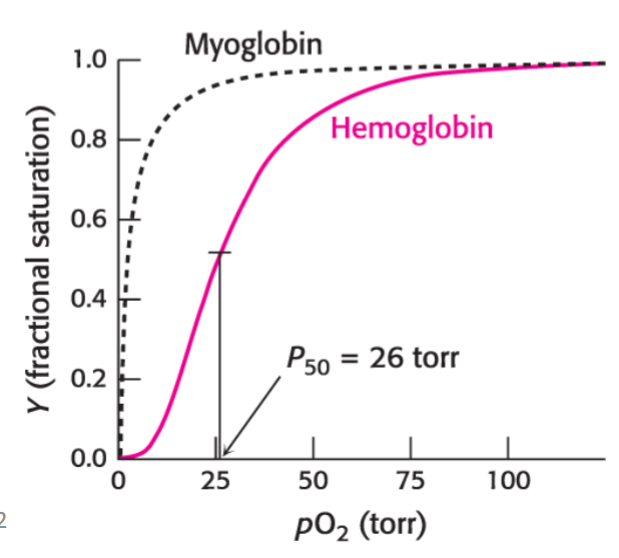
what is the physiological importance of cooperativity between hemoglobin and myoglobin? is one more efficient than the other? why?
the cooperativity pushes hemoglobin to be more affinitive in the lungs, so once one O binds, many more are inclined to bind too
on the opposite side, once the hemoglobin gets to the tissues, one O gets released and the positive cooperativity encourages the other Os to also get released, giving about a 66% O dropoff in the tissues
myoglobin doesn’t need to do have positive cooperativity because it’s main job is to store the oxygen for extreme cases
what does the response coefficient (R) measure? how does it differ for hemoglobin vs myoglobin?
change in ligand concentration required to move system from 10% to 90%
the width of the window needed to saturate the protein
hemoglobin - ultrasensitive → R < 81
myoglobin - hyperbolic → R = 81
much easier to saturate a hemoglobin system and because of positive cooperativity, it needs a smaller R
how do T and R states of hemoglobin affect O2 binding?
deoxy: no O2 bound (T, tense) → weaker binding
proximal His pulls Fe out of the plane
oxy: O2 bound (R, relaxed) → stronger binding
Fe is in the plane, pulls up proximal His
what does O2 binding do to the subunit interface?
it moves the helix, so the helices interacting are moved by one turn of the helix (~5.4 A)
change in binding state of one subunit → change in quaternary structure
what stabilizes the T state? what is needed for it’s protonation?
intersubunit salt bridges
lysine
an N terminus
His
how is H+ a heterotropic inhibitor?
a regulatory molecule that binds to an allosteric site on an enzyme to slow it down, where the inhibitor is a completely different molecule than the enzyme's normal substrate.
lower pH favors protonation of the interface residues that form salt bridges which stabilize the T state and decreases O2 affinity → shift right
how is BPG an allosteric inhibitor of Hb?
it decreases O2 affinity and stabilizes the T state → shift right
binds in the central cavity of the T state, which can’t be accessed in R state
how does BPG affect oxygen saturation in the tissues at high altitude?
the amount of oxygen going into the lungs doesn't change incredibly, but it is decreased with the presence of BPG.
without BPG the hemoglobin is more attached to the oxygen and doesn't want to let it go because it has a high affinity for it, so the tissues get a smaller percent of the beginning amount of oxygen
with BPG present, we start with a smaller amount of oxygen, but once in the tissues, hemoglobin is going to let the oxygen go more because of the lower affinity
overall the presence of BPG gives us more oxygen into the tissues, but still less than what our body would get at sea level without BPG present
shifts the graph to the right
how does fetal hgb differ from maternal hgb in terms of BPG?
fetal hgb has a reduced affinity for BPG, so it binds O2 more tightly than maternal hgb
in sickle cell anemia, what are the two copies of the HbS mutation that they have?
Glu6 and Val6 in the beta subunit
Val6 associates with the hydrophobic patch and aggregates into the fibers in the deoxy (T) state
what is the evolutionary advantage of HbS
carries of sickle cell trait have a protective advantage against malaria
what is thalassemia caused by?
loss or reduction of one of the hemoglobin units
alpha-thalassemia
not enough alpha subunit, forms an all beta tetramer (HbH)
binds O2 with high affinity and no cooperativity
beta-thalassemia
not enough beta subunit
alpha subunits form insoluble aggregates inside cells
how does the graph differ for normal hemoglobin and HbH?
HbH is similar to myoglobin
hyperbolic curve, low p50
