lecture 24 - DNA damage & repair
 Call Kai
 Learn
Learn Practice Test
 Spaced Repetition
 Match
Match Flashcards
 Knowt Play
1/28

There's no tags or description
Looks like no tags are added yet.
Name | Mastery | Learn | Test | Matching | Spaced | Call with Kai | Chat |
|---|
No analytics yet
Send a link to your students to track their progress
29 Terms
what are mutations
alternations in DNA structure can produce permanent changes in genetic info encoded if not repaired
examples of agent causing mutation
environment agents: UV light, reactive oxygen species, ionizing radiation
chemical agents
two types of mutations
point mutations: substitution of one base pair for another, usually caused by modification/damage of bases
insertions/deletions: of one or more base (“indels”), often caused by “DNA intercalating” agents
three types of point mutation
silent: still codes same amino acid
missense: codes for a different amino acid, can be mild - severe
nonsense: codes for a premature stop codon, cuts protein short and stop function, very severe
how do point mutations even happen ?
when template is damaged so its H-bond donor/acceptor arrangement favours a base other than the one it normally paris with
two types of base substitution:
transition
most common
purine replaced w/ a purine(e.g. G or A) or pyrimidine replaced w/ another pyrimidine(e.g. C or T)
tranversion
not common
purine replaced w/ pyrimidine or vice versa
2 chemical mutagens that modify bases and can lead to point mutations & how they do it
deamination
alkylating agents
modifications change H-bonding ability of the base, so they change DNA template leading to mutation
deamination
deaminating agents: nitrous acids
deaminates aromatic primary amines
Treatment of DNA with nitrous acid results in deamination of adenine, conversion to hypoxanthine. While adenine base pairs with thymine, hypoxanthine base pairs with cytosine because it can form two H-bonds with cytosine. Thus, deamination induces a mutation from A-T to G-C.
deamination can also occur spontaneously
cytosine can become deaminated to form uracil, resulting in a C-G → T-A mutation after replication.
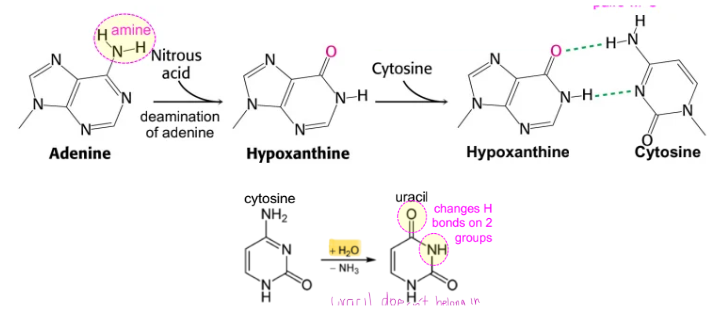
what method can repair deaminated bases
base excision repair
alkylating agents
alkyalting agents add a methyl/ethyl group, usually to purines
alkylating agents: S-adenosylmethionine, dimethylsuflate, dimethylnitrosamine
normal cellular metabolism can produce reactive oxygen speices (superxoide ion O2-, hydroxide radical, OH) which can also cause DNA alkylation
O6-alkylguanine is highly mutagenic bc it base pairs with T instead of C (GC→AT mutation after replication)
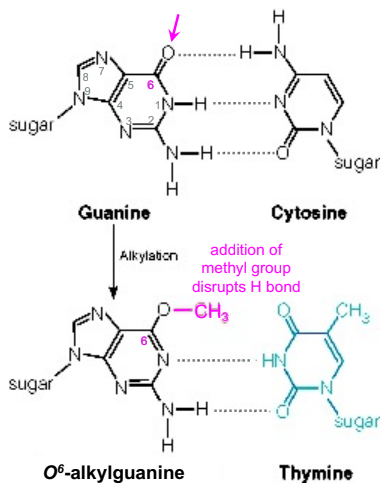
what method can repair deaminated bases and how
direct repair
Usually repaired before mutation occurs
by DNA repair enzyme O6-alkylguanine alkyltransferase, which transfers the methyl group to a cysteine in its own active site
whats the chemical mutagen that causes insertion/deletions
intercalation agents
intercalation agents
ethiduim bromide (EthBr)
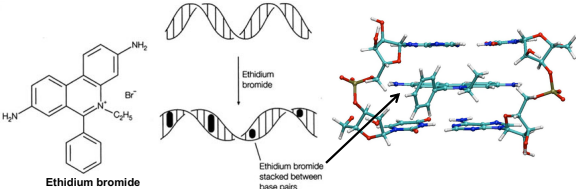
intercalating agent used to visualize DNA on agarose gels
intercalates between bases, becoming intensely fluorescent when exposed to UV light
Flat aromatic molecules such as acridines can intercalate between adjacent base pairs in the DNA double helix. Their presence can lead to the insertion or deletion of one or more base pairs.
how does ultraviolet and ionizing radiation damage DNA
ionizing radiation: UV light, x rays, gamma rays, cosmic rays
cause ring opening and breaks in sugar phosphate backbone of DNA (strand breaks)
UV light induces the condensation of 2 ethylene groups (C6=C5) in adjacent thymines on the same DNA strand to form a cyclobutane ring
adjacent thymins dimerize to form a cyclobutane thymine dimer which block replication and transcription because it causes helix distortion (kink) blocking polymerization machinery
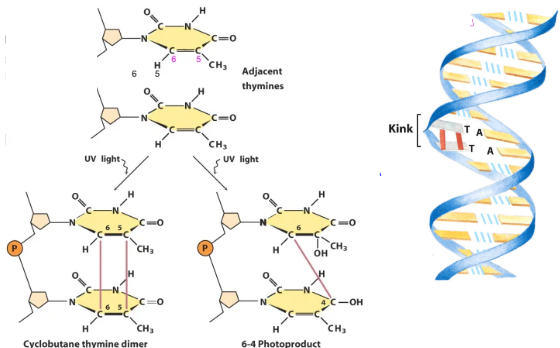
how can UV induced thymine dimers be repaired in bacteria and plants
in bacteria, this “lesion” can be corrected by a photo- reactivating enzyme photolyase that binds specifically to thymine dimers and uses visible light to hydrolyse the bonds linking the pyrimidine rings
the ability of an organism to survive UV irradiation directly correlates with its ability to remove thymine dimers from its DNA
photo-reactivation is a method of direct repair
how can UV induced thymine dimers be repaired in humans
humans do not have photolyases
thymine dimers are repaired by nucleotide excision and somtimes base excision repair
what can happen when thymine dimers are unrepaired
lead to melanomas (skin cancer)
ABC
A - asymmetry
B - border
C - colour
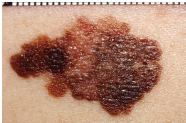
consequence of defects in nucleotide excision repair enzymes
people affected by a rare skin disease Xeroderma pigmentosum (XP) have mutations in a number of human nucleotide- excision repair genes (responsible for correcting thymine dimers)
people with XP are extremely sensitive to sunlight or ultraviolet light - die from melanoma and other skin malignancies (cancers)
changes in the skin become evident in infancy and worsen with time - skin becomes dry, and there is a marked atrophy of the dermis
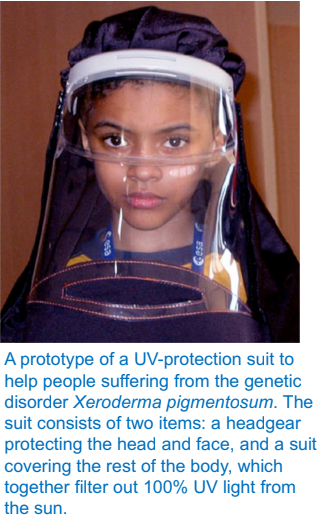
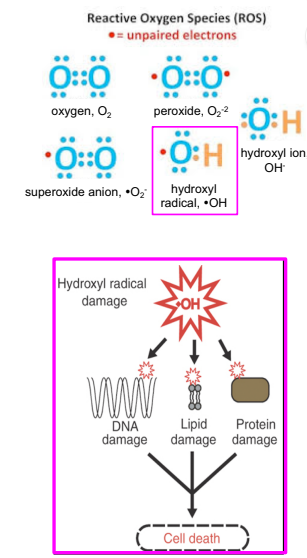
explain oxidation damage to DNA by reactive oxygen species
most prevalent soure of DNA damage
reactive oxygen speices: hydrogen peroxide, hydroxyl radicals, & superoxide radicals
arise during irradiation(exposing an object, food, or person to energy waves or particles), or as a byproduct of aerobic metabolism
can cause oxidization of deoxyribose and bases and strand breaks
how is damage from reactive oxygen species repaired
DNA glycosylases using base excision repair
The human genome sustains tens of thousands of “oxidative hits” per day, most of which are repaired by ^
cells have elaborate defense mechanism to convert reactive oxygen species to harmless products to prevent damage
also DNA repair mechanisms to repair damage
5 mechanisms of DNA repair and brief description
1. Direct repair - damaged bases are not removed but repaired “on-site;” e.g., O6-alkylguanine alkyltransferase, E. coli photolyase for thymine dimers
2. Base excision repair - offending base is removed and replaced; e.g., bases modified spontaneously or by chemical mutagens
3. Nucleotide excision repair - offending nucleotides are removed and replaced; e.g., thymine dimers in eukaryotes
4. Mismatch repair – when the wrong nucleotide is added during DNA replication – system must discriminate between the template (correct) and the newly synthesized strand (incorrect); many enzymes involved
5. Homologous recombination (repair of double strand breaks, stalled replication,etc.)
direct repair
fixes damaged genetic code without cutting the DNA backbone or needing a template
examples:
Photoreactivation: Uses photolyase enzymes activated by visible light to break abnormal bonds in UV-induced pyrimidine dimers,
Alkylation Reversal: Uses O6-methylguanine methyltransferase to remove unwanted methyl or alkyl groups from guanine bases.
base excision repair
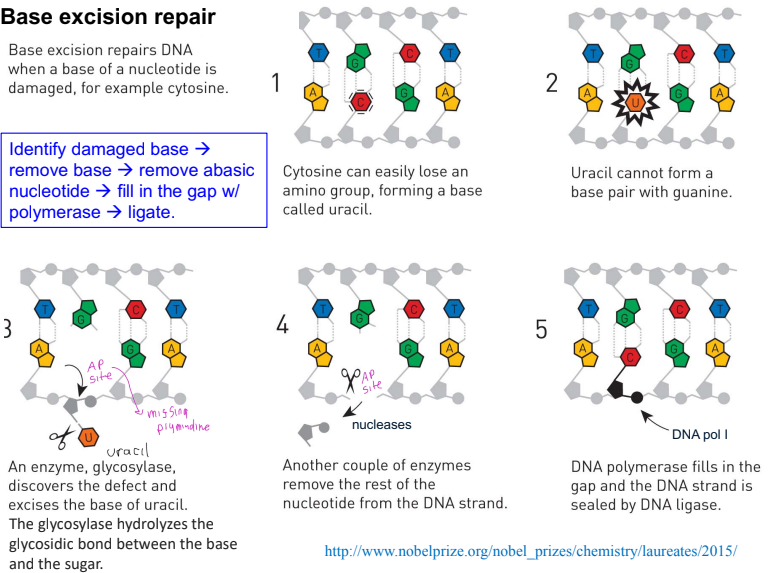
DNA glycosylase — role in base excision repair
→ Scans DNA and recognizes a specific type of damaged or incorrect base (e.g., uracil from cytosine deamination, or an oxidized base).
Cleaves the glycosidic bond between the damaged base and the deoxyribose sugar, removing just the base
Leaves behind an AP site (apurinic/apyrimidinic — a sugar with no base attached)
This AP site is then recognized by downstream enzymes (AP endonuclease, polymerase, ligase) to complete the repair
Different glycosylases exist for different types of damaged bases (specificity matters)
nucleotide excision repair
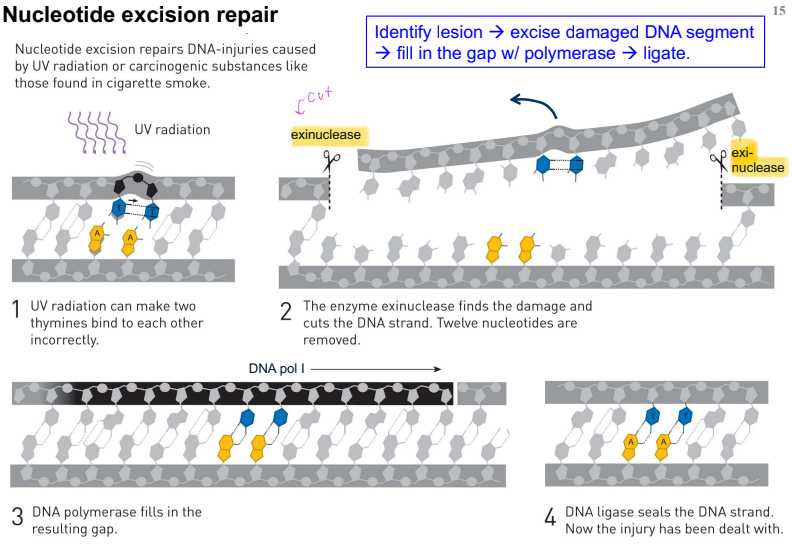
Enzymes that complete excision repair
Both base excision repair (BER) and nucleotide excision repair (NER) rely on the same general enzyme toolkit after the damage is recognized:
Nucleases — cut out the damaged region (in BER: an AP endonuclease cuts near the AP site left by glycosylase; in NER: nucleases cut on both sides of the damaged nucleotides, removing a short stretch)
DNA polymerase — fills the resulting gap by synthesizing new DNA using the intact complementary strand as a template
DNA ligase — seals the final nick, forming the last phosphodiester bond to restore an intact strand
Same "cut → fill → seal" logic as nick translation in replication, just triggered by damage instead of Okazaki fragment junctions
mismatch repair
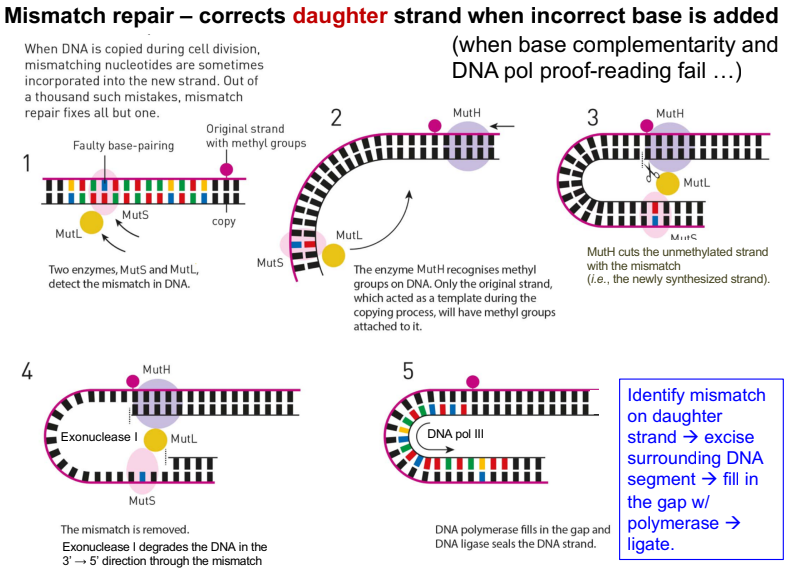
Mismatch repair — how the system knows which strand is wrong
After replication, the mismatch repair system must correct only the newly synthesized (daughter) strand, not the original template — but both strands now have "normal" bases, just paired incorrectly, so how does it know which one to fix?
The system uses transient strand markers to distinguish old vs. new DNA (e.g., in bacteria, the parental/template strand is methylated while the newly made daughter strand is not yet methylated)
This temporary asymmetry lets mismatch repair enzymes specifically target and excise the nucleotide on the unmethylated (new) strand, then resynthesize it correctly using the methylated (template) strand as the guide
Without this discrimination mechanism, the repair machinery could just as easily "fix" the correct base and lock in the mutation
homologous recombination
trimming the broken ends, using a matching homologous sequence (like a sister chromatid) as a template, and synthesizing new, exact DNA to bridge the gap