L8 Morality
 Studied by 0 people
 Call Kai
 Learn
Learn Practice Test
 Spaced Repetition
 Match
Match Flashcards
 Knowt Play
1/44

There's no tags or description
Looks like no tags are added yet.
Name | Mastery | Learn | Test | Matching | Spaced |
|---|
No study sessions yet.
45 Terms
What are social norms
a rule about how people should act in certain contexts
What theory proposes that are 2 general categories of social norms
Domain Theory
What 2 general categories of social norms does Domain Theory propose
moral norms and conventional norms
What are moral norms, what do they concern
the welfare of others
What 2 natural tendencies have moral norms evolved from
the natural tendencies to help one another and to avoid harm to one another
What are 3 rules within moral norms
one must help others, one should not hurt others and one should not steal
What are conventional norms
context-specific rules that do not directly concern the welfare of others
What are 3 properties of conventional norms
idiosyncratic, agent-neutral, context-specific
What is the classic view of moral development (older theories)
children are initially egocentric, selfish and amoral
What did Piaget, Kohlberg and Damon assume if children helped others
not to be helpful, for selfish purposes, to receive reward or avoid punishment
According to Domain Theory, when can children distinguish moral and conventional norms
by age 4
What are features of moral norms (opposite for conventional norms) in terms of changeability, seriousness, punishable, context and authority dependent
unchangeable, serious, punishable, context-independent, authority-independent
Two findings in children that contradict older theories of moral development
early prosociality and sophisticated understanding of social norms
What model was proposed in opposite to the traditional view
Two-step model
Who came up with the two-step model (think Dad and vanish)
Tomasello and Vaish
What does the two-step model suggest about moral development, and what are the steps
there are two key steps, second-person morality and norm-based morality
When does step 1 and step 2 emerge
before age 3 and after age 3
What defines step 1 second-person morality, 4 ways it is demonstrated
preference-based concern for others expressed in helping, sympathy, collaboration and sharing
What defines step 2 norm-based morality
generalised moral norms applying to anyone, enforcement of social norms
What 2 emotions are associated with norm-based morality
guilt and shame
What abilities characterise moral development between 0-12 months
empathy and social preferences
What abilities characterise moral development between 1-3 years
active prosociality; helping, sympathy, collaboration and sharing
How did Dondi et al demonstrate newborns’ self-awareness and ability to empathise, what response did they record
distress was greater for other babies’ cries than their own recorded crying
What did Hamlin, Wynn, & Bloom (2007) find about infants’ social preferences when watching a video of a ball being helped/hindered up a hill (what two ages and their preferences)?
6- and 10-month-olds prefer helpers over hinderers
What methodological approach is used to study infant morality and what is its drawback
indirect measures such as preferential looking; make large inferences/assumptions
How does methodology used in moral research change for ages 1-3
use of active behavioural paradigms in which they deal directly with moral behaviours
What is an example of active helping by 1-2 year olds in an experiment testing children’s ability to read and response to intentions/goals of individuals
if children want to help because they understand intentions, they crawl towards the experimenter to help them
What is the difference between intrinsic and extrinsic motivation for helping?
Intrinsic motivation involves helping because it feels right, whereas extrinsic motivation involves rewards or praise.
According to Hepach, Vaish and Tomasello, what does pupil dilation indicate in children
distress
How did Hepach et al demonstrate intrinsic motivation in children using pupil dilation
pupil dilation reduced, meaning distress reduced, when adults received helped, regardless of who helped
What is selective helping
children preferentially help individuals with positive or neutral intentions and avoid helping harmful agents
Evidence suggests that helping comes naturally, as opposed to ?
culturally
What does it mean that helping does not arise from culture
helping is not independent of social experience but it is not only learnt through teaching or imitation
What 3 patterns of helping suggest it comes naturally
early emergence, ineffectiveness of encouragement/reward and cross-culturally similar
How does collaboration contribute to moral development, development towards Step 2
fosters fairness, equality and shared expectations about deservingness
What did Hamann find about sharing after unequal distribution of marbles in collaboration vs parallel work condition?
equally shared marbles vs no sharing of marbles
3 ways to classify morality as fully-fledged
moral judgements, norm enforcement and generality of norms/impersonal
What 3 abilities do interview methods rely on
verbal ability, hypothetical thinking, counterfactual reasoning
Why is using interview methods to demonstrate moral judgement limiting
one may demonstrate moral knowledge but might not act on it
One experimental study involved teaching 2 and 3-year olds a novel game where children witnesses a puppet playing the game wrong, how did 3 year olds respond (not 2 year olds) to rule violations which demonstrated moral judgement (how?)
they intervened using normative language, words of obligation e.g. shouldn’t do that, not how it goes, demonstrating norm enforcement
How do 3 year olds treat rules versus 5 years old, showing differences in normative understanding
treat rules as obligations through norm enforcement
In what way does norm enforcement differ culturally
style of enforcement
What are 2 styles of norm enforcement
imperative protest vs normative protest
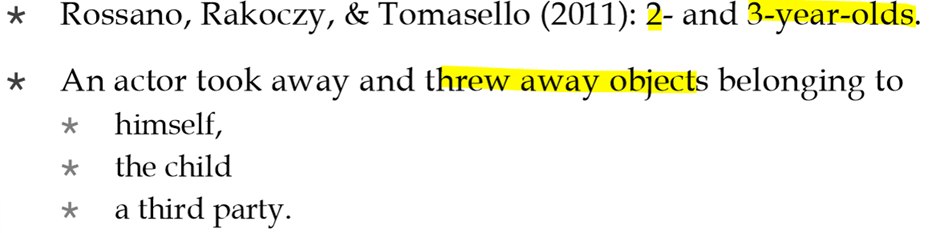
How did 2 and 3 year olds respond to these different conditions
both protested frequently when their own object was involved but only 3 year olds stood up for the third party
What 3 failures occur that mean children break social norms
failure of knowledge, of empathy/perspective taking, and inhibition