Chapter 3 intro pt2
 Call Kai
 Learn
Learn Practice Test
 Spaced Repetition
 Match
Match Flashcards
 Knowt Play
1/40

There's no tags or description
Looks like no tags are added yet.
Name | Mastery | Learn | Test | Matching | Spaced | Call with Kai | Chat |
|---|
No analytics yet
Send a link to your students to track their progress
41 Terms
How should patient exams be scheduled to reduce injury?
Avoid scheduling the same type of exam back-to-back.
Have sonographers perform a variety of examinations, allowing different muscles to fire.
Why should sonographers perform different types of examinations?
It allows different muscles to work, reducing strain on the same muscles.
How can gloves and mini-breaks help prevent injury?
Examination gloves should have textured fingers to prevent the need to grip the transducer too tightly and mini-breaks relax shoulder and neck muscles.
What are the guidelines for bedside examinations?
Ensure that the ultrasound system can be moved easily and has a small footprint.
Try to share bedside examinations with other staff
Bedside examinations should be reserved for those patients whose condition prohibits transporting them.
How can scanning rooms reduce the risk of injury?
Use ergonomic rooms, adjustable equipment, and separate monitors for the patient and sonographer.
What movements should sonographers minimize?
Sustained bending, twisting, reaching, lifting, and transducer pressure.
What should sonographers do with posture and scanning techniques?
Avoid awkward postures and vary scanning techniques and transducer grips.
How can sonographers reduce muscle strain during exams?
Alternate sitting and standing, adjust equipment, support arms, and take mini breaks.
How can sonographers reduce reaching and arm abduction?
Move the patient closer, adjust the table/chair height, and use arm support.
What is the 20-20-20 rule?
Every 20 minutes, look at something 20 feet away for about 20 seconds.
What should sonographers do to relax and prevent muscle strain
Relax muscles periodically and stretch the hands, wrists, shoulders, and spine.
Why should meal breaks be separate from work tasks?
To give the body a true break and allow muscles to rest.
Why should sonographers vary procedures, tasks, and skills?
To avoid repeatedly stressing the same muscles and body parts.
What body mechanics should sonographers use?
Use proper body mechanics when moving patients, wheelchairs, beds, stretchers, and ultrasound equipment.
What should sonographers do about persistent pain?
Report and document it to the employer and seek medical advice.
What should sonographers do to handle demanding work tasks?
Maintain a good level of physical fitness.
What should employers do to help prevent sonographer injuries?
Provide staffing solutions that allow enough time away from work.
Why are occupational injuries expensive for employers?
Employers pay for medical costs, replacement staff, workers’ compensation, and lost revenue.
How does losing experienced sonographers affect an employer?
It reduces productivity and makes it harder to maintain a skilled, stable workforce.
What are some costs of occupational injury to the worker?
Monetary hardship, permanent injury, chronic pain, and possible loss of their profession.
What are MSDs known for in occupational problems?
They are the most costly occupational problems and account for the majority of workers’ compensation costs.
How much of workers’ compensation costs are spent on occupational MSDs?
About $1 out of every $3.
What are indirect costs of occupational injuries?
Absenteeism, staff replacement and retraining, and loss of productivity or quality.
Mean cost
Mean cost per cause of upper extremity WRMSD is $8070 versus a mean cost of $4075 per case for all types of work-related injury.
How much higher can indirect costs be compared with direct costs?
About 3 to 5 times higher, reaching approximately $150 billion per year.
How much does it cost to find and hire a new sonographer?
About $10,000 on average.
Why is it worth investing in ergonomic equipment for a sonography room?
The cost of equipping the room is much less than the cost of a workers’ compensation injury.
How can a sonographer being in pain affect the patient?
The quality of the patient’s examination may suffer.
When should work-related injuries be reported?
Immediately to occupational health or the risk management department. and injuries should be recorded on OSHA logs.
What can happen if a work-related injury is not reported or recorded?
The worker’s compensation claim may be denied.
Asymmetric Forces on the Spine
Asymmetric forces are exerted on the spine when more weight is placed on one side of the body than the other. The head must be turned to view the monitor, resulting in a twisted neck.
Proper Sitting Position.
Sonographer sits up straight with the top of the monitor level with the eyes and an arm’s length away. The feet are supported on the ring of the chair, and the forearm is supported on a cushion.

Bad Ergonomics During Cardiac Scanning.
Bad ergonomics. Right-handed cardiac scanning results in the abduction of the arm over the patient’s back, hyperflexion of the right wrist, asymmetric posture, and twisting of the neck.

What is good ergonomics during cardiac scanning?
Turning the patient around to perform the study is one way to reduce risk factors.
Bad ergonomic practice in left-handed cardiac scanning.
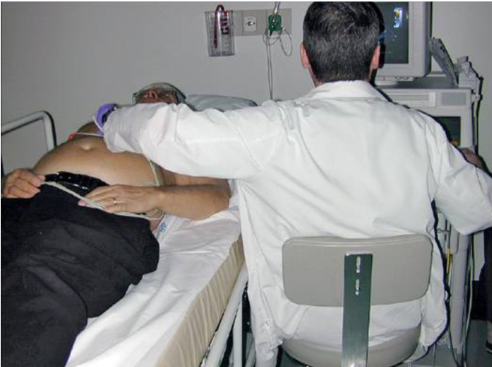

Good ergonomics in left-handed cardiac scanning.
The height of the chair is adjusted up and the table down to reduce the angle of abduction to 30 degrees or less. The patient is then brought close to edge of the table.
Poor ergonomics
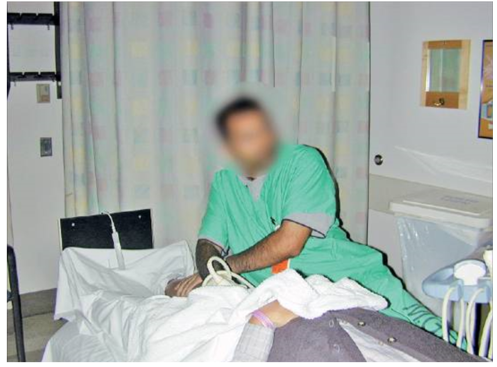
Good ergonomics
When scanning the patient’s left leg, the patient is turned so that the patient’s left leg is closest to the sonographer.

The most ergonomic way to perform a scan for the evaluation of DVT is shown if the patient is mobile.


For transvaginal scanning,
twisting of the forearm can be reduced or avoided by scanning from the foot of the table with the patient in stirrups.
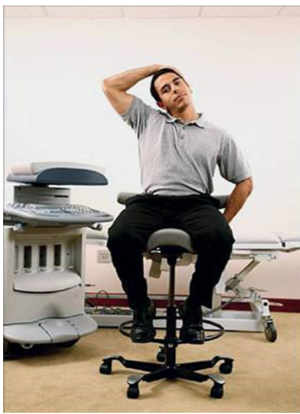
Stretches/exercises
Simple stretches and exercises that are performed throughout the day for a few minutes make a significant differenc
