AP BIO Unit 1 Macromolecules
 Call Kai
 Learn
Learn Practice Test
 Spaced Repetition
 Match
Match Flashcards
 Knowt Play
1/42

There's no tags or description
Looks like no tags are added yet.
Name | Mastery | Learn | Test | Matching | Spaced | Call with Kai | Chat |
|---|
No analytics yet
Send a link to your students to track their progress
43 Terms
Elements that form Hydrogen Bonds
Hydrogen → Fluorine, Oxygen, or Nitrogen
Organic Molecule
Polymer
A long molecule consisting of many similar or identical monomers linked together by covalent bonds.
Monomer
subunit that serves as the building block of a polymer.
What reaction connects monomers? +Explain
Condensation Reaction/Dehydration Reaction
Monomer becomes attracted to another monomer
Monomer releases water to form covalent bond with monomer
What reaction breaks down polymers into monomers?
Hydrolysis
(water + break)
Carbohydrate Structure
Elements: Carbon, Hydrogen, Oxygen
Bond: Glycosidic Linkage (can be broken by animals)
Ratio: 1:2:1
Disaccharide: Remove H2O
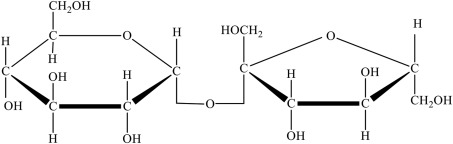
Carbohydrate Functions
Storage of Energy
Starch: Plants store extra glucose (in amylose or amylopectin)
Glycogen: Animals release when energy demand increases
Structure
Cellulose: Cell walls
Chitin: Arthropod and fungi
Carbohydrate Monomer
Monosaccharides
Glycosidic Linkages: Bond monosaccharides
Lipid Structure
Elements: Carbon, Hydrogen, Oxygen
Hydrocarbons → Hydrophobic
Types of Lipids
Waxes
Steroids
Fats
Phospholipids
Monomers of Lipids
Glycerol +
Fatty Acids: Central Carbon + Carboxyl + Chain of carbon atoms
Saturated Fats
Fatty acids without double bonds and thus are saturated in hydrogen atoms
Solid at room temp.
Straight chains
ex. butter, lard (animals)
Unsaturated Fats
Fatty acids with one or more double bonds and thus unsaturated in hydrogen atoms
Liquid at room temp.
Bent chains—prevent molecules from packing together to form a solid
ex. olive oil (plants)
Triglycerides/Fat Molecules
Lipids—Long-term energy storage
Glycerol + 3 Fatty Acids
Waxes
Lipids—water proofing, adhesives, candles
Alcohol molecule + 2 fatty acids
Phospholipid
Bilayer: Forms boundary b/w cell and external environment → separates components in eukaryotic cells
Amphiphilic/Amphipathic: Hydrophilic head (phosphate + glycerol) + Hydrophobic fatty acid tails (one saturated, one unsaturated)
Steroids
Lipids—Have multiple carbon rings
Hormones: Estrogen, testosterone, cholesterol
Protein Structure
Alpha/Central Carbon
Amino Group (NH2)
Carboxyl (O=C-OH)
R-Group: Determine function/structure

Protein Monomers
Amino Acids
Peptide Bond
Covalent bond between the carboxyl group of one amino acid to the amino group of another
Formed by dehydration

How to determine if protein is basic or acidic?
Basic: Positive charge
Acidic: Negative charge
How to determine if protein is polar or nonpolar?
Look at the end of R-Group (ignore amino and carboxyl groups)
Nonpolar: Methyl or other hydrocarbon
Polar: Anything with a charge
Primary Structure of Protein
The sequence of amino acids thru covalent bonds
determined by inherited genetic information
→ determines secondary and tertiary structure.
Secondary
The coils and folds of the peptide chains that contribute to the protein’s overall shape
regions stabilized by hydrogen bonds between atoms of the polypeptide backbone (partial negative oxygen atoms and partial positive hydrogen atoms attached to nitrogens)
Alpha Helix
Secondary structure
Hydrogen bonding every fourth amino acid

Beta Pleated Sheet
Secondary Structure
Two or more segments of the chain lying side by side (beta strands) connected by hydrogen bonds between parts of two parallel segments
Tertiary Structure
Three dimensional shape stabilized by interactions between side chains (R groups)
hydrogen bonds
covalent bonds
Hydrophobic Interaction
Tertiary structure— Usually occurs when nonpolar side chains cluster in the core of the protein away from water, creating van der waals interactions, and polar side chains create hydrogen bonds.
Disulfide Bridges
Tertiary structure— Reinforce shape by joining two sulfur atoms of cysteine monomers due to folding
Quaternary Structure
Association of two or more polypeptides (some proteins only)
hydrogen bonds
covalent bonds
Denaturation
Process in which a protein loses its native shape due to the disruption of weak chemical bonds and interactions, thereby becoming biologically inactive
Changes in–pH
Salinity
Temperature (excessive heat)
Transferred from aqueous environment to nonpolar solvent
Nucleic Acid Struture
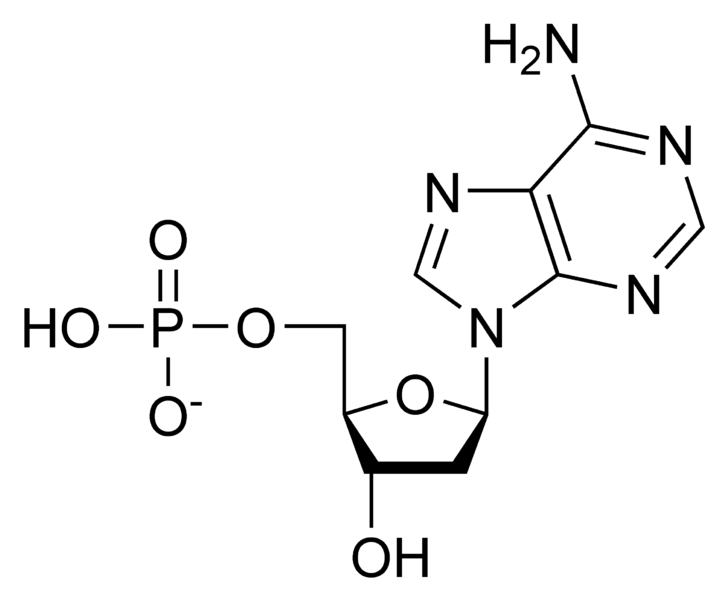
Monomer: Nucleotides
Nitrogenous Base
Pentose
1-3 Phosphate groups
Pyrimidines
Single-ring nitrogenous bases
Uracil
Thymine
Cytosine
Purines
Double-ring nitrogenous bases
Guanine
Adenine
DNA vs. RNA
Deoxyribose sugar vs. Ribose Sugar
Double vs. Single-stranded
Antiparallel vs. Varied
Which bases are found in DNA?
Cytosine, Guanine, Adenine, Thymine
Which four are found in RNA?
Cytosine, Guanine, Adenine, Uracil
ATP vs. ADP vs. AMP
More phosphates = More energy
ATP: 3 Phosphates
ADP: 2 Phosphates
AMP: 1 Phosphate
DNA Function
Provides directions for its own replication
directs RNA synthesis and (through RNA)
controls protein synthesis through gene expression
RNA Function
transcribes/translates DNA in protein synthesis, gene regulation, and is the genome of some viruses.
messenger RNA (mRNA) molecule interacts with the cell’s protein-synthesizing machinery to direct production of a polypeptide
transfer RNA (tRNA) brings amino acids to the ribosome during the synthesis of a polypeptide
What type of bond holds the nitrogenous bases together in the double helix of DNA?
Hydrogen bonds
Phosphodiester Linkages
a phosphate group that covalently links the sugars of two nucleotides
One end has a phosphate attached to a 5′ carbon, and the other end has a hydroxyl group on a 3′ carbon;
