Mood disorders and antidepressants 1
 Studied by 0 people
 Call Kai
 Learn
Learn Practice Test
 Spaced Repetition
 Match
Match Flashcards
 Knowt Play
1/43

There's no tags or description
Looks like no tags are added yet.
Name | Mastery | Learn | Test | Matching | Spaced | Call with Kai |
|---|
No study sessions yet.
44 Terms
Define mood
A conscious state of mind or predominant emotion
Define mood disorders
Abnormal elevations or lowering of mood
Give examples of mood disorders
Depression and bipolar disorder
What is the prevalence of mood disorders?
In 2010, 4 million people had mood disorders
How are mood disorders classified?
Mood disorders can be split into
- Bipolar disorders and unipolar disorders
There are 2 types pf unipolar disorders:
- major depression
- dysthymic disorder
There are 3 types of bipolar disorders:
- bipolar I
- bipolar II
- cyclothymia
What is the DSM-5?
Diagnostic and Statistical Manual of Mental Disorders, 5th edition
- it is used to diagnosis and assess symptoms of mood disorders
What are unipolar mood disorders?
Mood disorders with one pole - emotions move in one direction.
Here there is a lowering of mood.
e.g. major depressive disorder (MDD)
What are bipolar mood disorders?
Mood disorders with two poles - emotions move in two directions.
Here emotions swing from mania or depression
How does depression differ to sadness
1. Severity
- depression is a stronger emotion
2. Functional impairment - depression causes this
3. How long it lasts
- sadness is more short term
What is dysthymia?
This is a mild form of depression which persists.
Describe the prevalence of depression
- 1 in 38 adults in the UK have unipolar depression
- Globally > 300 million have depression (WHO estimates)
Who is depression most common in?
Women
Women are twice more likely to be depressed than men.
What can cause symptom variance in depression?
1. Age
- may present differently in an elderly patient compared to a child
2. Culture
- may not talk about emotion but more of the somatic symptoms of depression
Outline characteristic symptoms for unipolar mood disorders
These symptoms can be psychological and somatic.
Somatic:
- Aches and pains
- Low energy
- Changes in appetite
- Changes in sleep
- Psychomotor changes
Psychological
- Social withdrawal
- Inability to concentrate
- Irritability
- Anxiety
- Loss of enjoyment
- Feeling of guilt/ worthlessness
- Tearfulness
- Cognitive impairment
- Obsessive rumination
- Cognitive impairment
Outline diagnostic criteria for unipolar mood disorders
Diagnosing major depression
Must have the following symptoms in the same 2 week period.
- Depressed mood most of the day OR anhedonia in daily activities
PLUS any of the 4 following symptoms:
- Significant weight loss/gain (>5% in a month) OR change in appetite
- Insomnia/ hypersomnia
- Slowing down of thought and reduction of physical movement
- Fatigue or loss of energy nearly every day
- Feelings of worthlessness or excessive or inappropriate guilt
- Diminished concentration, or indecisiveness, nearly every day
- Recurrent thoughts of death or suicide
What is anhedonia?
An inability to experience pleasure
How and why do we assess the severity of depression?
We assess the severity by looking at the number of symptoms and the level of functional impairment.
Can have sub-threshold, mild, moderate or severe depression
This is important as it relates to the type of intervention which is appropriate for the patient.
Why do we use assessment scales in depression?
We use these scales in order to
- Assess symptom severity
- Evaluate response to treatment
- Promote self-management strategies
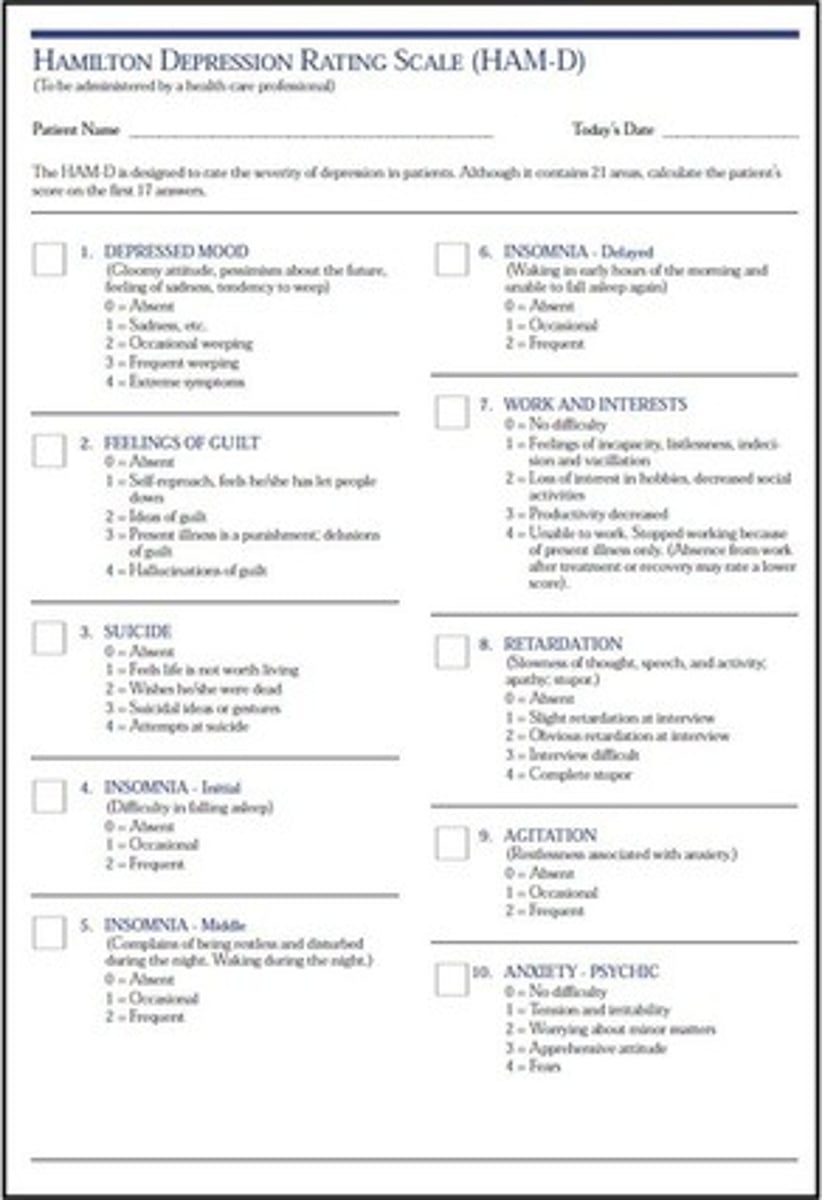
What assessment scales can we use to assess the severity of depression?
Clinical assessment scales - ones done by HCPs
1. Hamilton Depression Rating Scale (HAM-D or HDRS)
2. Montgomery-Asberg Depression Rating Scale (MADRS)
The Beck Depression Inventory (BDI) is a self-rating scale.
These are not routine scales
Define episodic major depressive disorder (MDD)
When symptoms tend to dissipate over time
Define recurrent major depressive disorder (MDD)
When depression occurs, future episodes are more likely
The average number of episodes is 4.
Define subclinical depression
When patients experience sadness plus 3 other symptoms for 10 days
There is still significant impairments in functioning even though full diagnostic criteria of depression are not met
Define persistent depressive disorder (dysthymia)
A depressed mood for at least 2 years (but not as severe as MDD) with 2 other symptoms:
- Poor appetite or overeating
- Sleeping too much or too little
- Psychomotor agitation or retardation
- Loss of energy
- Feelings of worthlessness
- Difficulty concentrating or indecisiveness
- Recurrent thoughts of death or suicide
What is the relationship between major depressive disorder (MDD) and persistent depressive disorder (dysthymia)?
Patients with dysthymia often go on to develop major depressive disorder (MDD).
What is mania?
States of intense elation or irritability
What is mixed episode?
Symptoms of both mania and depression in the same week
What is hypomania?
A mild form of mania, which involves 4 days or more of elevated mood. This does not interfere with functioning.
Outline diagnostic criteria for manic and hypomanic episodes
Elevated, expansive, or irritable mood AND 3 of the following:
-Psychomotor agitation or increase in goal-directed behaviour
-Excessive talking or pressured speech
-Racing thoughts and many ideas
-Reduced need for sleep
-Grandiosity or inflated self esteem
-Easily distractible
-Excessive involvement in pleasurable activities with negative consequences e.g. shopping sprees
How long do manic episodes last?
Symptoms last a week or more
If symptoms last more than a week, may result in hospitalisation
How long do hypomanic episodes last?
Symptoms last at least 4 days
There are clear changes in function but impairment is not marked
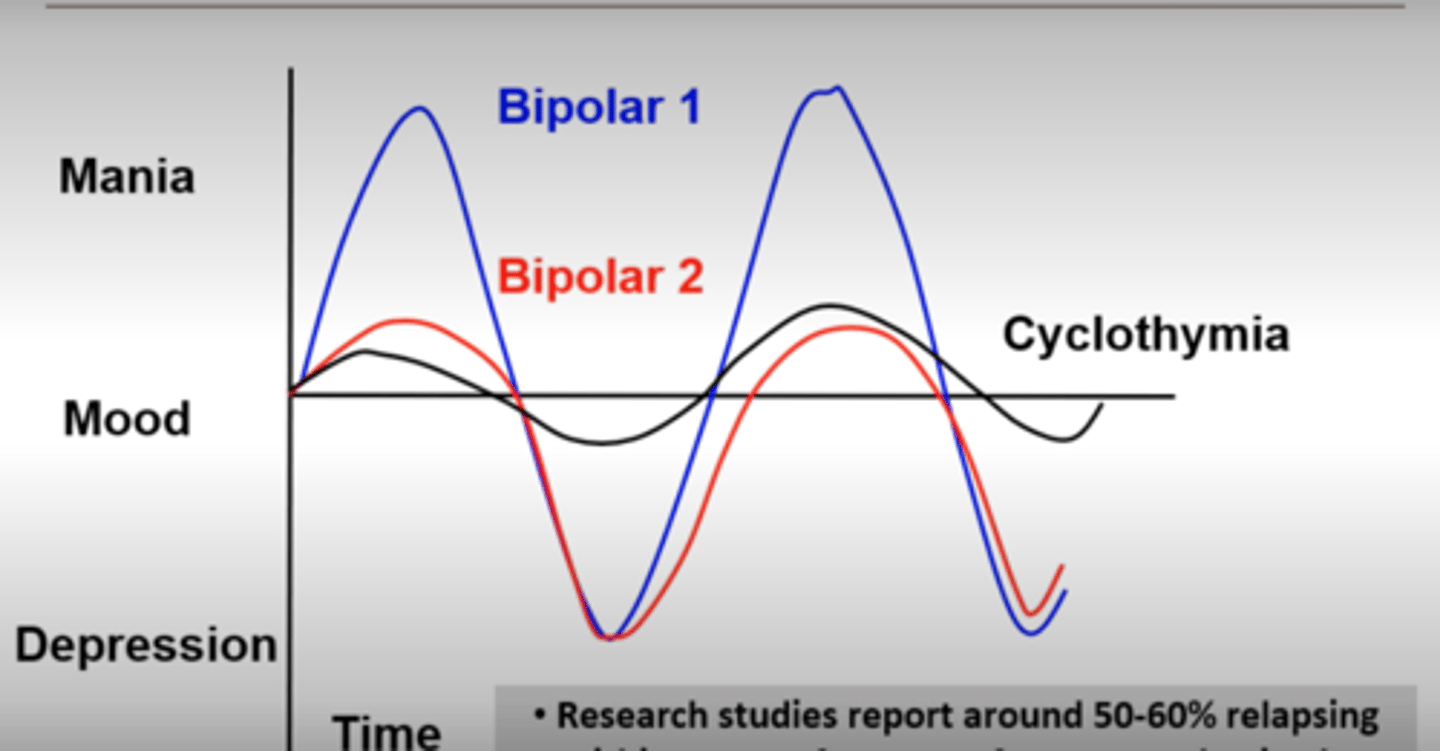
What is bipolar 1?
1 or more manic episode or mania or mixed episode
What is bipolar 2?
At least one major depressive episode with at least one episode of hypomania
What is cyclothymia?
This is a mild form of bipolar disorder where emotions range from mild depression to elation/ hypomania.
It lasts at least 2 years
What is bipolar cycling?
When a depressive episode ends and a manic episode follows after in the period of months and years.
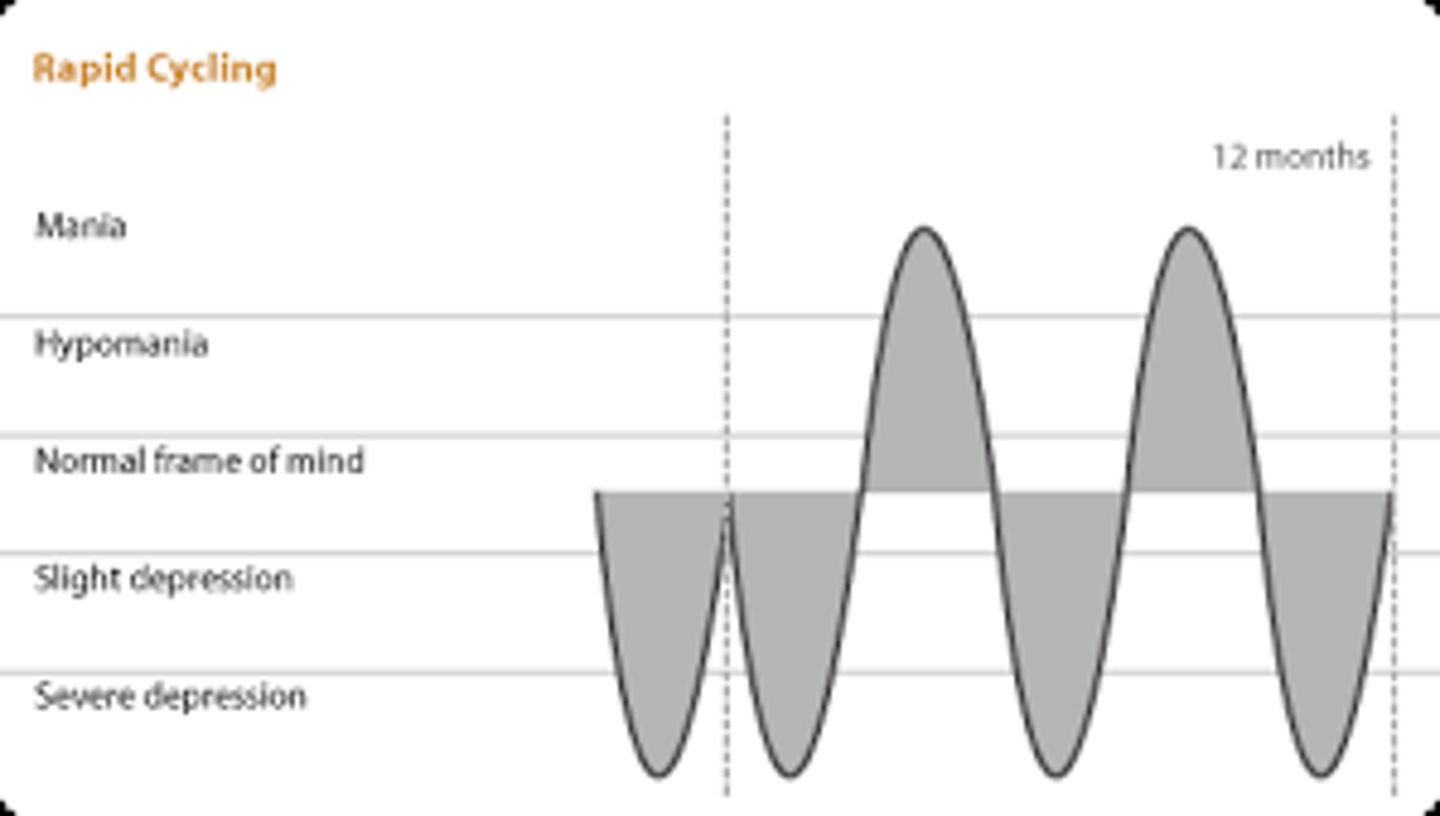
What is rapid cycling?
When the switch from a depressive episode to a manic episode in bipolar patients occurs within weeks-months.
-At least 4 episodes within past year
What is ultrarapid cycling?
When the change from a depressive episode to a manic episode in bipolar patients occurs within days-weeks
What is ultradian cycling?
When the switch from a depressive episode to a manic episode in bipolar patients occurs within hours-days
Describe the prevalence of bipolar disorder
1 in 100 people have bipolar disorder
- there is no difference in prevalence between men and women.
- age of onset is in 20s
What is seasonal affective disorder (SAD)?
When low exposure to daylight results in depression.
These are recurrent depressive episodes in a seasonal pattern.
What is post partum depression?
When within 4 weeks of giving birth, mothers experience depression. This is likely due to changes in hormones.
What is depression with catatonic features?
When depression causes extreme physical immobility or excessive peculiar physical.
What is depression with psychotic features?
Depression with delusions or hallucinations
What is depression with melancholic features?
Depression with anhedonia - an inability to experience pleasure
Give examples of medical conditions associated with mood disorders
- Pulmonary disease (COPD, asthma)
- Endocrine disorders (Hypo/hyperthyroidism, diabetes)
- Cancer
- Cardiovascular disease, especially MI
- CNS (migraine, infection, tumour, stroke, head injury, hypoxia)
- Neurological disorders (Alzheimer's, Epilepsy, Parkinson's, Huntington's, Multiple Sclerosis)
- B12, folate deficiency
- Chronic pain, back problems
- Sleep apnoea