A&P: Ch 3: cellular form and function
 Call Kai
 Learn
Learn Practice Test
 Spaced Repetition
 Match
Match Flashcards
 Knowt Play
1/39

There's no tags or description
Looks like no tags are added yet.
Name | Mastery | Learn | Test | Matching | Spaced | Call with Kai | Chat |
|---|
No analytics yet
Send a link to your students to track their progress
40 Terms
Robert Hooke
english scientist who created the word “cell” during the 17th century
cell theory
All living organisms are composed of one or more cells:
The cell is the basic unit of life
All cells arise from pre-existing cells
cell shapes

Limit on cell size
an overly large cell cannot support itself,
may rupture
• For a given increase in diameter, volume increases more than surface
area
• Volume proportional to cube of diameter
• Surface area proportional to square of diameter
cell membrane
act as a protective, selectively permeable barrier that separates the inside of the cell from the outside environment while controlling what enters and exits
Composition: selectively permeable, transport, cell communication and recognition, provides structural support
Microvilli
increases surface area for absorption
Cilia
coordinated movement creates a unidirectional current that propels substances across cell surfaces
Flagella
propels the cell
passive transport
lets small or balanced molecules slide naturally across the cell membrane (no ATP required)
active transport
forces molecules where the cell needs them, even if the area is already crowded (requires ATP)
Simple diffusion
Net movement of particles from an area of high concentration to low concentration
Diffusion through lipid bilayer
• Nonpolar, hydrophobic, lipid-soluble substances diffuse through lipid
layer
• Diffusion through channel proteins
• Water and charged, hydrophilic solutes diffuse through channel
proteins in membrane
• Cells control permeability by regulating number of channel
proteins or by opening and closing gates
Carrier mediated transport – specificity and saturation
Transport proteins in the plasma membrane that carry solutes from one side of the membrane to the other
facilitated diffusion
Facilitated diffusion is the passive movement of molecules or ions across a cell membrane through specific transmembrane proteins, moving from an area of high concentration to an area of low concentration without using cellular energy
Osmosis
the movement of water from high to low concentration
Osmotic pressure
amount of hydrostatic pressure required to stop osmosis
Endocytosis
brings external materials into the cell by wrapping the cell membrane around them to form a small pocket. That pocket pinches off into a membrane-bound package called a vesicle
Phagocytosis ("cell eating")
The cell engulfs large, solid particles or whole cells, such as immune cells destroying bacteria
Pinocytosis ("cell drinking")
The cell takes in surrounding extracellular fluid containing dissolved nutrients and small solutes.
Receptor-mediated endocytosis
Specific target molecules bind to dedicated receptor proteins on the cell surface before the membrane pinches inward.
Exocytosis
pushes internal materials out of the cell. A vesicle inside the cytoplasm moves toward the plasma membrane and fuses with it. The vesicle then opens up to release its contents into the fluid outside the cell. Cells use this process to export waste products, secrete hormones, and release neurotransmitters.
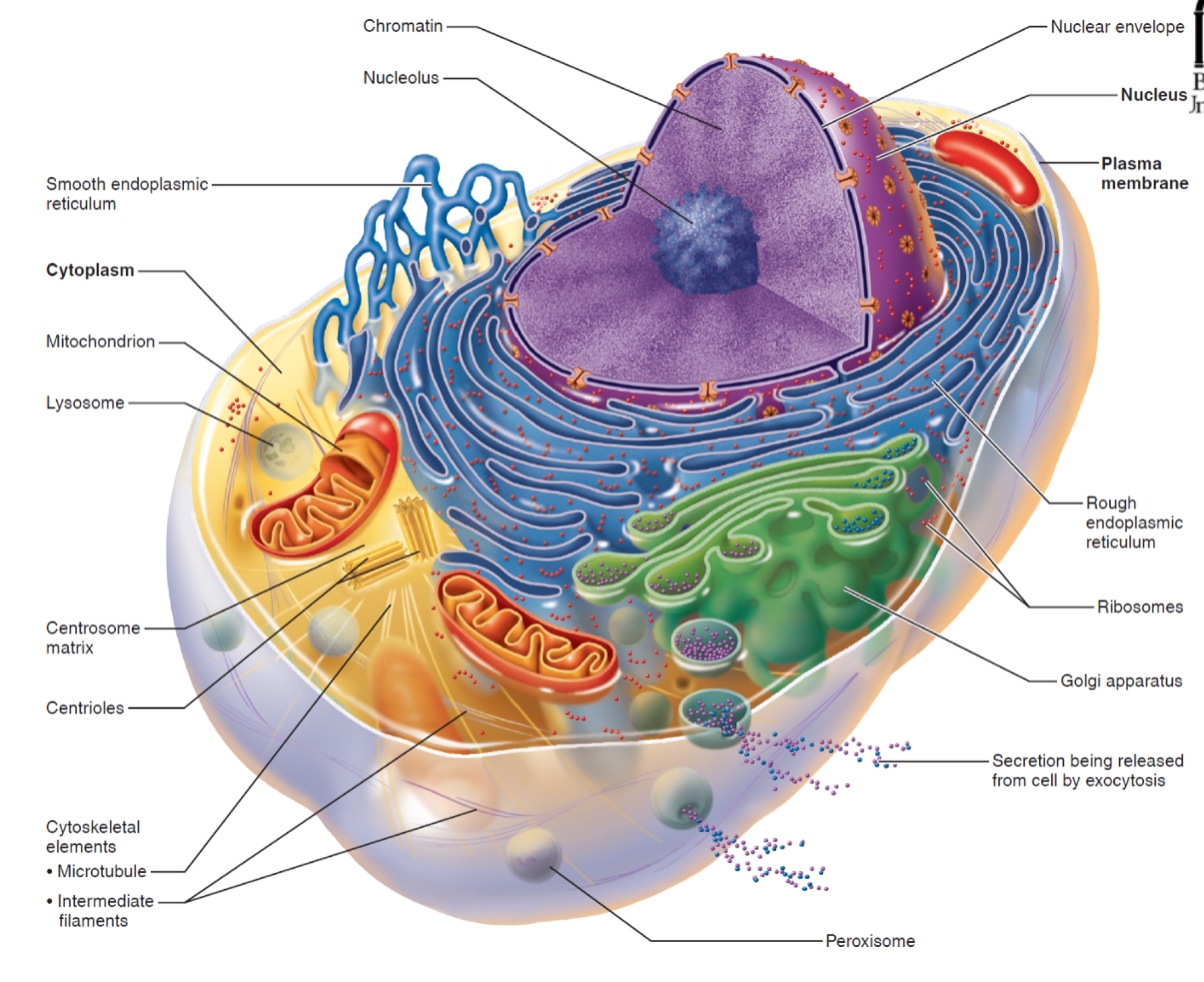
Nucleus
control center of the cell
Mitochondria
provides ATP to cell
Smooth er
synthesizes lipids, processes toxins, and stores calcium ions.
Rough er
synthesize, fold, modify, and transport proteins destined for the cell membrane, other organelles, or export outside the cell
Ribosomes
synthesize proteins by translating genetic instructions from messenger RNA (mRNA) into chains of amino acids
Golgi apparatus
packages, modifies, and sends proteins across cell or for secretion to send outside of the cell
Centrioles
organize microtubule network. During mitosis, form the spindle and asters, form the bases of cilia and flagella
Lysosomes
breaking down old cell parts, foreign invaders, and complex molecules
Peroxisomes
enzymes detoxify a number of toxic substances. The most important enzyme, catalase, breaks down hydrogen peroxide.
Microtubules
support the cell and give it shape. Involved in intra cellular and cellular movements
Endosymbiotic theory
key organelles inside complex eukaryotic cells—specifically mitochondria and chloroplasts—originated as independent prokaryotic bacteria that were engulfed by a larger host cell.
Supporting evidence:
Division: Mitochondria and chloroplasts reproduce independently through a splitting process very similar to bacterial binary fission.
DNA Structure: Both organelles contain their own circular DNA molecules, resembling bacterial chromosomes rather than the linear DNA found in eukaryotic nuclei.
Membranes: Their inner and outer membranes share biochemical similarities and specific transport proteins (like porins) with modern bacteria.
osmosis
the moment of water from high to low concentration
Histology
study of the skin
Radiology
a medical specialty that uses imaging technology to diagnose and treat diseases inside the human body
Auscultation
the medical practice of listening to the internal sounds of the body, usually using a stethoscope
Cytology
study of cells
Hypertonic
Higher solute level outside the cell.
Water moves out of the cell.
Cells shrink or shrivel
Hypotonic
Lower solute level outside the cell.
Water moves into the cell.
Cells swell and can burst
Isotonic
-equal concentration of solute (ex. water) and solvent (ex salt)
- cell keeps shape
characteristics of life
made of cells, use energy, grow, reproduce, respond to changes, keep internal balance, and adapt over time