Lecture 22: Attention
 Call Kai
 Learn
Learn Practice Test
 Spaced Repetition
 Match
Match Flashcards
 Knowt Play
1/10

There's no tags or description
Looks like no tags are added yet.
11 Terms
Attention Definition
Focalization and limitation of information processing resources - Schmidt and Wrisberg (2004)
3-stage model of Information Processing
Limited capacity system
Attention as a Single Resource
Can do multiple things as long as it doesn’t exceed resource capacity
Resource capacity → not fixed, can be expanded
Known/learned tasks take up less room
Ulric Neisser (Attention as a Single Resource)
New word shown every couple of seconds to participants; 15 words come with an adverse stimulus of an electroshock
At the end of semester, participants came back → 75 new words and the same 15 “shock” words, but no shock administer
Measured galvanic skin response
There was no conscious recognition of the shock words
Large galvanic response when the shock word was shown with no shock
Attention doesn’t have to be conscious → involuntarily captured
Early Theory of Attention as a Single Resource
Only one stimulus can enter the information processing system at a time → bottleneck after input
Cocktail party phenomenon → lots of people; talking in one conversation; you know there are other conversations happening but you are focused on the one you’re in
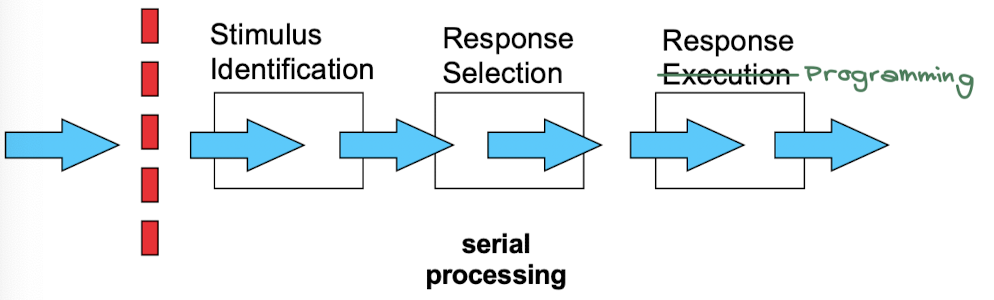
Later Theory of Attention as a Single Resource
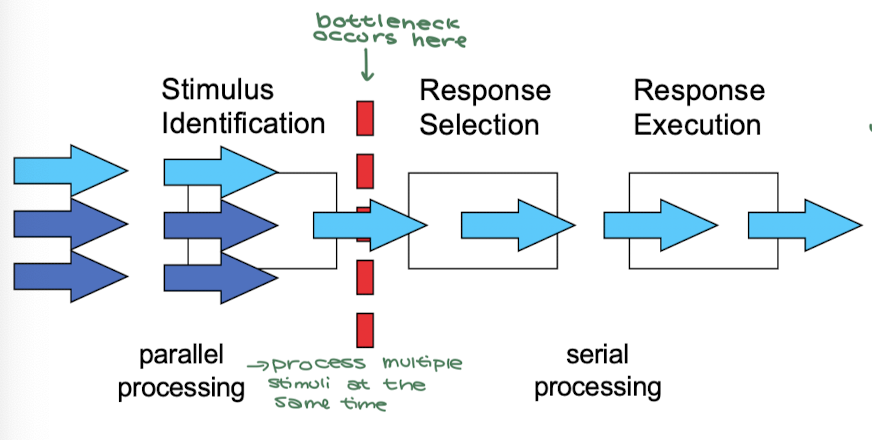
Bottleneck occurs after stimulus identification before response selection
Combination of parallel and serial processing
Parallel processing → process multiple stimuli at the same time
Serial processing → process one stimuli at a time
Consider the PRP
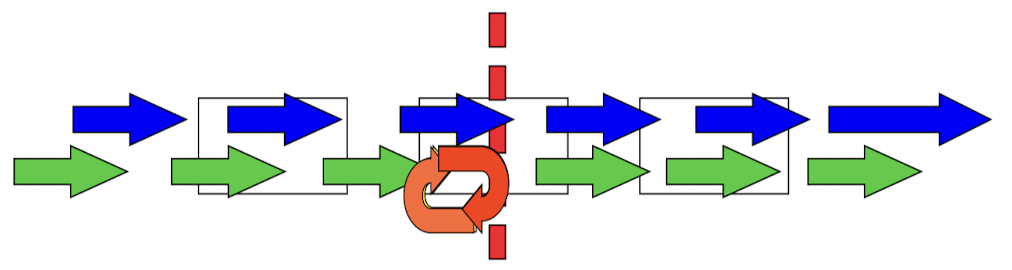
Psychological Refractory Period (PRP) (Attention as a Single Resource)
Stimulus 1 can get in but only after stimulus 1 is fully specified can stimulus 2 be processed → delay in second response
Attentional system best described by late model (bottle neck occurs between stimulus identification and response selection)
Delay in responding to the second of two stimuli presented in rapid succession
Interference in selection and organization of response
If inner stimulus interval between stimulus 1 and 2 is within 150ms → individual is in a state of psychological refractiveness (PR)
If it is beyond 150ms → no PR
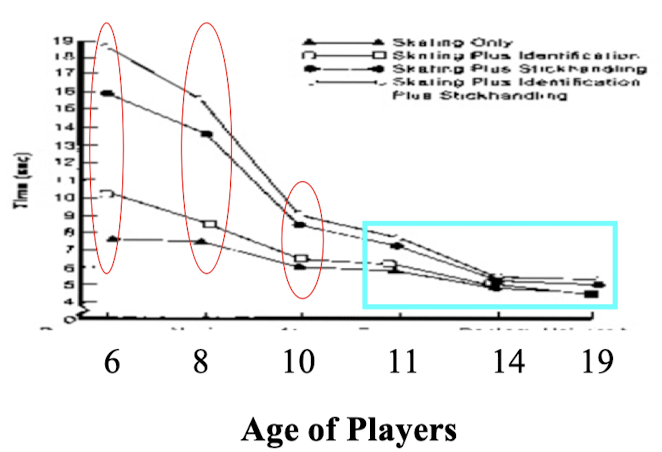
Putting Practice to the Test (Leavitt, 1979) (Attention and Automaticity)
6 age groups (6, 8, 10, 11, 14, 19) performing in an experimental condition → skating only; skating and geometric figures; skating and stickhandling; skating, stickhandling, and geometric figures
For 6 and 8 year olds → primary task of skating only deteriorated as a function of introducing a secondary task; skating is still attentionally demanding and need to devote significant amount of attention for skating
Attention and Coordination
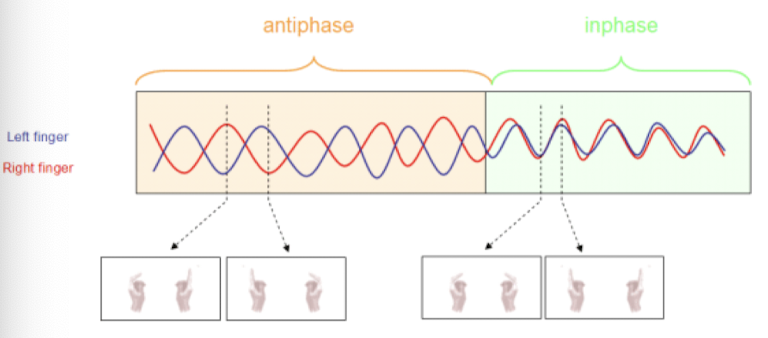
Inphase → performing a take where you have to flex and extend your fingers, right and left and the same time
Antiphase → flexing right hand while extending left hand; as you try to move as quick as your can, gradually fall back into inphase
Some people can maintain antiphase → musicians
Coordination and attentional demands associated with antiphase are so complex moving beyond 5 Hz → no longer can maintain antiphase pattern
Attentional system has a limited capacity in terms of temporal elements associated with coordination
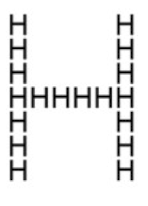
Global Local Paradigm
Globally letter H
Locally letter H
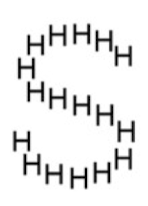
Problem with Global Local Paradigm
Globally letter S
Locally letter H
Where there is incongruency between global and local properties → problems
When asked to report local properties in an incongruent situation betwee local and global features → really long reaction time
Way to gauge attention systems in the neural correlates associated with our attentional system and the neural correlates associated with slip of attention
Neural Correlates of Attentional Slips
Congruent and incongruent global and local features
Slip of Attention → longer reaction time reporting local property of an incongruent stimulus
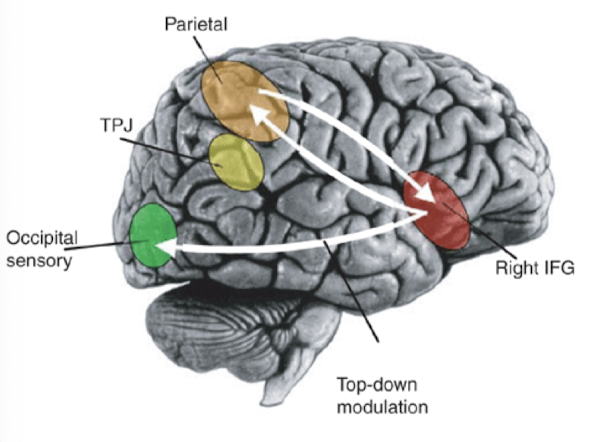
Cortical properties/systems active in a slip of attention → IFG, MFG, ACC (default attentional framework)
Inferior frontal gyrus (IFG) → stimulus-triggered orientation of attention
Middle frontal gyrus (MFG) → maintaining task goals in working memory
Anterior cingulate cortex (ACC) → conflict monitoring/resolution