Anatomy Test 4 (Axial Skeleton)
 Call Kai
 Learn
Learn Practice Test
 Spaced Repetition
 Match
Match Flashcards
 Knowt Play
1/267

There's no tags or description
Looks like no tags are added yet.
Name | Mastery | Learn | Test | Matching | Spaced | Call with Kai | Chat |
|---|
No analytics yet
Send a link to your students to track their progress
268 Terms
What is the vertebral column also known as?
The spine, backbone, and spinal column
What is the spinal column composed of? (Bone)
It is composed of a series of bones called vertebrae
How much of the body height does the spinal column make up?
It makes up about 2/5 of the total height of the body
What does the vertebral column consist of?
It consists of bone and connective tissue that surrounds and protects the nervous tissue of the spinal cord
On average, how long is the spinal cord?
Adult males- 71cm (28in)
Adult females- 61cm (24in)
What does the vertebral column function as?
A strong, flexible rod with elements that can move forward, backward, and sideways, and can rotate
What does the vertebral column enclose and protect?
It encloses and protects the spinal cord, supports the head, and serves as a point of attachment for the ribs, pelvic griddle, and muscles of the back and upper limbs
What is the total number of vertebrae in the body?
During early development there is 33, but as you age sections fuse together resulting in the average adults vertebral column consisting of 26 vertebrae
What are the different vertebrae and how many of each?
7 cervical vertebrae are found in the neck
12 thoracic vertebrae that are posterior to the thoracic cavity
5 lumbar vertebrae that support the lower back
1 sacrum consisting of 5 fused sacral vertebrae
1 coccyx consisting of 4 fused coccygeal vertebrae
Which vertebrae are moveable? Which are not?
The cervical, thoracic, and lumbar vertebrae are moveable while the sacrum and coccyx are not
How many curves does a regular vertebral column have?
4 normal curves
What are the curves and how do they curve?
The thoracic and sacral curves are the primary curves and they are concave
The cervical and lumbar curves are the secondary curves and they are convex
What do the curves of the vertebral column do?
They increase its strength, help maintain balance in the upright position, absorb shock during walking, and help protect the vertebrae from fracture
How are the vertebral curves developed?
In a fetus, they only have 1 single concave curve, but once they can hold their head up around 3 months old, the convex cervical curve starts to form, and once the child beings to sit up, stand, and walk, the convex lumbar curve develops.
Why are the thoracic and sacral curves the primary curves?
Because they retain the original curvature of the embryonic vertebral column
Why are the cervical and lumbar curves the secondary curves?
Because they begin to form several months after birth
When are all the vertebral curves developed?
They should all be fully developed by age 10, however the secondary curves may be progressively be lost in old age
What are the 3 main abnormal curves of the vertebral column?
Scoliosis
Kyphosis
Lordosis
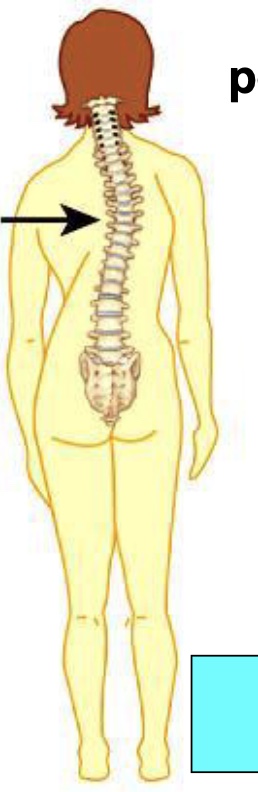
What type of abnormal curve is this?
Scoliosis
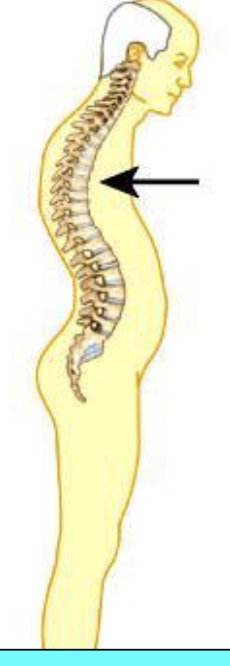
What type of abnormal curve is this?
Kyphosis
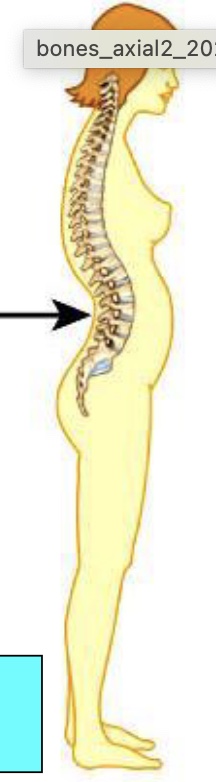
What type of abnormal curve is this?
Lordosis
How are abnormal curves formed?
Various conditions may exaggerate the normal curves of the vertebral column, or the column may acquire a lateral bend
What is scoliosis?
A lateral bending of the vertebral column
Where is scoliosis usually formed?
In the thoracic region
What can cause scoliosis?
Congenitally malformed vertebrae, chronic sciatica, paralysis of muscles on one side of the vertebral column, poor posture, or one leg being shorter than the other
What is kyphosis?
An increase in the thoracic curve of the vertebral column
What can kyphosis be caused by?
Tuberculosis of the spine causing vertebral bodies to partially collapse, causing an acute angular bending of the vertebral column
Degeneration of the intervertebral discs because of old age
Rickets and poor posture
Advanced osteoporosis in females
What is Lordosis also known as?
Hollow or sway back
What is lordosis?
An increase in the lumbar curve of the vertebral column
What causes lordosis?
Increased weight of the abdomen, as in pregnancy or extreme obesity, poor posture, rickets, osteoporosis, or tuberculosis of the spine
What are the structures found between the bodies of adjacent vertebrae from the second cervical vertebra to the sacrum called?
Intervertebral discs
How much weight do the intervertebral discs account for in the vertebral column?
25%
What does the structure of the intervertebral discs consist of?
Each disc has an outer fibrous ring consisting of fibrous cartilage called the annulus fibrosus and an inner soft, pulpy, mucoid substance called the nucleus pulposus
What is the outer fibrous ring of cartilage of the intervertebral disc called?
Annulus fibrosus
What is the inner soft, pulpy, mucoid substance of the intervertebral disc called?
Nucleus pulposus
What happens to the nucleus pulpous with age?
With increasing age, the watery mucoid region converts to fibrocartilage as it gradually become less hydrated
What do the superior and inferior surfaces of the intervertebral discs consist of?
A thin plate of hyaline cartilage, the vertebral end-plate
What is the vertebral end-plate?
The thin plate of hyalin cartilage on the superior and inferior surfaces of the intervertebral discs
What do the intervertebral discs do?
They form strong joints, permit various movements of the vertebral column, and absorb vertical shock
When are we the tallest? Why?
We are the tallest in the mornings, because during the day the intervertebral discs compress and lose water from their cartilaginous matrix so we are shorter at night. But while we are sleeping there is less compression and the nucleus pulposus rehydrates
Are intervertebral disc vascular or avascular?
Avascular
Since intervertebral discs are avascular, what do the annulus fibrosus and nucleus pulposus rely on? Why?
The annulus fibrosus and the nucleus pulposus rely on blood vessels from the bodies of the vertebrae to obtain oxygen and nutrients and remove wastes
What are the usual components of a vertebrae?
A body, a vertebral arch, and several processes
What is the largest part of a vertebrae?
The vertebral body
What does the vertebral body form in the vertebrae?
It forms the anterior clocklike mass of the bone
What creates the column like axis of the skeleton?
All the adjacent vertebral bodies lined up in a row
What do the vertebral bodies serve as?
The main weight-bearing component of the vertebral column
What lies between the adjacent vertebral bodies?
The intervertebral discs
What are the superior and inferior surfaces of the vertebral bodies like? Why?
They are roughened for the attachment of the hyaline cartilage (end-plate) of the intervertebral disc, which helps impede water loss from the disc into the bone of the vertebral body and, with the annulus fibrosus, encases the nucleus pulposus
What do the anterior and posterior surfaces of the vertebral body contain?
They contain the nutrient foramina, openings for blood vessels that deliver nutrients and oxygen, and remove carbon dioxide and wastes from bone tissue
What are the nutrient foramina of the vertebral body?
Openings for blood vessels that deliver nutrients and oxygen, and remove carbon dioxide and wastes from bone tissue
How does the vertebral arch extend?
It extends posteriorly from the vertebral body of the vertebra
Together, what do the vertebral body and vertebral arch do?
Together, they surround the spinal cord
What is the vertebral arch like?
It is complex and varies from region to region of the spinal column
What does the vertebral arch consist of?
Numerous bony projections that provide attachment surfaces and lever arms for muscles
What forms the base of the vertebral arch?
2 short, thick processes, called pedicles
What do the pedicles do in the vertebral arch?
They form the base of the vertebral arch, and project posteriorly from the body to unite with the laminae
What are the laminae in the vertebral arch?
The flat parts that join to form the posterior portion of the vertebral arch
Where does the vertebral foramen lie?
It lies between the vertebral arch and the body
What does the vertebral foramen contain?
The spinal cord and its meningeal coverings, adipose tissue, areolar connective tissue, and blood vessels
What forms the vertebral canal?
Collectively, the vertebral foramina of all vertebrae form the vertebral canal
What doe the pedicles of the vertebral arch exhibit?
Superior and inferior indentations called vertebral notches
What happens when vertebral notches are stacked on top of one another?
They form an opening between adjoining vertebrae on both sides of the column
What is each opening from the vertebral notches called?
Intervertebral foramen
What do the intervertebral foramen do?
They permit the passage of a single spinal nerve carrying information to and from the spinal cord
What do the ribs articulate with?
The thoracic vertebrae
How many processes arise from the vertebral arch?
7
What processes are extend posterolaterally at the junction of the lamina and pedicle?
Transverse processes
What single process projects posteriorly from the junction of the laminae?
A single spinous process (spine)
What do the single spinous process and 2 transverse processes serve as?
Lever arms and points of attachments for muscles
What do the remaining 4 processes that don’t form lever arms do?
They form joints with other vertebrae below or above
What do the 2 superior articular processes articulate with?
The 2 superior articular processes of a vertebra articulate (form a joint) with the 2 inferior articular processes of the vertebra immediately superior to it.
What do the 2 inferior articular processes of a vertebra articulate with?
The 2 inferior articular processes of the vertebra articulate with the 2 superior articular processes of the vertebra immediately inferior to them
Where do the transverse and articular processes typically arise?
Near the junction of the pedicle and lamina
What are the articulating surfaces of the articular processes referred to as?
Facets
What are facets covered with?
Hyaline cartilage
What are the articulations formed between the vertebral bodies and articular facets of successive vertebrae called?
Intervertebral joints
How many regions are there in the vertebral column?
5
What are the 5 regions of the vertebral column?
Cervical region
Thoracic region
Lumbar region
Sacral region
Coccygeal region
How are the vertebrae numbered in each vertebral region?
From superior to inferior
What are some changes that happen to the vertebral column with age?
Reduction of mass and density of the bone along with a reduction in the collagen-to-mineral content within the bone, changes that make make the bones more brittle and susceptible to damage
What happens to the articular surfaces of the vertebrae as you get older?
The articular surfaces, those surfaces where neighbouring bones move against one another, lose their covering cartilage as they age, in their place, rough bony growths form that lead to arthritic conditions
What happens in the vertebral column as you age?
Bony growths around the intervertebral discs called osteophytes, can lead to a narrowing (stenosis) of the vertebral canal
What are osteophytes?
Bony growths around the intervertebral discs
What does the narrowing of the vertebral canal cause?
It can lead to compressions of spinal nerves and the spinal cord, which can manifest as pain and decreased muscle function in the back and lower limbs
What is stenosis?
A narrowing of the vertebral column
What can cause a herniated (slipped) disc?
If the anterior or posterior ligaments of the intervertebral discs become injured or weakened, the pressure developed in the nucleus pulposus may be great enough to rupture the surrounding fibrous cartilage (annulus fibrosus). If this occurs, the nucleus pulposus may herniate (protrude) posteriorly or into one of the adjacent vertebral bodies
What region of the vertebral column is most likely to suffer from a herniated disk? Why?
The lumbar region, because it bears much of the weight of the body and is the region of the most bending and flexing
What does a herniated disc cause? Why?
Since the nucleus pulposus slips posteriorly toward the spinal cord and nerves, it puts pressure on the spinal nerves and can cause local weakness and acute pain
Where does the sciatic nerve pass?
From the spinal cord to the foot
What happens if the sciatic nerve is compressed by a herniated disc?
The pain will radiate down the posterior thigh, through the calf, and occasionally into the foot
What happens if pressure from a herniated disc is exerted on the spinal cord?
Some of its neutrons may be destroyed
What are treatment options for a herniated disc?
Bed rest, medication for pain, physical therapy and exercises, and percutaneous endoscopic diseconomy (removal of disc material using a laser). They may also undergo a laminectomy
What is a laminectomy?
A procedure in which parts of the laminae of the vertebra an intervertebral discs are removed to relieve pressure on the nerves
What vertebrae are the most variable?
The cervical vertebrae
Why are the cervical vertebrae the most variable?
Because the general structure of the first 2 vertebrae in this region are modified significantly from the structures of the remaining 5 cervical vertebrae
What do the cervical vertebrae from?
A delicate column of bones that vary considerably in the range of mobility at their joint surfaces
What is the size of the vertebral bodies and arches of the cervical vertebrae compared to the thoracic vertebrae?
The vertebral bodies of the cervical vertebrae are smaller than those of the thoracic vertebrae. However, the vertebral arches are larger
What is a unique characteristic used to identify a vertebra as a cervical vertebra?
A foramen in the transverse process
How many foramina do all cervical vertebrae have?
3