Flora & Fauna of Southern Ontario - Lecture 3
 Call Kai
 Learn
Learn Practice Test
 Spaced Repetition
 Match
Match Flashcards
 Knowt Play
1/19

Earn XP
Description and Tags
A set of vocabulary flashcards covering the key concepts related to the flora and fauna of Southern Ontario, specifically focusing on forest types, soil classifications, and notable species.
Name | Mastery | Learn | Test | Matching | Spaced | Call with Kai | Chat |
|---|
No analytics yet
Send a link to your students to track their progress
20 Terms
Forest
A land area not predominantly under agricultural or urban use, spanning an area greater than 0.5 ha, with trees taller than 5 m and tree canopy cover of more than 10%.
Dry Deciduous Forest
Forests that lose most of their leaves during dry periods, classified as a broad category of forests in North America.
Tropical Humid Forest
Warm and wet rainforest-type environments that are classified as a broad category of forests in North America.
Conifer Forests
Forests made up of coniferous trees, which generally do not seasonally lose their leaves, with exceptions like larches.
Temperate Deciduous Forest
Broadleaf forests that lose their leaves in winter, classified as a broad category of forests in North America.
South West Ontario falls into this category
Koppen Climate Classification
what do 1, 2 and 3 stand for and what letters relate to SW ON
A global method of classification for climatic regions, using a system of two to three letter codes based on temperature and precipitation.
temp. (a-e)
precip. (f-t)
max/ min temps, wet/hot desert (a-k)
South west ON = dfa
Luvisols def and what forest
Moderately leached soils with a subsurface horizon of clay accumulation, typically found in temperate forests and fertile for agriculture.
Temperate deciduous forest
Podzols def and what forest
Acidic soils under coniferous forests that exhibit intense leaching of nutrients, causing organic material and minerals to be removed from the surface.
Temperate deciduous & conifer forests
Nearctic Temperate Mixed Forest
A forest region characterized by a dense canopy of trees (15-20m), significant precipitation from snow and rainfall (750-1250mm), and long cold winters.
Eastern Hemlock
Fire prone, shade tolerant
Often preferred by deer
create acidic envi.
Black Cherry
Shade tolerant when young
Seeds dispersed through birds
Sweet White Violet
Attracts pollinators
Tolerant to deer browsing
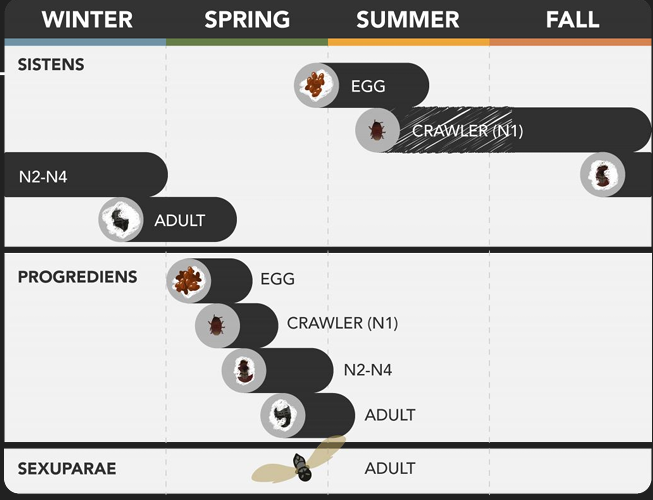
Hemlock Woolly Adelgid
life cycles
Invasive bug targeting Hemlock
American Beech
18-28m tall
shade tolerant
susceptible to fire
Eastern White pine
22-30m; long lived
fire dependent; outcompetes hardwoods after fire
yellow birch
18-30m tall
wind pollinated
ostrich fern
wetlands
rhizome
Mayapple
forest edge
spring ephemeral
Fauna of Nearctic temperate mixed forest
American Porcupine, Star-nosed Mole, Least weasel, Snowshoe Hare
dark eyed junco, brown creeper, black throated green warbler, scarlet tanager